Introduction
Gold is widely recognized as the shining embodiment of wealth and is used to create expensive products and add extra bling to luxurious items, such as smartphones, supercars, and even beef steaks. Despite the fact that other metals rarer than gold are often much cheaper, gold maintains a remarkably high price. To understand why this is the case, we must look at its origins, unique properties, and the sheer difficulty of extracting it from the Earth.
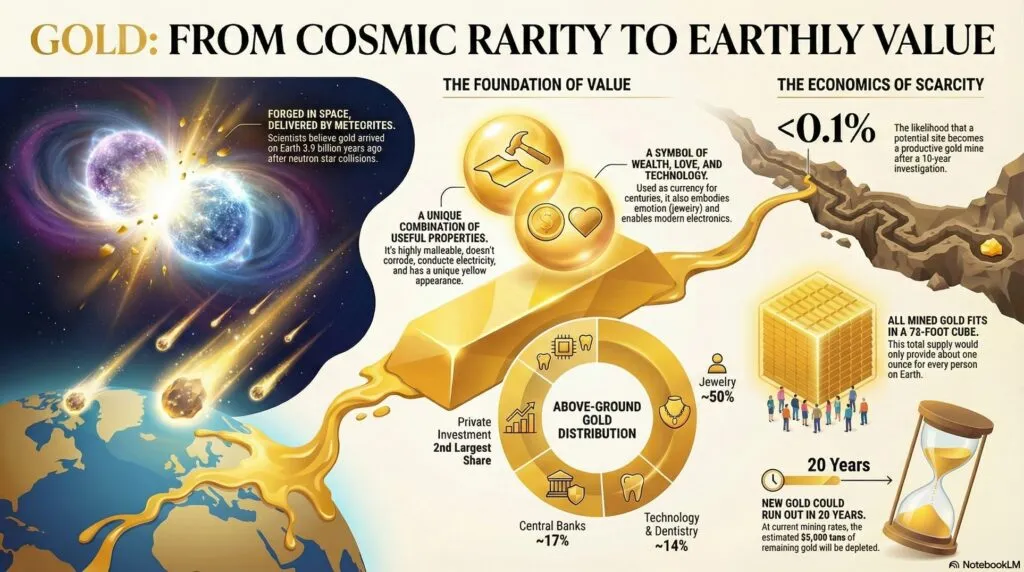
Table of Contents
From Neutron Stars to Earth’s Surface
Scientists theorize that gold arrived on Earth following a cosmic collision. The forging of gold atoms occurred in space after two neutron stars collided, which resulted in meteorites containing gold crashing into Earth approximately 3.9 billion years ago. Over millions of subsequent years, Earth’s bubbling hot core forced gold nuggets toward the surface.
Human interaction with this material dates back roughly 40,000 years, marked by gold flakes discovered in Paleolithic caves. Throughout the centuries, civilizations became enamored with the metal. For instance, the ancient Egyptians used gold as a currency and believed it to be the flesh of the gods, even burying themselves in the metal. This reverence is evident in the burial of King Tutankhamun, who was laid to rest in three gold-wrapped coffins, the innermost of which was made of pure, beaten gold that would now be worth over $1 million.
In the modern era, the US Congress solidified gold’s monetary importance by passing the Coinage Act in 1792, which fixed the price of gold to the US dollar. This fixation fueled historical events like the great US gold rush, which started in 1799 and later intensified in 1849 when tens of thousands of prospectors, known as the 49ers, raced to San Francisco in search of riches.
The Properties that Make Gold Noble
Gold (symbol Au, atomic number 79) is distinguished from other useful precious metals by its totally unique bright-yellow appearance. It is considered the most noble of all the noble metals.
Gold is prized for its versatility and unique physical characteristics:
- Malleability: It is highly malleable, meaning it can be deformed or changed without fracturing the material.
- Conductivity: It is a perfect material for conducting electricity.
- Durability: It does not corrode or rust, making it excellent for use in many products.
These features give gold both practical and superficial uses on Earth. For manufacturers, particularly those making smartphones or tablets, gold’s properties are invaluable. Beyond technology, gold holds significant emotional weight; for a bride, gold is the perfect embodiment of love and emotion. For investors, gold acts as an excellent portfolio-diversification tool, offering people an element of wealth they can feel and appreciate for its design.
Gold in Modern Life and Space
Gold is utilized in almost every electronic component, as well as in medicine and architecture. In fact, we even launch gold back out into the universe. It serves as a reliable component of spacecraft circuitry and is used in the lining of astronauts’ visors to protect them from the sun’s harmful heat and ultraviolet light.
The Difficulties of Extraction
Despite humans mining gold for millennia, the complexity of the process remains challenging. While technology has reduced the labor intensity in some operations, mining companies still face difficulties associated with the environments they operate in. They must navigate challenges like securing formal licenses from governments or social licenses from local communities, all of which contribute to the complexity of mine production today.
Identifying productive gold mines is a daunting task, requiring geologists, chemists, and engineers up to 10 years to examine a potential site. Even after this exhaustive process, the likelihood of a site developing into a productive gold mine is less than 0.1%. Furthermore, only 10% of these sites contain enough gold to justify any further development.
A Finite and Dwindling Resource
Considering its widespread use—on our fingers, around our necks, and in electronics—it may be surprising to know how little gold actually exists on Earth.
The world’s entire aboveground stock of gold is estimated to be around 190,000 tons. If this amount were melted down, it would form a cube only 72 feet across.
This finite supply is divided among several key industries:
- Jewelry: Accounts for the lion’s share, around 50%.
- Private Investment: Includes individuals holding bars, coins, or shares in exchange-traded funds.
- Central Banks: Account for a very significant volume, around 17% of the total stock.
- Technology or Dentistry: Makes up the final element, around 13% to 14%.
The future supply of gold is concerning, as new deposits are increasingly difficult to locate and obtain. Geologists estimate that only 55,000 tons remain buried in the Earth’s crust. If current global mining rates continue, we could run out of newfound gold in just 20 years.
As gold mining slows and the costs associated with extraction increase, gold could become even more expensive in the future.
Conclusion: The Enduring Value of Gold
The high price of gold stems from a potent combination of historical reverence, unique physical properties, and undeniable scarcity. Historically, civilizations like the ancient Egyptians viewed gold not just as currency but as the flesh of the gods, leading to its lasting association with wealth and power. Physically, its defining features—including being highly malleable, non-corrosive, and a perfect conductor of electricity—make it indispensable in modern technology and manufacturing, as well as appealing for emotional investment. Despite humans mining gold for millennia, the process remains extremely challenging, with less than 0.1% of potential sites ever developing into productive mines. The world’s aboveground stock is estimated at only 190,000 tons. Given that only an estimated 55,000 tons remain buried, new deposits are increasingly hard to locate. Because gold mining is slowing and the costs associated with extraction are rising, this finite resource could become even more expensive in the future.