Introduction
Artificial intelligence has moved far beyond science fiction and experimental labs. Today, it sits at the center of one of the most important economic shifts of the modern era. Governments, central banks, investors, and business leaders are all asking the same question: how will artificial intelligence reshape economic growth over the coming years? The answer matters because productivity, which measures how efficiently economies turn labor and capital into output, has been slowing in many advanced economies for more than a decade. This slowdown has limited wage growth, strained public finances, and reduced long-term living standards.
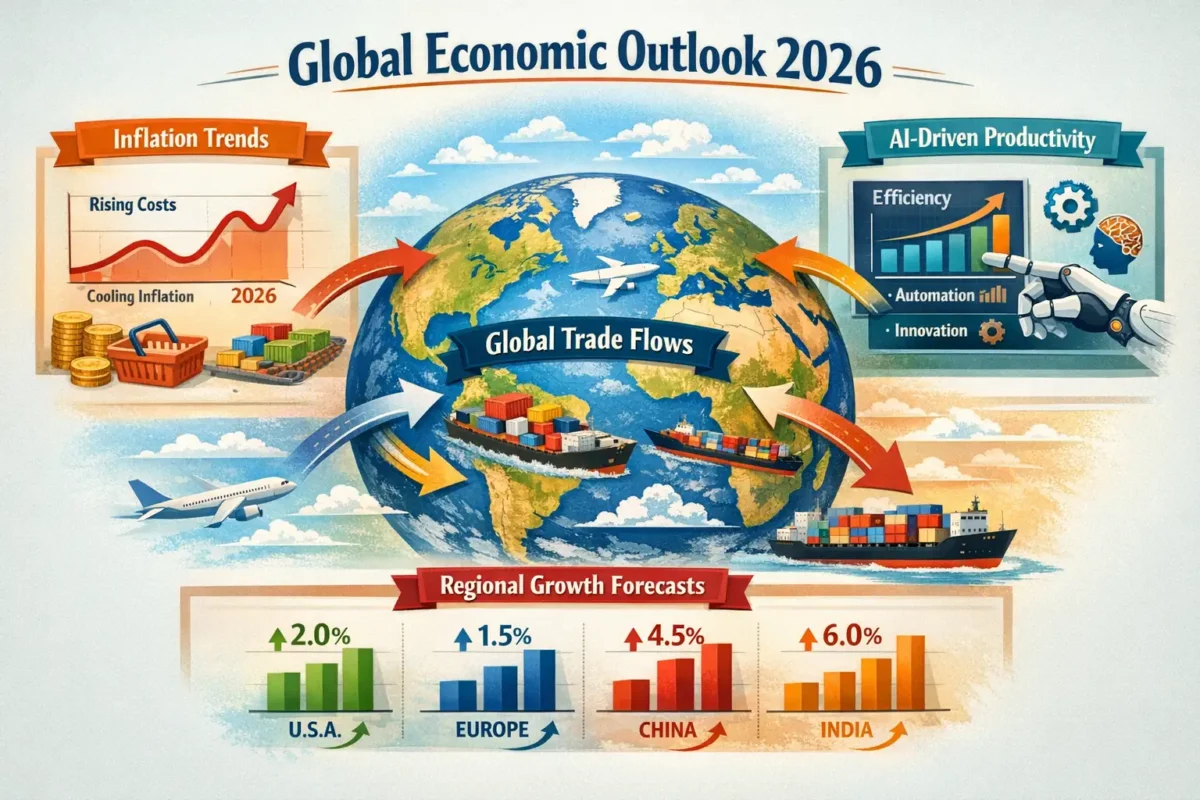
The AI economic impact 2026 is expected to mark a turning point in this trend. Unlike previous waves of digital technology, artificial intelligence directly augments human decision-making, automates cognitive tasks, and unlocks entirely new forms of value creation. From factories and logistics networks to financial markets and healthcare systems, AI is changing not just how work is done, but how economies grow.
In this article, you will learn why productivity is the foundation of economic prosperity, how artificial intelligence acts as a new general-purpose technology, and what the short- and long-term economic consequences may look like by 2026. We will explore benefits, risks, sector-level impacts, and policy challenges, using clear language, real-world examples, and trusted data sources. By the end, you should have a grounded, practical understanding of how the AI productivity revolution could reshape global economic growth in the years ahead.
Table of Contents
Why Productivity Growth Matters More Than Ever
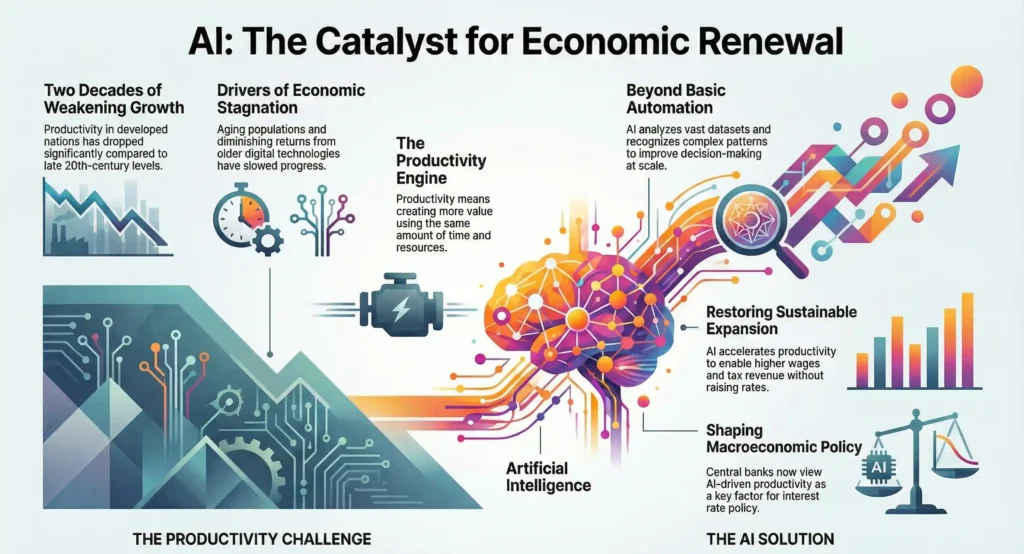
Productivity growth is the quiet engine behind rising incomes and stronger economies. At its core, productivity means producing more value with the same amount of time, labor, and resources. When productivity rises, businesses can pay higher wages, governments can collect more tax revenue without raising rates, and societies can improve living standards without working longer hours.
Over the past two decades, however, productivity growth has weakened across many advanced economies. According to data from the Organisation for Economic Co-operation and Development, average productivity growth in developed countries has been significantly lower since the global financial crisis compared to the late twentieth century. Economists have debated the causes, pointing to aging populations, lower business investment, and the diminishing returns of earlier digital technologies.
This is where artificial intelligence enters the picture. Unlike basic automation or simple software tools, AI systems can analyze vast datasets, recognize complex patterns, and continuously improve through learning. These capabilities allow firms to reduce waste, optimize operations, and make better decisions at scale. Central banks such as the Federal Reserve have increasingly highlighted productivity as a key factor shaping long-term economic growth, inflation dynamics, and interest rate policy.
By accelerating productivity, AI has the potential to reverse years of stagnation. The AI economic impact 2026 is therefore not just about faster computers or smarter apps, but about restoring a critical engine of sustainable economic expansion.
Artificial Intelligence as a General-Purpose Technology
To understand why artificial intelligence matters so much, it helps to view it as a general-purpose technology. General-purpose technologies are innovations that transform entire economies, rather than single industries. Historical examples include electricity, the steam engine, and the internet. Each initially appeared limited, but over time reshaped production methods, business models, and social structures.
AI fits this pattern closely. It is not confined to one sector, but can be embedded into manufacturing systems, financial services, healthcare, transportation, education, and government operations. Once adopted, it often triggers complementary investments, such as new software, workforce training, and organizational redesign. These second-order effects are where much of the economic value is created.
The International Monetary Fund has noted that AI adoption could affect a large share of global jobs, either by augmenting human tasks or automating them entirely. Importantly, augmentation, where humans work alongside AI, tends to produce the strongest productivity gains. For example, doctors using AI diagnostic tools can analyze medical images faster and more accurately, allowing them to treat more patients without sacrificing quality.
This broad applicability explains why economists expect the AI economic impact 2026 to extend far beyond the technology sector. As AI diffuses across industries, its influence compounds, gradually lifting economy-wide productivity and reshaping growth trajectories.
How AI Directly Boosts Productivity at the Firm Level
At the firm level, artificial intelligence improves productivity through several clear channels. First, it automates repetitive cognitive tasks such as data entry, scheduling, forecasting, and basic customer support. This reduces labor costs and frees employees to focus on higher-value activities. Second, AI improves decision quality by analyzing large datasets faster and more accurately than humans alone. Better decisions lead to less waste, fewer errors, and higher output.
Third, AI enables predictive capabilities. In manufacturing, predictive maintenance systems use machine learning to anticipate equipment failures before they occur, reducing downtime and costly repairs. In retail, demand forecasting algorithms help firms manage inventory more efficiently, minimizing stockouts and excess supply.
A widely cited study by the World Bank suggests that firms adopting advanced digital technologies tend to experience faster productivity growth than those that do not. However, the gains are not automatic. Companies that invest in complementary skills, data infrastructure, and organizational change see the strongest results.
Below is a simplified comparison of traditional productivity tools versus AI-driven systems.
| Aspect | Traditional Tools | AI-Driven Systems |
|---|---|---|
| Decision speed | Limited by human analysis | Near real-time |
| Error detection | Reactive | Predictive |
| Scalability | Linear | Exponential |
| Learning ability | Static | Continuous improvement |
These micro-level gains accumulate across thousands of firms, forming the backbone of the broader AI economic impact 2026.
Sector-Level Transformation and Economic Spillovers
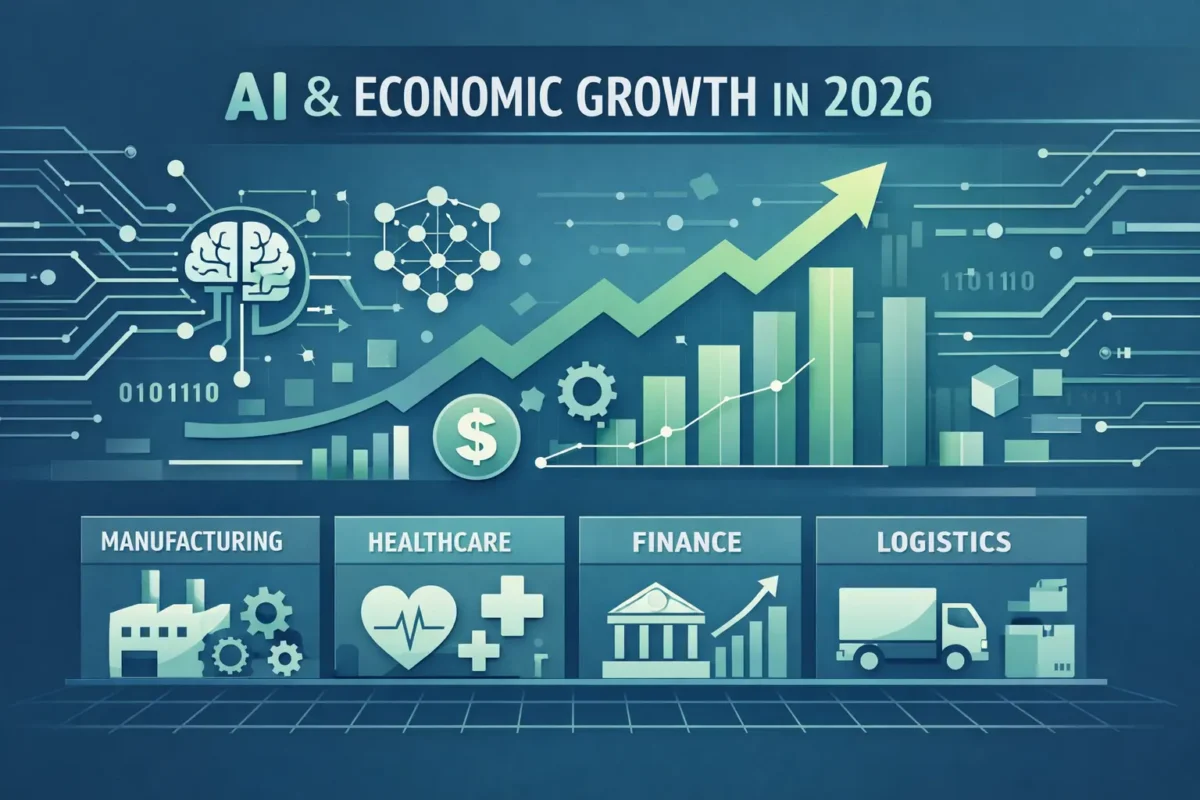
The productivity effects of artificial intelligence vary by sector, but the spillovers are powerful. In manufacturing, AI-powered robotics and quality control systems increase output consistency and reduce defects. In logistics, route optimization algorithms lower fuel costs and delivery times. In finance, AI improves risk assessment, fraud detection, and customer service efficiency.
Healthcare illustrates the spillover effect particularly well. When AI systems speed up diagnostics and administrative tasks, hospitals can treat more patients with the same staff and facilities. This not only boosts healthcare productivity but also improves workforce health, which feeds back into higher productivity across the entire economy.
Education is another critical area. Adaptive learning platforms personalize instruction, helping students master skills more efficiently. Over time, a more skilled workforce enhances innovation capacity and economic resilience.
The table below summarizes expected AI productivity effects across key sectors.
| Sector | Primary AI Application | Productivity Effect |
|---|---|---|
| Manufacturing | Predictive maintenance | Reduced downtime |
| Healthcare | Diagnostics and admin automation | Higher patient throughput |
| Finance | Risk and fraud analytics | Lower losses |
| Logistics | Route optimization | Faster delivery |
| Education | Personalized learning | Higher skill acquisition |
These sector-level improvements reinforce one another, amplifying the overall AI economic impact 2026 through interconnected supply chains and labor markets.
AI, Labor Markets, and Wage Dynamics
One of the most debated aspects of artificial intelligence is its impact on jobs and wages. While automation can displace certain roles, history suggests that productivity-enhancing technologies often create new jobs and raise average incomes over time. The key variable is how quickly workers can adapt and transition into new roles.
AI tends to complement high-skill and middle-skill tasks that involve judgment, creativity, and complex problem-solving. Workers who learn to use AI tools effectively often become more productive and valuable, supporting higher wages. At the same time, routine tasks are more vulnerable to automation, which can pressure wages in certain occupations.
The OECD has emphasized the importance of reskilling and lifelong learning to ensure that productivity gains translate into broad-based income growth. Without these policies, the benefits of AI could become concentrated among a narrow segment of workers and firms.
From a macroeconomic perspective, rising productivity can offset demographic pressures from aging populations. If fewer workers can produce more output, economies can sustain growth even as labor force growth slows. This dynamic is central to understanding the AI economic impact 2026 on long-term wage trends and employment patterns.
Risks, Limitations, and Uneven Adoption
Despite its promise, artificial intelligence is not a guaranteed productivity miracle. Several risks and limitations could slow or distort its economic impact. Data quality is a major constraint. AI systems rely on large, accurate datasets, and biased or incomplete data can produce flawed outcomes. Cybersecurity risks also rise as more economic activity depends on interconnected digital systems.
Another challenge is uneven adoption. Large firms with access to capital, data, and technical expertise tend to adopt AI faster than small and medium-sized enterprises. This gap can widen productivity differences within industries, potentially increasing market concentration and reducing competition.
Regulatory uncertainty also plays a role. Governments are still developing frameworks for AI governance, data privacy, and accountability. Poorly designed regulations could slow innovation, while weak oversight could undermine public trust.
The table below highlights key risks versus potential rewards.
| Dimension | Potential Reward | Associated Risk |
|---|---|---|
| Productivity | Faster growth | Uneven gains |
| Labor markets | Higher wages | Job displacement |
| Innovation | New business models | Market concentration |
| Governance | Efficiency | Ethical concerns |
Managing these trade-offs will heavily influence the realized AI economic impact 2026.
Global Implications and Geopolitical Dimensions
The productivity benefits of artificial intelligence will not be distributed evenly across countries. Advanced economies with strong digital infrastructure and research ecosystems are likely to benefit first. However, emerging markets could leapfrog if they adopt AI strategically in areas such as agriculture, healthcare, and financial inclusion.
Institutions like the World Bank have highlighted AI’s potential to improve public service delivery in developing economies, from tax collection to social welfare targeting. These gains can strengthen state capacity and support long-term growth.
At the same time, AI has become a strategic asset in global competition. Investments in semiconductor supply chains, cloud computing, and AI research are increasingly viewed through a national security lens. How countries navigate this competition will shape trade flows, investment patterns, and technological leadership.
By 2026, the AI economic impact 2026 is likely to be visible not only in GDP statistics, but also in shifting geopolitical alignments driven by technological capability.
Long-Term Growth, Inflation, and Monetary Policy
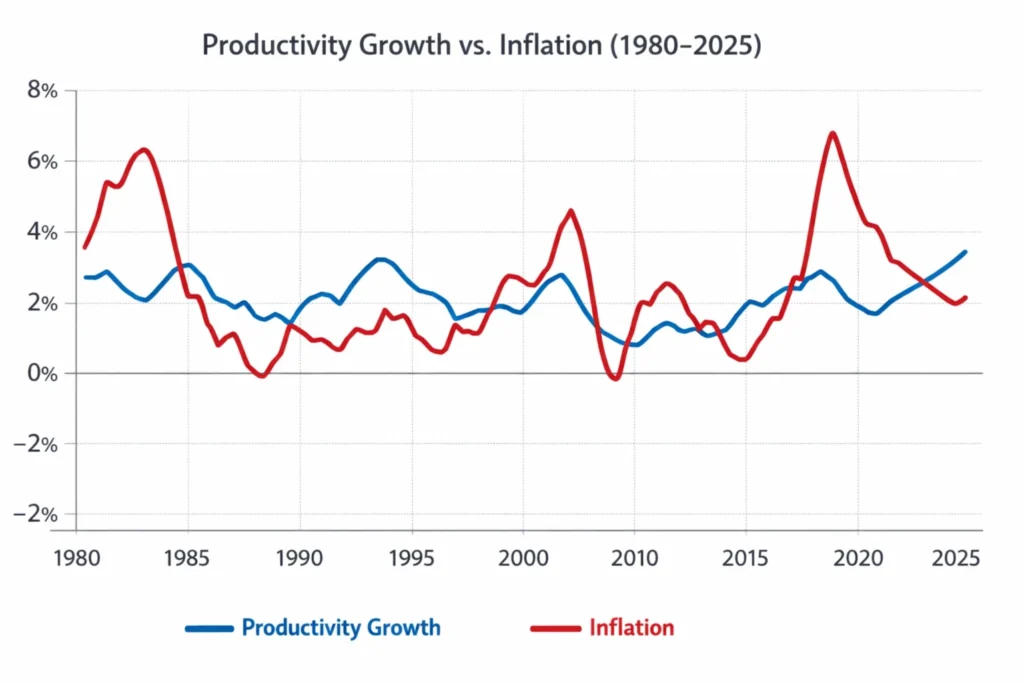
Productivity growth has important implications for inflation and monetary policy. When productivity rises, firms can produce more at lower cost, which helps contain inflationary pressures even when demand is strong. This gives central banks more flexibility to support growth without triggering runaway inflation.
The Federal Reserve and the European Central Bank have both noted that structural productivity improvements can influence the neutral interest rate, which is the rate consistent with stable inflation and full employment. If AI significantly boosts productivity, it could alter long-term interest rate dynamics.
However, the transition period may be uneven. Investment surges in AI infrastructure could initially increase demand and prices in certain sectors. Over time, as productivity gains spread, the disinflationary effects are likely to dominate.
Understanding these dynamics is essential for policymakers assessing the full AI economic impact 2026 on macroeconomic stability.
Conclusion
Artificial intelligence represents one of the most powerful productivity-enhancing forces in modern economic history. By improving decision-making, automating complex tasks, and enabling predictive capabilities, AI has the potential to reverse years of sluggish productivity growth and reshape long-term economic trajectories. The AI economic impact 2026 is not a distant theoretical concept, but a near-term transformation already unfolding across firms, sectors, and countries.
Yet the benefits are not automatic. Productivity gains depend on complementary investments in skills, data infrastructure, and organizational change. They also require thoughtful policies that encourage innovation while managing risks such as inequality, job displacement, and market concentration. History shows that general-purpose technologies deliver their greatest benefits when societies adapt institutions and labor markets to new realities.
For businesses, the lesson is clear. Treat AI not as a cost-cutting tool alone, but as a strategic investment in long-term productivity. For workers, continuous learning and adaptability will be critical to capturing wage gains. For policymakers, the challenge lies in creating an environment that supports broad adoption, fair competition, and inclusive growth.
As we approach 2026, artificial intelligence is poised to become a defining driver of economic growth. Understanding its mechanisms, limits, and opportunities today allows individuals, firms, and governments to make more informed, resilient decisions for the future.
Frequently Asked Questions
What does AI economic impact 2026 mean in practical terms?
It refers to the measurable effects of artificial intelligence on productivity, growth, wages, and economic structure by the year 2026, as AI adoption becomes widespread across industries.
Will AI increase or decrease employment overall?
AI is likely to both displace and create jobs. The net effect depends on how quickly workers can transition into new roles that complement AI technologies.
Which industries will benefit most from AI productivity gains?
Manufacturing, healthcare, finance, logistics, and education are expected to see some of the strongest productivity improvements.
Can small businesses benefit from the AI economic impact 2026?
Yes, especially through cloud-based AI tools that lower adoption costs, although access to skills and data remains a challenge.
How does AI affect inflation and interest rates?
By boosting productivity, AI can reduce production costs and help contain inflation over time, influencing long-term monetary policy decisions.
If you found value in this article, tell us in the comments how you think artificial intelligence will affect economic growth in your industry. You can also subscribe to our newsletter for future insights on technology, finance, and global economic trends.