Economics shapes almost every aspect of our daily lives, from the prices we pay at the supermarket to the interest rates on our savings and loans. Yet for many people, economics feels complex, abstract, or difficult to understand. This guide is designed to change that.
In this pillar article, we explain economics in a clear, structured, and practical way, helping you understand how economies function, why markets move, and how economic decisions affect individuals, investors, and businesses.
What Is Economics?
Economics is the study of how individuals, businesses, and governments allocate limited resources to satisfy unlimited needs and wants. At its core, economics tries to answer three fundamental questions:
- What should be produced?
- How should it be produced?
- For whom should it be produced?
Because resources such as money, labor, land, and time are limited, societies must make choices. Economics analyzes these choices and their consequences.
The Two Main Branches of Economics
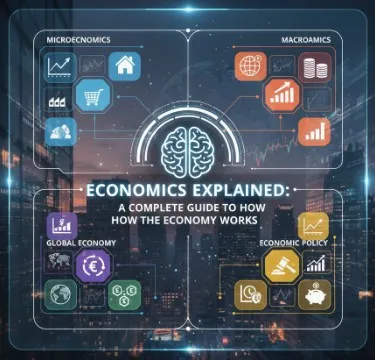
Economics is generally divided into two major branches: microeconomics and macroeconomics.
Microeconomics
Microeconomics focuses on individual economic units, such as:
- Consumers
- Firms
- Workers
- Industries
It examines how prices are determined, how supply and demand interact, and how individuals make decisions under scarcity.
Macroeconomics
Macroeconomics looks at the economy as a whole. It studies:
- Economic growth
- Inflation
- Unemployment
- Interest rates
- National income
Macroeconomics helps explain business cycles, recessions, and long-term economic development.
Key Economic Concepts Everyone Should Understand
Scarcity and Opportunity Cost
Scarcity exists because resources are limited. Every decision involves a trade-off, known as opportunity cost—the value of the next best alternative you give up when making a choice.
For example, investing money in stocks means giving up the opportunity to spend or save that money elsewhere.
Supply and Demand
Supply and demand form the foundation of market economies:
- Demand reflects how much consumers want a product at different prices.
- Supply reflects how much producers are willing to offer at different prices.
Prices adjust based on the interaction between supply and demand, signaling scarcity or abundance.
Incentives
Incentives influence behavior. Higher wages encourage people to work more; lower interest rates encourage borrowing and spending. Understanding incentives helps explain economic outcomes.
Economic Systems Explained
Different societies organize their economies in different ways.
Market Economy
In a market economy, decisions are driven by supply and demand with minimal government intervention. Prices guide production and consumption.
Command Economy
In a command economy, the government controls production, pricing, and distribution of goods and services.
Mixed Economy
Most modern economies are mixed systems, combining free markets with government regulation and social programs.
Key Economic Indicators You Should Know
Economic indicators help measure the health of an economy.
Gross Domestic Product (GDP)
GDP measures the total value of goods and services produced within a country. It is a primary indicator of economic growth.
Inflation
Inflation reflects the rate at which prices increase over time. Moderate inflation is normal, but high inflation reduces purchasing power.
Unemployment Rate
The unemployment rate measures the percentage of people actively seeking work but unable to find jobs.
Interest Rates
Interest rates influence borrowing, saving, and investing. Central banks use interest rates as a primary economic policy tool.
The Role of Central Banks and Monetary Policy
Central banks, such as the Federal Reserve or the European Central Bank, manage monetary policy to maintain economic stability.
Their main tools include:
- Adjusting interest rates
- Controlling money supply
- Conducting open market operations
Monetary policy affects inflation, employment, and overall economic growth.
Fiscal Policy and Government Spending
Fiscal policy refers to government decisions regarding:
- Taxation
- Public spending
- Budget deficits and debt
During economic slowdowns, governments may increase spending or cut taxes to stimulate growth. During inflationary periods, they may reduce spending or raise taxes.
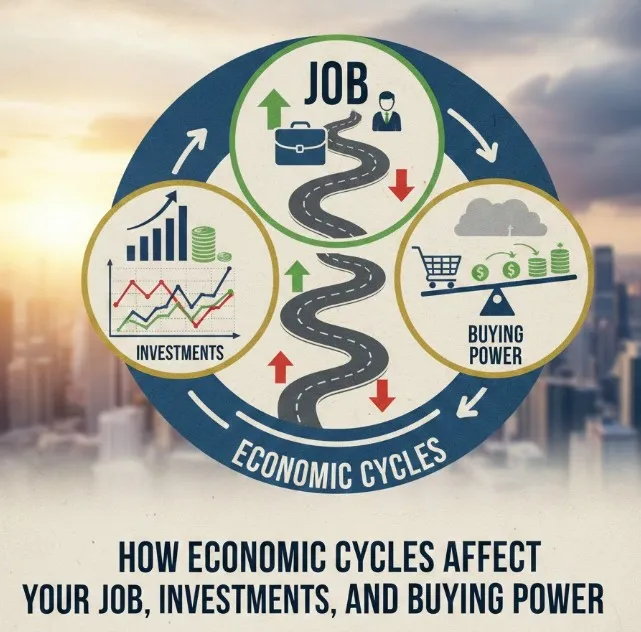
Economic Cycles: Expansion and Recession
Economies move in cycles:
- Expansion: rising output, employment, and income
- Peak: economic activity reaches high levels
- Recession: declining output and rising unemployment
- Recovery: gradual improvement
Understanding economic cycles helps investors and individuals make better long-term decisions.
How Economics Affects Individuals and Investors
Economic conditions directly impact:
- Job opportunities
- Cost of living
- Investment returns
- Business profitability
For investors, understanding macroeconomic trends can help manage risk, identify opportunities, and avoid emotional decision-making.
Global Economics and Interconnected Markets
Modern economies are deeply interconnected. Trade, capital flows, and currency movements link countries together.
Events such as:
- Interest rate changes
- Trade policies
- Geopolitical tensions
can have global economic consequences.
Why Understanding Economics Matters
Economic literacy empowers individuals to:
- Make informed financial decisions
- Understand market movements
- Evaluate government policies
- Plan for long-term financial stability
Rather than reacting emotionally to economic news, informed readers can analyze trends with confidence.
Final Thoughts
Economics is not just a theoretical subject—it is a practical framework for understanding how the world works. By mastering core economic concepts, you gain clarity, confidence, and the ability to make better financial and investment decisions.
This guide serves as a foundation. In related articles, we will dive deeper into economic indicators, market behavior, and how global economic trends affect investors and everyday life.