Introduction
The idea of earning passive income with no capital is one of the most searched—and misunderstood—topics in personal finance. Social media often promises “money while you sleep” with zero effort and zero investment. Reality is more nuanced.
This article answers a simple but critical question: Can you really build passive income without money?
You’ll learn what “no capital” actually means, which models are realistic, how long it takes, and what trade-offs exist. We’ll cover proven strategies across investing, personal finance, digital assets, and financial markets, explaining each in a beginner-friendly way while offering depth for experienced readers.
As Warren Buffett famously said, “If you don’t find a way to make money while you sleep, you will work until you die.” The key is understanding what you must invest instead of cash.
Table of Contents
What “No Capital” Really Means in Finance
Before exploring methods, we need clarity.
Financial Capital vs. Human Capital
When people say “no capital,” they usually mean no upfront cash. In economics, however, capital comes in multiple forms:
- Financial capital: money, assets, or savings
- Human capital: skills, knowledge, experience
- Time capital: effort invested today for future payoff
- Social capital: audience, network, or trust
Most “no-capital” passive income strategies rely heavily on human and time capital upfront.
“There is no such thing as truly free income—only income paid for in different currencies.”
Active First, Passive Later: The Core Principle
A critical truth often ignored online:
Passive Income Is Usually Delayed, Not Instant
Most realistic models follow this pattern:
- Active effort phase (learning, building, creating)
- Asset creation (content, system, intellectual property)
- Automation and scaling
- Passive or semi-passive income
Think of it less as “no work” and more as “work now, earn later.”
Proven Ways to Earn Passive Income with No Capital
Below are legitimate, realistic models that require little to no money, ranked by feasibility and scalability.
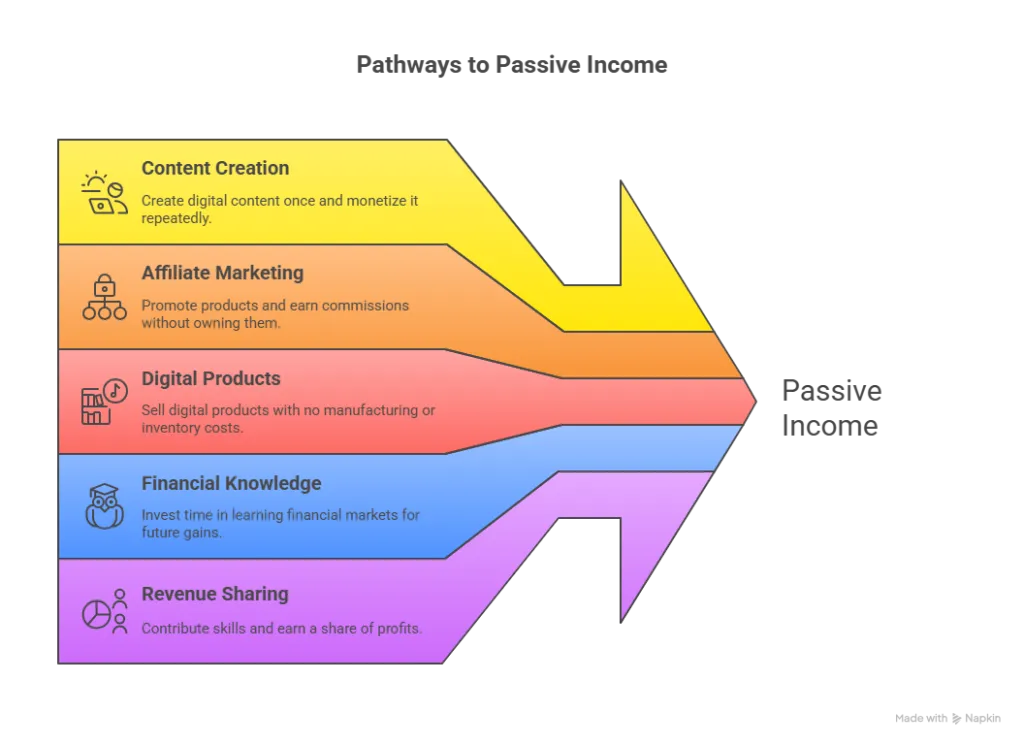
1. Content-Based Passive Income (Zero Financial Cost)
How It Works
You create digital content once and monetize it repeatedly.
Examples:
- Blog articles
- YouTube videos
- Podcasts
- Email newsletters
Monetization Methods
- Advertising revenue
- Affiliate marketing
- Sponsorships
- Digital product upsells
Real-World Example
A finance blog article explaining credit cards can earn:
- Ad revenue per 1,000 views (CPM)
- Affiliate commissions per signup
As one creator put it, “Your content becomes an employee that never sleeps.”
Pros
- No upfront money
- Highly scalable
- Builds long-term brand equity
Cons
- Takes months to gain traction
- Requires consistency and SEO knowledge
2. Affiliate Marketing Without Paid Ads
What Is Affiliate Marketing?
You promote products or services and earn a commission per sale—without owning the product.
Zero-Capital Approach
- Organic SEO blog posts
- Social media content
- Free communities (Reddit, Quora, Medium)
Example
A comparison article titled “Best Budget Investing Apps for Beginners” can generate recurring commissions.
Key Insight
Affiliate income becomes passive only after traffic is established.
“Traffic is the real asset in affiliate marketing.”
3. Digital Products Created with Skills (No Inventory)
Examples of Digital Assets
- PDFs and guides
- Templates (finance trackers, budgets)
- Online courses
- Stock research summaries
Why This Works Without Capital
- No manufacturing cost
- No inventory
- Distribution is free or low-cost
Economic Advantage
Digital products have near-zero marginal cost, meaning profits increase as sales scale.
4. Investing Time Instead of Money in Financial Markets
Is Investing Without Capital Possible?
You can’t invest in stocks without money—but you can invest in knowledge first.
Strategic Path
- Learn market fundamentals
- Practice with paper trading
- Build a track record
- Transition when capital becomes available
“The best investment you can make is in yourself.”
This reduces costly mistakes when you do invest real money.
5. Revenue-Sharing & Profit-Split Models
How It Works
Instead of capital, you contribute skills and earn a share of profits.
Examples:
- Managing content for revenue share
- Operating a sales funnel for commission
- Managing social media for ad revenue split
This model converts labor into equity-like income.
Comparing Passive Income Options (Conceptual Table)
| Method | Money Required | Time to Income | Scalability | Risk |
|---|---|---|---|---|
| Blogging | $0 | 3–12 months | High | Low |
| Affiliate marketing | $0 | 2–6 months | High | Medium |
| Digital products | $0 | 1–3 months | Very High | Medium |
| Revenue sharing | $0 | 1–2 months | Medium | Low |
| Market investing | Not possible | — | High | High |
Common Myths About Passive Income with No Capital
Myth 1: “It’s instant”
Reality: Passive income is delayed gratification.
Myth 2: “It requires no effort”
Reality: It requires front-loaded effort.
Myth 3: “Everyone can do it easily”
Reality: Skills, patience, and strategy matter.
“Passive income is simple—but not easy.”
How to Choose the Right Strategy for You
Ask yourself:
- Do I prefer writing, speaking, or designing?
- Can I stay consistent for 6–12 months?
- Do I want long-term compounding or faster cash flow?
Beginner Recommendation
Start with:
- Content + affiliate marketing
- Simple digital products
These provide learning, income, and scalability.
Conclusion: Is Passive Income with No Capital Real?
Yes—but not in the way it’s often advertised.
Passive income with no capital is possible if you are willing to invest:
- Time
- Skills
- Consistency
The most reliable path is building income-generating assets that compound over time. Focus less on shortcuts and more on systems.
“Build assets first. Income follows.”
Practical Next Steps
- Choose one model only
- Commit to 90 days of consistent effort
- Track progress like an investment
- Reinvest profits into growth