Introduction: Why Understanding Big Debt Crises Principles Is Your Financial Superpower
Are you ready to unlock a profound understanding of how global economies and financial markets genuinely operate? Forget the confusing daily headlines; Ray Dalio, one of the world’s most successful investors, offers a timeless and universal template for navigating the dramatic yet cyclical patterns of credit and debt,.
In his groundbreaking work, Principles For Navigating Big Debt Crises, Dalio shares the framework he developed over decades of research and real-world trading, helping him successfully navigate historical shocks like the 2008 financial crisis,. This book isn’t just history; it’s a manual for recognizing the repeatable cause-and-effect relationships that drive every major economic boom and bust, providing you with actionable Big Debt Crises Principles,.
What You Will Learn:
- The fundamental mechanics that turn credit into boom-and-bust cycles.
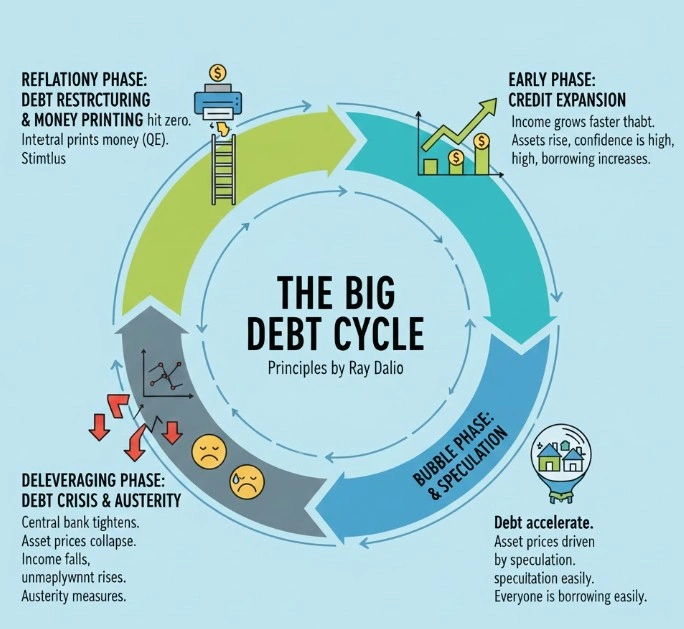
- How to identify the distinct phases of an archetypal debt cycle, from the “Goldilocks” start to the critical “Beautiful Deleveraging” resolution.
- The four powerful levers policy makers use to manage crises, and why balancing them is essential.
- The crucial difference between deflationary and inflationary crises,.
As Dalio asserts, if you learn how these cycles work, “you will see big debt crises very differently than you did before”. This summary breaks down these complex economic concepts into clear, motivational, and easy-to-apply lessons, ensuring you are better prepared for the storms ahead,.
Table of Contents
The Core Mechanism of Debt Cycles: Credit, Debt, and Human Nature
To understand a big debt crisis, we must first grasp the foundation: credit and debt. These terms might sound intimidating, but the underlying concepts are surprisingly simple and logical,.
Credit vs. Debt: The Essential Difference
Credit is essentially the giving of buying power. When you use credit, you gain the ability to make purchases now. Debt is simply the promise to pay that power back later.
Is credit inherently good or bad? That depends on its use.
- Good Credit: If borrowed money is used productively—for instance, to expand a business or fund a superior education—it generates sufficient income to service the debt, benefiting both the borrower and society,.
- Bad Debt: The problem arises when the credit produces insufficient economic benefit, leading to an inability to pay it back,.
Dalio notes that too little credit can be just as problematic as too much, resulting in “foregone opportunities,” such as failing to fund vital education or infrastructure improvements,.
The Monopoly Analogy: How Cycles Begin
A debt cycle starts the moment anyone—an individual, a company, or a nation—borrows money.
- Borrowing from the future: When you borrow, you spend more than you make, effectively borrowing from your future self.
- The inevitable reversal: This action creates a mandatory time in the future when you must spend less than you make in order to repay the debt. This pattern of overspending followed by forced underspending naturally creates a cycle.
To visualize this across an entire economy, imagine a game of Monopoly where the bank can make loans. Early in the game, players turn cash into productive property. But once they start borrowing heavily to acquire more properties (like hotels), they need immense amounts of cash to pay rents and service debts later on,. When the debtors run short of cash, they are forced to sell assets cheaply, jeopardizing the banks and causing the entire economic system to contract,.
The Key Insight: Lending inherently creates self-reinforcing movements—upward during the expansion, and downward during the contraction. During the upswing, rising incomes and asset prices support further borrowing, lifting spending beyond the economy’s sustainable productivity growth.
Why Debt Crises Are Cyclical
While debt crises may seem like random, chaotic events, Dalio stresses that they are nothing more than “logically-driven series of events that recur in patterns”.
Over the long term, debts rise faster than incomes. This happens because human nature pushes people to borrow and spend more rather than paying back debt immediately. Over many short-term cycles, the debt-to-income ratio ratchets higher and higher until the central bank can no longer lower interest rates to keep the expansion going (often because rates hit zero percent),,. This unsustainable increase in debt leads inevitably to the long-term debt crisis.
Navigating the Archetypal Big Debt Crises Principles
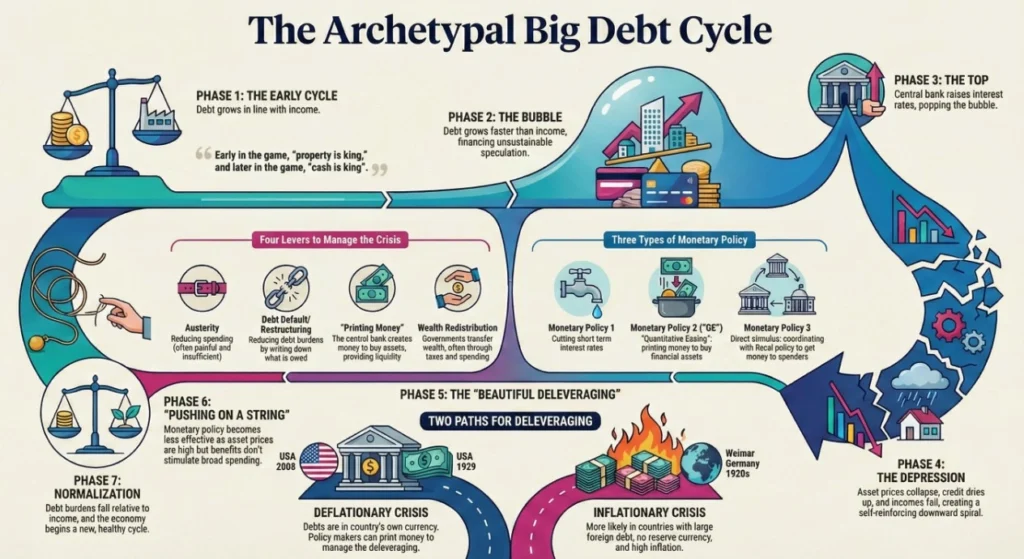
Dalio created a template by examining 48 big debt cycles throughout history, allowing him to identify consistent phases in these massive economic dramas,,. For simplicity, we will focus primarily on the most common type: the deflationary debt cycle (which characterized both the US Great Depression and the 2008 crisis),.
Phase 1: The Early Part of the Cycle (The Goldilocks Period)
This is the tranquil beginning, often called the “Goldilocks” period. Debt is growing, but it is growing appropriately because it is financing activities that produce fast income growth, like expanding a business. Debt burdens are low, balance sheets are healthy, and growth and inflation are “neither too hot nor too cold”. Everyone is positioned to handle more debt, setting the stage for the next phase.
Phase 2: The Bubble
In the bubble phase, caution vanishes. Debts rise faster than incomes, driving strong asset returns and accelerating growth.
- Self-Reinforcing Euphoria: Rising asset values increase collateral, allowing people to borrow more, which drives prices higher still. People feel wealthy and spend more than they earn.
- Falling Standards: Lenders, enjoying the good times, become complacent, and credit standards fall dramatically,. Unregulated financial institutions often emerge (the “shadow banking” system) to offer higher returns by taking on more leverage and risk.
- The Danger Signal: A classic warning sign is when increasing amounts of money are borrowed merely to cover debt service payments,. Near the peak, lending is based on the unrealistic expectation that unsustainable, above-trend growth will continue indefinitely.
Dalio notes seven measurable characteristics of an impending bubble,:
- Prices are high relative to traditional valuation measures.
- Prices are discounting future rapid appreciation from already high levels.
- There is broad bullish sentiment.
- Purchases are being financed by high leverage.
- Buyers have made exceptionally extended forward purchases (speculating on future gains).
- New buyers (who weren’t previously in the market) have entered the market.
- Stimulative monetary policy threatens to inflate the bubble even more.
Phase 3: The Top and the Reversal
The bubble is “ripe for a reversal” when prices are high, leverage is maximized, and “everyone believes that they will get better”.
- The Trigger: The top is most often triggered when the central bank begins to tighten credit and interest rates rise.
- The Vicious Cycle Begins: As borrowing becomes more expensive, debtors struggle to make payments, leading to a “negative wealth effect”,. Lenders worry and pull back, and asset prices begin to fall, reducing collateral value,. This begins a self-reinforcing contraction where decreased spending lowers income, making people less creditworthy, forcing further asset sales, and causing prices to drop even faster,,.
Phase 4: The Depression (The Ugly Deleveraging)
Unlike normal recessions where rate cuts can stimulate activity, a depression occurs when interest rates are already at or near zero, making that stimulus lever ineffective,.
- Credit Collapse: Debt defaults and restructurings hit leveraged lenders (like banks) “like an avalanche”. This creates fear and a “scramble for cash,” resulting in a liquidity crisis.
- Wealth Vanishes: Crucially, much of what people thought was their wealth—promises of credit—“is simply gone” when those promises cannot be met,.
- The Deleveraging Paradox: Despite massive defaults, debt burdens (debt as a percentage of income) often rise because incomes are falling faster than debts can be reduced,. The deflationary forces of austerity (spending cuts) and debt defaults dominate,.
Dalio emphasizes that this dynamic is not just psychological; it is mechanical: “debtors’ obligations to deliver money would be too large relative to the money they are taking in”. If the crisis is poorly managed, this phase creates severe social pain: jobs are lost, savings are wiped out, and “social tensions rise along with unemployment”,.
Phase 5: The Beautiful Deleveraging
A deleveraging is considered “beautiful” when policy makers manage the adjustment process such that debt-to-income ratios fall while economic activity and asset prices improve,.
The Goal: The core objective is to get the nominal growth rate of incomes back above the nominal interest rate,. This allows income to grow fast enough to service the existing debt without adding to the debt burden.
The Mechanism: This state is achieved by finding the “right balance” between deflationary forces (austerity/defaults) and inflationary/stimulative forces (money printing/currency devaluation/transfers),. The key stimulative action is increasing the supply of money to compensate for the “disappearance of credit”,.
A Critical Lesson on Money Printing: Dalio notes that “printing money” (debt monetization) is not inflationary if it only offsets falling credit and balances the deflationary forces,. It is simply “negating deflation”. This often takes the form of the central bank purchasing government securities and other assets (Quantitative Easing).
Phase 6 & 7: “Pushing on a String” and Normalization
When stimulative policies (low interest rates and QE) lose effectiveness—often because asset prices are pushed so high they offer poor returns, or debtors remain too fragile—central bankers may feel like they are “pushing on a string”,. At this point, the central bank has little “gas in the tank” to stimulate the economy further.
The system eventually stabilizes, typically entering a phase of Normalization. However, this recovery is slow, taking roughly five to ten years (a “lost decade”) for real GDP to reach its former peak, as investors remain reluctant to take risks.
Practical Applications: Actionable Lessons for Policy Makers and Individuals
The most valuable takeaway from Dalio’s template is the insight into how crises are managed and the risks associated with mismanagement.
Actionable Lesson 1: Identifying the Policy Levers
Governments and central banks have four main levers to reduce the debt burden relative to the income required to service it:
| Lever | Description | Impact on Economy | Example |
|---|---|---|---|
| 1. Austerity | Spending less and increasing taxes,. | Deflationary and depressive. Cuts income, which risks increasing the debt-to-income ratio further. | Cutting essential social services. |
| 2. Debt Defaults/Restructuring | Creditors agree to accept smaller payments or write down the value of the debt owed,,. | Deflationary and painful for creditors; frees up debtors’ cash flow. | Homeowners restructuring mortgages. |
| 3. Monetization/Money Printing | The central bank prints money to buy government or private debt,. | Inflationary and stimulates growth; cheapens the value of money/currency,. | Quantitative Easing (QE),. |
| 4. Wealth Transfers | Moving money/credit from the “haves” (capitalists/investors) to the “have-nots” (proletariat/workers),,. | Stimulative and can reduce social conflict, often through progressive taxes,. | Increasing taxes on the wealthy. |
Actionable Lesson 2: The Importance of Balance (The Beautiful Deleveraging Blueprint)
The key distinction between a catastrophe (ugly deleveraging) and a successful resolution (beautiful deleveraging) is striking the right balance between the painful, deflationary actions and the necessary, stimulative, inflationary ones,.
- The Rookie Mistake: Policy makers often rely too heavily on austerity and defaults initially, causing immense social pain and prolonging the crisis, because they are reluctant to provide stimulative government supports or monetization,. The US in the early 1930s made this error by being too slow to ease and monetize,.
- The Winning Strategy (US 2008-09): Policy makers must “print a lot of money” and execute aggressive government support quickly to offset the contracting credit and spread out the losses over time,. The US response in 2008-2009 was comparatively short-lived because officials acted “faster and smarter” than average by rapidly injecting liquidity and transitioning to monetization,.
Dalio notes that the biggest impediments to good management are “ignorance and a lack of authority”,. Policy makers must know how to use the levers well and have the political authority to do so.
Actionable Lesson 3: Recognizing Different Monetary Policies
During a severe debt crisis, the central bank may utilize three types of monetary policy, each decreasing in effectiveness over time:
- Monetary Policy 1 (MP1): Interest Rate Driven. This is the most effective policy in normal times, stimulating the economy by lowering borrowing costs, raising asset values, and reducing debt service burdens. It stops working when rates hit zero.
- Monetary Policy 2 (MP2): Quantitative Easing (QE). This involves “printing money” to buy financial assets (typically debt). It primarily benefits investors and savers, helping to stabilize asset prices and reduce risk premiums,. However, its effectiveness eventually diminishes when asset prices get too high and expected returns are pushed too low.
- Monetary Policy 3 (MP3): Direct Money to Spenders. When MP1 and MP2 are exhausted, the central bank must put money directly into the hands of spenders (not just investors/savers) and incentivize them to use it. This often involves coordination between monetary and fiscal policy, such as financing government spending directly or providing “helicopter money” (direct cash transfers) to households, particularly the less wealthy who have a higher incentive to spend,.
Actionable Lesson 4: The Critical Difference Between Deflationary and Inflationary Crises
The most important distinction in a debt crisis is determined by whether a country’s debt is denominated in its own currency or a foreign currency,.
| Crisis Type | Currency Denomination | Management Difficulty | Key Risks | Historical Example |
|---|---|---|---|---|
| Deflationary | Local/Domestic Currency (which the central bank controls),. | Easier: Policy makers can print money/monetize debt to spread out losses,. | The cycle gets stuck in the “Depression” phase due to insufficient stimulus. | US Great Depression (1929-1937): Policy makers were slow to ease and monetize until FDR broke the gold peg,. |
| Inflationary | Foreign Currency (which the central bank cannot print),. | Much Harder: Policy makers cannot print away foreign debt,. | Capital flight, currency collapse, and hyperinflation,. | Weimar Germany (1918-1924): Crushing foreign reparation debts and dependence on foreign capital led to runaway hyperinflation,. |
Actionable Insight: When debts are in your own currency, crises “can almost always be done well”. But if a country’s debts are in a foreign currency, “much more difficult choices have to be made”.
Key Takeaways: Lessons for Personal and Financial Strategy
Dalio’s template provides a powerful mental map, showing you fewer things happening over and over again, allowing you to anticipate major shifts.
Lessons for Investors and Individuals:
- Recognize the Warning Signs: Learn the characteristics of the bubble phase, especially high leverage and unrealistic price discounting, to avoid getting swept up in euphoria.
- Cash Flow is King: Understand that whether debt is good or bad depends on whether the borrowed money is used productively enough to generate sufficient income to service it. For society as a whole, too much debt service relative to income is the key factor that sparks the crisis.
- Diversify Crisis Exposure: In a crisis, traditional asset values collapse, and money seeks safety. Assets that do well in bad times include low-risk government bonds, gold, or cash.
- Ignore the Noise: Don’t be fooled by the frequent, sharp “bear market rallies” that occur during a depression; they are temporary periods of relief that fade when the fundamental debt imbalance remains unresolved,.
Lessons for Policy & Leadership:
- Speed and Boldness are Paramount: The single greatest factor determining the severity and length of a depression is how quickly and aggressively policy makers apply stimulative remedies,.
- Balance the Levers: Success lies in balancing the painful deflationary forces (defaults, austerity) with the necessary inflationary forces (monetization, transfers).
- Don’t Fear Monetization: Printing money to counteract contracting credit is crucial and proven to work without causing unacceptable inflation, provided it is used to replace the missing credit rather than actively abuse the system,.
- Prioritize Systemic Health over Punishment: While it’s natural to want to punish those who caused the bubble (“moral hazard”), saving systemically important institutions is critical to preventing the entire economy from collapsing,.
Final Thoughts: Embracing the Big Debt Crises Principles
Ray Dalio’s research is an exhilarating reminder that history doesn’t repeat itself exactly, but its fundamental mechanics rhyme. By examining many cases, he found that he was seeing “fewer things happening over and over again, like an experienced doctor who sees each case of a certain type of disease unfolding as ‘another one of those'”.
The detailed templates provided in the book, especially concerning the management of the deflationary debt cycle and the necessary political actions required to achieve a “beautiful deleveraging,” serve as vital maps for anyone seeking to navigate their financial future. By internalizing these Big Debt Crises Principles, you can move beyond simply reacting to current events and begin to anticipate the logical progression of the economic machine, allowing you to thrive even through the most tumultuous times.