Introduction
The global financial system is quietly undergoing one of the most profound transformations in modern history. Behind the headlines about cryptocurrencies and digital payments, a deeper structural shift is taking place, one that could redefine how ownership, investment, and wealth creation work across the world. At the center of this change is real world asset tokenization, a concept that connects traditional assets like real estate, bonds, commodities, and private equity with blockchain technology.
Today, trillions of dollars in assets remain illiquid, hard to access, and expensive to trade. Large institutions dominate these markets, while individuals face high entry barriers, long settlement times, and complex legal structures. Real world asset tokenization directly addresses these problems by converting real assets into digital tokens that can be securely traded, stored, and managed on blockchain networks.
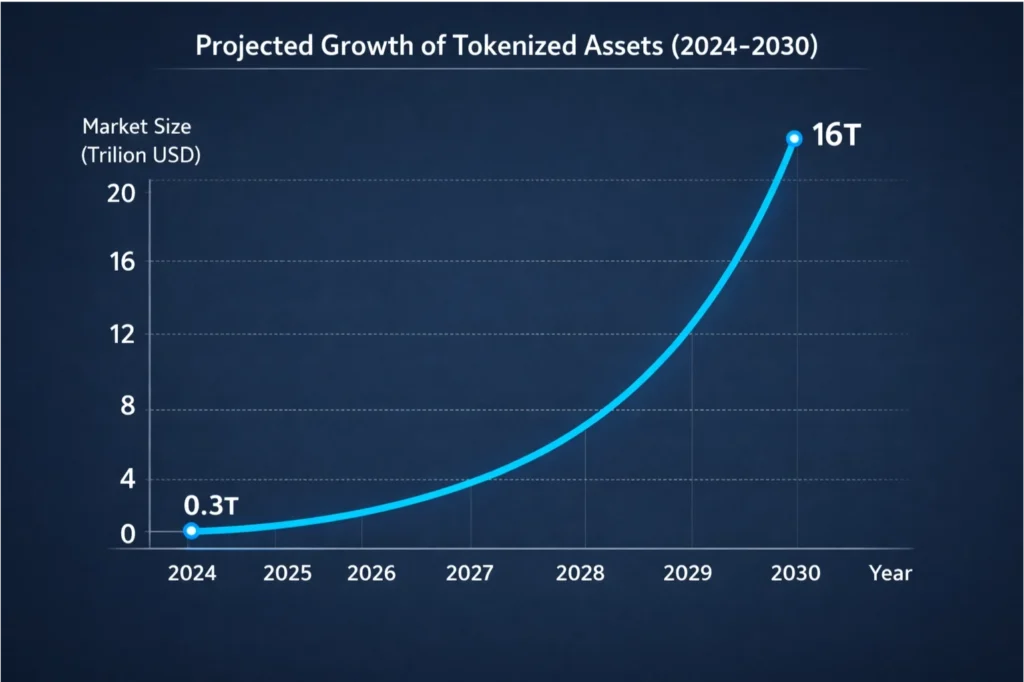
This topic matters now more than ever. Major financial institutions, including global banks and asset managers, are actively piloting tokenization platforms. Regulators are publishing frameworks instead of warnings. According to research from the World Economic Forum, tokenized assets could represent over $30 trillion in value by 2030, signaling not a trend but a structural evolution of finance.
In this article, you will learn what real world asset tokenization actually means in simple terms, how it works behind the scenes, why institutions are adopting it, the benefits and risks involved, and how it may reshape investing over the next decade.
Table of Contents
What Is Real World Asset Tokenization and Why It Matters
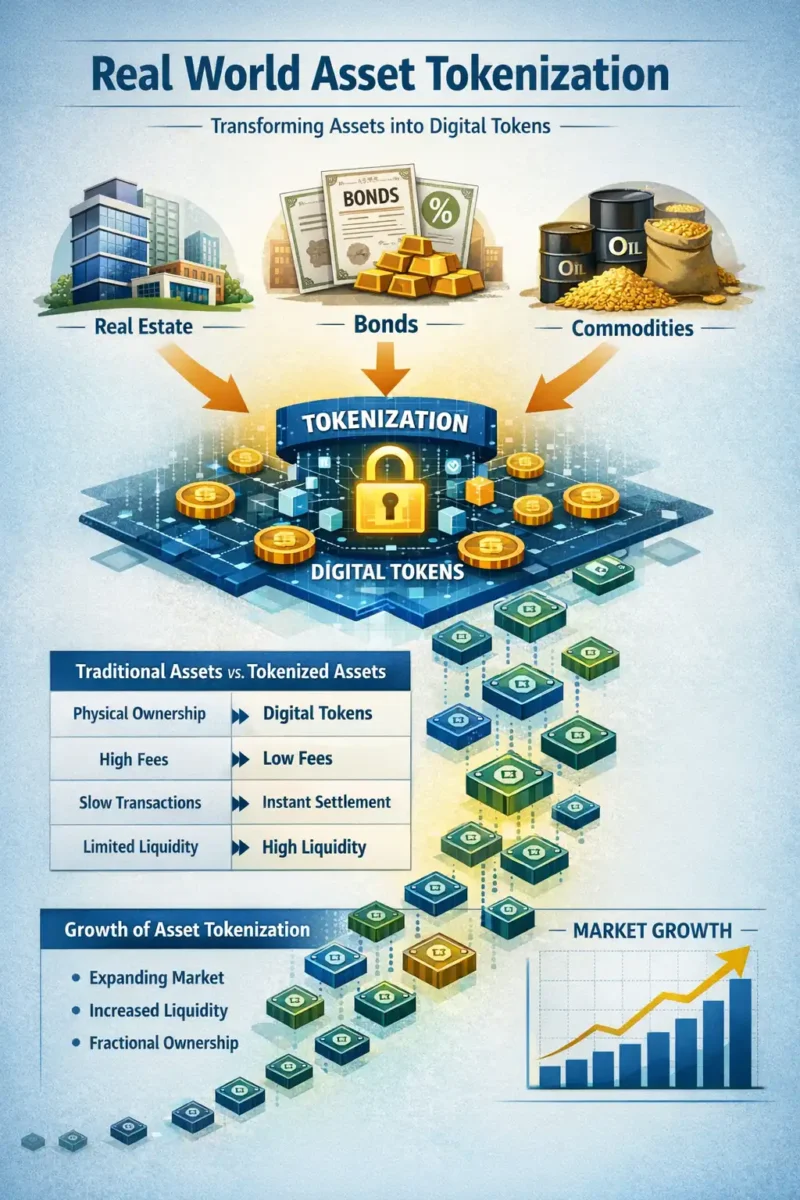
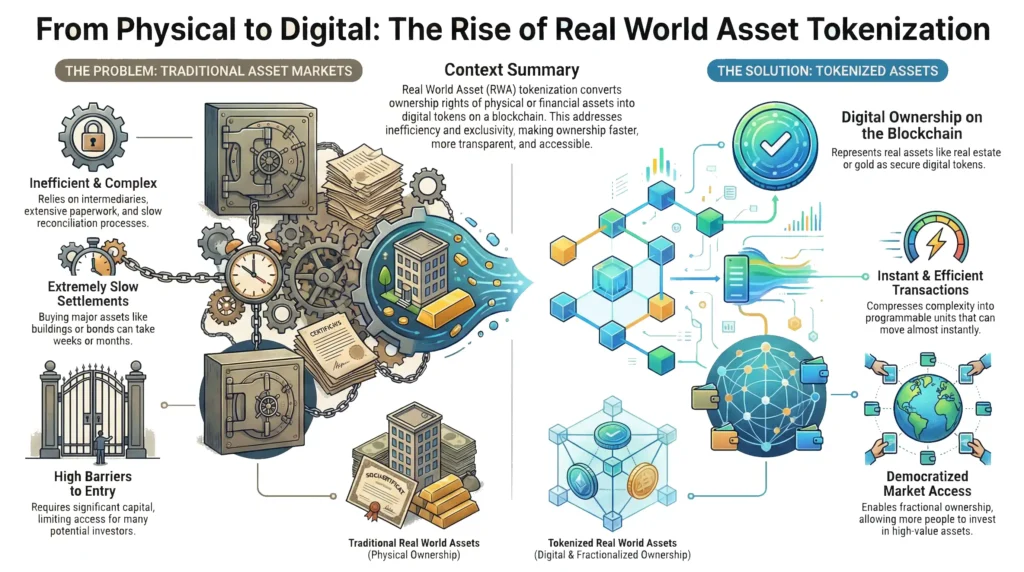
Real world asset tokenization refers to the process of representing ownership rights of physical or traditional financial assets as digital tokens on a blockchain. These tokens are not speculative coins. They are digital representations of real economic value, backed by legally enforceable claims to assets such as real estate, government bonds, corporate debt, commodities like gold, or even fine art.
At its core, tokenization solves a long-standing problem in finance, which is inefficiency. Traditional asset markets rely on intermediaries, paperwork, reconciliation, and slow settlement processes. Buying a building, a bond, or a private equity stake can take weeks or months, involve multiple legal entities, and require significant capital. Tokenization compresses this complexity into programmable digital units that can move almost instantly.
The importance of this shift goes beyond technology. It changes who can participate in markets. By breaking assets into smaller tokenized units, tokenization enables fractional ownership, allowing investors to access assets that were previously out of reach. This is particularly relevant in a world where wealth inequality and access to investment opportunities remain uneven.
According to the World Economic Forum and research cited by the International Monetary Fund, tokenization has the potential to improve capital efficiency, reduce counterparty risk, and increase transparency across financial markets. These benefits explain why regulators and institutions are no longer asking whether tokenization will happen, but how fast it can be safely implemented.
How Real World Asset Tokenization Works in Practice
Understanding how real world asset tokenization works does not require technical expertise. The process follows a logical sequence that connects legal ownership, technology, and market infrastructure. First, a real asset is legally structured so that ownership rights can be represented digitally. This often involves creating a special purpose vehicle or legal wrapper that holds the asset.
Next, digital tokens are issued on a blockchain. Each token represents a specific share or claim on the underlying asset. Smart contracts, which are self-executing programs on the blockchain, define the rules governing these tokens. These rules can include dividend payments, interest distribution, voting rights, or transfer restrictions.
Once issued, the tokens can be distributed to investors through regulated platforms or private placements. Transactions are recorded on a blockchain ledger, creating a transparent and immutable ownership history. Settlement occurs in near real time, compared to days in traditional markets.
The role of regulation is critical here. Tokenization does not remove the need for compliance. Know Your Customer and Anti Money Laundering checks still apply. In fact, many tokenization platforms integrate compliance directly into smart contracts, ensuring that only eligible participants can hold or trade certain assets. Institutions such as the European Central Bank have explored this model in their research on distributed ledger technology and financial market infrastructure.
Simplified tokenization process
- Asset identification and legal structuring
- Token creation on blockchain
- Smart contract rule definition
- Investor onboarding and compliance
- Trading, settlement, and reporting
Types of Assets Being Tokenized Today
Real world asset tokenization is not limited to a single asset class. Its flexibility allows it to be applied across a wide range of traditional markets, each with unique benefits. Real estate is one of the most active areas, where buildings or rental income streams are divided into digital shares, enabling fractional ownership and global investor access.
Fixed income products such as bonds and treasury instruments are also being tokenized. Governments and financial institutions see tokenized bonds as a way to reduce issuance costs, improve transparency, and enable faster settlement. The European Investment Bank has already issued digital bonds on blockchain platforms, demonstrating real world adoption.
Commodities like gold are another major category. Tokenized gold allows investors to own fractional amounts of physically backed assets without dealing with storage or logistics. Private equity and private credit are emerging areas, where tokenization improves liquidity in markets traditionally known for long lock-up periods.
| Asset Class | Why Tokenization Is Useful | Key Benefit |
|---|---|---|
| Real estate | High value and illiquid | Fractional ownership |
| Bonds | Slow settlement | Instant settlement |
| Commodities | Storage complexity | Easy transfer |
| Private equity | Long lock-ups | Improved liquidity |
According to Investopedia, tokenization is especially powerful in markets where friction and opacity are high, which explains why these asset classes are leading adoption.
Benefits of Real World Asset Tokenization for Investors and Institutions
The advantages of real world asset tokenization extend across the entire financial ecosystem. For individual investors, the most visible benefit is access. Tokenization lowers minimum investment thresholds, allowing participation in high-quality assets with relatively small amounts of capital. This democratization of investment is often cited as one of the most transformative aspects of the technology.
Institutions benefit from operational efficiency. By reducing the number of intermediaries, tokenization lowers costs related to custody, settlement, and reconciliation. Transactions that previously took days can settle in minutes, freeing up capital and reducing counterparty risk. Transparency also improves, as blockchain ledgers provide real-time visibility into ownership and transaction history.
Another key benefit is programmability. Smart contracts enable automated compliance, interest payments, and corporate actions. This reduces human error and administrative overhead. Research from the Bank for International Settlements highlights that programmable assets could significantly improve financial market resilience if implemented responsibly.
| Stakeholder | Traditional Model | Tokenized Model |
|---|---|---|
| Retail investors | High barriers | Fractional access |
| Institutions | Manual processes | Automated workflows |
| Markets | Limited transparency | Real-time visibility |
Risks, Challenges, and Limitations to Consider
Despite its promise, real world asset tokenization is not without risks. Regulatory uncertainty remains one of the most significant challenges. While progress is being made, legal frameworks vary across jurisdictions, creating complexity for cross-border tokenized assets. Investors must understand that not all tokens are equally protected under law.
Technology risk is another factor. Smart contract bugs, cybersecurity threats, and platform failures can result in losses if not properly managed. While blockchain itself is resilient, the surrounding infrastructure must meet institutional-grade security standards.
Liquidity risk also deserves attention. Tokenization can improve liquidity, but it does not guarantee active markets. A tokenized asset without sufficient buyers and sellers may still be difficult to exit. Additionally, valuation transparency depends on reliable pricing mechanisms, which are still developing in some tokenized markets.
| Risk Category | Description | Mitigation |
|---|---|---|
| Regulatory | Unclear legal status | Licensed platforms |
| Technology | Smart contract bugs | Audits and testing |
| Liquidity | Limited trading | Market maker involvement |
The International Monetary Fund has emphasized that responsible innovation requires aligning tokenization with existing financial stability principles.
Long-Term Impact on Global Finance and Capital Markets
Over the long term, real world asset tokenization has the potential to reshape how capital flows globally. By making assets more liquid, transparent, and accessible, tokenization could unlock trillions of dollars in currently idle or inefficiently allocated capital. This could benefit emerging markets by improving access to global investors.
Financial institutions may evolve from intermediaries into platform operators and service providers. Custody, compliance, and asset servicing will remain essential, but delivered through digital infrastructure. Central banks are also exploring how tokenized assets might interact with central bank digital currencies, potentially creating fully digital settlement layers.
The transformation will not happen overnight. Hybrid systems combining traditional and tokenized assets are likely to dominate in the medium term. However, as standards mature and trust builds, tokenization could become a foundational layer of modern finance rather than a niche innovation.
Frequently Asked Questions
What is real world asset tokenization in simple terms
Real world asset tokenization means turning ownership of physical or traditional financial assets into digital tokens that can be traded on a blockchain.
Is real world asset tokenization safe
It can be safe when done through regulated platforms with strong legal and technical safeguards, but risks still exist.
Can individuals invest in tokenized assets
Yes, one major benefit of real world asset tokenization is enabling fractional ownership for individual investors.
Are tokenized assets legally recognized
In many jurisdictions they are, but legal recognition depends on local regulations and asset structure.
Will tokenization replace traditional finance
It is more likely to complement and gradually transform traditional finance rather than replace it entirely.
Conclusion
Real world asset tokenization represents a structural shift in how financial assets are created, owned, and exchanged. By combining the legal foundations of traditional finance with the efficiency and transparency of blockchain technology, tokenization addresses long-standing inefficiencies that have limited access and slowed capital movement for decades.
For investors, this evolution offers new opportunities, but also requires education and careful risk assessment. Tokenization is not a shortcut to profits. It is an infrastructure upgrade that changes the mechanics of markets. Understanding how assets are structured, regulated, and traded remains essential.
Institutions, regulators, and technology providers are now collaborating rather than competing, signaling that tokenization has moved beyond experimentation. As standards mature and adoption grows, the financial system may become more inclusive, efficient, and resilient.
The key takeaway is not to chase hype, but to recognize direction. Real world asset tokenization is not a speculative idea. It is a practical response to real problems in global finance, and its influence will likely expand steadily over the coming years.
If you found value in this article, tell us in the comments what part of real world asset tokenization you want to learn more about. You can also subscribe for future insights on modern finance and investing.