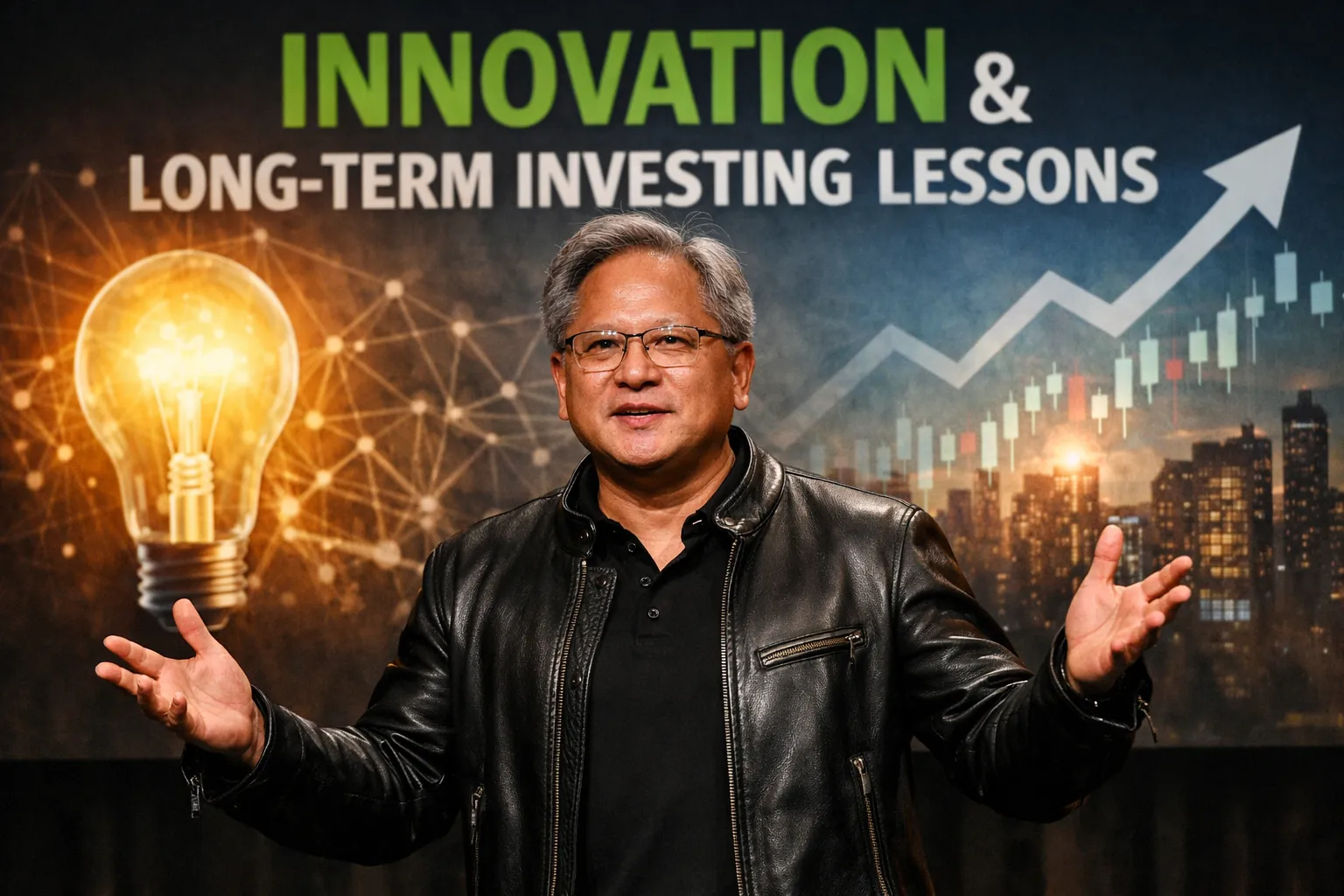
Introduction: Why Jensen Huang’s Journey Matters to Investors
Jensen Huang, the co-founder and CEO of NVIDIA, is one of the most influential figures in modern financial markets and technology-driven investing. His life story is not just a tale of entrepreneurial success—it is a real-world case study in long-term investing, innovation-led growth, and strategic leadership.
For investors, personal finance enthusiasts, and those seeking passive income opportunities through equity markets, Jensen Huang’s journey offers valuable lessons on patience, risk management, market cycles, and compounding value. This article explores his life story, business philosophy, and the financial lessons investors can apply to their own portfolios.
Table of Contents
Early Life and Background: Foundations of Resilience
From Immigrant Roots to American Opportunity
Jensen Huang was born in Taiwan in 1963 and later moved to the United States as a child. Like many immigrant families, his parents emphasized education, discipline, and adaptability—qualities that later shaped his leadership style.
Huang often recalls being sent to a boarding school at a young age, where he learned independence and perseverance. Reflecting on those experiences, he once said:
“Life doesn’t get easier; you just get better at dealing with it.”
Financial Insight
From a personal finance perspective, Huang’s early life highlights a critical principle: human capital is the first investment. Skills, education, and resilience often deliver higher long-term returns than any financial asset.
Founding NVIDIA: A High-Risk Entrepreneurial Bet
Starting NVIDIA in 1993
Jensen Huang co-founded NVIDIA in 1993 with two engineers, Curtis Priem and Chris Malachowsky. At the time, the semiconductor industry was intensely competitive, capital-intensive, and volatile—hardly a “safe” investment.
The founders launched NVIDIA with a simple but ambitious goal: to revolutionize computer graphics.
Surviving Near Failure
In the late 1990s, NVIDIA came close to bankruptcy after a failed product launch. Instead of giving up, Huang made a bold pivot, refocusing resources and doubling down on innovation.
“Our company is thirty years old, and we have reinvented ourselves at least five times.”
Investor Lesson
This period underscores an essential investing concept: volatility is not the same as risk. NVIDIA’s stock experienced extreme fluctuations early on, but long-term investors who understood the company’s fundamentals were rewarded.
NVIDIA’s Growth Story: Compounding in Action
From Gaming to AI Dominance
Initially known for gaming GPUs, NVIDIA expanded into data centers, artificial intelligence, autonomous vehicles, and cloud computing. This strategic diversification transformed the company into a cornerstone of modern financial markets.
Key Growth Drivers:
- Explosive demand for AI and machine learning
- Expansion into enterprise and cloud infrastructure
- High-margin software and platform ecosystems
Stock Performance Example
A long-term investment perspective illustrates the power of compounding:
| Year | NVIDIA Share Price (Approx.) | Key Milestone |
|---|---|---|
| 1999 | IPO at ~$12 | Public listing |
| 2010 | ~$15 | Gaming GPU dominance |
| 2020 | ~$260 | AI and data center growth |
| 2024 | $800+ | AI-driven market leadership |
(Prices adjusted for stock splits)
Passive Income Angle
While NVIDIA historically focused on growth rather than dividends, long-term shareholders benefited from capital appreciation, a key passive wealth-building strategy.
Leadership Philosophy: A Blueprint for Long-Term Value
Thinking in Decades, Not Quarters
Unlike many executives focused on short-term earnings, Huang emphasizes long-term vision:
“If you want to build something great, you have to be willing to be misunderstood for a long time.”
This mindset aligns closely with value investing principles, where patience and conviction often outperform frequent trading.
Corporate Culture and Innovation
Huang fosters a culture that encourages experimentation and calculated risk-taking—an approach mirrored by successful investors who allow room for uncertainty while managing downside risk.
Financial Lessons Investors Can Learn from Jensen Huang
1. Innovation Drives Market Outperformance
Companies that lead technological shifts often outperform market indices over time.
2. Concentration Can Beat Diversification (With Knowledge)
NVIDIA’s success shows that high-conviction investments, when backed by deep understanding, can generate outsized returns.
3. Reinvestment Fuels Compounding
NVIDIA consistently reinvested profits into R&D, echoing the personal finance principle of reinvesting returns to accelerate wealth growth.
4. Emotional Discipline Matters
Surviving downturns—both as a CEO and investor—requires emotional control and long-term thinking.
Jensen Huang and the Broader Financial Markets
AI as a Structural Trend
NVIDIA’s rise is closely tied to artificial intelligence becoming a structural growth trend, not a short-term hype cycle. This has implications for:
- Equity market valuations
- ETF investing
- Long-term retirement portfolios
Risk Awareness
Despite NVIDIA’s success, Huang frequently warns against complacency:
“The moment you think you’ve made it, you’ve already started falling behind.”
For investors, this reinforces the importance of continuous learning and portfolio review.
Conclusion: Key Takeaways and Practical Actions
Jensen Huang’s life story is a powerful reminder that wealth creation is rarely linear. His journey offers timeless lessons for investors and personal finance learners alike:
Key Takeaways:
- Invest in skills before assets
- Embrace volatility when fundamentals are strong
- Focus on long-term compounding
- Stay disciplined through market cycles
Practical Actions for Readers:
- Study businesses, not just stock prices
- Allocate part of your portfolio to innovation-driven sectors
- Reinvest gains to build passive income over time
- Maintain a long-term mindset, even during market downturns
Jensen Huang’s story is not just about building a trillion-dollar company—it’s about building lasting value, both in business and investing.