From Automated Content to AI Agent Businesses: Your Comprehensive Guide to Earning While You Sleep

Key Insights into AI-Driven Passive Income
- Semi-Passive, Not Fully Automated: While AI offers unprecedented leverage, true “hands-off” income remains largely aspirational. The realistic goal is semi-passive income, where initial effort and ongoing optimization lead to significantly reduced manual work.
- AI as Leverage for Creation and Automation: AI excels at accelerating asset creation (content, software, courses) and automating repetitive tasks (support, lead follow-up, posting). This allows for lean business operations driven by workflows and AI agents.
- Focus on Systems and Specific Niches: Success hinges on building valuable, systematized offerings within well-defined niches. Generic content is saturated; real value comes from applying AI to solve specific business problems like lead generation, sales, or operational efficiency.
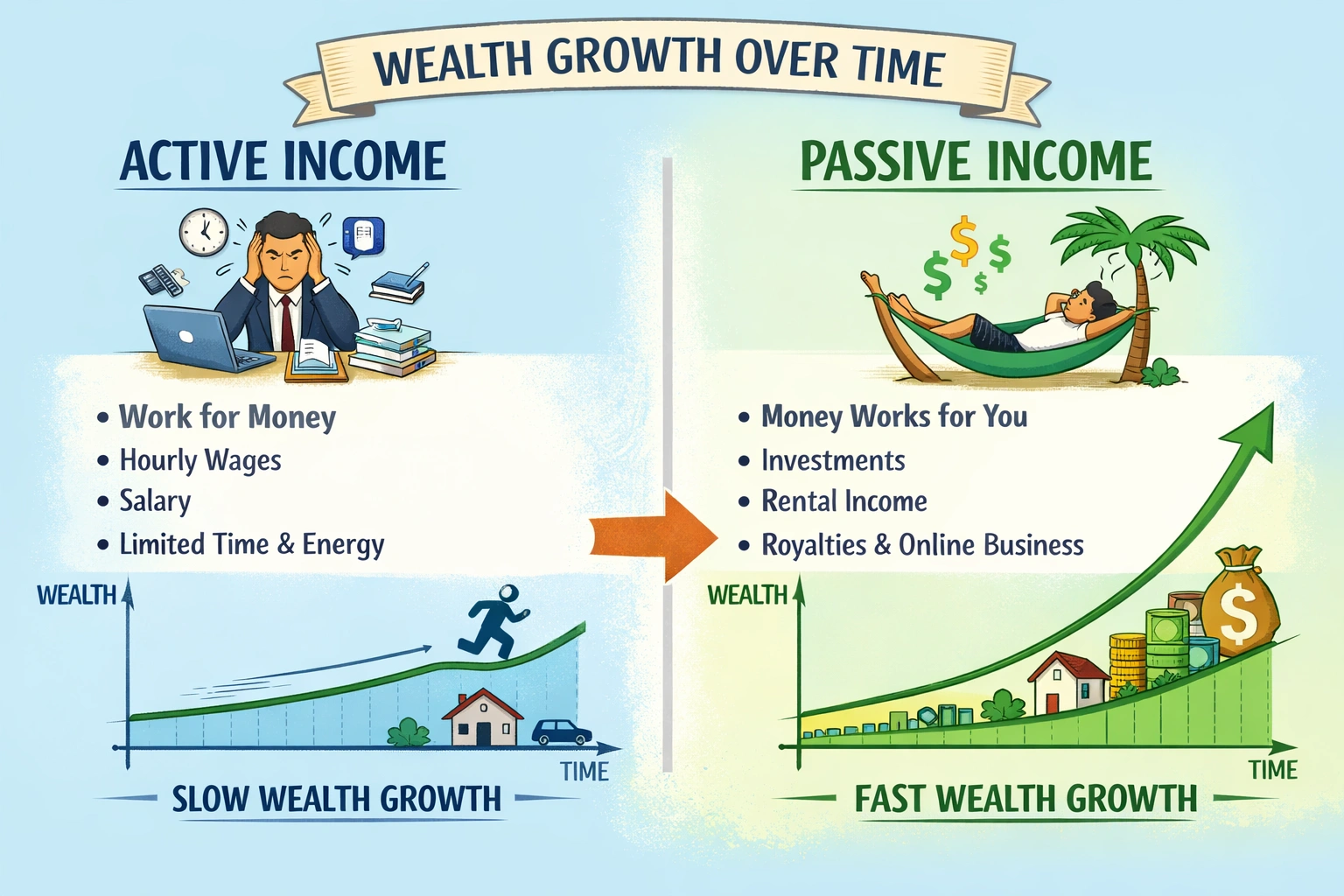
The year 2026 marks a pivotal moment in the evolution of passive income, largely due to the rapid advancements and widespread adoption of Artificial Intelligence. Gone are the days when passive income was solely tied to traditional investments like real estate or dividend stocks. Today, AI has opened a new frontier, enabling individuals to generate revenue streams with minimal ongoing effort by automating content creation, e-commerce, marketing, and even intricate business processes.
However, it’s crucial to adopt a realistic perspective. The notion of “100% hands-off” passive income is largely a myth. Instead, the focus for 2026 is on achieving semi-passive income, where significant upfront work—involving market research, setup, testing, and optimization—establishes a system that then operates with 80-90% automation. This shift transforms AI from a magic money button into a powerful tool for leverage, allowing creators and entrepreneurs to build durable, scalable income streams that require only 1-5 hours of maintenance per week after the initial build phase.
Defining AI-Powered Passive Income: A Modern Perspective
Beyond Traditional Definitions: The Role of AI in Wealth Generation
Passive income traditionally refers to earnings derived from ventures in which an individual is not actively involved on a daily basis. In 2026, AI significantly amplifies this concept by automating core business functions, thus minimizing the need for constant human intervention. The primary ways AI contributes to passive income generation include:
- Accelerated Asset Creation: AI tools can draft articles, generate video scripts, design templates, and even help develop software, dramatically speeding up the creation of valuable assets.
- Workflow Automation: Repetitive tasks such as customer support, email marketing, social media posting, and data reporting can be automated using AI agents and intelligent workflows (e.g., n8n, Zapier, Make).
- Lean Business Operations: AI enables the operation of businesses that run largely on autopilot, from initial lead generation to product delivery and customer service, transforming them into highly efficient, self-sustaining entities.
Despite these capabilities, it’s vital to recognize that an initial investment of time and effort is indispensable. This includes market research to identify profitable niches, careful setup of AI tools and workflows, and continuous testing and optimization to ensure the system performs effectively. The goal is not to eliminate work entirely but to front-load it, allowing for a gradual reduction in active involvement as the system matures.
The Core Components of an AI-Powered Passive Income System
Building Blocks for Sustainable Automation
Almost all successful AI-based passive income models in 2026 are built upon a combination of interconnected components:
- Traffic Generation: Attracting users or visitors through various channels like search engines, social media, advertisements, or app marketplaces.
- Irresistible Offer: The product or service that generates revenue, which could be anything from affiliate links and course sales to SaaS subscriptions, templates, or qualified leads.
- Intelligent Automation: Utilizing AI agents, chatbots, email/SMS sequences, and platforms like n8n or Zapier to automate interactions and processes.
- Conversion System: Optimized landing pages, sales funnels, email sequences, and chatbots designed to convert traffic into revenue-generating actions.
The genius lies in designing a system where AI facilitates every step: from attracting potential customers, nurturing their interest automatically, converting them into paying customers, and finally, delivering the product or service with minimal human input.
Leading AI Passive Income Models for 2026
Diverse Avenues for AI-Enhanced Earning
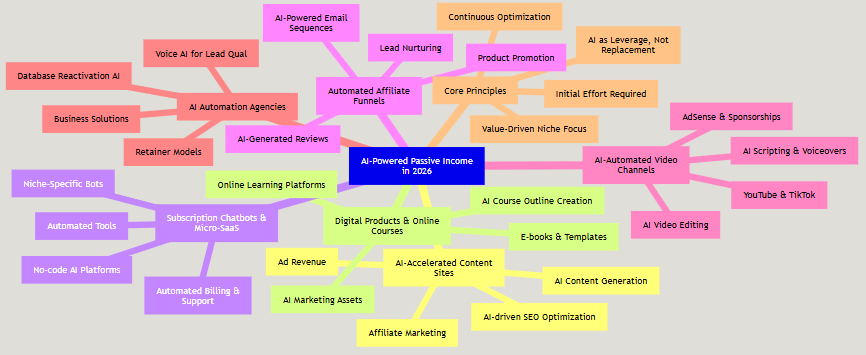
AI-Accelerated Affiliate Content Sites
This model involves building content-rich websites (blogs, niche portals) that earn through affiliate links, display ads, or digital products. AI plays a crucial role in researching trending topics, optimizing content for search engines, drafting articles, and ensuring freshness. Once articles rank and email funnels are established, daily work becomes significantly reduced, focusing mainly on maintenance, updates, and strategic new content.
AI-Enhanced Digital Products & Online Courses
Creating self-paced online courses, templates, and digital downloads is highly conducive to passive income. AI assists in outlining course structures, scripting content, designing workbooks, generating sales page copy, and even crafting promotional assets. Once built, these assets can sell for extended periods with minimal intervention, requiring only occasional updates and support.
Subscription Chatbots & Micro-SaaS
Developing niche-specific AI chatbots or small software tools (Micro-SaaS) and offering them on a subscription basis presents a strong passive income opportunity. Examples include chatbots for FAQ handling in dental clinics or AI agents that write listing descriptions for real estate agents. The key is to standardize workflows and provide robust self-service options, allowing new sign-ups to onboard autonomously.
AI Affiliate Marketing with Automated Funnels
This strategy promotes AI tools or other products as an affiliate, with AI managing most of the marketing funnel. AI can create comparison posts, reviews, video scripts, and even entire email nurturing sequences. By integrating chatbots for pre-purchase queries, the entire process becomes largely automated once content ranks or videos gain consistent views.
AI-Automated YouTube & Short-Form Video Channels
Leveraging AI to script, voice, edit, and repurpose video content for platforms like YouTube and TikTok allows for monetization through ads, sponsorships, and affiliate links. AI tools can generate B-roll, create visuals, auto-caption, and suggest SEO-optimized titles. Once a video catalog is established, these channels can generate semi-passive income, especially for evergreen “how-to” or product review content.
AI Automation Agencies with Retainers
Instead of hourly freelance work, this model focuses on building and maintaining AI systems for businesses, charging monthly retainers. Examples include AI-powered database reactivation for old leads or voice AI systems for 24/7 lead qualification. While initially active, standardizing workflows and relying on AI agents for day-to-day operations can transition this into a highly profitable semi-passive agency model.
The Blueprint: Building Your AI-Powered Passive Income System
A Step-by-Step Approach to Automation
Step 1: Define Your Niche and Business Model
The first critical step is to select a single, primary business model and narrow it down to a very specific niche. For instance, instead of “AI for business,” focus on “AI automations for real-estate agents.” This precision ensures that all subsequent efforts—content creation, offers, and automations—are highly targeted and ultimately more profitable.
Step 2: Map Out the Value Chain
Visualize how customers will discover you, what free value they receive, what they ultimately purchase, and how the product/service is delivered and supported primarily via AI. This funnel—Traffic → Lead Magnet/Value → Automated Nurture → Offer → Delivery → Upsell—is the backbone of your passive income system.
Step 3: Assemble Your AI Tech Stack
A robust AI stack is essential. This typically includes:
- Content AI: For generating blog posts, emails, scripts, and ad copy.
- Design/Video AI: For creating visuals, B-roll, and video edits.
- Automation Platforms: Tools like n8n or Zapier to connect applications and trigger AI workflows.
- Chatbots/AI Agents: For website interactions, customer support, and lead handling.
- Analytics & Dashboards: AI-driven tools to interpret data and suggest optimizations.
The goal is to automate every recurring task, establishing either a workflow, an AI agent, or a simple AI-assisted standard operating procedure.
Step 4: Create Your Minimum Viable Product (MVP)
Depending on your chosen model, this could be 10-30 keyword-researched articles, a 3-5 module starter course, an MVP chatbot tool, or an effective AI-driven automation for lead reactivation. While AI assists in drafting and structuring, human oversight is crucial for factual accuracy, injecting unique experience, and ensuring genuine problem-solving.
Step 5: Systematize Repetitive Tasks
Any task performed more than twice should be considered for automation or AI assistance. This applies to lead capture, welcome sequences, customer support, and content repurposing. The focus is on building “money-making workflows” that operate continuously.
Step 6: Optimize with AI-Assisted Analytics
Once traffic and revenue begin, leverage AI to analyze performance. AI can identify areas of high conversion, pinpoint funnel leaks, suggest A/B tests for headlines and calls-to-action, and recommend optimization strategies. This continuous feedback loop ensures sustained growth.
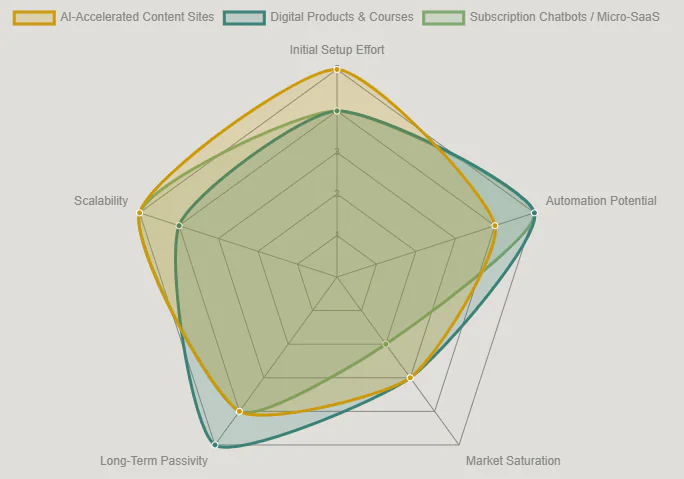
This radar chart compares the characteristics of three leading AI-powered passive income strategies. It evaluates them across metrics such as Initial Setup Effort, Automation Potential, Market Saturation, Long-Term Passivity, and Scalability, providing a visual guide to their inherent strengths and challenges. The scale from 0 to 5 allows for a quick comparative analysis of each model’s demands and potential.
Realistic Expectations: The Path to Semi-Passivity
Understanding the Time and Effort Investment
While the allure of “set it and forget it” income is strong, the reality in 2026 is that truly passive income (requiring zero hours) is largely unrealistic for durable and legal ventures. What is achievable, however, is semi-passive income. This involves an initial period of intense building and optimization, typically spanning 3 to 12 months, followed by a maintenance phase requiring 1-5 hours per week.
The typical trajectory involves:
- Months 0-3: Heavy Build Phase (10-30 hrs/week) – Dedicated effort to set up the chosen model.
- Months 3-9: Optimization & Growth (5-15 hrs/week) – Refining systems, expanding content, and attracting more users.
- After 9-12 Months: Semi-Passive Maintenance (1-5 hrs/week) – If systems are well-established, focus shifts to updates, content refresh, and strategic experiments.
Income streams that rely on evergreen content, recurring subscriptions, and highly automated funnels tend to achieve higher levels of passivity over time.
Potential Risks and Mitigation Strategies
Navigating the Challenges of AI Automation
While AI offers immense opportunities, it also introduces specific risks that need careful management:
Over-Automation Without Value
Relying solely on AI for content generation without human review can lead to low-quality output, platform penalties, and a damaged brand reputation. To counter this, ensure human oversight for public-facing content and prioritize genuine problem-solving over sheer volume.
Platform Dependency
Over-reliance on a single platform’s algorithm (e.g., Google, YouTube, TikTok) makes an income stream vulnerable to sudden changes. Mitigate this by building an owned audience, such as an email list, and diversifying traffic sources over time.
Legal and Compliance Issues
When using AI, it’s crucial to understand terms of service, commercial usage rights for AI tools, and intellectual property considerations. Transparency regarding AI use, clear disclosure of affiliate relationships, and adherence to platform policies are essential to avoid legal pitfalls.
Why 2026 is Unique for AI-Driven Passive Income
Matured Tools and Shifting Opportunities
Several factors make 2026 a particularly opportune moment for AI-powered passive income:
- Maturity of No-Code/Low-Code AI Tools: Non-technical users can now build sophisticated AI agents, automations, and Micro-SaaS solutions without extensive coding knowledge.
- Business Openness to AI: Businesses are increasingly receptive to AI handling critical functions like calls, chats, and outreach, especially when it demonstrably drives revenue (e.g., speed-to-lead systems).
- Shift from Generic Content to Niche Solutions: The market for generic AI-generated content is becoming saturated. The competitive edge now lies in niche expertise, unique offers, and smart automations that solve specific business problems rather than just producing content.
In essence, applying AI to real-world business challenges—particularly in areas of leads, sales, and operations—is significantly more valuable than merely leveraging AI for basic content creation.
A 90-Day Action Plan for Starting Your AI Passive Income Journey
From Conception to Initial Revenue
This lean 90-day blueprint provides a structured approach to kickstarting your AI-powered passive income venture:
| Timeframe | Focus Area | Key Activities | AI Tools/Assistance |
|---|---|---|---|
| Days 1-7 | Decision & Research | * Pick one business model + niche. * Define target audience and pain points. * Research competitors and market demand. | * Generate competitor maps. * Brainstorm content ideas. * List common objections/pain points. |
| Days 8-30 | First Asset Creation | * Create Minimum Viable Product (MVP): e.g., 10-20 articles, starter course, initial automation. * Set up basic automations: email capture, welcome sequence. | * Draft outlines and content. * Generate examples and templates. * Improve clarity and structure. |
| Days 31-60 | Traffic & Conversion | * Publish consistently. * Launch on 1-2 distribution channels (e.g., search + social, marketplace + email). * Gather early feedback and refine offer/pricing. | * Automate content scheduling. * Assist in ad copy creation. * Analyze early conversion metrics. |
| Days 61-90 | Systematize & Improve | * Identify successful elements (top pages, videos, clients). * Automate repetitive tasks around these successes. * Analyze metrics and plan next steps for optimization. | * Automate content repurposing. * Suggest A/B tests. * Interpret analytics for actionable insights. |
This table outlines a practical 90-day plan for launching an AI-powered passive income stream, detailing key activities and how AI can support each stage from initial research to system optimization.
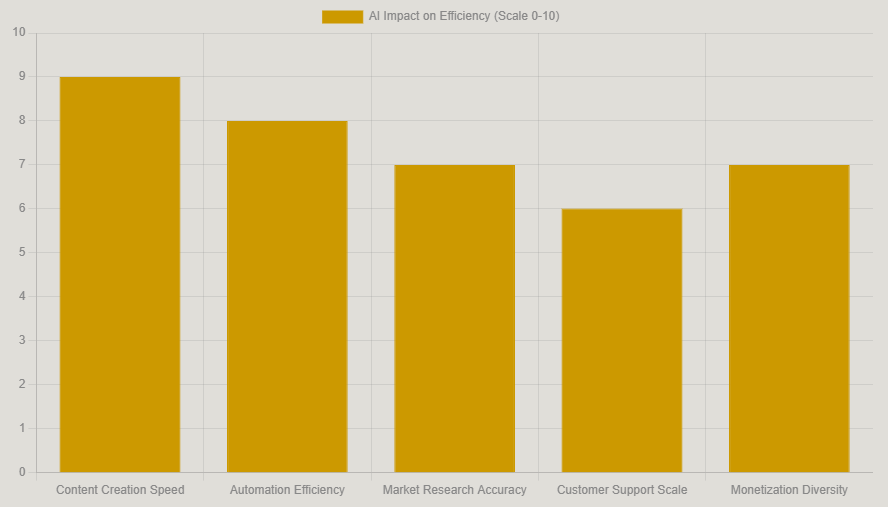
This bar chart illustrates the perceived impact of AI across various business functions crucial for passive income generation, on a scale from 0 to 10. It highlights how AI significantly boosts Content Creation Speed and Automation Efficiency, while also providing substantial improvements in Market Research Accuracy, Customer Support Scale, and Monetization Diversity.
Embracing the AI Era: Beyond “Passive” to “Leveraged” Income
The Mindset for Success in 2026
Individuals who are successfully building “passive income with AI” in 2026 share a common mindset:
- They view AI as a strategic partner, not a complete replacement for human effort.
- They focus on solving real, often “boring” problems (e.g., missed calls, outdated leads, repetitive support, content bottlenecks).
- Their emphasis is on building scalable systems and recurring revenue models (subscriptions) rather than one-off gigs.
- They are prepared to invest significant time and effort upfront, understanding that meaningful semi-passive returns will materialize over months, not days.
Approaching AI as a tool to own and automate valuable systems—rather than chasing unrealistic get-rich-quick schemes—is the key to building realistic and increasingly hands-off income streams in 2026.
A Visual Deep Dive: AI Income Streams to Start from Scratch
Understanding Real-World Applications
To further illustrate the practical applications of AI in generating passive income, here’s a relevant YouTube video that delves into specific AI income streams. This video showcases actual strategies and tools that can be employed, offering concrete examples of how AI can be leveraged for earnings:
This video, titled “5 AI Income Streams I’d Start From Scratch in 2026,” provides practical insights into various AI automations and workflows. It’s highly relevant as it offers actionable strategies for building passive income systems using AI, directly aligning with the comprehensive guide presented here. The content covers real business workflows and specific AI tools, making it an excellent visual complement to the theoretical frameworks discussed.
Frequently Asked Questions
What does “passive income with AI” truly mean in 2026?
In 2026, “passive income with AI” refers to generating revenue streams where artificial intelligence automates a significant portion of the work, such as content creation, marketing, customer support, and operational tasks. It’s more accurately described as “semi-passive” because it still requires initial setup, ongoing maintenance, and strategic optimization by a human to ensure its effectiveness and sustainability.
How much initial effort is required to set up AI-powered passive income?
Significant initial effort is required, typically spanning 3 to 12 months, with an investment of 10-30 hours per week in the initial building phase. This involves market research, selecting the right AI tools, setting up workflows, creating initial assets (e.g., content, digital products), and establishing marketing funnels. After this period, the time commitment can reduce to 1-5 hours per week for maintenance and optimization.
What are the most effective AI-powered passive income models for 2026?
Some of the most effective models for 2026 include AI-accelerated affiliate content sites, AI-enhanced digital products and online courses, subscription chatbots and Micro-SaaS, AI affiliate marketing with automated funnels, AI-automated YouTube and short-form video channels, and AI automation agencies operating on retainer models. These models leverage AI for either content creation, automation, or both.
Can AI fully automate customer support for a passive income business?
AI can automate a substantial portion of customer support through chatbots that handle FAQs, provide instant responses, and guide users through common issues. However, for complex inquiries or highly sensitive situations, human intervention is still necessary. The goal is to offload routine tasks to AI, freeing up human operators for more critical or nuanced interactions, making support semi-automated.
What are the main risks associated with AI-driven passive income?
Key risks include over-automation leading to low-quality output and reputational damage, excessive reliance on a single platform’s algorithm (platform dependency), and potential legal or compliance issues related to AI-generated content or data usage. Mitigating these risks involves human oversight, diversifying income streams, and staying informed about ethical AI use and regulations.
Conclusion: The Future is Leveraged, Not Just Passive
The year 2026 is an era where AI is not merely a technological novelty but a fundamental catalyst for wealth creation. While the dream of truly “passive” income remains largely theoretical, the reality of “semi-passive” or “leveraged” income is more accessible than ever before. By strategically integrating AI into core business functions—from content creation and marketing to customer service and operational workflows—individuals can build robust, scalable, and increasingly autonomous income streams.
Success in this new landscape hinges on a proactive mindset: embracing AI as a powerful partner, focusing on solving specific, valuable problems within defined niches, and committing to the initial effort required to build and optimize these automated systems. The opportunity is not about bypassing work entirely, but about working smarter, allowing AI to amplify human ingenuity and create a future where earning “while you sleep” is a tangible reality for those willing to innovate and adapt.