
Managing money is not about complex formulas or chasing the latest investment trend. True financial success comes from mastering a few timeless principles—habits that build wealth steadily, protect you from costly mistakes, and give you long-term peace of mind.
Whether you are just starting your financial journey or looking to strengthen your current position, the following personal finance lessons focus on discipline, patience, simplicity, and mindset—the foundations of lasting financial independence.
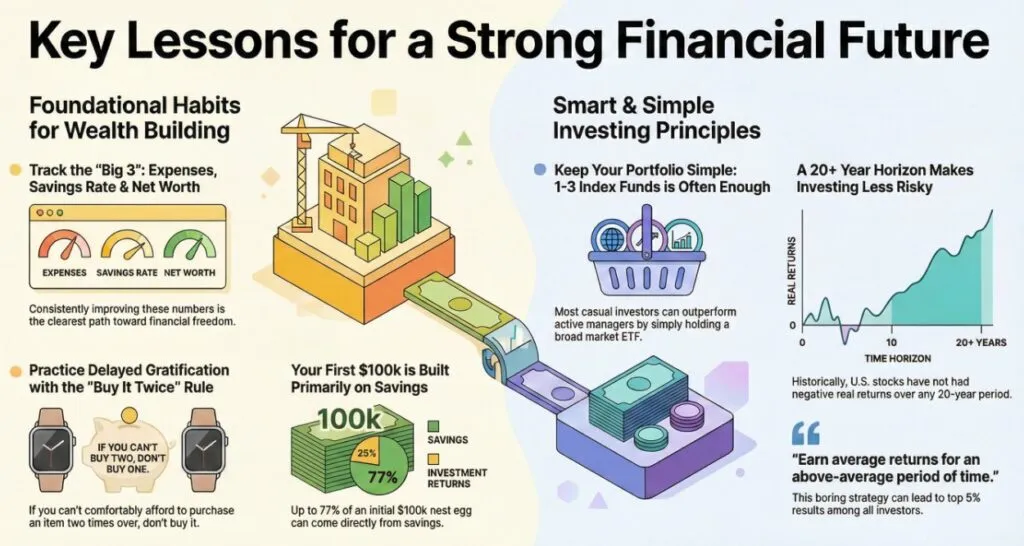
Table of Contents
1. Delayed Gratification: The Cornerstone of Wealth Building
Delayed gratification is one of the most powerful concepts in personal finance. It means choosing long-term rewards over short-term pleasure—a mindset that separates financially secure individuals from those stuck in constant stress.
In investing, delayed gratification is why long-term investors outperform short-term traders. Holding assets such as stocks, index funds, or retirement accounts for decades allows compound growth to work in your favor.
In everyday life, a simple rule helps reinforce this discipline: if you cannot afford to buy something twice, you cannot afford it once. This mindset protects you from overextending yourself and encourages thoughtful spending.
Delayed gratification also applies to major life choices—career moves, education, or entrepreneurship. When decisions are evaluated with a 10- or 20-year perspective, clarity replaces impulsiveness, and better outcomes follow.
2. Know Your Numbers: Master the Three Financial Metrics That Matter
Financial progress begins with awareness. To stay in control of your money, you must regularly track three key metrics:
Expenses
Understanding where your money goes is non-negotiable. Fixed expenses such as housing, transportation, and utilities should ideally remain below 50–60% of your income. Exceeding this level leaves little room for saving or investing.
Tracking discretionary spending is equally important. Regular check-ins during the month help you adjust before overspending becomes a habit.
Savings Rate
Your savings rate determines how quickly you can build wealth. Start with a realistic goal—such as saving 10% of your income—and gradually increase it over time. A higher savings rate creates flexibility and accelerates investment growth.
Net Worth
Tracking net worth provides a long-term view of financial progress. Even when income fluctuates, a rising net worth confirms that your financial foundation is strengthening year after year.
3. Keep Investing Simple: Avoid Portfolio Overload
Many investors believe owning more assets equals better diversification. In reality, over-investing often leads to overlapping exposure and unnecessary complexity.
Most broad-based index ETFs are already well diversified. Holding too many funds can dilute performance without reducing risk. In fact, data shows that long-term investors who simply buy and hold a broad market ETF have outperformed the majority of actively managed funds.
Simplicity is not a weakness—it is a strategic advantage. A focused, low-cost portfolio encourages discipline and reduces emotional decision-making.
4. Understand Depreciating Assets Before You Buy
A depreciating asset is anything that loses value over time. Cars are the most obvious example, but many everyday items fall into this category, including electronics, furniture, luxury goods, and even some home upgrades.
The most damaging mistake is financing depreciating assets with high-interest debt. When you borrow to buy something that is losing value, you pay interest while the asset declines—creating a double financial loss.
Before making major purchases, ask whether the item improves your long-term financial position or simply satisfies a short-term desire.
5. Time Is Your Greatest Financial Advantage
Time reduces investment risk. While markets may experience volatility in the short term, long-term data consistently shows that extended holding periods dramatically improve outcomes.
Historically, long-term investors in diversified stock markets have avoided negative real returns over 20-year periods. Over 30 years, returns tend to normalize even further.
Attempting to time the market often results in missed opportunities. Consistent investing, regardless of market conditions, allows compound growth to work uninterrupted.
6. Build the Foundation First: Saving Before Investing
At the start of your financial journey, saving matters more than investing. When capital is limited, your ability to invest is constrained, no matter how attractive returns may seem.
Building an initial emergency fund and savings buffer creates stability and reduces financial stress. The first major wealth milestone—often cited as the first $100,000—is achieved primarily through disciplined saving, not investment returns.
Early savings have the greatest long-term impact because they have more time to compound.
7. Make Investing Boring and Consistent
Successful investing rarely feels exciting. Long-term wealth is built through routine contributions, patience, and minimal intervention.
Rather than reacting to market news, adopt a strategy of regular investing—also known as dollar-cost averaging. This approach removes emotion from decision-making and smooths market volatility over time.
Investors who earn average returns consistently over decades often outperform those chasing extraordinary gains in short periods.
8. Focus on Your Own Financial Journey
Comparing your financial progress to others is one of the fastest ways to lose focus. Every individual has unique goals, income levels, responsibilities, and timelines.
Social media amplifies unrealistic expectations and encourages impulsive spending. By focusing on your own progress instead of external comparisons, you reduce financial stress and improve decision quality.
Personal finance is personal. Progress should be measured against your past self, not someone else’s highlight reel.
9. Avoid Lifestyle Inflation and the Illusion of Wealth
The appearance of wealth often hides financial fragility. Many high-income individuals struggle financially due to excessive spending and debt—a phenomenon sometimes described as the “high-income, low-net-worth” trap.
True wealth is built by consistently living below your means. Studies of millionaires repeatedly show that financial independence is achieved through restraint, not extravagance.
Prioritizing financial security over status leads to freedom, flexibility, and long-term peace of mind.
10. Respect Your Unique Risk Profile
No financial strategy works for everyone. Risk tolerance varies based on income stability, age, responsibilities, and personal comfort with volatility.
Advice from books, experts, or peers should be treated as guidance—not instruction. Every financial decision must pass through your own risk filter.
The most successful individuals are those who adapt proven principles to fit their personal circumstances, rather than blindly following generic advice.
Final Thoughts: Small Habits Create Big Financial Change
Personal finance is not about perfection—it is about consistency. Small, disciplined actions taken repeatedly over time create exponential results.
By practicing patience, simplifying decisions, saving early, and investing with a long-term mindset, you place yourself on a path toward lasting financial independence.
The goal is not just to make money, but to build a life where money works for you—not the other way around.