Introduction
In periods of economic uncertainty—rising inflation, volatile markets, and unpredictable job security—one personal finance question becomes especially critical: emergency fund or investing first?
Many people feel torn between building long-term wealth through investing and protecting themselves from short-term financial shocks. As Warren Buffett famously said, “Risk comes from not knowing what you’re doing.” Understanding the correct order of financial priorities reduces that risk dramatically.
In this article, you’ll learn:
- What an emergency fund really is and why it matters
- When investing should come before—or after—saving
- How financial markets and economic cycles affect this decision
- A practical framework to balance security and growth, even in a risky economy
Whether you’re a beginner or an experienced investor, this guide will help you make a confident, evidence-based decision.
Table of Contents
Understanding the Financial Foundation
What Is an Emergency Fund?
An emergency fund is money set aside specifically for unexpected expenses or income disruptions, such as:
- Job loss
- Medical emergencies
- Urgent home or car repairs
According to guidance frequently cited by major financial educators and institutions like Investopedia, a standard emergency fund typically covers:
- 3–6 months of essential living expenses
- Held in cash or highly liquid, low-risk accounts
- Easily accessible without penalties or market risk
As personal finance author Suze Orman puts it, “An emergency fund is not an investment; it’s insurance for your life.”
What Does Investing Mean in This Context?
Investing involves allocating money into assets such as:
- Stocks
- Bonds
- Index funds
- Real estate
- ETFs
The goal is long-term growth and wealth creation, benefiting from compound returns over time. Historical data from U.S. equity markets, often referenced by Federal Reserve research and financial market analysts, shows that stocks outperform cash over long periods—but with short-term volatility.
This volatility is exactly why timing and preparation matter.
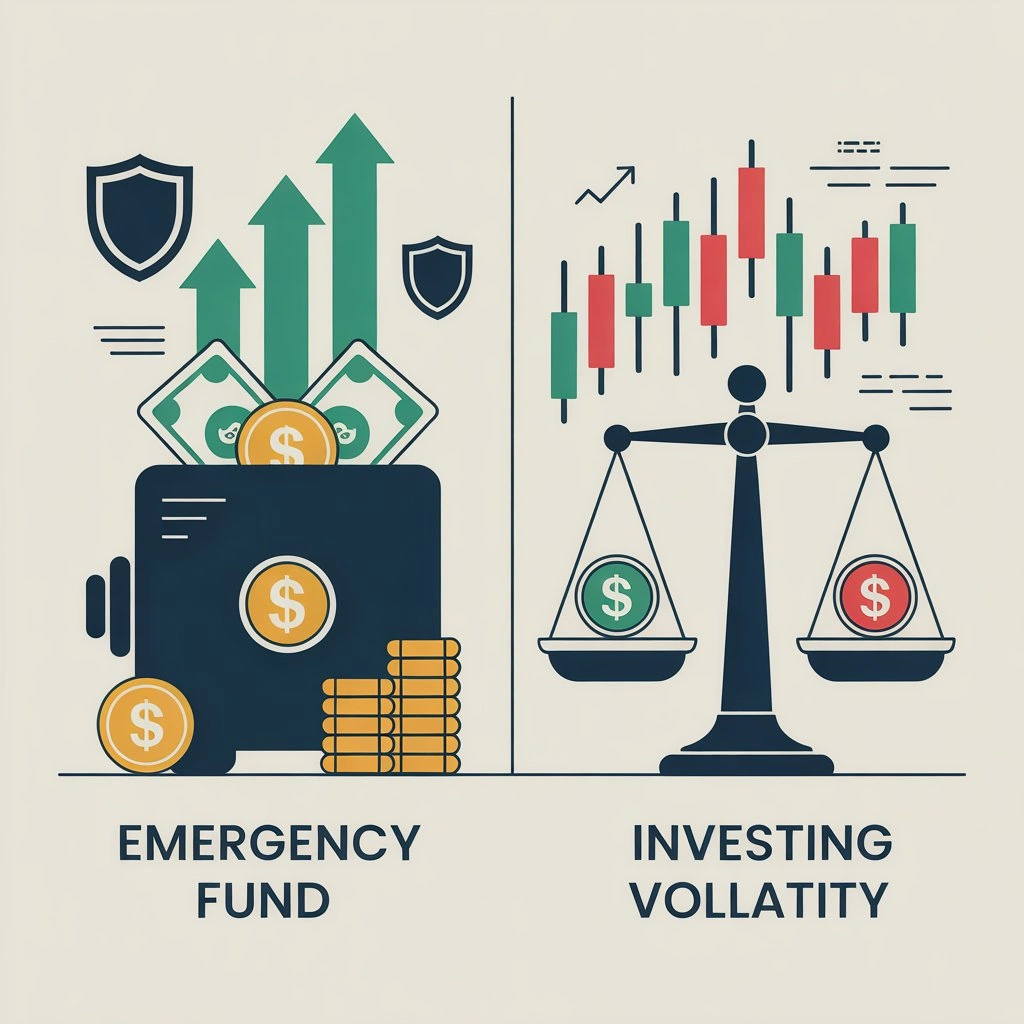
Emergency Fund vs Investing: The Core Trade-Off
Why an Emergency Fund Comes First for Most People
In a risky economy, liquidity and stability matter more than theoretical returns.
Key reasons to prioritize an emergency fund first:
- Prevents selling investments at a loss during market downturns
- Reduces reliance on high-interest debt (credit cards, personal loans)
- Provides psychological comfort, improving long-term investing discipline
As behavioral finance research often highlights, investors without cash buffers are more likely to panic-sell during downturns—locking in losses instead of riding out volatility.
When Investing First Can Make Sense
There are specific scenarios where investing before fully funding an emergency fund may be reasonable:
- You have stable income (e.g., government job or long-term contract)
- You already have partial savings (1–2 months of expenses)
- Your employer offers investment matching, such as a 401(k) match—often described as “free money”
- You have low fixed expenses and minimal debt
As one common investing quote goes, “Time in the market beats timing the market.” Delaying investing too long can carry its own opportunity cost.
A Balanced Strategy for a Risky Economy
The Hybrid Approach: Save and Invest Simultaneously
Rather than treating this as an all-or-nothing decision, many financial planners recommend a phased approach:
Step 1: Build a Starter Emergency Fund
- Save $1,000–$2,000 (or one month of expenses)
- Focus on speed and accessibility
Step 2: Begin Investing Modestly
- Start with diversified, low-cost index funds
- Automate monthly contributions to remove emotion
Step 3: Expand Your Emergency Fund
- Gradually reach 3–6 months of expenses
- Adjust upward if your income is unstable or the economy worsens
This approach balances risk management with long-term growth, a principle consistently emphasized in mainstream personal finance literature.
How Economic Conditions Change the Decision
High Inflation Environments
- Cash loses purchasing power
- Investing offers inflation-beating potential
- Still, emergency funds remain necessary despite lower real returns
Market Volatility and Recessions
- Emergency funds become more valuable
- Job losses increase during downturns
- Forced selling during bear markets is especially damaging
As noted in financial crisis analyses by central banks and market historians, households with sufficient emergency savings recover faster and avoid long-term financial scarring.
Visual Framework: Emergency Fund vs Investing Priority
Imagine a simple pyramid:
- Base: Emergency fund (financial stability)
- Middle: Debt management and insurance
- Top: Investing and passive income
Without a solid base, the entire structure becomes unstable.
Common Mistakes to Avoid
- Investing aggressively with no cash buffer
- Treating credit cards as an “emergency fund”
- Keeping emergency savings in volatile assets
- Waiting for a “perfect” time to start investing
As the saying goes, “The best financial plan is one you can stick to.”
Conclusion: What Comes First?
So, emergency fund or investing first?
For most people—especially in a risky economy—the answer is clear:
- Start with an emergency fund
- Then invest consistently and patiently
However, personal finance is personal. A hybrid strategy often delivers the best real-world results, combining safety with growth.
Practical Actions You Can Take Today
- Calculate one month of essential expenses
- Open a separate savings account for emergencies
- Start investing small, but start now
- Review and adjust as your income and the economy change
Financial security isn’t built overnight—but it is built deliberately.