Have you ever looked at the price of an everyday item and been shocked by how much it has increased over time? It is a common experience, felt by consumers across the globe, and it signals a fundamental economic reality: prices keep going up. For instance, a basic burger that might have cost around $2.00 back in the year 2000 could now command a price of nearly $6.00 in 2024. Similarly, a movie ticket, once costing about $5.00 in 2000, may now require you to pay more than $10.00 for admission to the same theater. This pervasive upward trend in costs is not a coincidence or a coordinated effort by sellers; rather, it is the result of one overarching economic force: Inflation.
While many people have heard the term, truly understanding what inflation means, why it occurs, and how it impacts your personal finances is essential. This comprehensive guide, written for both beginners and advanced readers, breaks down the mechanisms of inflation, explains how it is measured, analyzes its paradoxical role in economic health, and provides actionable strategies for safeguarding your wealth against the silent erosion of purchasing power.
Table of Contents
Section 1: What Exactly Is Inflation?
At its simplest, inflation is when the prices of goods and services rise over time. Crucially, this rise in prices has a reciprocal effect: it simultaneously causes the value of money to decrease.
To illustrate this concept, consider the price of a cup of coffee. In the 1970s, the average price for a cup of coffee was only about $0.25. If you were to try to buy that same cup of coffee today in 2024 with those same $0.25, you would likely only receive an empty cup. The cost of coffee has gone up, meaning the value of your $0.25 has fallen, making everything seem more expensive. When inflation is active, your money loses its ability to purchase as much as it once could.
The Four Primary Drivers of Inflation
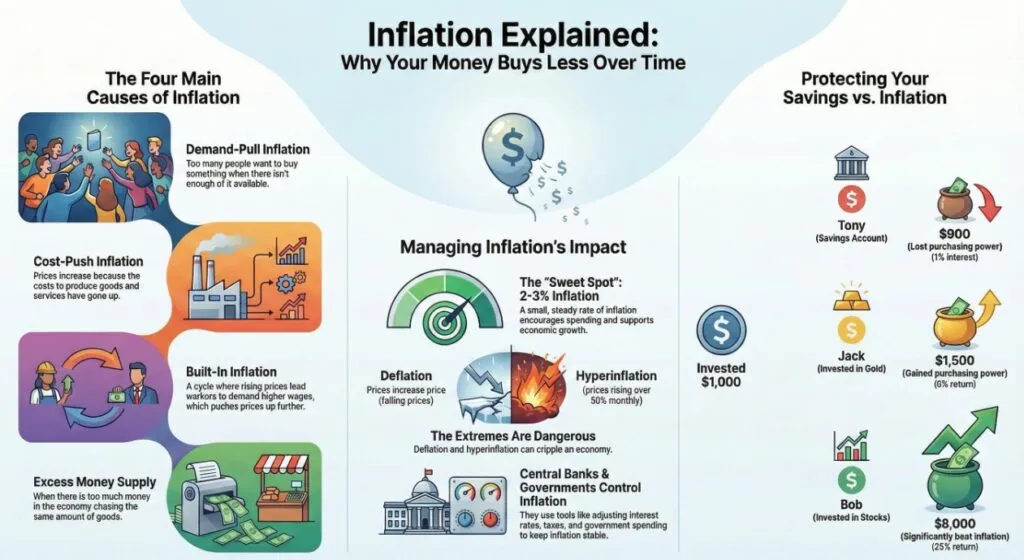
Inflation is rarely caused by a single factor, but rather by a combination of underlying economic pressures. We can categorize these pressures into four main types:
1. Demand-Pull Inflation
Demand-pull inflation occurs when aggregate demand exceeds aggregate supply. Essentially, a large number of people want to buy something, but there is not enough of that item available.
Imagine a scenario involving corn. Normally, consumers demand 10 tons of corn, and farmers produce exactly 10 tons—a perfect balance. However, if a natural disaster, such as a tornado, destroys most of the corn crops, leaving only 3 tons available while demand remains steady, people begin competing intensely to secure the limited supply. As consumers compete, they are willing to pay higher prices. If a can of corn previously cost $2.00, it might now cost $3.00 because of the shortage. In this mechanism, consumers are effectively “pulling” the price up by their willingness to pay more for scarce resources.
2. Cost-Push Inflation
Cost-push inflation happens when the cost of manufacturing or providing goods increases, forcing producers to raise their selling prices to maintain profit margins.
Consider a popcorn seller who typically sells popcorn for $3.00. This $3.00 price might break down as $1.00 for the cost of corn, $1.00 for other operational costs, and $1.00 for profit. If the same tornado that caused corn scarcity (as in the previous example) forces the popcorn seller to now pay $2.00 for corn, while other production costs remain stable, the seller’s costs have increased. If the seller kept the price at $3.00, they would make zero profit. To secure their essential $1.00 profit, the seller is compelled to raise the retail price of the popcorn, perhaps to $4.00. This is cost-push inflation, where higher production costs push the final consumer prices upward.
3. Built-In Inflation (The Wage-Price Spiral)
Built-in inflation is driven by expectations and the increasing cost of living, creating a self-perpetuating cycle. As the prices of goods and services rise, the cost of living increases. To cope with these higher expenses, workers subsequently request higher wages,.
For instance, workers at a shoe company might have an average cost of living of $900 per month while earning $1,000 per month, leaving them a small surplus. If rising prices cause their cost of living to jump to $1,000 per month, their ability to save vanishes. They ask their boss for a pay raise, perhaps to $1,200. While this helps the workers, it means the shoe company now faces higher labor costs, increasing their overall cost of production. To offset this and maintain their profit level, the company raises the price of its shoes. This is a vicious cycle: higher product costs lead to higher wages, which then lead to even higher product prices as companies protect their profits, ensuring the cycle continues indefinitely.
4. Too Much Money in the Economy (Monetary Inflation)
When the total supply of money circulating within an economy increases too quickly, the value of that currency naturally decreases, leading to inflation,.
Imagine a loaf of bread costs $5.00, and there are five people, each possessing $5.00, with five loaves available. Everyone buys one loaf. If the government were to suddenly inject money into the system, giving every person an additional $5.00 (so everyone now has $10.00), people naturally desire to buy more. They might now want two loaves each, but supply remains fixed at five loaves. Recognizing this heightened demand and increased spending power, the bakery raises the price of the single loaf to $10.00. In the end, each person still buys just one loaf, but it costs twice as much. This price increase is not because the bread is inherently worth more, but because the abundance of money has caused its value to decline.
This type of monetary inflation often exhibits characteristics of both demand-pull (people compete with more money) and cost-push inflation. Once the bakery starts making more money, they also face competition from other bakeries for raw materials like wheat, driving up the cost of wheat and forcing the bakery to raise bread prices again to keep pace. Historically, extreme instances of money printing have led to catastrophic hyperinflation in nations such as Zimbabwe, Venezuela, and Weimar Germany,.
Section 2: Measuring Inflation: The Consumer Price Index (CPI)
To gauge the health and direction of the economy, governments and institutions need a reliable method to quantify inflation,. While an inflation rate that is too high can seriously damage an economy, determining that rate requires measurement.
The most common method used globally is the Consumer Price Index (CPI).
How the CPI Works
The CPI is a tool used to track how the prices of a fixed “basket” of everyday goods and services change over time. The concept is simple, although the real-world calculation is complex, encompassing many more items than a basic example.
For a simplified understanding, imagine a basket consisting of bread ($3.00), milk ($4.00), eggs ($5.00), a candle ($8.00), and a movie ticket ($10.00) in 2024. The total cost of this basket is $30.00.
One year later, in 2025, the prices change: bread rises to $3.30, milk to $4.20, eggs to $5.30, the candle to $8.10, and the movie ticket remains $10.00,. The new total cost of the basket is $30.90. By comparing the two years ($30.90 vs. $30.00), we find that prices have increased by 3%. Therefore, the calculated CPI for that year is 3%, meaning that, on average, prices have risen by this amount.
The Limitations of Averages
While the CPI provides a rough overall average of price increases, it is crucial to recognize that a low CPI does not always mean prices are rising slowly for everyone. The index is merely an average, and it might not specifically reflect the true cost pressures faced by consumers.
In the example above, the prices for essential daily items like bread, milk, and eggs rose significantly (10%, 5%, and 6%, respectively). Meanwhile, less essential items, such as the candle, only increased by 1.25%, and the movie ticket did not increase at all. Even if the official CPI shows a small overall increase (like 3%), consumers may still feel that life is getting much more expensive because the items they absolutely need—food and utilities—are the ones experiencing the steepest price hikes. The CPI is an overall rough average, not a specific reflection of essential living costs.
Section 3: The Paradox of Inflation: Why We Need a Little Bit
Given that inflation makes goods more expensive and reduces money’s purchasing power, it might seem logical to aim for 0% inflation, or even “minus inflation” (deflation), to make everything cheaper. However, in the long run, this approach is severely detrimental to economic health.
1. Small Inflation is Necessary for Growth
Central banks globally usually target an annual inflation rate of around 2% to 3%. This is considered the “magic number” because small, predictable inflation is good for sustained economic growth.
Why? Small inflation encourages economic activity. If people know that prices will gradually increase, they are more likely to spend money or invest now rather than hoard their savings. If spending is deferred because people expect prices to drop, businesses struggle. When consumers spend, businesses grow, job opportunities are created, and the economy remains robust.
2. Deflation (Minus Inflation) Is Dangerous
When the inflation rate drops below 0%, resulting in falling prices, this condition is known as deflation.
While cheaper goods sound appealing, deflation has disastrous consequences. When prices fall consistently, consumers postpone purchases, hoping the price will drop even further later. Simultaneously, companies find that their revenues are declining, forcing them to cut costs, often by lowering wages or reducing the workforce, to maintain profits. This leads to a scenario where, paradoxically, everything is cheaper, but few people have enough money to buy anything.
A historical example of the danger of deflation is the Great Depression in the U.S. during the 1930s. Massive deflation was a key cause behind this period, which represents one of the worst economic disasters in history.
3. Hyperinflation Is a Nightmare
If a small amount of inflation is healthy, and deflation is destructive, then too much inflation is an economic catastrophe,. When inflation spirals out of control, it is termed hyperinflation.
Hyperinflation is defined as average prices increasing by more than 50% every single month. Prices don’t just increase slowly; they skyrocket rapidly. For example, if a loaf of bread costs $3.00 in January 2025, it might cost $4.50 by February. If hyperinflation continues unabated, by January 2026, that same loaf could cost $389. The most famous recent case of hyperinflation occurred in Venezuela due to excessive money printing, which caused the currency to lose value so rapidly that prices increased hourly,. The currency became so worthless that citizens reportedly abandoned their money on the streets because it could no longer purchase anything.
Section 4: The Control Mechanisms: Monetary and Fiscal Policy
Since both hyperinflation and deflation are damaging, stabilizing inflation requires careful intervention. This responsibility is shared between the central bank (Monetary Policy) and the government (Fiscal Policy),.
The Central Bank: Monetary Policy
Monetary policy refers to the decisions made by central banks, such as the Federal Reserve, to manage the money supply and adjust interest rates.
1. Adjusting Interest Rates
Interest rates are fundamentally the cost of borrowing money, expressed as a percentage. If you borrow $1,000 at a 10% interest rate, you must repay $1,000 plus $100 in interest.
- To stimulate inflation (when it is too low): The central bank sets interest rates low, making it cheaper to borrow. This encourages more people to take out loans and spend. Increased spending injects money into the economy, boosting demand and pushing inflation upward, similar to demand-pull inflation.
- To curb inflation (when it is too high): The central bank raises interest rates. Higher rates mean borrowing becomes more expensive due to higher interest payments. This causes fewer people to borrow, reduces the amount of money circulating, and lowers consumer spending, which helps bring the inflation rate down.
Central banks must execute this carefully, as keeping rates too high for too long can severely slow economic activity by making borrowing and investing prohibitively difficult.
2. Controlling the Money Supply (Open Market Operations)
Controlling the money supply is critical because too much money causes high inflation, while too little money causes deflation. Central banks manage the money supply primarily through a technique called open market operation (OMO).
- Expansionary OMO (To increase money supply/raise inflation): When there is too little money, the central bank buys government bonds and treasuries from commercial banks (like Bank of America or HSBC),. The central bank buys these assets at a higher price to deliberately inject money into the economy. As commercial banks receive this influx of funds, they become eager to lend money, often resulting in them lowering their own interest rates to compete for borrowers. This creates more money in the economy, raising the inflation rate.
- Contractionary OMO (To decrease money supply/lower inflation): If inflation is too high (meaning too much money is circulating), the central bank performs the opposite action: contractionary OMO. They resell government bonds back to commercial banks. When banks purchase these bonds, money is transferred from the commercial banks back to the central bank. With less money available, banks lend less and consequently raise their interest rates. This causes fewer people to borrow, reduces the overall money supply, and brings the inflation rate down,.
In essence, OMO uses the buying and selling of treasuries as a precise method for the central bank to inject or retract money from the economic system.
The Government: Fiscal Policy
Fiscal policy refers to decisions made by the government regarding the adjustment of taxes and spending.
1. Adjusting Taxes
Taxes directly affect the amount of disposable income consumers have.
- To curb inflation: If consumers have too much money and are generating demand-pull inflation, the government might raise taxes. This reduces the money available for spending, thereby lowering consumer demand and decreasing inflation.
- To stimulate inflation: If inflation is too low, the government might reduce taxes so people retain more money, encouraging them to spend and buy more things. However, governments tend to raise taxes more frequently and rarely decrease them.
2. Adjusting Government Spending
Government spending on large-scale projects can significantly influence the money supply,.
Imagine you own a store selling construction materials. If the government decides to build a new bridge, they buy huge quantities of materials from your store. They also hire engineers, designers, and workers for the project. As the store owner, engineers, and workers all receive more money from this massive project, they collectively increase their spending, which ultimately leads to higher inflation.
Conversely, if the government decides to lower their spending and halt such projects, you lose the government orders, and the engineers and workers stop getting paid. This reduction in income causes all these parties to lower their personal spending. Since government projects often involve thousands of store owners, engineers, and hundreds of thousands of workers, and are worth millions or even billions of dollars, adjusting government spending has a massive impact on the national money supply.
Section 5: Protecting Your Wealth from Inflation
Understanding inflation is only the first step; the second is knowing how to protect your personal wealth from its debilitating effects.
If you follow the traditional advice to “save your money in a piggy bank,” you are actually losing ground to inflation. If you saved $1,000 in 2014, by 2024, that same $1,000 will not buy the same quantity of goods it could 10 years earlier, precisely because of inflation,. The value of your money is eroded while it sits idle.
The simple answer to protecting your money’s value is investing.
Investment Strategies Against Inflation
Investors seek assets that either retain or increase their value faster than the rate of inflation.
- Gold: Many people suggest buying gold as a hedge against inflation. Because gold is a commodity with a limited supply and high, consistent demand, it tends to become more valuable when inflation rates rise. People historically trust gold to maintain stable wealth during periods of economic uncertainty.
- Higher-Yield Investments: Other people may prefer assets that potentially offer higher returns than gold, such as stocks, real estate, or cryptocurrencies. These investments aim for a higher return on investment (ROI) that significantly outpaces the rate of inflation.
The Importance of Real Returns
When assessing an investment, it is critical to look beyond the nominal return and understand the actual return after accounting for inflation.
Consider three people in 2014, each starting with $1,000:
- Bob invested $1,000 in Apple stocks.
- Jack invested $1,000 in gold.
- Tony saved $1,000 in a regular savings account.
Ten years later, in 2024, their nominal returns are,:
- Bob (Stocks): Made $9,000 (25% average annual return).
- Jack (Gold): Made $1,800 (6% average annual return).
- Tony (Savings Account): Made $1,104 (1% average annual deposit interest).
Now, if the average annual inflation rate over those ten years was 2%, we must subtract inflation from their returns to find the real value of their investment:
- Bob (Stocks): Real return is 23% (25% minus 2%), meaning a profit of $7,000.
- Jack (Gold): Real return is 4% (6% minus 2%), meaning a profit of around $500.
- Tony (Savings Account): Real return is -1% (1% minus 2%). Tony’s saving account interest rate failed to beat the 2% inflation.
Even though Tony technically has $1,104 in his account, because $1,000 in 2014 is equivalent to approximately $1,200 in 2024 purchasing power, Tony’s money can only buy what $900 could have purchased a decade ago. His money lost 1% of its value every year.
This analysis highlights that merely saving money in a low-interest account is a guarantee of losing purchasing power to inflation. To truly stay ahead, one must invest their capital in tools that offer returns significantly higher than the average inflation rate.
Conclusion: Mastering the Economic Tide
Inflation is not an accident; it is an integral and natural part of the economy, driven by diverse factors ranging from unexpected events like natural disasters, to the deliberate policy decisions of central banks and governments, and even market behavior.
Since we cannot eliminate inflation, our strategy must shift from avoidance to awareness and action. By understanding the forces that cause prices to rise and how those forces are measured and controlled, you gain crucial insight into the economic landscape.
The critical takeaway for personal finance is this: understanding how inflation works and how to protect yourself from it through smart investments is essential to staying ahead. Always ensure you learn and understand any investment tool before committing your capital. By actively seeking returns that surpass the inflation rate, you ensure your wealth retains its purchasing power, navigating the constant economic tide successfully.
Understanding inflation is like learning to sail; you can’t stop the wind, but you can adjust your sails to move forward. If you leave your money idle, the wind (inflation) pushes you backward, but if you invest wisely, you harness that force to grow your wealth.


One thought on “The Silent Tax: Understanding Inflation and How to Navigate the Rising Cost of Living”