Introduction: Why Interest Rates Matter to Everyone
Interest rates are one of the most powerful forces in the global economy, yet they are often misunderstood. Whether you are saving money, investing in stocks, buying a home, or running a business, interest rates directly influence your financial outcomes.
In simple terms, interest rates are the price of money. When central banks raise or lower them, they affect borrowing costs, consumer spending, investment decisions, inflation, and even currency values. As former Federal Reserve Chair Ben Bernanke once said, “Monetary policy works not just through interest rates, but through expectations.”
In this article, interest rates explained in a clear and practical way, you will learn:
- What interest rates really are and how they work
- Why central banks control interest rates
- How rate changes affect investing, personal finance, and passive income
- What rising or falling rates mean for financial markets
Table of Contents
What Are Interest Rates? (Interest Rates Explained Simply)
Definition of Interest Rates
An interest rate is the percentage charged for borrowing money or earned for lending it. It applies to:
- Loans (mortgages, personal loans, business credit)
- Savings accounts and bonds
- Credit cards and lines of credit
Example:
If you borrow $10,000 at a 5% annual interest rate, you pay $500 per year in interest.
Real vs. Nominal Interest Rates
Understanding this distinction is critical for investors.
- Nominal interest rate: The stated rate you see
- Real interest rate: Nominal rate minus inflation
Formula:
Real Interest Rate = Nominal Rate − Inflation
If inflation is 4% and your savings account pays 2%, your real return is –2%, meaning your purchasing power is shrinking.
Why Central Banks Control Interest Rates
Central banks exist to maintain economic stability. Their primary tool is interest rate policy.
Key Objectives of Central Banks
Central banks such as the Federal Reserve, European Central Bank, and Bank of England typically focus on:
- Price stability (controlling inflation)
- Full or high employment
- Sustainable economic growth
- Financial system stability
As economist John Maynard Keynes noted, “The difficulty lies not so much in developing new ideas as in escaping from old ones.” Central banks continuously adapt policy to changing conditions.
How Central Banks Set Interest Rates
Central banks do not directly control every interest rate in the economy. Instead, they influence:
- The policy rate (benchmark rate)
- Interbank lending costs
- Market expectations
From this benchmark, other rates adjust:
- Mortgage rates
- Bond yields
- Corporate borrowing costs
Interest Rates and Inflation: A Delicate Balance
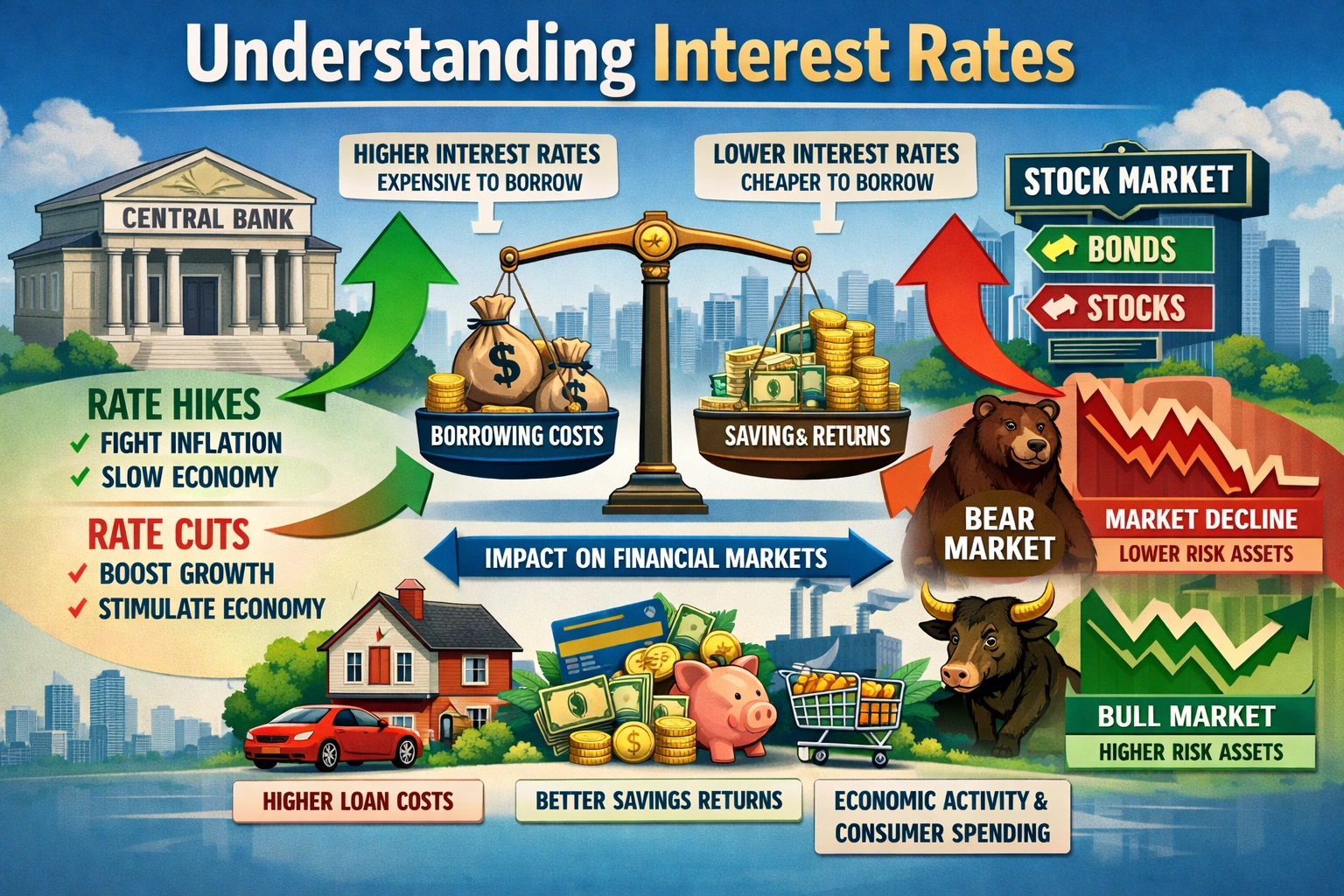
Why Raising Rates Fights Inflation
When inflation rises too quickly:
- Borrowing becomes cheaper
- Spending increases
- Prices rise further
By raising interest rates, central banks:
- Make loans more expensive
- Encourage saving instead of spending
- Reduce demand pressure
This slows inflation over time.
Why Lowering Rates Stimulates Growth
During recessions or economic slowdowns:
- Consumers stop spending
- Businesses delay investment
Lower rates:
- Encourage borrowing
- Support investment and hiring
- Boost asset prices
As one central banker famously said, “Low rates are medicine, but too much medicine creates new problems.”
How Interest Rates Affect Financial Markets
Interest Rates and Stock Markets
The relationship between stocks and interest rates is complex but predictable.
- Rising rates:
- Higher borrowing costs
- Lower corporate profits
- Pressure on stock valuations
- Falling rates:
- Cheaper capital
- Higher growth expectations
- Support for equities
Growth stocks are usually more sensitive to rising rates than value stocks.
Interest Rates and Bond Markets
Bond prices move inversely to interest rates.
| Interest Rate Movement | Bond Prices | Yields |
|---|---|---|
| Rates rise | Fall | Rise |
| Rates fall | Rise | Fall |
This is why long-term bonds carry higher interest rate risk.
Interest Rates and Currencies
Higher interest rates often attract foreign capital seeking better returns, strengthening the currency. Lower rates may weaken it.
Impact on Personal Finance and Passive Income
Borrowers vs. Savers
Interest rate changes create winners and losers.
Borrowers benefit when rates are low:
- Cheaper mortgages
- Lower loan payments
- Easier business expansion
Savers benefit when rates are high:
- Higher savings account yields
- Better returns on bonds and fixed-income investments
Passive Income Strategies in Different Rate Environments
Understanding interest rates helps optimize passive income.
- Low-rate environment:
- Dividend stocks
- Real estate
- Growth investments
- High-rate environment:
- Bonds and Treasury bills
- High-yield savings accounts
- Money market funds
As Warren Buffett famously said, “Interest rates are to asset prices what gravity is to matter.”
Common Misconceptions About Interest Rates
“Higher Interest Rates Are Always Bad”
Not true. Higher rates:
- Control inflation
- Protect purchasing power
- Reward disciplined savers
“Central Banks Can Control Inflation Instantly”
Interest rate changes work with a delay, often taking 6–18 months to fully impact the economy.
Conclusion: Key Takeaways and Practical Actions
Understanding interest rates is essential for smart financial decision-making.
Key Takeaways
- Interest rates are the cost of money and influence all areas of finance
- Central banks control rates to manage inflation and economic growth
- Rate changes affect stocks, bonds, currencies, and passive income
- Savers and borrowers are impacted differently depending on the rate cycle
Practical Actions You Can Take
- Adjust your investment strategy based on interest rate trends
- Protect your savings from inflation by focusing on real returns
- Match passive income strategies to the current rate environment
In short, interest rates explained clearly show why central banks hold such influence over global financial markets—and why every investor should pay attention.