In the world of finance and investing, few acronyms carry as much weight as GDP. Whether you are tracking the health of a domestic market or looking for international investment opportunities, understanding Gross Domestic Product (GDP) is essential for making informed decisions. It is the primary tool used by governments and central banks to determine if an economy is thriving or sliding toward a recession.
In this article, you will learn exactly what GDP represents, how it is calculated through various methods, the crucial difference between Nominal and Real GDP, and how to use metrics like PPP and Per Capita to compare global economies fairly.
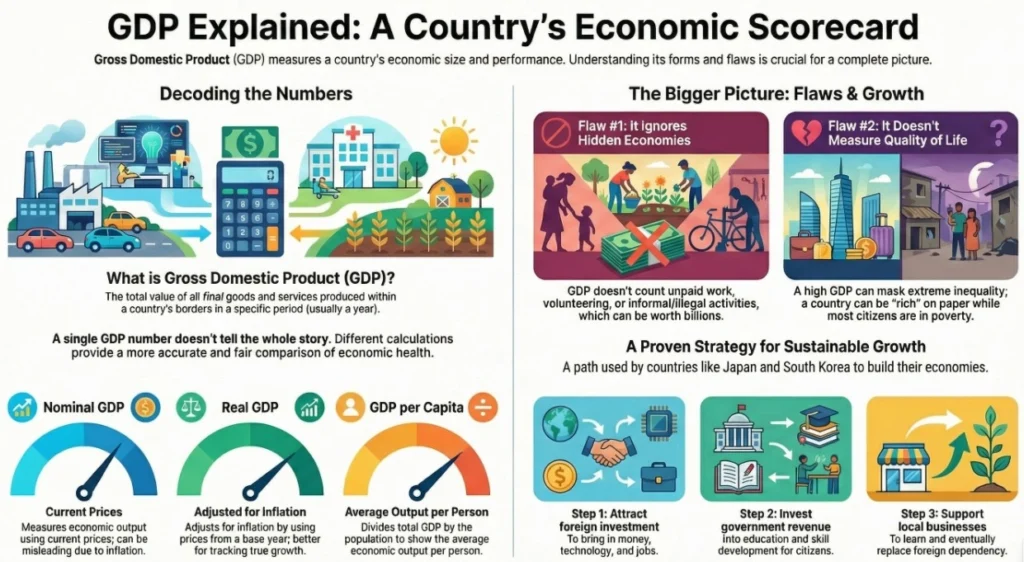
Table of Contents
What is GDP? Defining the Bakery of a Nation
At its core, Gross Domestic Product (GDP) represents the total value of all final goods and services produced within a country’s borders during a specific time period, typically a year or a quarter.
To understand this concept simply, the sources suggest imagining a country as a large bakery. The GDP would be the total revenue from all the bread, cakes, and cookies sold. However, there are specific rules to this calculation:
- Final Products Only: To avoid “double counting,” GDP only tracks the finished product. For instance, the flour used to make a cake is not counted separately because its value is already included in the price of the cake.
- Domestic Borders: It does not matter if a business is owned by a local or a foreigner; if the production happens within the country, it counts toward that country’s GDP. For example, an American opening a bakery in the U.K. contributes to the U.K.’s GDP, not the U.S. GDP.
- Raw Materials: If a country only produces raw materials (like flour) and cannot manufacture finished goods (like bread), those raw materials are then considered the “final product” for that specific economy.
How GDP is Measured: The Three Pillars of Calculation
According to the sources, there are three distinct methods to calculate GDP, all of which should ideally yield the same result.
1. The Production Method
This calculates the total value of every final product and service created within the country.
2. The Spending Method
This is perhaps the most common way to view economic activity. It follows a specific formula: GDP = Consumer Spending + Investment + Government Spending + Net Exports.
- Consumer Spending: Everyday purchases by individuals, such as groceries.
- Investment: Businesses spending on themselves, such as a factory purchasing new machinery.
- Government Spending: Expenditures on public projects, like building bridges or paying salaries to workers.
- Net Exports: Calculated as exports (selling to other countries) minus imports (buying from others).
3. The Income Method
This method tallies the total income earned from production, including salaries, business profits, rents, and taxes, while subtracting government subsidies.
Nominal vs. Real GDP: Why Inflation Matters
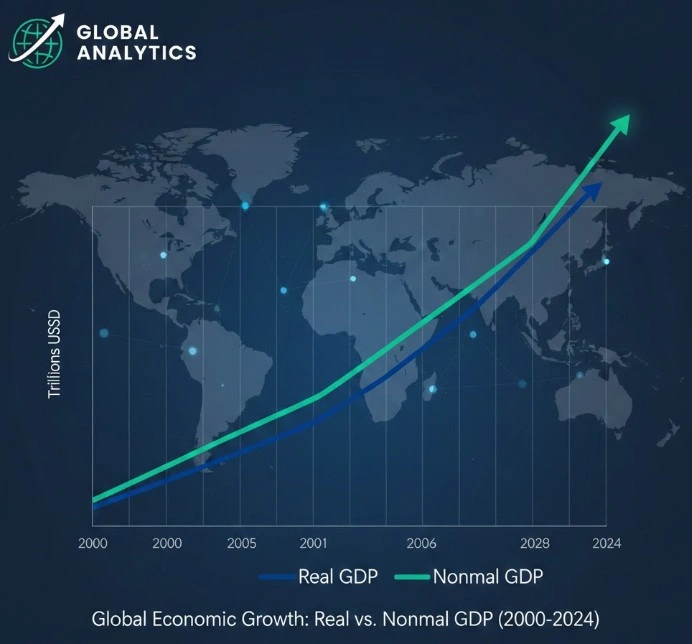
For investors, the distinction between Nominal and Real GDP is critical for identifying genuine economic growth.
- Nominal GDP: This uses current prices without adjusting for inflation. If a bakery produces 10 loaves of bread in 2024 at $3 each, the GDP is $30. If in 2025 they produce the same 10 loaves but the price rises to $4 due to inflation, the Nominal GDP jumps to $40, even though the actual output hasn’t grown.
- Real GDP: To get a more accurate picture, Real GDP uses prices from a specific “base year”. By ignoring price hikes and focusing on the volume of production, Real GDP reveals whether an economy is truly expanding or just experiencing rising prices.
| Feature | Nominal GDP | Real GDP |
|---|---|---|
| Price Basis | Current market prices | Fixed base-year prices |
| Inflation Adjustment | No | Yes |
| Accuracy | Can be misleading due to inflation | More accurate for tracking growth |
Comparing Global Economies: PPP and Per Capita
Total GDP doesn’t always tell the whole story. For instance, Germany has a larger economy than many countries with more land and higher populations. To make fair comparisons, analysts use two specialized metrics:
Purchasing Power Parity (PPP)
PPP adjusts for the fact that prices and exchange rates vary between countries. For example, if $1 buys one loaf of bread in India but $3 is required for the same loaf in the U.S., the PPP ratio (3:1) helps equalize these differences to show the actual “purchasing power” of each economy.
GDP Per Capita
This metric divides a country’s total GDP by its population. It is a vital tool for understanding the average economic output per person.
- Example: In 2025, Singapore’s Nominal GDP per capita is approximately $93,000, while Indonesia’s is around $5,000. Even though Indonesia has a higher total GDP due to its massive population of 280 million, the per capita data shows that, on average, individuals in Singapore produce significantly more economic value.
The Limitations of GDP
While GDP is the most popular method for measuring economic performance, it has notable flaws:
- Informal Activities: GDP does not count unpaid volunteer work or illegal activities, which can be worth billions.
- The “Tax Haven” Distortion: In countries like Ireland, foreign companies may register profits locally for tax benefits. This inflates the GDP, but the money often leaves the country immediately, providing little benefit to the local citizens.
- Quality of Life: High GDP does not always mean a high standard of living. Equatorial Guinea has a high PPP GDP per capita due to oil, yet 70% of its population lives below the poverty line due to corruption and unequal distribution.
Actionable Insights: How Nations Drive Sustainable Growth
For those interested in emerging markets, the sources highlight a proven strategy for increasing GDP:
- Attract Foreign Investment: This brings in capital and technology, which creates jobs and boosts production.
- Invest in Human Capital: Use government revenue to fund education and skills training, leading to higher productivity and innovation.
- Transition to Local Ownership: Encourage local businesses to learn from foreign entities so they can eventually lead the market.
- Real-World Success: Japan, South Korea, China, and Singapore all utilized these strategies to transform from impoverished nations into global economic powers.
Key Takeaway for Readers
GDP is more than just a number; it is a snapshot of economic health. As an investor or a curious citizen, tracking Real GDP and GDP Per Capita allows you to see past inflation and population size to identify where real value is being created.
Sources & References
The insights in this article are based on the educational video “GDP Fully Explained: Per Capita, PPP, Nominal” by the YouTube channel Explains 101, which provides a foundational look at economic measurement and global financial comparisons.