Introduction: Why Understanding the Economy Matters
The economy often feels abstract—full of charts, acronyms, and headlines that seem disconnected from everyday life. Yet the economy influences nearly every financial decision you make: your salary, the price of groceries, mortgage rates, stock market returns, and the feasibility of building passive income.
This article explains how the economy works in clear, simple language—without dumbing it down. You’ll learn how money flows, why markets rise and fall, how governments and central banks shape outcomes, and how all of this connects to investing, personal finance, passive income, and financial markets. Whether you’re a beginner or an experienced investor, the goal is practical clarity.
As economist John Maynard Keynes famously said, “The difficulty lies not so much in developing new ideas as in escaping from old ones.” Let’s reset the basics.
Table of Contents
The Economy at Its Core: A Simple Framework
What Is an Economy, Really?
At its most basic level, an economy is a system for:
- Producing goods and services
- Distributing income
- Exchanging value through money
Every economy—local or global—runs on three fundamental actors:
- Households (workers and consumers)
- Businesses (producers and employers)
- Government (regulator, spender, and tax collector)
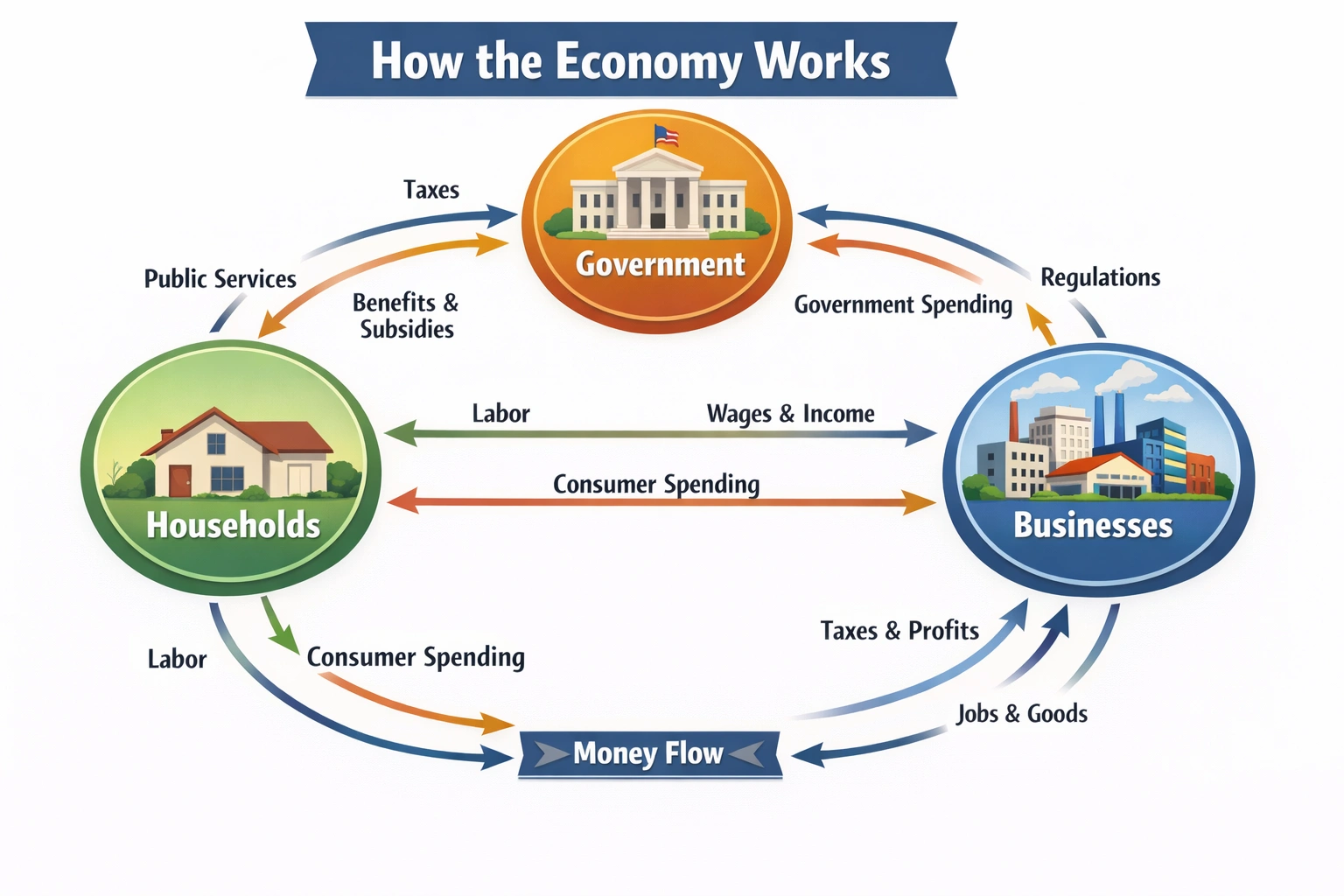
Money flows between these groups in a continuous loop known as the circular flow of income.
The Circular Flow Explained (Without Jargon)
Imagine this simplified flow:
- Households provide labor → Businesses pay wages
- Households spend money on goods and services
- Businesses earn revenue, pay costs, and invest
- Governments collect taxes and spend on public services
A simple table illustrates this:
| Actor | Gives | Receives |
|---|---|---|
| Households | Labor, consumption | Wages, dividends, services |
| Businesses | Goods, jobs | Revenue, investment returns |
| Government | Infrastructure, stability | Taxes |
When this flow is healthy, economic growth follows.
Economic Growth: Why GDP Isn’t the Whole Story
What GDP Measures—and What It Misses
Gross Domestic Product (GDP) measures the total value of goods and services produced in an economy. It’s often used as a shorthand for economic health.
GDP includes:
- Consumer spending
- Business investment
- Government spending
- Net exports
However, GDP does not measure:
- Income inequality
- Financial security
- Quality of life
As Robert Kennedy once noted, “GDP measures everything except that which makes life worthwhile.”
For investors and individuals, growth matters—but how that growth is distributed matters just as much.
Boom, Bust, and the Business Cycle
Economies move in cycles:
- Expansion – rising output, jobs, and profits
- Peak – growth slows, inflation pressures rise
- Recession – falling demand, layoffs, lower spending
- Recovery – confidence returns, investment resumes
Understanding this cycle helps explain why:
- Stock markets are volatile
- Passive income can fluctuate
- Job markets tighten or loosen
Money, Inflation, and Interest Rates
What Is Money—and Why Trust Matters
Money works because people trust it as:
- A medium of exchange
- A store of value
- A unit of account
Inflation erodes that trust by reducing purchasing power. For example, with 5% inflation, $100 today buys what $95 bought last year.
The Role of Central Banks
Central banks (like the Federal Reserve or the European Central Bank) manage:
- Interest rates
- Money supply
- Financial stability
When inflation rises, rates increase to slow spending. When growth stalls, rates fall to encourage borrowing and investment.
As former Fed Chair Ben Bernanke said, “Monetary policy works in part through managing expectations.”
For investors, this explains why:
- Bonds fall when rates rise
- Growth stocks are sensitive to interest rates
- Real assets often hedge inflation
Financial Markets: Where Expectations Meet Reality
Why Markets Move Before the Economy Does
Financial markets are forward-looking. Stock prices reflect expectations of future earnings, not today’s conditions.
This is why:
- Markets may rise during recessions
- Markets may fall during strong economic data
As Warren Buffett puts it, “The stock market is a voting machine in the short run and a weighing machine in the long run.”
How Different Assets React to the Economy
Here’s a simplified view:
| Asset Class | Performs Best When |
|---|---|
| Stocks | Economic expansion, moderate inflation |
| Bonds | Low inflation, slowing growth |
| Real Estate | Stable growth, reasonable interest rates |
| Commodities | High inflation, supply shocks |
Understanding how the economy works allows better asset allocation and risk management.
Personal Finance in the Economic System
Your Income Is an Economic Signal
Your salary reflects:
- Productivity
- Labor market demand
- Inflation expectations
In strong economies, wages rise. In weak ones, job security becomes the priority.
Why Saving and Investing Matter More Than Ever
When inflation outpaces savings interest, cash loses value. Investing becomes essential—not optional.
Key principles:
- Emergency fund for stability
- Long-term investing for growth
- Diversification to reduce economic risk
Passive income—through dividends, rental income, or interest—is essentially your personal share of economic output.
Passive Income: Your Role in Capitalism
How Passive Income Fits into the Economy
Passive income comes from owning assets that generate cash flow:
- Dividend-paying stocks
- Bonds and funds
- Real estate
- Businesses and royalties
You’re shifting from labor income to capital income.
As Thomas Piketty observed, “When the rate of return on capital exceeds economic growth, wealth inequality increases.” For individuals, owning productive assets is a way to participate in growth rather than just observe it.
Government Policy and Economic Outcomes
Taxes, Spending, and Incentives
Governments influence economic behavior through:
- Tax policy
- Public investment
- Regulation
Infrastructure spending boosts productivity. Poorly designed incentives distort markets. Investors watch fiscal policy closely because it shapes long-term returns.
Conclusion: Key Takeaways and Practical Actions
Understanding how the economy works doesn’t require jargon—just clear thinking.
Key takeaways:
- The economy is a flow of money, labor, and trust
- Growth comes in cycles, and markets anticipate change
- Inflation and interest rates shape all investments
- Personal finance decisions are economic decisions
- Passive income is participation in long-term growth
Practical actions:
- Track inflation and interest rate trends
- Diversify across assets sensitive to different economic phases
- Invest consistently, not emotionally
- Focus on long-term fundamentals, not headlines
As economist Paul Samuelson wisely said, “Investing should be more like watching paint dry or watching grass grow.”

I saw one of these in Nauru and I bought one.