Introduction
The world of digital assets has been a relentless cycle of boom and bust. For years, the narrative was dominated by speculative frenzy and the allure of “getting in early.” Yet, as the market matures, a fundamental truth emerges: hype is temporary, but utility is permanent. The enduring value of any digital asset is found in its tangible, real-world use-case. This shift from speculation to function is a profound psychological evolution in how we perceive digital ownership. The digital asset utility is the bedrock of the next decentralized web. This article explores the human biases fueling bubbles, defines genuine utility, and examines the psychological factors that make functional assets last. Moving past the emotional rollercoaster of hype toward the steady value of utility is the only sustainable path forward.
Table of Contents
The Anatomy of Hype: Why the Human Brain Craves Speculation

The initial surge in the value of many digital assets is rarely driven by a sober assessment of their use-case. Instead, it is a powerful cocktail of human psychology, behavioral economics, and network effects. To understand why utility is so important, we must first dissect the psychological forces that prioritize hype.
The Role of FOMO and Social Proof
The Fear of Missing Out (FOMO) is perhaps the single most potent psychological driver in a bull market. Digital assets operate on a 24/7 global market, where rapid, exponential gains are constantly broadcast across social media. This environment triggers a powerful social proof mechanism: if everyone else is getting rich, the individual feels an intense pressure to participate, regardless of the underlying fundamentals. This is a classic example of herding behavior, where the perceived wisdom of the crowd overrides individual rational analysis [1]. The emotional high of potential wealth becomes a more immediate reward than the intellectual work of assessing digital asset utility.
Cognitive Biases: The “Greater Fool Theory” in Action
Beyond social pressure, several cognitive biases contribute to the dominance of hype. The Greater Fool Theory posits that one can make money from an overvalued asset by selling it to an even “greater fool.” This mindset is inherently speculative and completely detached from utility. Furthermore, biases like anchoring (fixating on a past high price) and confirmation bias (only seeking information that supports a positive outlook) keep investors locked into a speculative cycle long after the asset’s fundamentals have deteriorated. The psychological comfort of being wrong with the crowd often outweighs the discomfort of being right alone.
| Psychological Driver | Hype-Driven Behavior | Utility-Driven Behavior |
|---|---|---|
| Motivation | Quick, exponential financial gain | Long-term, sustainable value accrual |
| Decision Basis | Social Proof, Price Action, News | Fundamental Analysis, Use-Case Assessment |
| Primary Emotion | Fear of Missing Out (FOMO) | Confidence, Strategic Patience |
| Risk Perception | Dismissed as “part of the game” | Managed through Due Diligence |
| Time Horizon | Short-term trading, “flipping” | Long-term holding, participation in ecosystem |
Defining Digital Asset Utility: Beyond the Buzzword
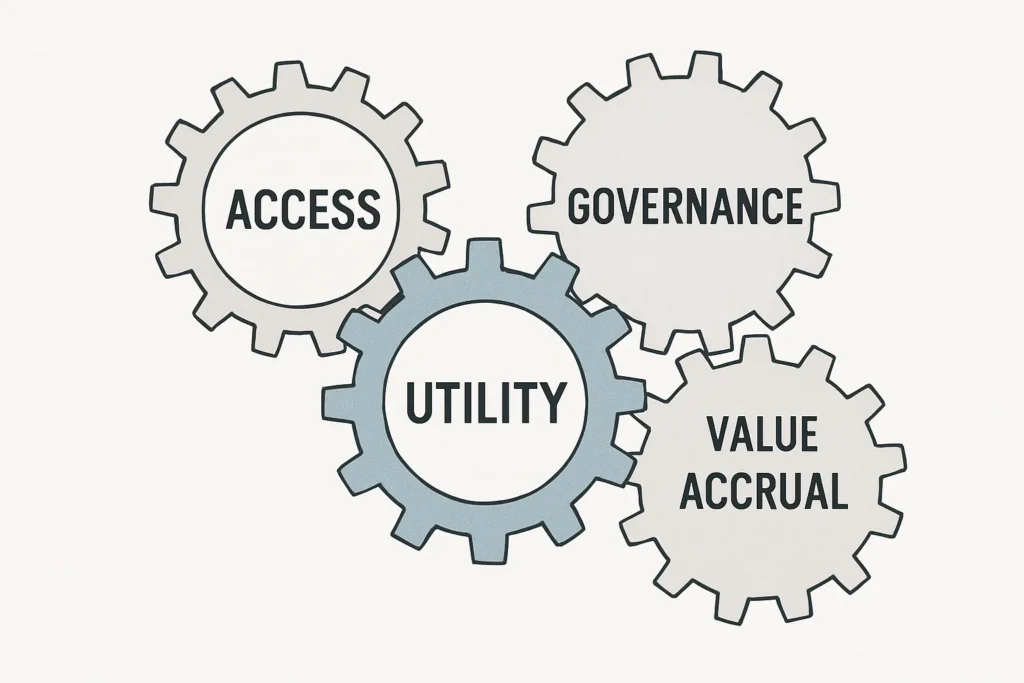
If hype is the emotional noise, utility is the signal. Digital asset utility is the capacity of a token or asset to perform a specific, valuable function within an ecosystem, a platform, or the real world. It is the answer to the question: “What can I do with this asset, other than sell it?” This definition moves beyond simple financial speculation and into the realm of practical application.
Functional Utility: Access, Governance, and Interoperability
The most straightforward form of utility is functional utility, which grants the holder specific rights or capabilities.
- Access Utility: The asset acts as a key to unlock a product or service. For example, a token might be required to pay for decentralized storage (like Filecoin) or to access premium features in a Web3 application.
- Governance Utility: The asset grants voting rights, allowing the holder to participate in the decision-making process of a decentralized autonomous organization (DAO). This gives the asset a direct, measurable influence on the future direction of the protocol.
- Interoperability Utility: The asset serves as a bridge or medium of exchange between different blockchain ecosystems, solving the critical problem of fragmentation in the decentralized space.
Economic Utility: Tokenomics and Value Accrual
Economic utility refers to the mechanisms by which the asset captures and accrues value from the economic activity it facilitates. A well-designed tokenomic model ensures that as the utility of the underlying platform increases, the value of the token naturally follows. This can be achieved through:
- Fee Burning: A portion of the fees generated by the platform’s use is permanently removed from circulation, creating deflationary pressure.
- Staking Rewards: Holders are incentivized to lock up their assets to secure the network or provide liquidity, earning a yield derived from the platform’s revenue.
- Real-World Asset (RWA) Tokenization: This is arguably the highest form of utility, where a digital asset represents fractional ownership of a tangible, income-generating asset, such as real estate, fine art, or corporate bonds [2]. The utility is the legal and financial right to a share of the asset’s cash flow.
The Psychology of Ownership in a Virtual World

The shift to utility is deeply intertwined with the human need for ownership and control. In the digital realm, where everything can be copied, the concept of true ownership was elusive until the advent of blockchain technology. This technology, by providing verifiable scarcity and traceability, has unlocked a powerful psychological phenomenon: psychological ownership of digital assets.
Psychological Ownership and the Sense of Control
Psychological ownership is the feeling that something is “mine,” even if one does not legally own it. In the context of digital assets, this feeling is significantly amplified by the blockchain’s inherent features [3].
- Traceability and Verifiability: Knowing the exact provenance of a digital asset, and that its history is immutable on a public ledger, provides a sense of certainty and control that was previously impossible with digital goods.
- Self-Investment: The act of acquiring, staking, or actively using a utility token—the “self-investment” in the ecosystem—strengthens the emotional bond with the asset. This is a key finding in consumer behavior research, where self-investment positively influences users’ psychological ownership and engagement [4].
- Control over Identity: For assets like profile picture NFTs (PFP NFTs) that are used for digital identity, the utility is the right to represent oneself in a specific community. The ownership of the asset is a form of self-expression and control over one’s digital persona.
Digital Identity and Status Signaling
The utility of many digital assets is social. They serve as powerful tools for status signaling and community belonging. Holding a specific governance token or a membership NFT signals alignment with a particular ideology or group. The utility here is the access to a social network, exclusive information, and the psychological benefit of being an “insider.” This social utility is often mistaken for hype, but it is a genuine, non-financial use-case that satisfies the fundamental human need for affiliation and status.
| Utility Type | Primary Psychological Benefit | Example |
|---|---|---|
| Functional (Access) | Control, Empowerment | Paying for decentralized storage with a token |
| Economic (RWA Tokenization) | Security, Predictability | Receiving dividends from a tokenized real estate asset |
| Social (Governance/NFT) | Affiliation, Status, Identity | Voting on a DAO proposal or using a PFP as an avatar |
| Psychological (Traceability) | Certainty, Connection | Verifying the immutable history of a digital collectible |
Case Studies: When Utility Outshines the Hype
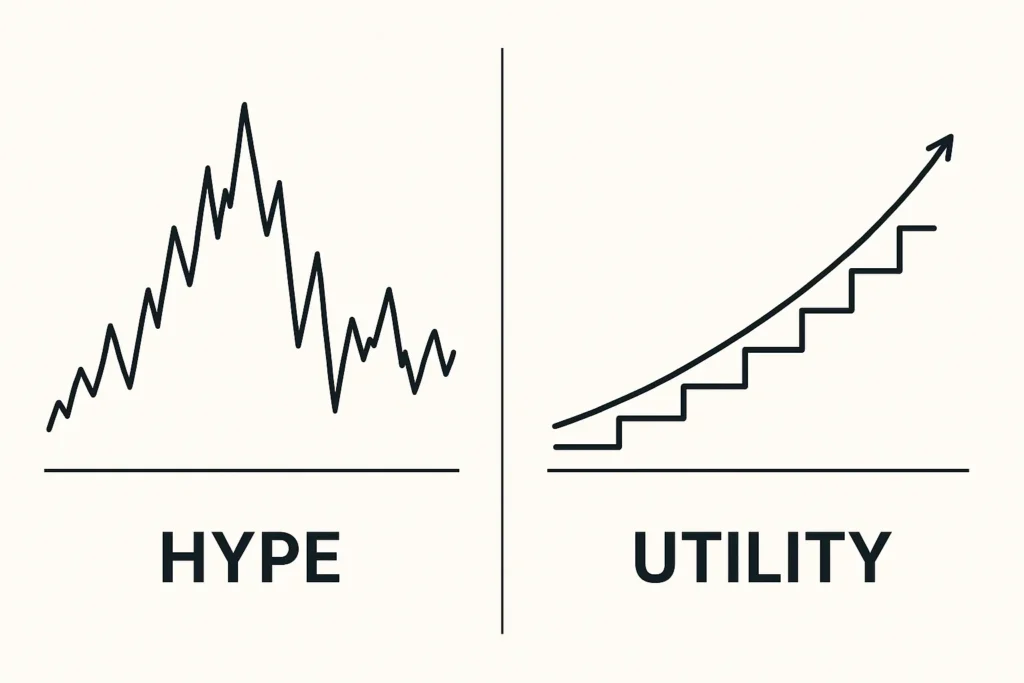
The history of digital assets is littered with projects that soared on hype and crashed due to a lack of utility. Conversely, the most enduring projects are those whose use-case was clear from the start, even if their initial price action was modest.
Decentralized Finance (DeFi) and Financial Inclusion
DeFi is the clearest example of utility-driven growth. The utility of a DeFi protocol is the ability to borrow, lend, and trade without intermediaries. The tokens associated with these protocols (e.g., governance tokens) derive their value directly from the fees generated by these functional services. The psychological appeal is the promise of financial autonomy and the removal of gatekeepers. This utility is tangible: it allows individuals in unbanked regions to access credit or allows anyone to earn a yield on their assets, a function that transcends speculative trading.
Real-World Asset (RWA) Tokenization: The Ultimate Utility
The tokenization of Real-World Assets (RWAs) represents the convergence of digital asset technology with traditional finance, and it is a movement driven entirely by utility. The utility is the ability to:
- Fractionalize Ownership: Making high-value assets (like a skyscraper or a corporate bond) accessible to smaller investors.
- Increase Liquidity: Converting illiquid assets into easily tradable digital tokens.
- Enhance Transparency: Using the blockchain to provide immutable proof of ownership and transaction history.
Industry reports anticipate that the tokenization of securities and corporate bonds will accelerate significantly, highlighting a structural shift toward institutional-grade utility [5]. The psychological comfort for investors here is the link to a tangible, income-generating asset, replacing the uncertainty of pure speculation with the predictability of cash flow.
The NFT Evolution: From JPEGs to Functional Passes
Early NFTs were the epitome of hype, with value driven purely by social signaling and speculation. However, the market is rapidly evolving toward utility-focused NFTs:
- Membership Passes: NFTs that grant access to exclusive events, communities, or software tools.
- Digital Licenses: NFTs that serve as verifiable licenses for software or intellectual property.
- Supply Chain Tracking: NFTs used to track the provenance of physical goods, providing a utility of trust and authenticity.
In these cases, the asset’s value is directly proportional to the value of the service or access it provides, making the digital asset utility the primary determinant of its long-term price floor.
The Future: Institutional Adoption and the Normalization of Utility
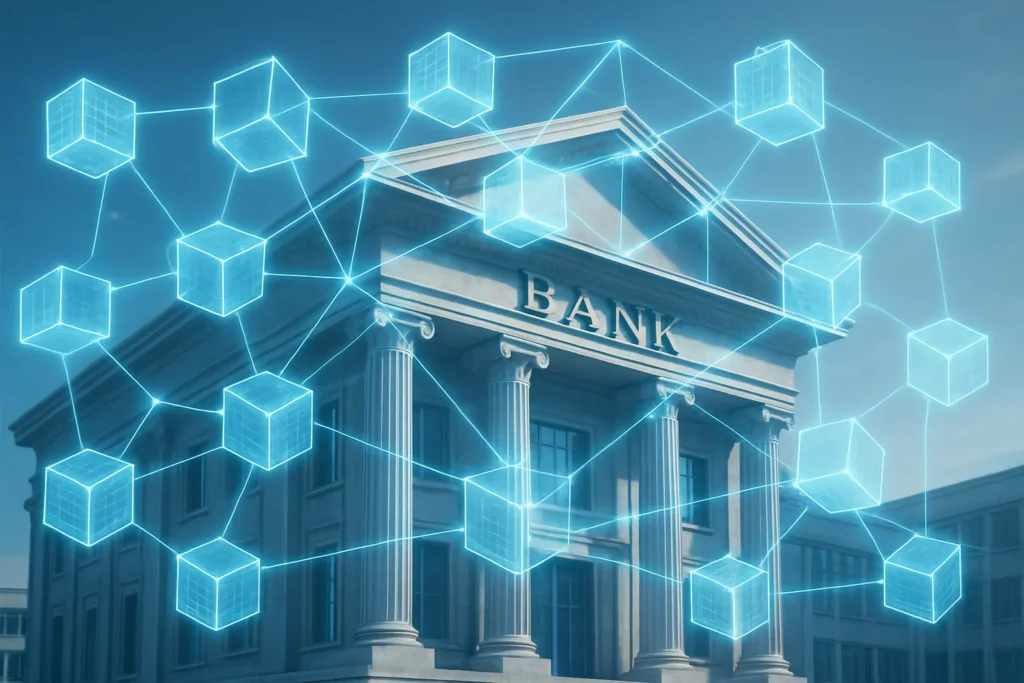
The next phase of the digital asset market will be defined by the normalization of utility, largely driven by institutional adoption. Major financial institutions, once wary of the speculative nature of the market, are now focusing on the underlying technology’s utility.
The Institutional Mandate for Utility
Institutional investors, such as pension funds and sovereign wealth funds, operate under strict regulatory and fiduciary duties. They cannot justify large-scale investment based on hype or social media trends. Their entry into the market is predicated on finding assets with clear, defensible utility. This is why the focus has shifted to:
- Regulated Stablecoins: Used for efficient, cross-border settlement and treasury management.
- Tokenized Securities: Offering a more efficient, 24/7 market for traditional assets.
- Infrastructure Protocols: Blockchains that provide the secure, scalable rails for these utility-driven applications.
The 2026 Digital Asset Outlook suggests that this institutional era will accelerate structural shifts, with macro demand for digital assets being underpinned by their functional use-cases [6].
The Behavioral Shift: From Trader to User
As utility becomes the dominant narrative, the psychological profile of the typical digital asset holder will change. The market will shift from being dominated by short-term traders seeking to exploit volatility to long-term users who value the asset for its function.
- Reduced Volatility: Utility-driven assets are inherently less volatile because their value is tied to predictable cash flows or measurable usage metrics, not speculative sentiment.
- Focus on Fundamentals: Investors will increasingly use traditional valuation models (Discounted Cash Flow, Price-to-Earnings) adapted for digital assets, moving away from purely technical analysis.
- The Power of the Network: The psychological reward will shift from the thrill of a quick profit to the satisfaction of participating in and benefiting from a growing, functional network.
This behavioral shift marks the final psychological victory of utility over hype, creating a more stable, mature, and ultimately more valuable ecosystem for all participants.
Conclusion
The journey of digital assets has been a turbulent one, characterized by the intense psychological forces of speculation and the quiet, persistent power of function. The market is now at an inflection point, where the noise of hype is being drowned out by the clear signal of digital asset utility. For the space to achieve its full potential, it must continue to prioritize assets that solve real-world problems, grant tangible rights, and provide measurable value beyond the possibility of a quick flip. The most successful digital assets of the future will be those that align with the deepest human needs—the need for control, for ownership, for community, and for a verifiable, functional use-case. Investors and builders who embrace this psychological truth—that a strong use-case matters more than any marketing campaign—will be the ones who not only survive the next market cycle but define the next era of the decentralized economy.
FAQ Section
What is the difference between a utility token and a security token?
A utility token is designed to provide access to a product or service within a blockchain ecosystem, and its value is tied to the demand for that service. A security token, conversely, represents an ownership stake in an external asset, such as a company’s equity, real estate, or a share of profits, making it subject to traditional securities regulations. The core difference lies in the function: access versus ownership.
How can I identify a digital asset with genuine utility?
Genuine utility can be identified by asking three key questions: Does the asset solve a problem that cannot be solved more efficiently by traditional means? Is the asset required to use a specific, functional service? Does the asset accrue value from the fees or revenue generated by its use? If the answer to these questions is yes, the asset likely has strong, defensible utility.
Is social utility, like community membership, considered “real” utility?
Yes, social utility is a genuine, non-financial form of utility. It satisfies the fundamental human psychological needs for affiliation, status, and identity. If an asset grants access to an exclusive, valuable community or serves as a verifiable form of digital identity, its value is derived from that functional access, not just speculation.
What role does psychological ownership play in the long-term value of a digital asset?
Psychological ownership, enhanced by the blockchain’s traceability and the user’s self-investment, creates a stronger emotional and cognitive bond between the user and the asset. This bond encourages long-term holding, active participation in the ecosystem, and a reduced likelihood of panic selling, contributing to the asset’s overall stability and long-term value.
How is institutional adoption changing the focus from hype to utility?
Institutional investors are driven by fiduciary duty and regulatory compliance, which mandates investment in assets with clear, measurable fundamentals. Their focus on tokenized Real-World Assets (RWAs), regulated stablecoins, and robust infrastructure protocols forces the market to prioritize functional, utility-driven assets over purely speculative ones, thereby maturing the entire ecosystem.
We encourage you to share your thoughts on the psychological shift from hype to utility in the comments below. Which digital assets do you believe have the strongest, most enduring use-cases? Subscribe to our newsletter for more in-depth analysis on the future of the decentralized economy.
References
[1] From Hype to Utility: How Crypto Investors Are Rewriting the Playbook. Medium. https://medium.com/bcgontech/from-hype-to-utility-how-crypto-investors-are-rewriting-the-playbook-d4a779a2de8e
[2] Digital Asset Policy: Key 2025 Changes & 2026 Outlook. Fireblocks. https://www.fireblocks.com/blog/policy-changes-2025-outlook-2026
[3] Trend of owning the intangible: the mediating role of psychological ownership in cultural consumption within blockchain ecosystems. Nature. https://www.nature.com/articles/s41599-025-05286-w
[4] Dark Sides of Digital Asset Consumption and Consumer Well-Being: Impact of Psychological Ownership. Wiley Online Library. https://onlinelibrary.wiley.com/doi/10.1002/cb.70011?af=R
[5] 2026 Digital Asset Outlook: Dawn of the Institutional Era. Grayscale Research. https://research.grayscale.com/reports/2026-digital-asset-outlook-dawn-of-the-institutional-era
[6] The Investable Universe 2.0: Institutional Adoption in Motion. Galaxy Research. https://www.galaxy.com/insights/research/investable-universe-of-digital-assets-25