Introduction
Inflation is no longer a distant economic concept discussed only by central bankers and economists. It directly affects how much food you can buy, how expensive housing becomes, and how quickly your savings lose value. As we move deeper into a world shaped by higher interest rates, geopolitical uncertainty, and persistent price pressures, protecting purchasing power has become a priority for everyday investors, not just institutions. This is where inflation hedge assets come into focus.
Over the past few years, many people discovered a hard truth. Money sitting in cash or low-yield savings accounts quietly loses value when inflation outpaces interest earned. In 2026, this challenge is expected to remain relevant as governments continue to manage debt, supply chains adjust to global shifts, and central banks walk a fine line between controlling prices and avoiding recession. Understanding how inflation works, and more importantly how to position your assets against it, is no longer optional.
In this article, you will learn what makes certain assets resistant to inflation, why some traditional safe havens fail during inflationary periods, and which investment categories have historically protected wealth when prices rise. We will explore real-world examples, risks, and long-term considerations so you can make informed decisions rather than chase trends. By the end, you will have a practical framework for evaluating inflation hedge assets in 2026 and beyond, regardless of whether you are a conservative saver or a long-term growth investor.
Table of Contents
Understanding Inflation and Why It Erodes Wealth
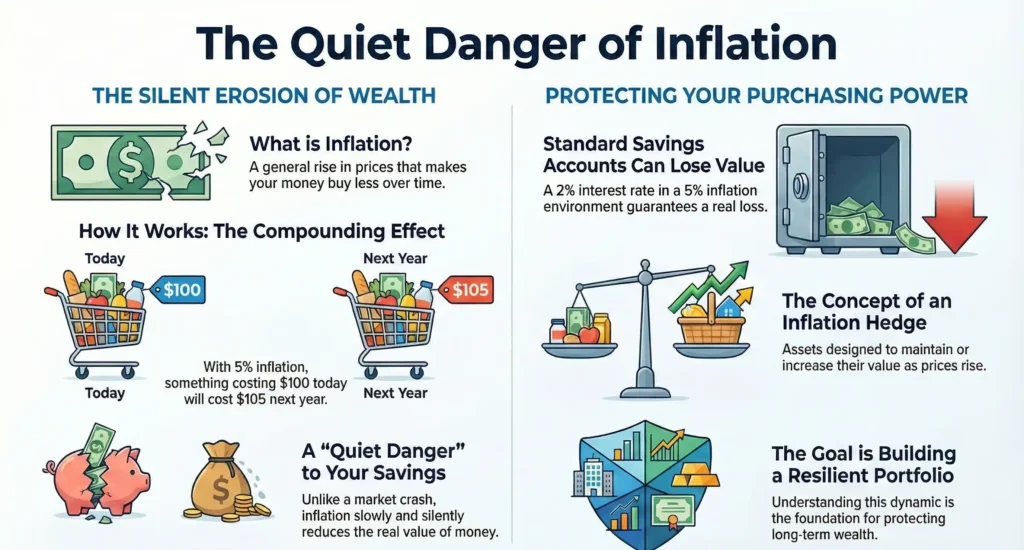
Inflation simply means a general rise in prices over time, which reduces the purchasing power of money. If inflation runs at 5 percent annually, something that costs $100 today will cost about $105 next year. While this sounds manageable in the short term, the compounding effect over years can be devastating for unprotected savings. A bank account earning 2 percent interest in a 5 percent inflation environment effectively guarantees a real loss.
Inflation is driven by multiple factors. These include increased money supply, higher production costs, strong consumer demand, and supply constraints. Central banks like the Federal Reserve attempt to control inflation through interest rate policy, but their tools are imperfect and often delayed in impact. According to the Federal Reserve’s educational resources, inflation tends to fluctuate in cycles rather than disappear permanently, making long-term planning essential rather than reactive investing.
What makes inflation especially dangerous is its quiet nature. Unlike a stock market crash, inflation does not cause panic headlines every day. Instead, it slowly reduces the real value of salaries, pensions, and savings. This is why inflation hedge assets matter. They are designed, either by structure or market behavior, to maintain or increase real value when prices rise. Understanding this dynamic is the foundation for building a resilient portfolio.
What Makes an Asset an Effective Inflation Hedge
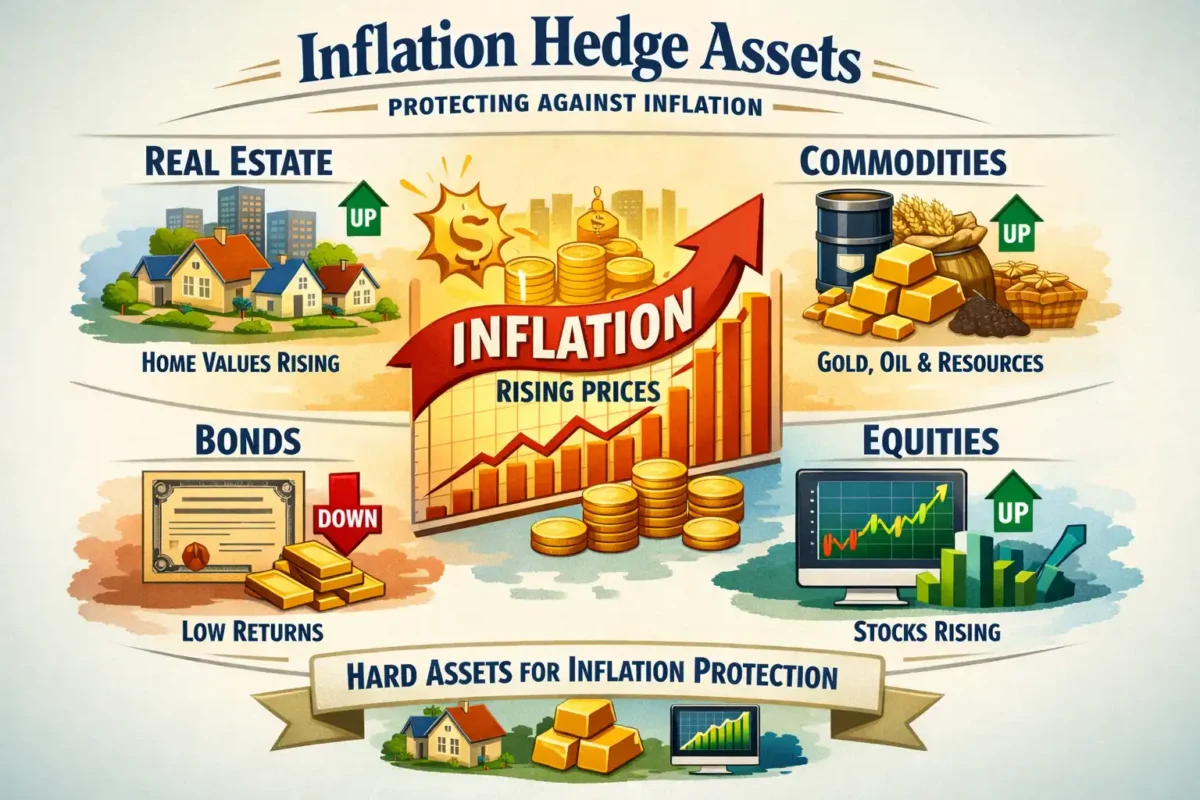
Not all investments protect against inflation, even if they appear valuable or popular. An effective inflation hedge typically has one or more of the following characteristics. It generates income that rises with inflation, its price adjusts upward as costs increase, or it is scarce and cannot be easily created by monetary expansion.
Real assets, such as property or commodities, often perform well during inflation because their intrinsic value rises with replacement costs. Financial assets, like certain bonds or equities, can also hedge inflation if their cash flows adjust accordingly. For example, companies with strong pricing power can pass higher costs onto consumers without losing demand.
However, no asset is a perfect hedge in all scenarios. Some perform well during moderate inflation but struggle during stagflation, which is inflation combined with weak economic growth. Others may protect purchasing power but introduce volatility or liquidity risks. The key is understanding trade-offs rather than seeking a single “safe” investment.
Below is a simplified comparison of inflation hedge characteristics.
| Asset Type | Adjusts With Inflation | Income Potential | Volatility |
|---|---|---|---|
| Real Estate | High | Medium to High | Medium |
| Commodities | High | Low | High |
| Inflation-Linked Bonds | Direct | Low to Medium | Low |
| Equities with Pricing Power | Indirect | High | Medium to High |
This framework will help guide the deeper analysis of specific inflation hedge assets suitable for 2026.
Real Estate as a Long-Term Inflation Hedge
Real estate has long been considered one of the most reliable inflation hedge assets, and for good reason. Property values and rental income tend to rise over time as construction costs, land scarcity, and wages increase. When inflation pushes up the cost of building new housing, existing properties often become more valuable by comparison. This natural adjustment mechanism helps preserve real value.
Rental properties offer a particularly strong inflation hedge because rents can be adjusted periodically, allowing income to keep pace with rising prices. According to data and explanations from Investopedia, real estate income often tracks inflation more closely than fixed-income investments. Additionally, mortgages with fixed interest rates become easier to service in real terms as inflation erodes the value of debt.
However, real estate is not without risks. Rising interest rates can reduce affordability and temporarily pressure prices. Location also matters significantly. Properties in high-demand urban or economic hubs tend to outperform those in declining regions.
| Real Estate Advantage | Potential Risk |
|---|---|
| Inflation-linked rental income | Illiquidity |
| Tangible asset with scarcity | High entry costs |
| Debt benefits from inflation | Interest rate sensitivity |
Commodities and Natural Resources
Commodities such as oil, metals, and agricultural products often respond directly to inflation because they are inputs in the production of goods and services. When inflation rises, commodity prices usually rise as well, making them classic inflation hedge assets. Gold, in particular, has been viewed as a store of value for centuries.
Gold’s appeal lies in its scarcity and independence from any single government or currency. During periods of high inflation or monetary instability, investors often turn to gold as a hedge against currency devaluation. The World Gold Council frequently highlights gold’s historical role in preserving purchasing power over long periods.
That said, commodities can be volatile and do not generate income. Their prices are influenced by global demand, technological changes, and geopolitical events. This makes them better suited as a portion of a diversified portfolio rather than a standalone strategy.
| Commodity Type | Inflation Protection | Income |
|---|---|---|
| Gold | High | None |
| Energy | High | None |
| Agriculture | Medium to High | None |
Inflation-Linked Bonds and Government Securities
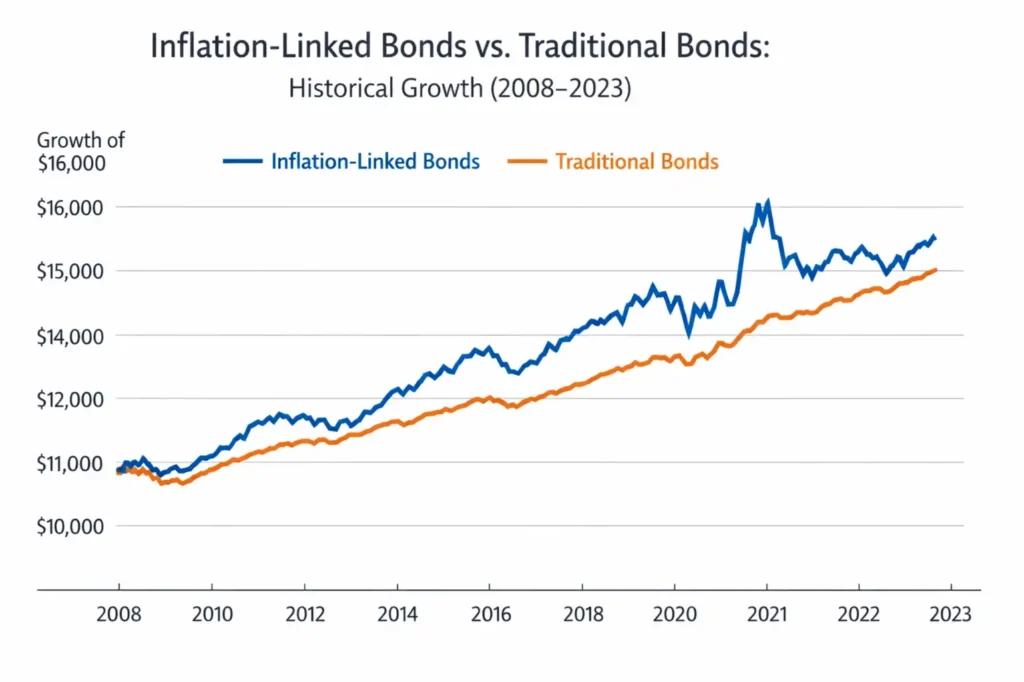
Inflation-linked bonds, such as Treasury Inflation-Protected Securities in the United States, are specifically designed to protect investors from inflation. Their principal value adjusts with changes in the consumer price index, ensuring that returns maintain real purchasing power. For conservative investors, these instruments offer a predictable and transparent hedge.
Central banks and governments issue these bonds to reassure investors during inflationary periods. According to the U.S. Treasury and OECD research, inflation-linked bonds provide lower volatility compared to equities or commodities, making them suitable for capital preservation strategies.
The main drawback is lower expected returns compared to growth-oriented assets. They protect wealth but rarely grow it significantly. Additionally, they are still exposed to interest rate risk if sold before maturity.
Equities with Strong Pricing Power
Stocks are often misunderstood during inflation. While inflation can increase costs, companies with strong brands, essential products, or monopolistic advantages can pass these costs onto consumers. This pricing power allows revenues and profits to rise with inflation, making certain equities effective inflation hedge assets.
Sectors such as consumer staples, energy, healthcare, and infrastructure often perform relatively well during inflationary periods. Morningstar research frequently emphasizes the importance of economic moats, which are competitive advantages that protect profitability over time.
Equities also benefit from long-term growth, making them attractive for investors with longer time horizons. However, they are sensitive to market sentiment and interest rate changes, which can cause short-term volatility.
| Equity Feature | Inflation Impact |
|---|---|
| Pricing power | Positive |
| High debt levels | Negative |
| Essential services | Positive |
Alternative Assets and Modern Inflation Hedges
Beyond traditional categories, alternative assets such as infrastructure funds, farmland, and certain digital assets are increasingly discussed as inflation hedge assets. Infrastructure projects often have contracts linked to inflation, ensuring stable real returns. Farmland benefits from rising food prices and limited supply.
Digital assets like Bitcoin are sometimes described as inflation hedges due to their fixed supply. While academic debate continues, their short history and high volatility make them speculative rather than proven inflation protection tools. The International Monetary Fund has cautioned investors about relying solely on digital assets for macroeconomic hedging.
A balanced approach involves treating alternatives as complementary rather than core holdings.
Building a Balanced Inflation-Resilient Portfolio for 2026
The most effective strategy against inflation is diversification. Relying on a single asset class exposes investors to specific risks. Combining real assets, inflation-linked securities, equities with pricing power, and selective alternatives creates a more resilient structure.
A practical framework might look like this.
| Asset Category | Role |
|---|---|
| Real Estate | Income and real value |
| Inflation-Linked Bonds | Stability |
| Equities | Growth |
| Commodities | Shock protection |
Conclusion
Inflation is not an anomaly. It is a recurring feature of modern economies, shaped by policy decisions, demographic shifts, and global supply dynamics. In 2026, the question is not whether inflation will exist, but how prepared investors are to deal with it. Understanding inflation hedge assets allows you to move from reactive decisions to deliberate, long-term planning.
Each asset discussed in this article plays a different role. Real estate offers tangible value and income that adjusts over time. Commodities provide direct exposure to rising prices but require patience and risk tolerance. Inflation-linked bonds deliver stability and predictability, while equities with pricing power offer growth potential that can outpace inflation over decades. Alternative assets add diversification but should be approached with realism rather than hype.
The most important takeaway is balance. No single investment protects against every inflation scenario. By combining assets with different inflation responses, you increase the likelihood of preserving purchasing power across economic cycles. Equally important is aligning investments with your time horizon, risk tolerance, and income needs.
Inflation quietly erodes wealth, but informed strategy quietly rebuilds it. With thoughtful allocation and a long-term mindset, inflation hedge assets can transform inflation from a threat into a manageable factor within a resilient financial plan.
Frequently Asked Questions
What are inflation hedge assets?
Inflation hedge assets are investments designed to maintain or increase real value when inflation rises. They include real estate, commodities, inflation-linked bonds, and equities with pricing power.
Are stocks good inflation hedge assets?
Some stocks are effective inflation hedge assets, especially companies that can raise prices without losing customers. Not all stocks provide this protection.
Is gold still relevant as an inflation hedge?
Gold remains relevant due to its scarcity and historical role as a store of value, though it can be volatile and does not generate income.
How much of my portfolio should be inflation-protected?
This depends on your risk tolerance and goals, but many financial planners suggest allocating a meaningful portion to inflation hedge assets during inflationary periods.
Are inflation-linked bonds risk-free?
They reduce inflation risk but still carry interest rate and government credit risk, especially if sold before maturity.
If you found this guide helpful, consider sharing your thoughts or experiences with inflation investing in the comments. You can also subscribe for future insights on long-term wealth protection strategies and practical financial education.