Introduction
Financial markets today feel more unpredictable than ever. Inflation spikes, interest rate changes, geopolitical tensions, and sudden market sell offs have become part of the regular news cycle. For everyday investors, this constant uncertainty raises a simple but important question. How can you invest confidently when prices swing up and down so sharply? This is where dollar cost averaging in volatile market conditions becomes especially relevant.
Dollar cost averaging is not a new idea. It has been discussed for decades by financial educators and long term investors. Yet many people still misunderstand how it works or doubt whether it can remain effective during extreme volatility. Some believe it only works in calm markets, while others assume it is a beginner strategy that experienced investors outgrow. In reality, dollar cost averaging was designed specifically to deal with uncertainty, emotional decision making, and imperfect market timing.
This article explores whether dollar cost averaging still works in today’s volatile economies and how it fits into modern investing. You will learn what the strategy really is, why volatility changes investor behavior, and how consistent investing can reduce risk without eliminating opportunity. We will also examine historical examples, compare dollar cost averaging with lump sum investing, and discuss when this approach may or may not be suitable. By the end, you will have a clear, practical understanding of how to use dollar cost averaging thoughtfully rather than blindly.
Table of Contents
Understanding Dollar Cost Averaging and Why It Matters
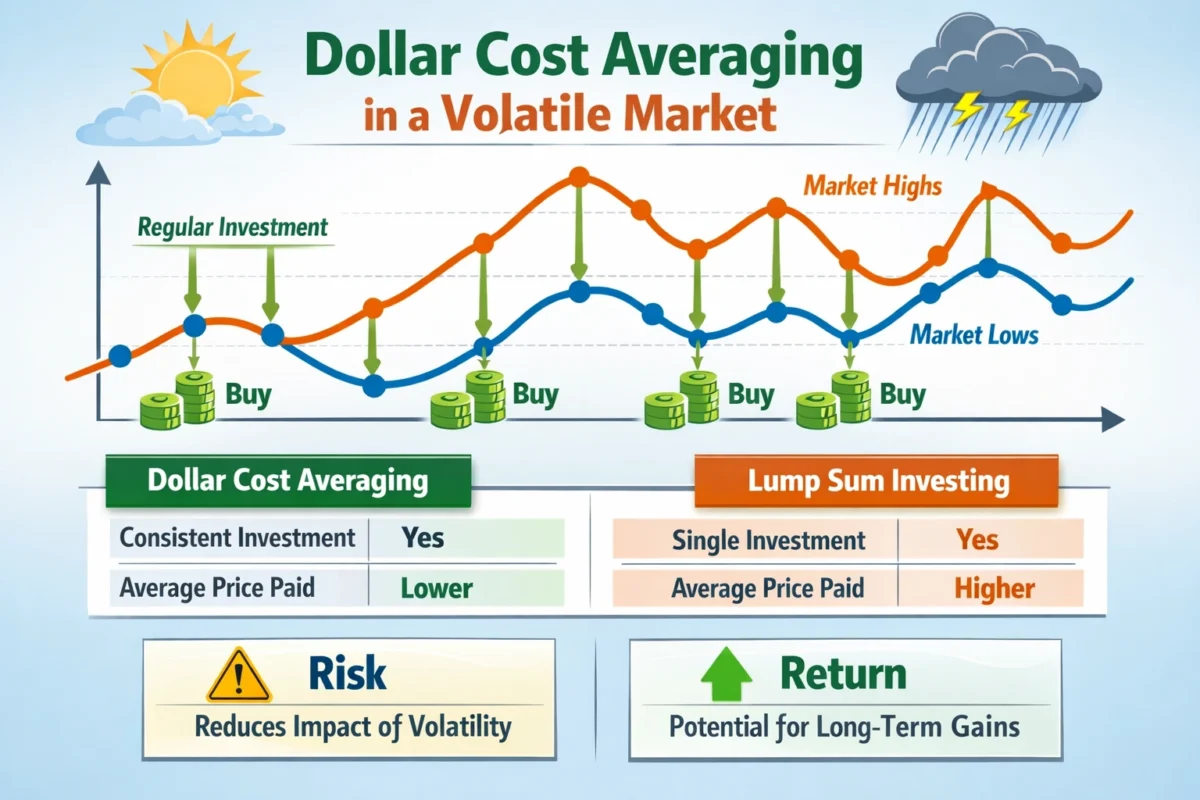
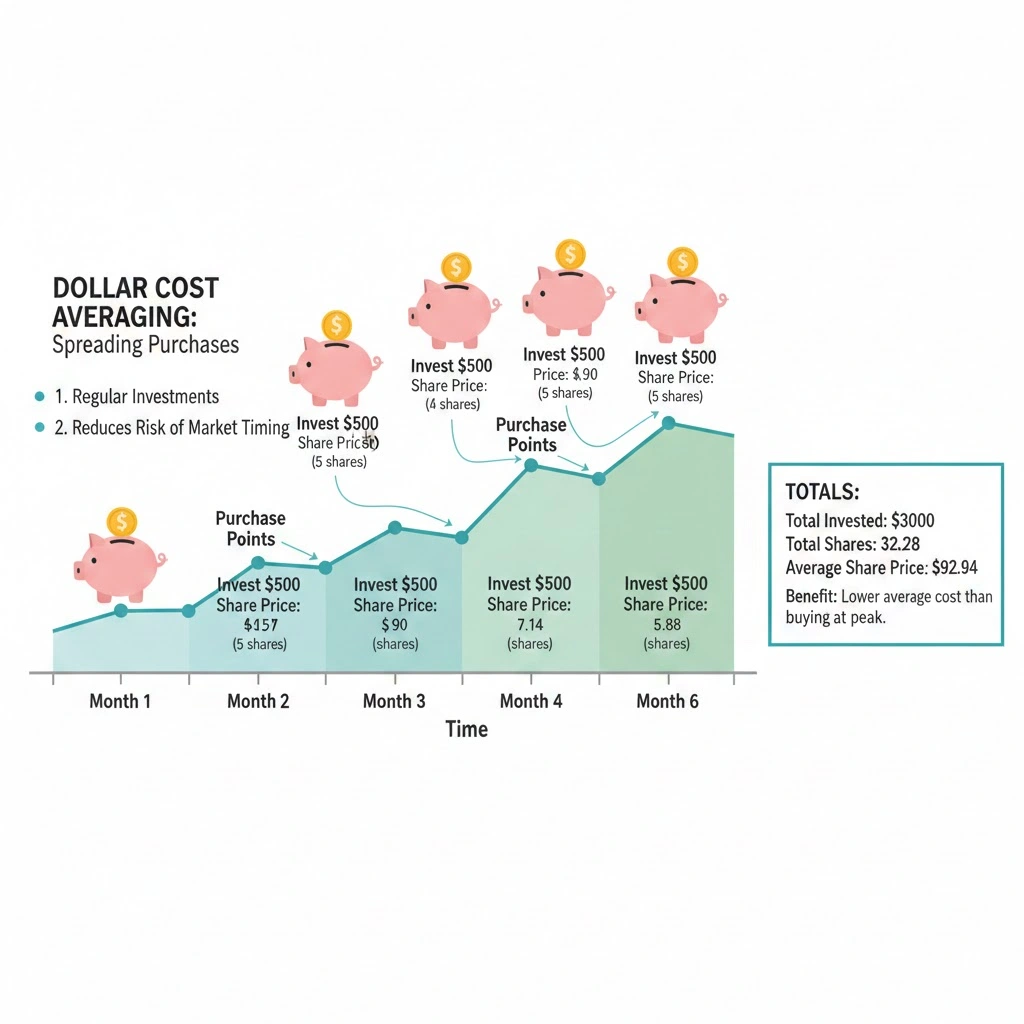
Dollar cost averaging is a simple investment strategy where you invest a fixed amount of money at regular intervals, regardless of market conditions. Instead of trying to guess the best time to enter the market, you commit to investing consistently, such as every month or every paycheck. Over time, this means you buy more units when prices are low and fewer units when prices are high, which can lower your average purchase cost.
This approach matters because human psychology is often the biggest enemy of good investing. Many people buy more when markets are rising because confidence is high, then panic and sell when markets fall. Dollar cost averaging removes much of this emotional decision making by turning investing into a habit rather than a reaction. According to Investopedia, this strategy helps reduce the impact of volatility on large purchases of financial assets and encourages disciplined investing over time (https://www.investopedia.com).
In volatile economies, price swings can be sharp and frequent. Inflation data releases, central bank announcements from institutions like the Federal Reserve (https://www.federalreserve.gov), or global crises can move markets dramatically within days. Dollar cost averaging does not prevent losses, but it spreads risk over time. Instead of investing all your money at a potentially bad moment, you gradually enter the market, which can smooth out the emotional and financial impact of volatility.
Why Market Volatility Feels Worse Than Ever
Volatility refers to how much and how quickly prices move up and down. While markets have always experienced ups and downs, modern volatility feels more intense due to faster information flow, algorithmic trading, and global interconnectedness. A policy decision by the European Central Bank or a supply chain disruption can ripple across global markets in hours rather than months.
Another reason volatility feels worse is behavioral. Investors today are constantly exposed to market news through smartphones and social media. Seeing daily fluctuations can trigger emotional responses even when long term fundamentals remain intact. The International Monetary Fund has noted that increased global uncertainty often amplifies short term market reactions, even if long term economic growth remains steady (https://www.imf.org).
In such environments, many investors freeze or make impulsive decisions. They wait for clarity that never fully comes, or they chase short term rallies. Dollar cost averaging in volatile market conditions offers a structured alternative. Instead of responding to every headline, investors follow a predefined plan. This consistency can be especially valuable when markets move sideways or experience repeated corrections.
Volatility also affects income and savings behavior. During economic uncertainty, people may worry about job stability or rising living costs. Dollar cost averaging allows flexibility because contributions can be adjusted without abandoning the overall strategy. This adaptability is one reason it remains relevant across different economic cycles.
How Dollar Cost Averaging Performs During Volatile Periods
The performance of dollar cost averaging depends on market direction, time horizon, and investor discipline. In rising markets, lump sum investing often produces higher returns because more money is invested earlier. However, in volatile or declining markets, dollar cost averaging can reduce the risk of entering at an unfortunate time.
Historical examples illustrate this clearly. During the global financial crisis of 2008, investors who invested gradually through retirement plans continued buying as markets fell. When markets eventually recovered, those consistent purchases at lower prices significantly improved long term returns. According to research cited by Morningstar (https://www.morningstar.com), investors who stayed invested through downturns often outperformed those who exited and waited for stability.
Dollar cost averaging does not guarantee profits, but it improves behavior. It keeps investors engaged during downturns rather than sidelined by fear. In volatile economies, recoveries often begin unexpectedly. Investors who wait for certainty may miss early gains. By contrast, those using dollar cost averaging participate automatically.
Dollar Cost Averaging vs Lump Sum Investing
One of the most common debates in investing is whether to invest all available money at once or spread it out over time. Both approaches have advantages, and understanding the difference is essential for making informed decisions.
Lump sum investing means investing a large amount immediately. Historically, markets tend to rise over long periods, so investing earlier often leads to higher returns. However, this assumes emotional resilience and favorable timing. Dollar cost averaging sacrifices some potential upside in exchange for lower emotional and timing risk.
Comparison Table: Dollar Cost Averaging vs Lump Sum Investing
| Factor | Dollar Cost Averaging | Lump Sum Investing |
|---|---|---|
| Timing risk | Lower | Higher |
| Emotional stress | Reduced | Often high |
| Potential returns | Moderate | Potentially higher |
| Suitability | Volatile markets, steady income | Stable markets, large capital |
| Behavior discipline | Strong | Requires confidence |
In volatile economies, dollar cost averaging often aligns better with real life behavior. Many investors receive income gradually rather than as a large sum. For them, dollar cost averaging is not just a strategy but a natural reflection of cash flow.
Benefits of Dollar Cost Averaging in Volatile Market Conditions
The main strength of dollar cost averaging lies in its simplicity and psychological support. It does not attempt to predict markets, which even professionals struggle to do consistently. Instead, it focuses on process over prediction.
Key benefits include:
- Reduced impact of short term market swings.
- Encouragement of long term investing habits.
- Lower likelihood of emotional mistakes.
- Accessibility for beginners and experienced investors alike.
From a financial education perspective, organizations like the World Bank emphasize the importance of regular saving and investing as tools for building resilience in uncertain economies (https://www.worldbank.org). Dollar cost averaging aligns well with this principle because it promotes consistency over speculation.
Risks and Limitations You Should Understand
Despite its advantages, dollar cost averaging is not a perfect strategy. One limitation is opportunity cost. In strong bull markets, spreading investments over time can result in lower returns than investing early. Another risk is false security. Some investors assume dollar cost averaging protects them from losses entirely, which is not true. Market risk still exists.
There is also the risk of poor asset selection. Dollar cost averaging into a fundamentally weak investment does not improve outcomes. It simply spreads losses over time. That is why asset quality and diversification remain essential.
Risk vs Reward Table
| Aspect | Risk | Potential Reward |
|---|---|---|
| Timing | Miss early gains | Avoid bad entry points |
| Volatility | Continued losses | Lower average cost |
| Behavior | Overconfidence | Discipline and consistency |
Understanding these trade offs helps investors use dollar cost averaging as a tool rather than a crutch.
When Dollar Cost Averaging Makes the Most Sense
Dollar cost averaging works best when markets are volatile, income is regular, and the investment horizon is long. It is especially suitable for retirement accounts, index funds, and diversified portfolios. Young investors benefit because time smooths out market cycles.
It may be less suitable for short term goals or when investing a one time windfall in a stable, upward trending market. In such cases, combining strategies can be effective. Some investors invest part of their capital immediately and dollar cost average the rest.
Practical Steps to Apply Dollar Cost Averaging Today
Implementing dollar cost averaging does not require complex tools. Most brokerage platforms allow automatic recurring investments. The key steps include choosing diversified assets, setting a realistic contribution amount, and sticking to the plan.
Practical tips:
- Align investments with your income schedule.
- Use low cost index funds for broad exposure.
- Review your plan periodically without reacting emotionally.
- Increase contributions gradually when income grows.
Educational platforms like OECD financial literacy resources emphasize automation as a way to improve long term financial outcomes (https://www.oecd.org). Automation supports the core philosophy of dollar cost averaging by removing hesitation and procrastination.
Conclusion
Dollar cost averaging remains a relevant and powerful strategy, especially in uncertain economic environments. It does not promise the highest possible returns, nor does it eliminate market risk. What it offers instead is something many investors struggle to achieve, consistency, discipline, and emotional control. In volatile economies where headlines change daily and confidence swings rapidly, these qualities can be more valuable than perfect timing.
By investing regularly, you participate in market growth while reducing the psychological burden of decision making. You accept that volatility is unavoidable but manageable. Over long periods, this mindset often leads to better outcomes than reactive investing driven by fear or excitement.
For investors with steady income, long term goals, and limited desire to predict markets, dollar cost averaging in volatile market conditions provides a practical framework. It encourages patience, supports diversification, and aligns investing behavior with real life financial patterns. Like any strategy, it works best when paired with quality assets, clear goals, and realistic expectations.
Ultimately, successful investing is less about brilliance and more about behavior. Dollar cost averaging helps shape behavior in a way that supports long term financial health. In a world that feels increasingly unstable, that stability may be its greatest strength.
Frequently Asked Questions
Is dollar cost averaging effective during high inflation?
Yes, dollar cost averaging can still work during high inflation because it maintains consistent market exposure. However, choosing assets that historically outpace inflation, such as equities, is important.
Does dollar cost averaging reduce risk completely?
No, it reduces timing and emotional risk but does not eliminate market risk. Asset values can still decline.
How often should I invest using dollar cost averaging?
Most investors use monthly or biweekly schedules aligned with income. Consistency matters more than frequency.
Can experienced investors use dollar cost averaging?
Absolutely. Many experienced investors use it to manage large portfolios or reduce emotional bias.
Is dollar cost averaging in volatile market conditions better than waiting for stability?
Often yes, because markets tend to recover before stability feels obvious. Waiting can mean missing early gains.
If you found this article helpful, consider sharing it with someone who feels unsure about investing in uncertain times. You can also leave a comment below with your experience or questions. For more practical insights on building long-term financial confidence, subscribe to our updates and continue learning at your own pace.