Introduction: Why Passive Income Matters Now
Passive income is no longer a nice-to-have; it is becoming a financial necessity in a world of rising living costs, uncertain job security, and increasingly volatile markets. For beginners, the challenge is simple:which passive income ideas actually workwithout requiring a finance degree or huge starting capital?
This guide focuses onpassive income ideas for beginnersthat are realistic, data-backed, and scalable over time. You will learn:
- What passive income really is (and what it is not)
- Beginner-friendly vehicles you can start with small amounts
- How to evaluate risk, return, and effort
- Practical examples, numbers, and a simple comparison chart
- Clear next steps to build your own passive income portfolio
Table of Contents
What Is Passive Income, Really?
True Passive vs “Fake” Passive Income
In personal finance,passive incomerefers to money you earn with minimal ongoing effortafteran initial setup. The IRS, for example, classifies things like rental activity and certain business interests as passive, but in practice, many so‑called passive income streams still require monitoring, maintenance, or decision-making.
Key distinctions:
- Not passive:Overtime pay, freelancing, gig work, or any income tied directly to your hours.
- Semi-passive:Rental property you self-manage, a blog that needs fresh content, a YouTube channel.
- More passive:Index funds, dividend ETFs, high-yield savings, automated robo-advisors, or well-managed REITs.
A helpful rule of thumb:
“If your income stops the moment you stop working, it is not passive.”
Core Principles for Beginners
The Three Dimensions of a Passive Income Idea
When evaluatingpassive income ideas for beginners, think in terms of three dimensions:
- Risk:How likely is it that you lose money?
- Return:What is the realistic long-term yield or growth?
- Effort:How much time, skill, and ongoing management is needed?
Good beginner ideas score:
- Low to moderate risk
- Reasonable, not sensational returns
- Manageable effort with clear systems
Beginner-Friendly Passive Income Ideas That Actually Work
1. High-Yield Savings Accounts and Cash Management
High-yield savings accounts (HYSAs) are one of the simplest passive income tools for beginners. Online banks and fintech platforms today often offer annual percentage yields (APYs) around 3.5–4.3%, compared with national averages near 0.4% for traditional savings.
Why it works for beginners:
- FDIC insurance (usually up to $250,000 per depositor, per institution)
- No market volatility
- Instant or near‑instant access to cash
Example:
- You hold 5,000 USD in a high-yield savings account at 4.0% APY.
- In one year, you earn roughly 200 USD in interest.
- Effort: near zero, aside from choosing the right account.
“High-yield savings accounts are ideal if you are looking for a place to park your money,” notes NerdWallet, highlighting both safety and liquidity.
This will not make you rich, but it is a low-risk foundation for your passive income strategy.
2. Dividend Stock and ETF Investing
Dividend-paying stocks and ETFs are a classicpassive income idea for beginnerswho want exposure to the stock market without picking individual companies.
Many broad-market ETFs, such as those tracking the S&P 500, currently yield around 1.2–1.5% in dividends. Dedicated high-dividend ETFs can yield 3–4% or more, depending on the underlying holdings and strategy.
Why it works:
- Automatic diversification via ETFs
- Dividends can be reinvested or taken as cash
- Accessible through most brokers with no or low commissions
Example:
- 10,000 USD invested in a high-dividend ETF yielding 4.0% could generate roughly 400 USD per year in dividends, before taxes.
- Historically, total returns (price appreciation + dividends) can be higher over long periods, but short-term volatility is common.
A common guideline is: “Dividends are not guaranteed; they are a distribution of profits, not a promise.”
Beginners should focus on broad, low-cost ETFs rather than chasing the highest yield or speculative stocks.
3. Investment-Grade Bond ETFs
Investment-grade bond ETFs provide exposure to diversified baskets of government and corporate bonds. Their yields typically sit between cash and stocks, with lower volatility than equities but higher risk than insured savings accounts.
For example, an investment-grade bond ETF like BlackRock’s IGEB has delivered total returns that include both interest payments and price changes; recent annual returns have been in the low- to mid-single digits, with a multi-year total return around 4–6% annualized depending on the period.
Why it works:
- Regular interest payments
- Lower volatility than stocks
- Easy to buy and sell like a stock
Example:
- 10,000 USD in an investment-grade bond ETF yielding about 3–4% could provide 300–400 USD in interest annually, plus or minus price fluctuations.
This can be a solid building block for a balanced passive income portfolio, especially for conservative investors.
4. REITs (Real Estate Investment Trusts)
REITs allow you to invest in real estate without buying property directly. They are required, in many jurisdictions, to distribute a high percentage of taxable income to shareholders as dividends, which often results in attractive yields.
Publicly traded REITs can focus on:
- Residential buildings
- Commercial offices
- Warehouses and logistics
- Data centers and cell towers
Historically, equity REITs have provided competitive long-term total returns with significant dividend components, though they are sensitive to interest rates and economic cycles.
Why REITs are beginner-friendly:
- No need to manage tenants or repairs
- Buy and sell via a brokerage account
- Often yield more than broad stock indices
A popular saying in REIT investing is: “You collect rent checks without ever picking up a hammer.”
5. Robo-Advisors and Automated Portfolios
Robo-advisors automate investing in diversified portfolios of ETFs based on your risk tolerance and goals. Many platforms offer automated rebalancing and tax‑loss harvesting for a modest advisory fee.
For beginners, this can provide:
- Instant diversification
- Passive management
- A disciplined, rules-based approach
While robo-advisors do not create “extra” passive income beyond market returns, they help you capture:
- Growth from stock ETFs
- Income from bond and dividend ETFs
- Compounding through automatic reinvestment
This is ideal if you want a largely hands-off experience.
6. Peer-to-Peer Lending and Alternative Platforms (With Caution)
Some platforms allow individuals to lend money directly to borrowers or participate in alternative private credit or real estate loans. Yields can appear attractive, often in the mid- to high-single digits, but risks include:
- Borrower default
- Platform risk
- Illiquidity
For true beginners, these should be a small, experimental slice of your portfolio, not the core. A common warning in this space is:
“Higher yield almost always means higher risk.”
Comparison: Yields of Simple Passive Income Ideas
To give a rough sense of how some of these beginner-friendly ideas compare, consider typical yield ranges as of late 2025.
Typical Yield Ranges (Illustrative)
These numbers are approximate and change over time; always check current yields and fees before investing.
Visual Snapshot: Yields of Beginner Assets
Below is a simple conceptual chart comparing sample yields of three accessible vehicles:
- High-yield savings: 4.0%
- Dividend ETF: 1.5%
- Bond ETF: 3.0%
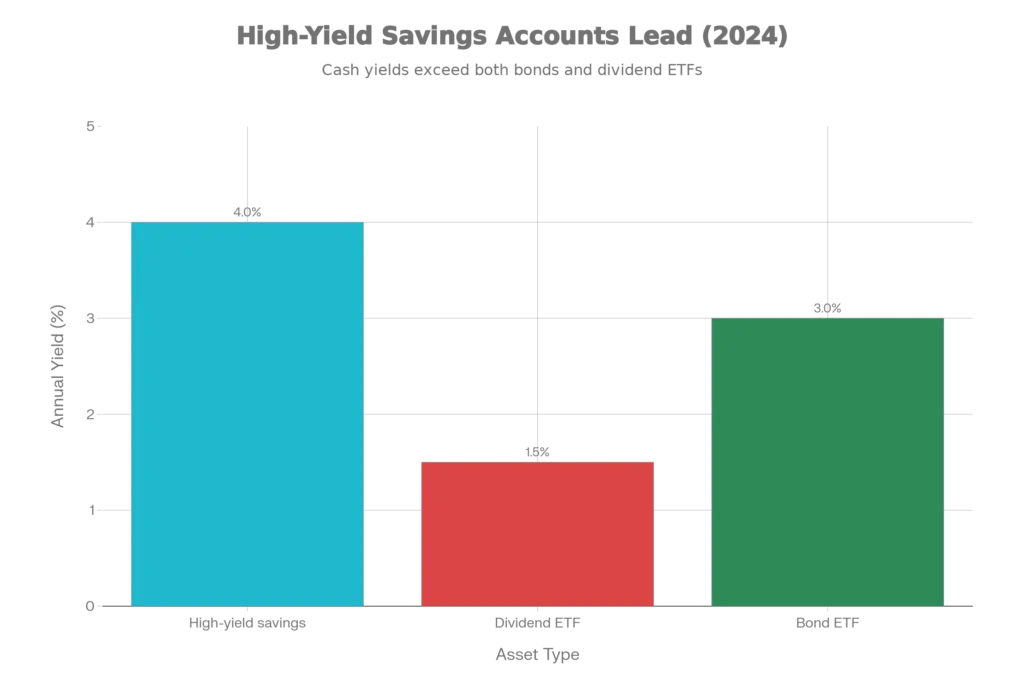
This helps illustrate a basic principle:
- Cash (HYSAs) can be competitive in high-rate environments.
- Bonds sit in the middle.
- Broad dividend ETFs often yield less in pure income, but provide growth potential.
Building a Simple Beginner Passive Income Portfolio
Step 1: Start With Safety and Liquidity
Before chasing higher yields, build acash buffer:
- Emergency fund of 3–6 months’ expenses in a high-yield savings account
- Short-term goals (e.g., next 1–2 years) also in cash or very short-term instruments
This ensures you are not forced to sell investments at a bad time.
Step 2: Add Market-Based Passive Income
Once your safety net is in place, allocate new money to long-term vehicles such as:
- Dividend ETFs(for growth + income)
- Bond ETFs(for stability + income)
- REITs(for property exposure + income)
A simple beginner allocation might look like:
- 40% global stock or dividend ETF
- 40% investment-grade bond ETF
- 20% REIT ETF
This is not a one-size-fits-all recommendation but an example of combininggrowth, income, and diversification.
Step 3: Automate Contributions
Turn your passive income strategy into a system:
- Set automatic monthly transfers to your brokerage.
- Use recurring purchases of ETFs.
- Reinvest dividends by default unless you need income.
A useful mantra here is:
“Consistency beats intensity in investing.”
Risk Management for Passive Income Ideas
Key Risks to Understand
Even the bestpassive income ideas for beginnerscarry risk. Common ones include:
- Market risk:Prices can fall, sometimes sharply, even if yields look attractive.
- Interest rate risk:Bond and REIT prices can decline when rates rise.
- Inflation risk:Cash yields below inflation lose purchasing power over time.
- Concentration risk:Over-reliance on one asset type or sector.
Mitigation strategies:
- Diversify across asset classes and regions.
- Avoid putting short-term money into high-volatility assets.
- Review your portfolio annually, not daily.
Practical Action Plan for Beginners
1. Clarify Your Time Horizon and Goals
Ask:
- Do you need income now, or are you reinvesting for the future?
- What is your risk tolerance?
- How stable is your primary income?
Short-term goals favor safer instruments (HYSAs, short-term bonds), while long-term wealth building can use more stock and REIT exposure.
2. Choose a Reliable Platform
Look for:
- Regulated brokers and banks
- Transparent fees
- Simple user interface and educational tools
Reputable comparison sites like Bankrate, NerdWallet, and major brokerages can help you evaluate products like high-yield savings accounts and ETFs.
3. Start Small but Start Soon
You do not need thousands to begin:
- 50–100 USD per month into a diversified ETF
- 500–1,000 USD placed in a high-yield savings account
- Gradual scaling as confidence and income grow
The power comes from compounding over time, not from guessing the perfect moment.
Conclusion: Turning Ideas Into Income
Beginner-friendly passive income ideas that actually work are neither glamorous nor viral. They areboring on purpose: high-yield savings accounts, diversified ETFs, bond funds, and REITs you can hold for years.
The key lessons:
- Use high-yield savings as your safe base and liquidity layer.
- Add dividend ETFs, bond ETFs, and REITs for sustainable income and growth.
- Understand that yield is only one dimension; risk, time horizon, and diversification matter just as much.
- Automate contributions and let compounding do most of the heavy lifting.
If you focus onsimple, diversified, and repeatable strategies, the bestpassive income ideas for beginnerscan become a powerful engine for long-term financial independence.