Introduction
Economic crises have a way of reshaping how people think about money, trust, and the future. When inflation rises, banks wobble, or currencies lose value, investors naturally search for alternatives that feel safer, smarter, or more independent. In recent years, cryptocurrencies have moved to the center of that conversation, especially during periods of financial stress. As a result, certain crypto narratives in economic crisis situations tend to spread quickly across social media, headlines, and investment forums.
These narratives often sound convincing because they tap into real fears and genuine problems within the traditional financial system. Some promise protection from inflation, others claim independence from banks, and many suggest that crypto represents a completely new and safer financial order. While parts of these stories contain truth, they are often simplified, exaggerated, or missing important context.
This matters today more than ever. With recurring global shocks, from high inflation to banking instability and geopolitical tension, millions of people are making financial decisions based on these narratives. Understanding where they are accurate and where they fall short can mean the difference between informed investing and costly mistakes.
In this article, you will learn the most common crypto narratives that appear during economic crises, why they resonate so strongly, and what they frequently overlook. We will break down each idea in plain language, connect it to real world examples, and explain the risks and limitations that are often ignored. By the end, you will have a clearer, more balanced framework for thinking about crypto during turbulent economic times.
Table of Contents
Crypto as a Safe Haven Asset
During financial turmoil, one of the loudest claims is that cryptocurrencies, especially Bitcoin, function as a safe haven similar to gold. This narrative suggests that when stocks fall, banks struggle, or governments print excessive money, crypto will protect wealth. The idea is emotionally powerful because it reflects a desire for something outside the traditional system.
A safe haven asset is typically defined as one that holds or increases its value during periods of market stress. Gold has historically played this role during inflationary periods and geopolitical crises. Crypto supporters argue that Bitcoin’s fixed supply makes it resistant to inflation, unlike fiat currencies that can be printed by central banks. The Federal Reserve itself explains how money supply expansion can contribute to inflation, which fuels this argument further.
However, historical data tells a more complex story. During major market selloffs, such as the COVID-related crash in early 2020 and risk-off periods in 2022, Bitcoin and other cryptocurrencies often fell alongside equities. Research from institutions like the International Monetary Fund shows that crypto markets have become increasingly correlated with traditional financial markets, particularly technology stocks.
This does not mean crypto has no long term value. It means the safe haven narrative oversimplifies reality.
What the narrative gets right
- Bitcoin has a limited supply capped at 21 million coins.
- Crypto exists outside direct government control.
- Long term holders have sometimes benefited during currency devaluation episodes.
What it often misses
- High short term volatility during crises.
- Strong correlation with risk assets during market stress.
- Lack of historical evidence across many crisis cycles.

Crypto as Protection Against Inflation
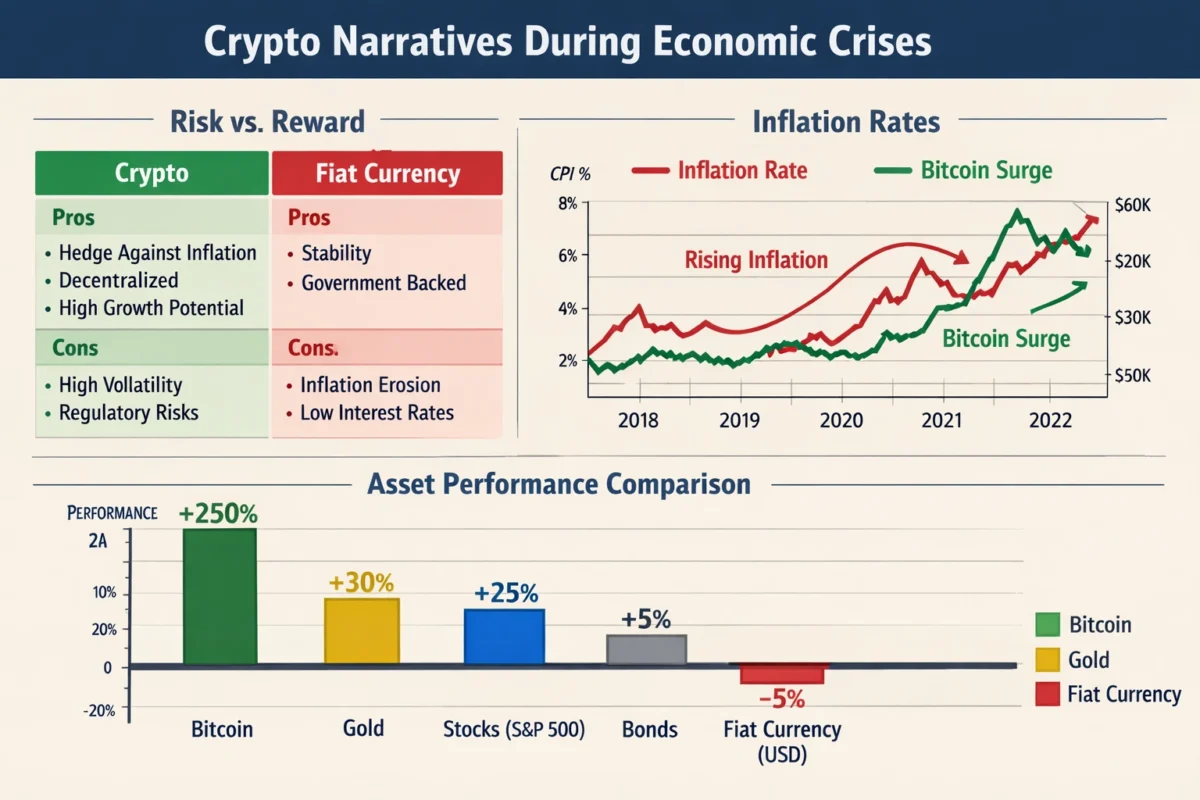
Another popular claim is that crypto automatically protects against inflation. This narrative gained traction during periods of rapid price increases in the United States, Europe, and emerging markets. The logic is simple: if inflation reduces the value of money, an asset with limited supply should rise in value.
Inflation occurs when prices rise across the economy, reducing purchasing power. Central banks like the European Central Bank openly explain inflation dynamics and monetary policy responses. Crypto advocates argue that decentralized currencies remove the risk of money printing.
In theory, scarcity can support value. In practice, inflation protection depends on whether an asset’s demand rises faster than inflation itself. During recent inflationary periods, crypto prices experienced extreme swings rather than steady appreciation. Bitcoin fell sharply in 2022 despite inflation reaching multi-decade highs in many economies.
Part of the reason is that crypto markets are still driven heavily by speculation, liquidity conditions, and investor sentiment. When central banks raise interest rates to fight inflation, risk assets often decline, and crypto has been treated as one of them.
This creates a gap between the inflation hedge narrative and real-world performance.
| Asset Type | Inflation Hedge History | Short Term Volatility | Crisis Reliability |
|---|---|---|---|
| Gold | Strong historical record | Low to moderate | High |
| Real estate | Moderate to strong | Low | Medium |
| Bitcoin | Limited historical data | Very high | Uncertain |
Crypto Replacing Banks and Governments
One of the most ideological crypto narratives in economic crisis periods is the belief that crypto will replace banks and governments entirely. This idea resonates strongly when trust in institutions declines, such as during bank failures or sovereign debt concerns.
Cryptocurrencies were originally designed to allow peer-to-peer transactions without intermediaries. Blockchain technology enables decentralized record keeping, which reduces reliance on traditional banks for certain functions. Platforms like Ethereum have expanded this vision by enabling smart contracts, which automatically execute agreements.
However, the idea that crypto can fully replace banks ignores the complexity of modern financial systems. Banks do more than hold money. They provide credit, manage risk, support payments infrastructure, and comply with regulatory frameworks designed to protect consumers. Even decentralized finance platforms often rely on centralized elements, such as stablecoin issuers or exchanges.
Institutions like the World Bank emphasize the importance of financial stability and regulation, especially during crises. When crypto platforms collapse or are hacked, there is often no lender of last resort or deposit insurance.
Key limitations of this narrative
- No widespread consumer protection mechanisms.
- Limited scalability for global payment volumes.
- Dependence on regulation for fiat integration.
Crypto can complement financial systems, but replacement is far more complex than headlines suggest.
Crypto as a Tool for Financial Freedom
During economic stress, people naturally seek control over their money. Crypto is often presented as a path to financial freedom, especially in countries facing capital controls, currency devaluation, or restricted banking access.
This narrative has genuine merit in specific contexts. In countries with unstable currencies, some individuals have used crypto to preserve value or facilitate cross-border transfers. Academic research and case studies referenced by organizations like the OECD highlight how digital assets can improve financial inclusion when traditional systems fail.
Yet financial freedom also requires stability, education, and infrastructure. Crypto wallets come with personal responsibility. Losing private keys means losing funds permanently. Price volatility can turn savings into losses quickly. Scams and fraud are also more prevalent in unregulated environments.
| Aspect | Traditional Finance | Cryptocurrency |
|---|---|---|
| Consumer protection | Strong | Limited |
| Accessibility | High in developed markets | High globally |
| Volatility | Low | High |
| Personal responsibility | Shared | Individual |
Crypto as Digital Gold
The phrase “digital gold” appears frequently during economic crises. It suggests that Bitcoin will follow the same long term role as gold, acting as a store of value across generations.
Gold has thousands of years of history as a monetary asset. It is physically scarce, widely accepted, and culturally embedded. Bitcoin shares scarcity and divisibility, but lacks the historical trust that gold carries.
Morningstar research notes that store of value assets require stability and long term confidence. Crypto is still in an adoption phase, with regulatory uncertainty and technological risks. While Bitcoin may evolve into a digital store of value, assuming it already functions as one can lead to unrealistic expectations.
This narrative often ignores time. Gold earned its role slowly. Crypto is attempting something similar in decades, not centuries.
Crypto Always Recovers Stronger After Crises
A commonly repeated claim is that crypto always comes back stronger after every crisis. Supporters point to past price recoveries following major crashes. While it is true that some cryptocurrencies have rebounded, survivorship bias plays a major role.
Thousands of crypto projects have failed permanently. Only a small percentage recovered or thrived. During economic crises, weaker projects often disappear, while stronger ones consolidate market share.
Investopedia explains survivorship bias as focusing only on winners while ignoring failures. Applying this bias to crypto can distort risk perception.
What recovery narratives overlook
- Many tokens never recover.
- Regulatory changes can permanently alter markets.
- Past performance does not guarantee future results.
What These Narratives Miss as a Whole
Taken together, these crypto narratives in economic crisis moments share a common flaw. They focus on potential benefits while downplaying uncertainty, volatility, and structural risks. Crypto is neither a guaranteed shield nor a guaranteed failure. It is an evolving asset class with unique characteristics.
Economic crises amplify emotions. Fear and hope coexist, making simple stories more attractive than nuanced analysis. Understanding the full picture requires acknowledging both innovation and limitation.

Conclusion
Crypto narratives tend to thrive when traditional systems feel fragile. During economic crises, people naturally gravitate toward ideas that promise protection, independence, or a fresh start. Many of the popular stories around crypto contain elements of truth. Limited supply, decentralization, and global accessibility are real innovations. They deserve serious attention.
However, the problem begins when these ideas are treated as guarantees rather than possibilities. Crypto has not yet proven itself as a consistent safe haven, a reliable inflation hedge, or a full replacement for banks and governments. Its volatility, regulatory uncertainty, and technological risks remain significant, especially during periods of financial stress.
A thoughtful approach means separating ideology from evidence. It means understanding historical context, recognizing market behavior, and accepting that no asset performs perfectly in all conditions. Crypto can play a role in a diversified financial strategy, but only when expectations are realistic and risk is clearly understood.
For long term decision-making, investors should focus on education rather than narratives. Study how assets behave across cycles. Understand why prices move, not just how high they can go. Use trusted sources, question simple explanations, and avoid emotional decisions during crises.
Economic uncertainty will continue to appear. Crypto will continue to evolve. Those who take the time to understand both the promise and the limits will be better positioned to navigate whatever comes next.
Frequently Asked Questions
Is crypto really useful during an economic crisis?
Crypto can be useful in specific situations, such as cross-border transfers or protecting against severe currency controls. However, crypto narratives in economic crisis periods often exaggerate its reliability and underestimate volatility.
Is Bitcoin a safe haven like gold?
Bitcoin shares some characteristics with gold, but historical data shows it often behaves like a risk asset during crises rather than a traditional safe haven.
Can crypto protect against inflation?
Crypto may protect against inflation in the very long term, but short term performance during inflationary periods has been inconsistent and highly volatile.
Will crypto replace banks in the future?
Crypto may complement banking systems, but full replacement is unlikely due to regulatory, structural, and consumer protection challenges.
Should beginners invest in crypto during a crisis?
Beginners should approach crypto cautiously during crises, focus on education, and avoid making decisions based solely on popular narratives
If you found this article helpful, consider subscribing for more clear and balanced insights on investing and financial markets. Feel free to share your thoughts or experiences in the comments. Your perspective adds value to the discussion.