Introduction
The global economic outlook 2026 sits at a rare crossroads where uncertainty and opportunity exist side by side. After years of inflation shocks, geopolitical tension, and rapid technological disruption, governments, businesses, and households are all asking the same question: where is the world economy really heading next?
Unlike previous cycles, today’s economic story is not driven by a single factor. Inflation remains sticky in some regions while easing in others. Trade wars and strategic protectionism are reshaping global supply chains. At the same time, artificial intelligence is no longer a future concept but an active economic force transforming productivity, labor markets, and investment flows.
Understanding the global economic outlook 2026 matters because decisions made today will shape financial stability, job security, and long-term growth for years to come. Whether you are an investor assessing risk, a business leader planning expansion, or simply someone trying to protect purchasing power, the direction of the global economy affects you directly.
In this article, you will learn how inflation is evolving across major economies, why global trade tensions are redefining globalization, and how AI-driven growth could offset some structural economic challenges. We will explore risks, opportunities, and realistic scenarios using historical context, real-world examples, and clear explanations of key financial concepts, all in plain English.
Table of Contents
Inflation Trends and Monetary Policy in 2026
Inflation remains one of the most influential forces shaping the global economic outlook 2026. After the sharp price surges of the early 2020s, driven by supply chain disruptions, energy shocks, and aggressive fiscal stimulus, central banks spent several years tightening monetary policy. Raising interest rates is a tool used by central banks to slow borrowing and spending, which in turn helps cool inflation.
By 2026, inflation dynamics are expected to be uneven. Advanced economies like the United States and the eurozone are likely to see inflation closer to central bank targets, typically around 2 percent, according to guidance from institutions such as the Federal Reserve and the European Central Bank. However, emerging markets may continue to struggle with higher inflation due to currency weakness, food price volatility, and debt servicing costs.
High interest rates, while effective against inflation, also slow economic growth. This creates a delicate balancing act for policymakers. If rates stay high for too long, they risk triggering recessions. If they are lowered too quickly, inflation could return.
Key inflation drivers in 2026 include:
- Energy price stability and geopolitical supply risks
- Wage growth versus productivity gains
- Government debt levels and fiscal discipline
- Global commodity demand
| Region | Inflation Trend | Monetary Policy Stance |
|---|---|---|
| United States | Moderating | Gradual rate cuts |
| Eurozone | Near target | Cautious easing |
| Emerging Markets | Elevated | Selective tightening |
| China | Low inflation | Stimulus-focused |
Trade Wars and the Reshaping of Globalization
Trade wars are no longer temporary disruptions. They have become a structural feature of the global economy, significantly influencing the global economic outlook 2026. A trade war occurs when countries impose tariffs or restrictions on imports to protect domestic industries or gain geopolitical leverage. While these measures may support local producers in the short term, they often raise costs for consumers and businesses.
By 2026, global trade is expected to be more fragmented than in previous decades. The era of hyper-globalization, where goods flowed freely across borders with minimal friction, is being replaced by regional trade blocs and strategic alliances. The United States, China, and the European Union are increasingly prioritizing economic security over efficiency.
This shift has led to the concept of “friend-shoring,” where companies relocate supply chains to politically aligned countries rather than the cheapest producers. While this reduces geopolitical risk, it often increases production costs and inflationary pressure.
Economic impacts of ongoing trade tensions:
- Higher consumer prices due to tariffs
- Reduced efficiency in global supply chains
- Increased investment in domestic manufacturing
- Slower global trade growth
| Trade Model | Cost Efficiency | Political Risk | Supply Stability |
|---|---|---|---|
| Globalized | High | High | Medium |
| Regionalized | Medium | Medium | High |
| Domestic-focused | Low | Low | Very High |
AI-Driven Growth and Productivity Transformation
Artificial intelligence is one of the most powerful forces shaping the global economic outlook 2026. AI refers to computer systems that can perform tasks normally requiring human intelligence, such as data analysis, pattern recognition, and decision-making. Unlike past technologies, AI improves itself over time through learning, which amplifies its economic impact.
By 2026, AI adoption is expected to boost productivity across sectors including finance, healthcare, logistics, and manufacturing. Productivity means producing more output with the same amount of labor, which is essential for long-term economic growth. According to research cited by institutions like the OECD and IMF, productivity gains are the only sustainable way to offset aging populations and rising public debt.
However, AI-driven growth is not evenly distributed. High-skill workers benefit the most, while routine jobs face automation risk. This creates both opportunity and social tension.
Benefits and risks of AI-led growth:
- Faster economic expansion without inflation
- Improved efficiency and lower operating costs
- Job displacement in repetitive roles
- Rising inequality without policy intervention
| Factor | Short-Term Impact | Long-Term Impact |
|---|---|---|
| Productivity | Moderate | High |
| Employment | Disruption | Job transformation |
| GDP Growth | Gradual | Accelerated |
Global Debt, Fiscal Policy, and Financial Stability
Government debt plays a crucial role in the global economic outlook 2026. Public debt increased significantly during the past decade as governments spent heavily to stabilize economies during crises. Debt itself is not inherently bad. It becomes a problem when interest payments grow faster than economic output.
By 2026, many countries face higher debt servicing costs due to elevated interest rates. This limits fiscal flexibility, meaning governments have less room to respond to future shocks. Advanced economies can often manage higher debt because they borrow in their own currencies, but emerging markets are more vulnerable.
Fiscal policy refers to government decisions on spending and taxation. In 2026, fiscal discipline is expected to return gradually, with targeted spending on infrastructure, climate transition, and digitalization rather than broad stimulus.
| Country Type | Debt Risk | Policy Flexibility |
|---|---|---|
| Advanced Economies | Medium | High |
| Emerging Markets | High | Low |
Regional Economic Outlooks for 2026
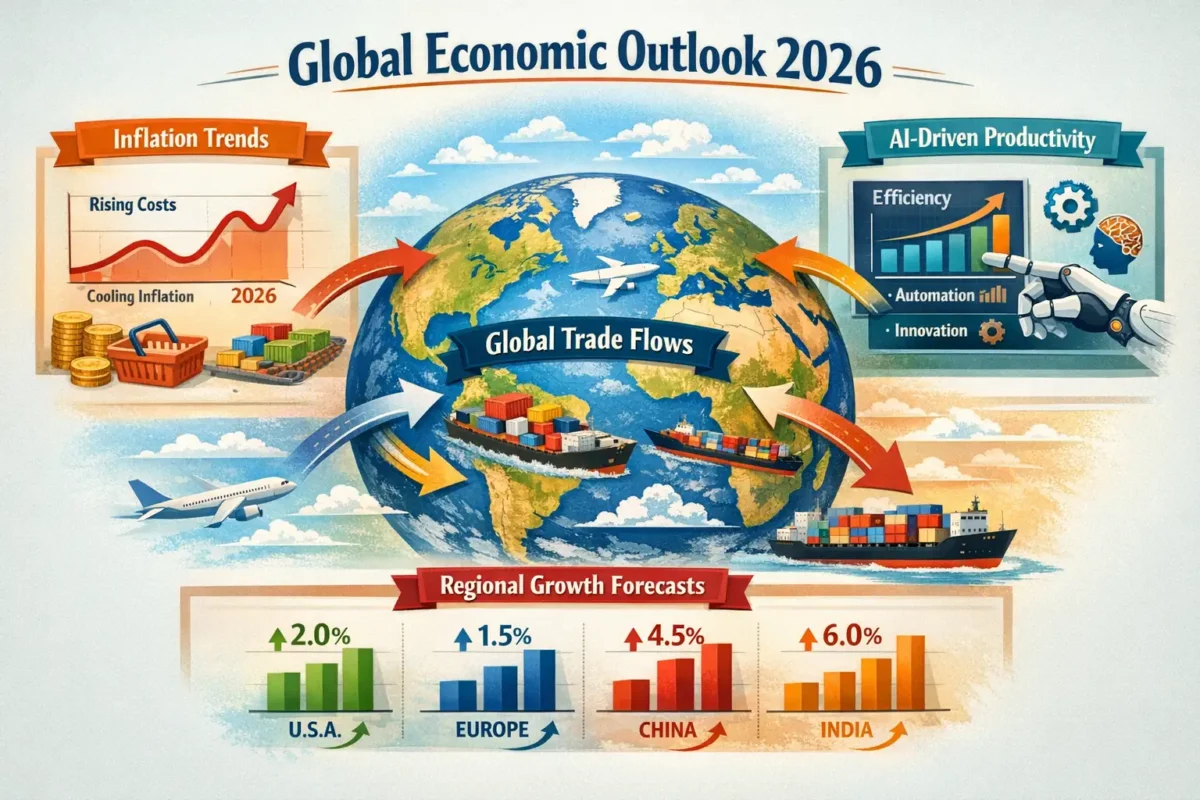
The global economic outlook 2026 varies significantly by region. The United States is expected to experience moderate growth driven by consumer spending and technological innovation. Europe faces slower growth due to demographic challenges and energy transition costs, though stability remains strong.
China’s economy is transitioning from export-led growth to domestic consumption and technology investment. While growth rates are lower than in previous decades, they are more sustainable. Emerging markets in Asia and Africa present long-term growth potential but remain sensitive to capital flows and currency volatility.
Regional growth expectations:
- United States: Stable, innovation-led growth
- Europe: Low growth, high stability
- China: Structural transition phase
- Emerging Markets: High potential, higher risk
Conclusion
The global economic outlook 2026 is defined by complexity rather than crisis. Inflation is no longer spiraling out of control, but it has not disappeared. Trade wars are reshaping globalization, making supply chains more resilient yet more expensive. Artificial intelligence offers a powerful engine for growth, but its benefits depend heavily on education, regulation, and adaptation.
For individuals and businesses, the key lesson is balance. Blind optimism ignores real risks, while excessive pessimism misses long-term opportunities. Understanding how inflation, trade policy, AI, and debt interact allows for smarter decisions, whether that means diversifying investments, upgrading skills, or planning cautiously for expansion.
Practical action in this environment means thinking long-term, staying informed, and avoiding reactive decisions based on short-term headlines. Economic cycles always evolve, but those who understand the forces behind them are better positioned to adapt and thrive.
Frequently Asked Questions
What is the global economic outlook 2026?
The global economic outlook 2026 refers to expectations for worldwide growth, inflation, trade, and financial stability in the year 2026.
Will inflation be fully under control by 2026?
Inflation is expected to be lower in many advanced economies, but some regions may still face elevated price pressures.
How do trade wars affect everyday consumers?
Trade wars often increase prices on imported goods and reduce product variety due to tariffs and restrictions.
Can AI really boost global economic growth?
Yes, AI can significantly increase productivity, which supports long-term economic growth if managed responsibly.
Is global debt a major risk in 2026?
Debt is manageable for advanced economies but poses higher risks for emerging markets with limited fiscal flexibility.
If you found value in this deep dive into the global economy, consider subscribing for future insights and updates. Tell us in the comments if this article helped clarify where the world economy may be heading in 2026.