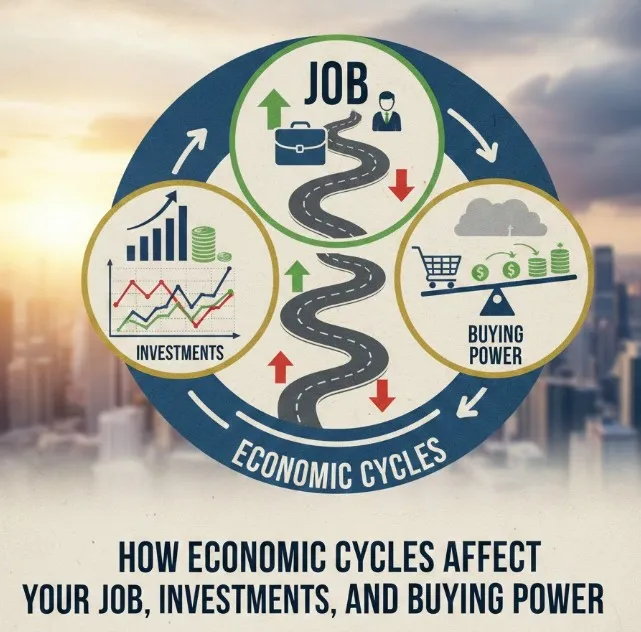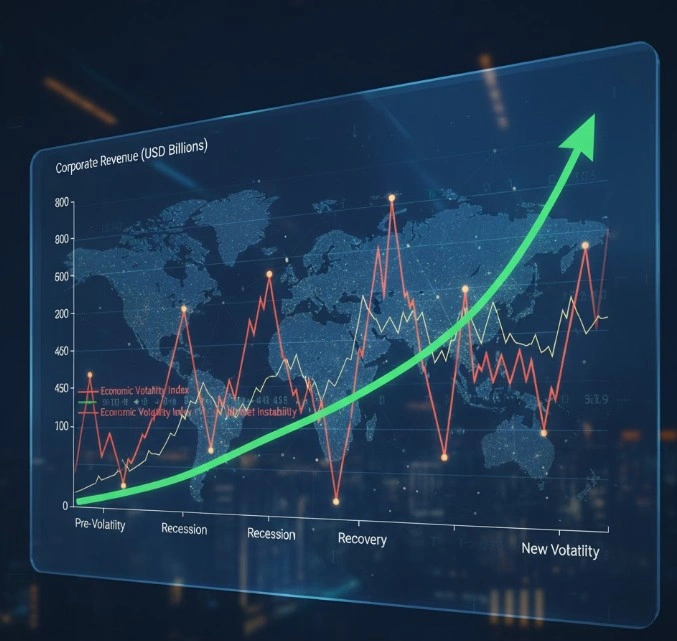
The 2025 earnings season has illuminated a complex and highly volatile global economic landscape, shaped profoundly by geopolitical risks, shifting trade policies, and persistent inflation. For investors and financial strategists, analyzing the performance of the world’s largest companies provides critical indicators regarding overall Global Economic Resilience and where opportunities for sustainable value creation lie amidst uncertainty.
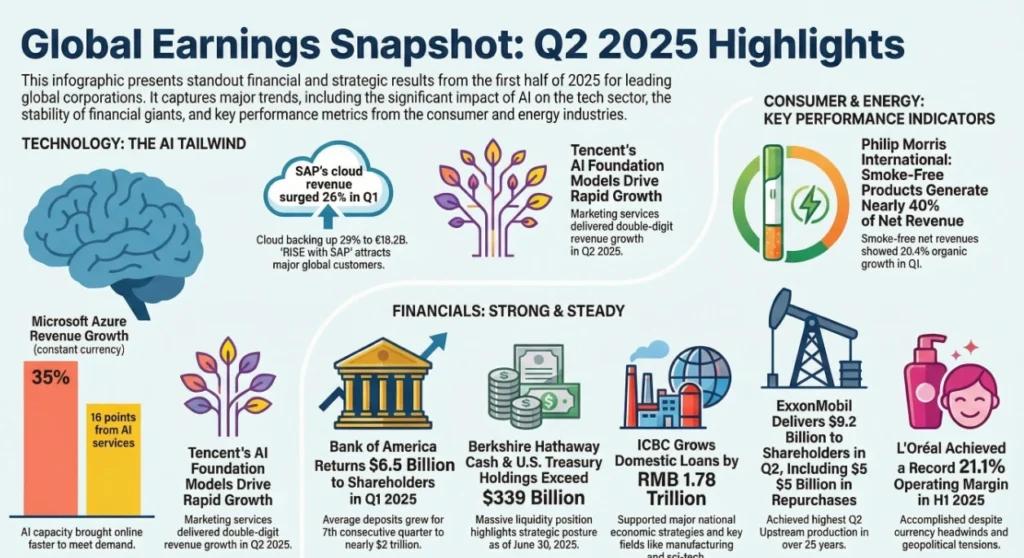
This long-form analysis dissects how major corporate entities are not only surviving macroeconomic shocks but actively leveraging strategic investments, diversification, and disciplined operations to maintain growth trajectories into 2026. Understanding these dynamic trends is crucial for navigating financial markets and positioning assets for long-term compounding.
Table of Contents
Macroeconomic Shocks: Tariffs and Foreign Exchange Volatility
The most immediate and quantifiable threats impacting multinational corporate profits are abrupt changes in global trade regulations—specifically tariffs—and sustained volatility in foreign exchange rates (FX). These factors necessitate swift operational adjustments and sophisticated financial risk management.
The Costly Calculation of Tariffs on Global Trade
Tariffs represent a direct increase in the cost of goods sold (COGS) or supply chain expenditure, often leading to pressure on margins or requiring painful choices regarding price increases for consumers.
Direct Financial Impacts:
- Automotive Sector: Toyota Motor Corporation anticipates a substantial negative impact on its operating income for the full fiscal year ending March 31, 2026, estimating a total headwind of 1,400.0 billion yen due to U.S. tariffs, with 450.0 billion yen hitting the first quarter alone. Meanwhile, Tesla noted that shifting global trade and fiscal policies create significant difficulty in planning and measuring impacts on its supply chain and cost structure. Tesla’s cost of tariffs increased by roughly $300 million sequentially in Q2 2025, primarily impacting the automotive and energy segments.
- Aerospace Manufacturing: GE Aerospace is managing heightened tariffs by leveraging duty drawbacks and expanding foreign trade zones, aiming to reduce the gross impact to a net cost of approximately $500 million for 2025. This remaining headwind is planned to be offset by SG&A cost controls and pricing actions.
- Consumer Goods: Procter & Gamble (P&G) estimates a gross annual impact from tariffs in the range of $1.0 to $1.5 billion before tax. For the fourth quarter of fiscal 2025, tariffs impacted core gross margin by 40 basis points, flowing through due to the Retail Inventory Method (RIM) accounting. In fiscal 2026, P&G anticipates approximately $1.0 billion (before tax) in higher costs from tariffs.
- Semiconductors: TSMC noted that potential tariff policies pose uncertainties and risks to end-market demand, especially in consumer-related and price-sensitive market segments. Furthermore, the eventual dilution of gross margins from overseas expansion is expected to widen, driven primarily by inflation and potential tariff-related cost increases.
Strategic Mitigation for Resilience:
Firms are responding strategically to build Global Economic Resilience against trade uncertainty by diversifying sourcing and localizing production.
- Supply Chain Diversification: Home Depot emphasizes that over 50% of its purchases are sourced domestically, and it actively diversifies its supply chain with suppliers having sourcing strategies across several countries. They anticipate that within 12 months, no single country outside the U.S. will represent more than 10% of their purchases.
- In-House Manufacturing: Johnson & Johnson (J&J) noted that if the U.S. wants to build manufacturing capacity, tax policy is a more effective tool than tariffs. J&J has committed to investing $55 billion in the U.S. over four years, aiming to manufacture nearly all advanced medicines used in the U.S. domestically at the completion of that plan. J&J’s largest product, Skyrizzy, is currently manufactured in the U.S. for the domestic market.
Foreign Exchange: The Hidden Headwind and Tailwind
Currency fluctuations remain a persistent source of noise in quarterly reports. The discrepancy between reported (nominal) results and constant currency (CC) or operational results offers investors a truer view of underlying business performance.
- Technology and Cloud: Alphabet’s Q2 2025 revenue grew 14% nominally, but only 13% in constant currency. Microsoft’s Q2 2025 revenue grew 18% nominally, translating to a 17% growth rate in constant currency.
- Consumer and Payments: Amazon reported a $1.5 billion favorable FX impact on its Q2 2025 revenue. Conversely, Mastercard reported Q2 2025 net revenue growth of 17% (reported GAAP), which was slightly lower at 16% on a currency-neutral basis.
- Pharmaceuticals: For the first half of 2025, Novo Nordisk’s sales increased 16% in Danish kroner but demonstrated 18% growth at Constant Exchange Rates (CER). For J&J, Q2 2025 reported sales growth was 5.8%, but operational growth (excluding FX) was 4.6%. FX volatility can lead to higher or lower yield dynamics depending on hedging and client mix.
The strong appreciation of the Swiss Franc against key currencies, notably the U.S. Dollar, posed a significant challenge for European multinationals in H1 2025. For Roche, the strong franc appreciation had an adverse impact on results expressed in CHF of 3 percentage points on sales and 5 percentage points on core operating profit.
Corporate Countermeasures: Investment in AI and Digital Transformation
In the face of macroeconomic uncertainty, leading companies are doubling down on long-term capital expenditure and research and development (R&D), viewing investments in AI and digital infrastructure as the key to securing future market leadership and driving margin efficiencies.
AI Investment: The New Engine for Enterprise Efficiency
A pronounced trend across major tech and enterprise software companies is the massive scaling of capital investment designed to build the necessary technical infrastructure for the AI era.
Key Investment Metrics and Targets:
- Hyperscaler CapEx: Alphabet increased its 2025 CapEx expectation from $75 billion to approximately $85 billion, largely driven by investments in servers and acceleration in data center construction to meet Cloud customer demand. Microsoft reported $24.2 billion in capital expenditures for Q4 FY 2025. Meta reported Capital expenditures of $17.01 billion in Q2 2025 and expects full-year CapEx to be in the range of $114–118 billion.
- Enterprise AI Spend: IBM reported its cumulative AI book of business has reached $7.5 billion in just six quarters. Alibaba Cloud revenue from AI-related products has maintained triple-digit year-over-year growth for the seventh consecutive quarter.
- Chip Demand: NVIDIA noted that the Blackwell ramp is the fastest in its company’s history, and AI Factory build-outs are driving significant revenue. Webscale customers placed AI infrastructure orders exceeding $2 billion for Cisco in fiscal year 2025, more than double the original $1 billion target.
The Strategic Rationale for Investment:
Management teams view AI investment as non-negotiable for long-term efficiency and competitiveness:
- Cost Management and Productivity: P&G is leveraging generative AI and digital tools, enabling substantial gross productivity savings (560 basis points in Q4 FY25). Salesforce sees Agentforce delivering digital labor, dramatically reducing the complexity and cost of routine transactions for customers like the Latin American retailer Falabella.
- Overcoming Supply Constraints: Both Alphabet and AWS noted that strong customer demand for AI products currently exceeds their available infrastructure capacity, requiring accelerated CapEx investment to close the gap.
- Ecosystem Development: Samsung is emphasizing that MX (Mobile eXperience) will establish a distinctive AI ecosystem through collaboration with global tech companies and is evolving its Galaxy AI experience from app-centric to agent-centric interfaces.
The Shift to Cloud and the Software Moat
The ongoing migration to the cloud and the expansion of subscription-based models provide revenue predictability, serving as a crucial structural advantage against turbulent spot markets.
- Cloud Growth and Backlog: Google Cloud’s annual revenue run rate now exceeds $50 billion and grew 32% in Q2 2025. Its backlog reached $106 billion, confirming sustained long-term demand. AWS, with an annualized run rate exceeding $123 billion, grew 17.5% year-over-year.
- Software Predictability: SAP highlights the resilience of its business model, noting that 86% of its revenue is now considered more predictable. Its current cloud backlog grew by 28% at constant currencies in Q2 2025.
- Subscription Power: Microsoft Cloud revenue reached $46.7 billion in Q4 FY25 (25% CC growth), sustained by continuous subscription revenue increases across M365 Commercial and Dynamics. Subscription services revenue for Amazon was $12.2 billion in Q2 2025, up 12% year-over-year. For streaming giant Netflix, revenue grew 13% nominally in Q1 2025, driven primarily by membership growth and higher subscription pricing.
Consumer Health and Market Dynamics
Corporate earnings serve as a detailed proxy for consumer health, revealing divergent spending behaviors based on income segment and necessity versus luxury goods.
Consumer Spending: Bifurcation and Resilience
While overall consumer spending remains a concern due to inflation and interest rates, companies operating in either essential categories or high-end luxury demonstrated higher degrees of resilience.
- Mass Market Pressure: McDonald’s reported that global comparable sales grew nearly 4% in Q2 2025, but noted that lower-income households continue to face high pressure, with their QSR visits declining double digits in Q2. This pressure has broadened to middle-income households, confirming a bifurcated economy.
- Essential Categories: Walmart noted that consumers are “aware, smart, and value conscious”. The retailer is responding by managing costs to keep food and consumables prices as low as possible, believing that cost pressure on general merchandise should not affect essential food prices.
- Luxury Stability: Luxury goods conglomerate LVMH showed good resilience, with local demand remaining solid in Europe and stable in the United States, despite a 3% organic decline overall due to trade tensions and abrupt currency swings impacting tourism.
- Pharmaceutical Demand: Demand for key pharmaceutical products remains robust, particularly in novel therapeutic areas. Novo Nordisk reported overall sales growth of 18% (CER) in H1 2025, driven overwhelmingly by 58% CER growth in Obesity Care. AbbVie also reported robust sales growth in its non-Humira portfolio, confirming strong demand for Skyrizi and Rinvoq.
Strategic Pricing and Portfolio Management
To defend margins against inflation and external cost pressures, companies are using strategic pricing, often coupled with innovation, while actively managing their product portfolios.
- Pricing for Value: P&G maintains that its superior products hold value even in challenging times, demonstrating that consumers are willing to choose brands that deliver performance. P&G expects pricing on tariff-impacted SKUs in the U.S. to be approximately mid-single digits.
- Innovation-led Pricing: The Coca-Cola Company’s price/mix improved by 6% in Q2 2025, primarily due to disciplined pricing actions and favorable mix. Nestlé reported accelerating pricing of 2.7% in H1 2025, specifically noting high increases in Coffee and Confectionery to offset raw material inflation.
- Portfolio Rationalization: P&G is undertaking a new restructuring program that involves streamlining its portfolio, including discontinuing certain non-strategic product/market combinations to focus energy and resources on higher value creation opportunities. Nestlé is also focused on managing underperforming business units and has initiated a strategic review of its mainstream and value Vitamins, Minerals, and Supplements (VMS) brands.
Conclusion: Key Takeaways for Financial Markets
The recent corporate earnings reports underscore that 2025 remains a year of unprecedented external complexity. However, underlying momentum driven by technological transformation (AI, Cloud) and strong consumer demand for innovative, high-value products offers a clear path toward Global Economic Resilience.
Key Takeaways and Actionable Insights:
- Investment over Austerity: Companies committing aggressively to high-CapEx, long-term AI infrastructure and R&D (Alphabet, Microsoft, Oracle, NVIDIA) are laying the groundwork for substantial future operational efficiencies and margin expansion, which will be realized as depreciation headwinds eventually subside.
- Digital Moats Win: The structural shift toward subscription and cloud-based revenue models (Microsoft, SAP, Salesforce) provides a significant buffer against cyclical economic downturns, offering investors higher certainty in revenue forecasting.
- Inflation is Managed, Not Eliminated: While businesses are offsetting input costs and tariffs through productivity and tactical pricing, investors must expect pricing to remain active, especially in essential and specialty categories like pharmaceuticals and consumables.
- Watch the Consumer Bifurcation: The stark difference in purchasing behavior between high-income segments (still resilient) and lower-income consumers (under severe pressure) suggests that consumer-facing companies must emphasize value, often through two-tiered pricing and loyalty programs (McDonald’s, Walmart).
The ability of these globally dominant firms to integrate massive capital deployment into their operational strategies demonstrates high institutional strength, positioning them to outperform competitors and drive continued, albeit uneven, global economic expansion.