Is Bitcoin an inflation hedge
Inflation shapes everyday life, from the rising cost of groceries to the value of your savings. When inflation accelerates, each unit of money buys fewer goods and services, making protecting purchasing power a core concern for investors. This reality drives the question at the heart of this article: Is Bitcoin an inflation hedge, and if so, under what conditions? That is the SEO focus primary keyword we explore deeply in this article, starting with why it matters today.
In the wake of high inflation episodes around the world, especially following the COVID-19 pandemic’s economic shockwaves and stimulus policies, investors and policymakers have scrutinized traditional inflation hedges such as gold and inflation-linked bonds. Over the past decade, Bitcoin has emerged from niche crypto culture into mainstream capital markets, prompting headlines claiming it acts like “digital gold” and preserves value during inflationary environments. But does this claim hold up under academic research and real-world evidence? This article unpacks the data, the theory, and practical implications for long-term investors.
In the sections that follow, we will:
- Clarify what an inflation hedge actually is in financial terms.
- Compare Bitcoin’s performance against traditional inflation hedges.
- Explore empirical research on Bitcoin’s inflation-hedge properties across markets and over time.
- Highlight risks and realistic expectations for investors considering Bitcoin for inflation protection.
By the end of this article, you will understand not just whether Bitcoin can hedge inflation, but why this question is more nuanced than it seems, and how that informs smarter investment decisions today.
What Does “Inflation Hedge” Really Mean?
At its core, an inflation hedge is an asset that either maintains or increases in purchasing power when the general price level rises. In simpler terms, if inflation erodes the value of cash, an inflation hedge should ideally rise in value enough to offset that erosion, thereby protecting your real wealth.
In economic terms, inflation refers to a sustained increase in the price level of goods and services, typically measured by indices such as the Consumer Price Index (CPI). A hedge is an investment that reduces financial risk, in this case, the risk that inflation weakens purchasing power.
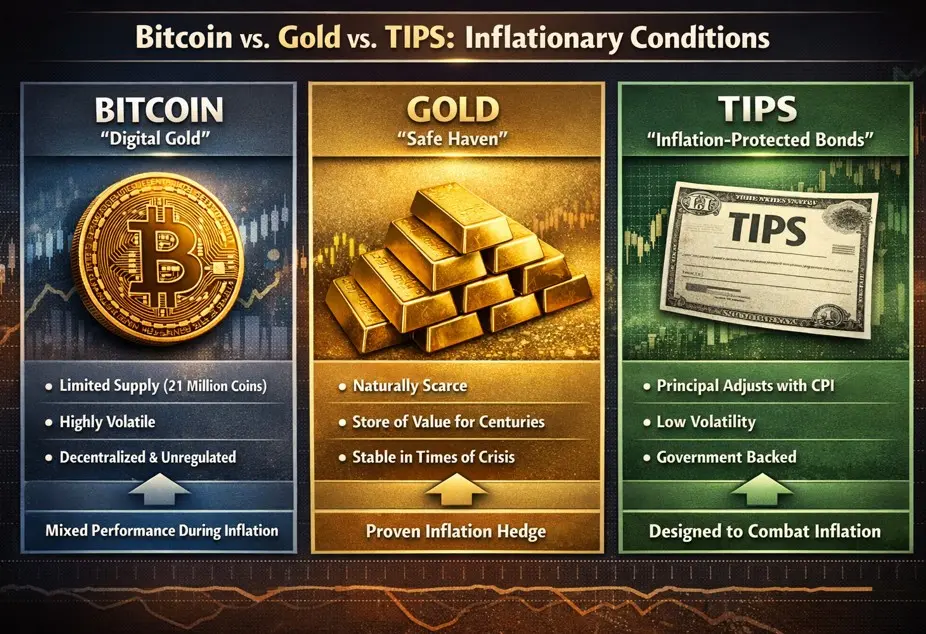
Historically, assets such as gold and Treasury Inflation-Protected Securities (TIPS) have served as inflation hedges because their prices tend to move in ways that counterbalance rising consumer prices. For instance, gold often rises during periods of currency weakness or rising inflation expectations, and TIPS adjust their principal value in line with inflation, offering explicit protection.
With Bitcoin emerging as a new asset class, its advocates argue its fixed supply cap of 21 million coins protects it from inflationary dilution, unlike fiat currencies that can expand supply via central bank policies. However, scarcity alone does not guarantee inflation-hedging behavior.
To evaluate whether Bitcoin actually behaves like an inflation hedge, we need to look at empirical evidence rather than just theoretical claims.
Bitcoin’s Theoretical Case as an Inflation Hedge
At first glance, Bitcoin appears to tick key theoretical boxes that might support inflation hedging. It has a limited supply of coins, is decentralized so no single authority can print new Bitcoin, and has growing adoption trends that increase liquidity and perceived value.
This has led commentators to frame Bitcoin as “digital gold,” an asset free from government control and inflationary dilution. However, theory and real-world behavior can diverge sharply.
For example, as S&P Global points out, while cryptocurrencies could theoretically function as inflation hedges, the historical record is too short and mixed to conclusively confirm this narrative. Low correlations between cryptocurrency returns and traditional inflation expectations suggest limited real-world inflation hedge performance to date (coindesk.com).
There is also the distinction between an inflation hedge, which offers long-run protection, and a safe haven, which protects during market stress. Bitcoin’s price behavior historically resembles a risk asset more than a safe haven. In many inflationary episodes, Bitcoin has rallied with broader risk-on markets and collapsed during risk-off periods, which is inconsistent with classical inflation hedges.
What Academic Research Says: Mixed Evidence
When we turn to academic literature, the picture becomes nuanced and sometimes contradictory, pointing to conditional or context-specific inflation-hedging properties rather than a universal claim.
Study Highlights
Recent empirical research finds the following:
- Bitcoin returns have increased after positive inflation shocks in some analyses, suggesting it can act as an inflation hedge under certain conditions. However, this effect was most pronounced in Bitcoin’s early days and appears to weaken as institutional adoption grows and market integration deepens (doity.com.br).
- A comprehensive study across multiple countries showed Bitcoin could hedge inflation in some regions and under certain market regimes, outperforming traditional assets in turbulent periods but not consistently across all contexts (mdpi.com).
- Several other studies conclude there is no significant correlation between Bitcoin’s returns and inflation, especially in developed economies, undermining the idea that Bitcoin reliably hedges inflation like gold or TIPS (amresearchreview.com).
- Independent research highlights negative Bitcoin price reactions to inflation surprises, which contradicts the notion of Bitcoin as an inflation hedge (ideas.repec.org).
The emerging consensus is that Bitcoin’s inflation hedge properties are context-dependent and not universal or stable across time and markets. For instance, results can vary depending on the inflation measure used (CPI versus PCE), time horizon, and the sample period (sciencedirect.com).

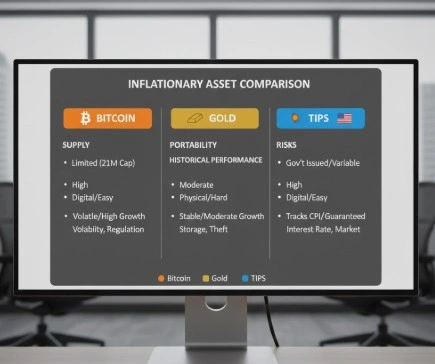
Pros and Cons: Bitcoin Compared to Traditional Inflation Hedges
| Feature | Bitcoin | Gold | TIPS (Treasury Inflation-Protected Securities) |
|---|---|---|---|
| Supply Scarcity | Yes, limited by protocol | Yes, naturally scarce | No, not limited by supply |
| Regulatory Risk | High | Moderate | Low |
| Volatility | Very high | Moderate | Low |
| Historical Inflation Hedge | Mixed evidence | Decades of partial evidence | Designed to protect from inflation |
| Safe Haven Characteristics | Unclear | Often stable in crisis | Not designed as a safe haven |
| Liquidity | High | High | High |
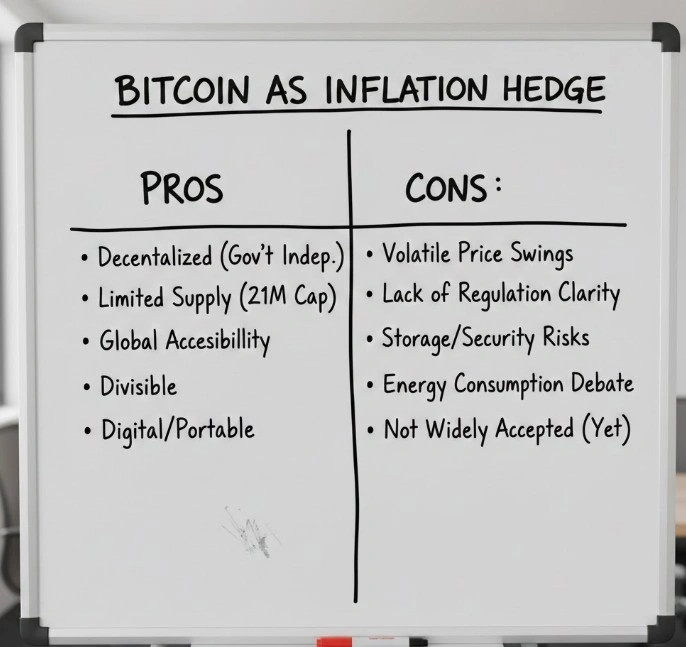
Pros of Bitcoin Inflation Hedge Narrative:
- Scarcity and fixed supply logic is easy to understand.
- Decentralized nature appeals to those skeptical of government policy.
- In some historical cases, Bitcoin has outpaced inflation over long time frames in terms of nominal returns.
Cons and Risks:
- Extreme volatility reduces reliability as a risk-reducing hedge.
- Regulatory uncertainty can sharply move the asset.
- Lack of a long, consistent empirical track record like gold or TIPS.
Long-Term Versus Short-Term Perspective
One of the biggest misconceptions in the Bitcoin inflation hedge debate is conflating long-term nominal returns with inflation-hedging properties.
Long-term nominal returns:
Bitcoin has delivered extraordinary gains over long horizons, often outpacing inflation when looking at a raw price chart. This has fueled the narrative that it protects against inflation. However, a high nominal return alone does not qualify an asset as an inflation hedge if these gains are driven primarily by speculative demand or momentum rather than a structural inflation link.
Short-term inflation linkage:
Aggregate evidence suggests Bitcoin does not consistently rise in direct response to rising inflation data points. In fact, in some studies, Bitcoin reacted negatively to inflation surprises, behavior inconsistent with an inflation hedge (ideas.repec.org).
Bitcoin’s appeal for inflation protection may be more about long-term growth expectations than predictable inflation-hedging behavior.
Practical Implications for Investors
If you are considering Bitcoin as part of an inflation-protection strategy, here are practical takeaways:
- Treat Bitcoin as a speculative overlay, not a core hedge. Unlike TIPS or inflation-linked bonds, Bitcoin’s price can swing dramatically over short periods. It may offer upside but also introduces significant risk.
- Diversify traditional hedges with Bitcoin cautiously. A modest allocation, if risk tolerance allows, might enhance diversification due to Bitcoin’s unique return drivers. However, it should complement, not replace, established hedges.
- Consider macro context and market regimes. Bitcoin has sometimes acted like an inflation hedge in volatile or risk-on market environments, but this pattern is not guaranteed.
- Time horizons matter. Your investment horizon should be explicit, whether you aim to hedge inflation structurally for decades or seek short-term speculative gains.
Conclusion: A Nuanced Answer to “Is Bitcoin an Inflation Hedge”
So, Is Bitcoin an inflation hedge? The short, honest answer is sometimes, and under specific conditions, but not reliably or universally.
Bitcoin’s unique structure and fixed supply give it theoretical appeal as an inflation hedge. However, real-world evidence paints a more complex picture. Bitcoin’s price behavior has shown links to broader risk markets, volatility spikes during financial stress, and inconsistent empirical support for inflation hedging across countries and time periods (mdpi.com).
Rather than viewing Bitcoin as a standalone answer to inflation risk, intelligent investors should see it as one piece of a diversified strategy. Traditional inflation hedges like TIPS offer direct protection, while gold provides historical refuge in turbulent times. Bitcoin may contribute diversification and asymmetric return potential but also carries speculative risk and regulatory uncertainty.
Ultimately, whether Bitcoin works for you as part of an inflation strategy depends on your risk tolerance, time horizon, and financial goals. An informed approach weighs both academic research and practical considerations, acknowledging Bitcoin’s promise without overselling its inflation hedge credentials.
Frequently Asked Questions
1. What does it mean when people say Bitcoin is a hedge against inflation?
It means people believe Bitcoin’s value will hold up or rise when inflation erodes fiat currency values. Evidence shows this relationship is not reliable.
2. How does Bitcoin compare to traditional inflation hedges like gold?
Gold has a long history as a hedge. Bitcoin’s track record is shorter and much more volatile, making its inflation hedge status less certain (mdpi.com).
3. Should I invest in Bitcoin to protect against inflation?
Only if you understand and accept the risks. Bitcoin may offer diversification, but it should not replace traditional inflation hedges.
4. Can Bitcoin protect purchasing power in countries with high inflation?
In some emerging markets, Bitcoin has been used as an alternative store of value, but volatility and access challenges mean it is not a guaranteed solution.
5. Does Bitcoin always rise when inflation rises?
No. Studies show the correlation between inflation data and Bitcoin returns is inconsistent, and Bitcoin can react negatively to inflation surprises (ideas.repec.org).
6. Is Bitcoin a safe haven during economic turbulence?
Bitcoin often behaves like a risk asset, falling in sync with equities during market stress, unlike classic safe havens.