Introduction: Building the World’s Largest Everything Store
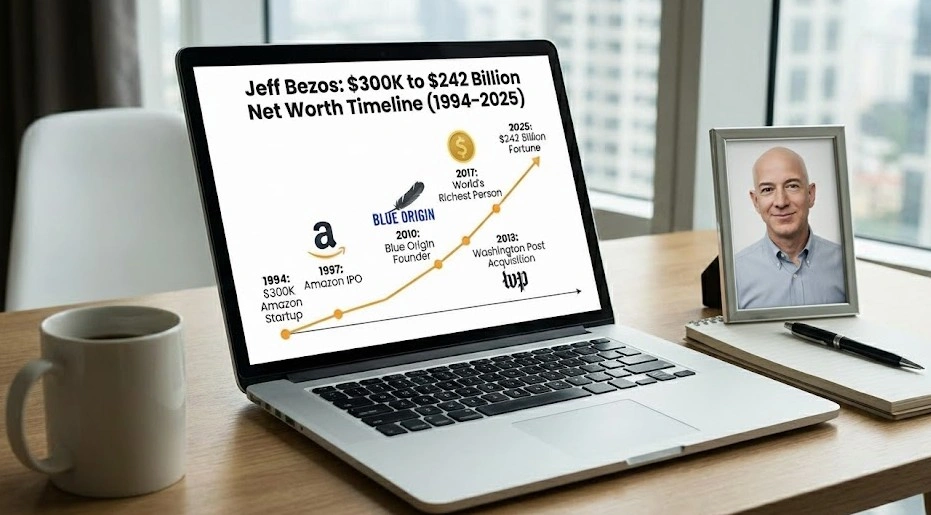
In December 2025, Jeff Bezos stands as the third richest person in the world with a net worth of approximately $242.3 billion according to Forbes. Behind Elon Musk and a select few others, Bezos remains one of the wealthiest individuals in human history, having built Amazon from a garage-based online bookstore into a $2.4 trillion e-commerce and technology empire that has fundamentally transformed how the world shops, reads, watches entertainment, and stores data.
Unlike many billionaires whose wealth stems from inheritance or a single lucky break, Bezos’ fortune represents a deliberate, methodical approach to building sustainable competitive advantages across multiple industries. From revolutionizing retail through Amazon, to redefining cloud computing with Amazon Web Services (AWS), to pioneering commercial space exploration through Blue Origin, and influencing journalism via The Washington Post, Bezos has consistently demonstrated an ability to identify and dominate emerging markets.
This comprehensive analysis traces his complete financial evolution, examining each major decision, investment, and pivot that contributed to building one of history’s most significant fortunes. Whether you’re an investor seeking to understand the principles that drove Amazon’s success, an entrepreneur looking to learn from one of the world’s most successful business builders, or simply curious about how one person accumulated such unprecedented wealth, this article provides the insights you need.
As Bezos himself once said during his 2010 Princeton commencement speech:
“We are our choices. Build yourself a great story.” This is that story.
Table of Contents
Early Life and Education: The Foundation of Future Success (1964-1994)
From Albuquerque to Princeton
Jeffrey Preston Jorgensen was born on January 12, 1964, in Albuquerque, New Mexico, to Jacklyn Gise, a 17-year-old high school student, and Ted Jorgensen, a 19-year-old. His biological father left when Jeff was a toddler. When Jeff was four years old, his mother remarried Mike Bezos, a Cuban immigrant who legally adopted Jeff, giving him the surname that would become synonymous with e-commerce.
Growing up in Houston and later Miami, Bezos displayed exceptional intelligence and entrepreneurial spirit from an early age. In high school, Bezos developed the Dream Institute, a center that promoted creative thinking in young students, demonstrating early leadership and educational vision.
Princeton and Wall Street: Building Technical and Financial Expertise
Bezos graduated summa cum laude from Princeton University in 1986 with degrees in electrical engineering and computer science. This dual expertise in technology and systematic thinking would prove invaluable in building data-driven businesses.
After graduation, Bezos worked on Wall Street in various roles, including positions at Fitel, Bankers Trust, and eventually D.E. Shaw & Co., a quantitative hedge fund. At D.E. Shaw, Bezos was promoted to senior vice president at age 26—the firm’s youngest ever in that position—putting him in charge of examining investment possibilities in the burgeoning Internet market.
As former Amazon chief scientist Andreas Weigend explained: “David Shaw was the one who revolutionized Wall Street by introducing data. And I think Jeff really embraced that, that idea that, ‘hey, if you have data, ultimately, you win.'”
Financial Snapshot (1994):
- Net Worth: Modest savings from Wall Street career
- Primary Asset: Technical and financial expertise
- Annual Salary: Approximately $1 million+ as senior vice president at D.E. Shaw
The Amazon Decision: Calculated Risk and the “Regret Minimization Framework” (1994)
The Awakening: 2,300% Growth Statistics
In spring 1994, Bezos read that web usage was growing at a rate of 2,300% a year. This statistic became his “wake up call,” as he later described it.
As Bezos recounted: “The wake up call was finding this startling statistic that web usage in the spring of 1994 was growing at 2,300 percent a year. You know, things just don’t grow that fast. It’s highly unusual, and that started me about thinking, ‘What kind of business plan might make sense in the context of that growth?'”
The Product Selection Process
After making a list of the “top 20” products that he could potentially sell on the internet, he decided on books because of their low cost and universal demand. The other finalists included compact discs, computer hardware, computer software, and videos.
Books won for several strategic reasons:
- Low unit price minimized customer purchase risk
- Enormous selection (millions of titles in print)
- Universal demand across demographics
- Difficult for traditional retailers to stock comprehensive inventories
- No need to sample before purchase (unlike music or clothing)
The Cross-Country Journey
The choice of Seattle was strategic: proximity to Microsoft meant abundant software engineering talent from nearby University of Washington, and the location outside California avoided sales tax obligations that would have disadvantaged the startup against California-based competitors.
Garage Beginnings: Building Amazon 1.0 (1994-1997)
Initial Capital and First Employees
Bezos initially invested $10,000 of his own money and took out $84,000 in loans over the first year. More significantly, he accepted approximately $245,573 (equivalent to $506,800 in 2024) from his parents as an investment, though he warned them there was a 70% chance they’d never see their money again.
If his parents never sold a share of their initial investment, Bloomberg estimates that their stake would have been worth $3.80 billion at peak valuations—representing a return of approximately 1,550,000% on their investment.
The first employee was Shel Kaphan, who began building and designing a rudimentary website. Kaphan, whom some consider a co-founder, later reflected: “I mean, nobody at the beginning had any clue how big Amazon could become. Nobody. Certainly not Jeff. I have spreadsheets of his projections from when he was trying to hire me. And I don’t remember the specific numbers, but it was a lot, lot smaller than it turned out to be.”
The “Door Desk” Culture
The famous “door desk” emerged from necessity—Bezos bought doors from Home Depot and attached legs to them to create desks. This frugality became embedded in Amazon’s culture and remains a symbol of the company’s core values today.
Launch and Explosive Early Growth
On July 16, 1995, Amazon.com officially launched as an online bookseller. The first book ever sold was Douglas Hofstadter’s “Fluid Concepts and Creative Analogies: Computer Models of the Fundamental Mechanisms of Thought”.
Growth was immediate and explosive:
- First Week: $12,000 in sales according to HistoryLink
- Within 30 Days: Doing $20,000 per week in sales
- First Month: Shipped books to all 50 U.S. states and 45 countries
- Early Challenge: The team initially implemented a system that beeped every time a customer placed an order, but orders soon came in so quickly that the beepers had to be disabled
1995 Venture Capital: The Kleiner Perkins Investment
In 1995, Bezos raised an $8 million Series A round of funding from Kleiner Perkins Caufield & Byers, one of Silicon Valley’s most prestigious venture capital firms. This investment provided crucial capital for expansion and validated Amazon’s business model to the broader investment community.
Financial Snapshot (1995):
- Company Valuation: ~$8 million (implied by VC investment)
- Bezos’ Ownership: Majority stake
- Revenue Run Rate: $1 million+ annually
Going Public: The 1997 IPO and Becoming a Millionaire (1997-2001)
The Initial Public Offering
On May 15, 1997, Amazon listed on the Nasdaq, offering 3 million shares at an initial $18 per share. The company was valued at $438 million at IPO, and the offering raised $54 million.
As the Wall Street Journal reported at the time: “Although the company has yet to produce net profit, several analysts say…they expect the company to rake in revenue in the multimillion-dollar range within a few years.”
This marked a pivotal moment: Bezos first became a millionaire in 1997 after raising $54 million through Amazon’s initial public offering. By year-end 1997, Amazon’s stock had risen dramatically, multiplying Bezos’ paper wealth many times over.
The Dot-Com Bubble Ride
Bezos was first included on the Forbes World’s Billionaires list in 1999 with an estimated net worth of $10.1 billion, placing him 19th in the world and 10th in the USA. Amazon’s stock had shot up almost 40-fold from its IPO price, sending Bezos’s personal fortune above $12 billion.
However, the dot-com bubble’s burst in 2000-2001 was brutal. His net worth decreased to $6.1 billion a year later—a 40.5% drop. By the time the technology bubble had finished deflating in 2001, his shares were valued at less than $2 billion.
The Barnes & Noble Battle
As Amazon grew, traditional booksellers took notice. Barnes & Noble launched a lawsuit against Amazon because the online business used the phrase “the world’s largest bookstore.” Barnes & Noble claimed this was false because Amazon wasn’t a bookstore at all, but rather a book broker. The companies settled out of court for an undisclosed sum, and Amazon continued using the phrase.
Even more telling, Bezos and his tiny team often held meetings at a local Barnes & Noble in the early days—strategizing in the aisles of the nation’s largest brick-and-mortar book chain. When Barnes & Noble’s founders met with Bezos in 1996 and warned that their own online venture would eclipse Amazon, Bezos responded by doubling down with his “Get Big Fast” strategy.
Surviving the Dot-Com Crash: Amazon’s First Profit (2001-2003)
The Long Road to Profitability
Unlike most dot-com companies that prioritized quick profitability to satisfy investors, Amazon did not expect to make a profit for four to five years. This patience, while causing stockholders to complain, ultimately saved the company.
In 2001, the dot-com bubble burst, destroying many e-companies in the process, but Amazon survived. The company finally turned its first profit in the fourth quarter of 2001: $0.01 per share on revenues of more than $1 billion.
As Fortune reported: “Unlike many dot-com era founders, Bezos eschewed the lure of quick profits, instead prioritizing scale at the expense of short-term returns.”
This profit margin, though extremely modest, proved to skeptics that Bezos’ unconventional business model—building infrastructure and customer base before extracting profits—could succeed.
Financial Snapshot (2001):
- Net Worth: ~$2 billion (post dot-com crash low)
- Amazon Revenue: $1+ billion
- Amazon Profit: $0.01 per share (first profitable quarter)
- Bezos’ Ownership: Significant majority stake
Building the Everything Store: Expansion Beyond Books (2003-2010)
Diversification Strategy
Although Amazon was originally an online bookstore, Bezos had always planned to expand to other products. By the mid-2000s, Amazon had systematically expanded into:
- Music and DVDs (late 1990s)
- Electronics and toys (early 2000s)
- Clothing and jewelry (mid-2000s)
- Cloud computing services—Amazon Web Services/AWS (2006)
- Digital content with Kindle (2007)
The Kindle, launched in 2007, represented a particularly bold bet—Amazon entering hardware manufacturing to control the entire book ecosystem from creation to consumption.
Amazon Prime: The Loyalty Revolution
In February 2005, Amazon launched Amazon Prime, offering unlimited two-day shipping for a flat annual fee. As CEO Jeff Bezos said in a statement at the time:
“Amazon Prime is ‘all-you-can-eat’ express shipping. Though expensive for the Company in the short-term, it’s a significant benefit and more convenient for customers.”
The offering didn’t become widely popular until years later, but by 2018 it reached over 100 million subscribers, creating a massive moat around Amazon’s core business through customer lock-in.
The Early Investment Portfolio
Beyond Amazon, Bezos makes personal investments through his venture capital vehicle, Bezos Expeditions. His most famous early investment: he was one of the first shareholders in Google, investing $250,000 in 1998.
That $250,000 investment resulted in 3.3 million shares of Google stock (6.6 million after the 2014 stock split), worth approximately $3.1 billion at its peak—representing a return of over 1,200,000%.
Key Investments via Bezos Expeditions:
- Google (1998): $250,000 → $3.1 billion
- Airbnb (early investor)
- Uber (early investor)
- Twitter (early investor)
- Unity Biotechnology (life-extension research)
- Various healthcare and AI companies
Blue Origin: Betting on Space (2000-Present)
The Secret Space Company
In 2000, Blue Origin was founded with the mission of space travel. Bezos is both the owner and founder, keeping it entirely private and self-funded.
The company remained largely secret for its first several years, with Bezos funding development through systematic sales of Amazon stock. As Bezos said in April 2017, he funds the enterprise through the sale of “about $1 billion a year of Amazon stock.”
In 2021 the amount was increased to $2 billion as the company performed its first human-crewed flights and Bezos’s share sales accelerated.
First Human Flight: Bezos Goes to Space
On July 20, 2021, Bezos himself flew to space aboard Blue Origin’s New Shepard vehicle, crossing the Kármán line (the boundary of space) just nine days after Richard Branson’s Virgin Galactic flight. The flight represented both personal fulfillment and marketing for Blue Origin’s space tourism business.
Current Valuation
Blue Origin remains privately held with no public shareholders. Estimates for its valuation range widely from $10 billion to $50 billion, though accurate valuation is difficult given the unique nature of the space industry and Bezos’s sole ownership.
Since 2002, Bezos has sold roughly $48 billion worth of Amazon shares, with a significant portion funding Blue Origin. This represents one of the largest personal investments in space exploration in history.
Blue Origin Financial Impact:
- Investment to Date: $3.5+ billion (conservative estimate)
- Estimated Current Value: $10-50 billion range
- Business Model: Space tourism, government contracts, launch services
- Long-term Vision: Millions of people living and working in space
The Washington Post: Media Ownership (2013-Present)
The Surprising Acquisition
In August 2013, Bezos paid $250 million in cash to purchase The Washington Post, one of America’s most prestigious newspapers.
Many believed the Post was only worth $60 million at the time, but Bezos paid a premium—likely because he saw opportunity to apply Amazon’s digital and technology expertise to transform a struggling traditional media company.
As Bezos once wrote of the deal: “If it were hopeless, that would not be something I would get involved in. I looked at the Post’s situation, and I was super optimistic, but it needed to be transitioned into a national and a global publication. There’s one gift the internet brings newspapers. It destroys almost everything, but it brings one gift, and that is free global distribution.”
Transformation and Controversy
Under Bezos’ ownership, The Washington Post successfully transitioned to a digital-first model, dramatically expanding its subscriber base and achieving profitability. However, the ownership has not been without controversy.
In October 2024, in the final days of the 2024 presidential election, The Post found itself embroiled in controversy over its decision not to endorse a candidate, despite the Editorial Board having drafted an endorsement of Vice President Kamala Harris. The decision was made by Bezos, who argued in an op-ed that endorsements only increased public mistrust of the news media.
Readers reacted with outrage, and within days some 200,000 subscriptions—about 8%—had been canceled.
Washington Post Investment:
- Purchase Price: $250 million (2013)
- Current Estimated Value: $500 million – $1 billion
- Status: Profitable under Bezos ownership
- Strategic Value: Media influence, information access, prestige
The Wealth Explosion: Becoming the World’s Richest (2017-2020)
Crossing the Centibillionaire Threshold
Bezos was named the “richest man in modern history” after his net worth increased to $150 billion in July 2018. He became the first centibillionaire on the Forbes Real Time Billionaires Index and the second person ever to achieve this feat since Bill Gates in 1999.
The wealth explosion was driven primarily by Amazon’s stock performance. Between 2017 and 2020, Amazon’s market capitalization grew from approximately $400 billion to over $1.5 trillion, with Bezos maintaining a significant ownership stake.
In August 2020, according to Forbes, he had a net worth exceeding $200 billion—making him only the second person in history to reach this milestone.
The Divorce: $38 Billion Becomes $38 Billion
On January 9, 2019, after 25 years of marriage, Jeff and MacKenzie Bezos announced their divorce. The settlement, finalized in April 2019, became one of the most expensive in history.
MacKenzie Scott received approximately $38 billion in Amazon stock—about 25% of their combined Amazon holdings, or 4% of the company. This represented roughly 19.7 million shares worth $38.3 billion when finalized.
Notably, she also received:
- Voting control of her shares transferred to Jeff
- Jeff retained 100% ownership of Blue Origin
- Jeff retained 100% ownership of The Washington Post
According to Forbes, MacKenzie Scott has donated over $19 billion in the five years following the divorce, yet her net worth remains at approximately $32 billion due to Amazon stock appreciation—demonstrating how extreme wealth can grow faster than even massive philanthropic giving.
In contrast, Bezos has given away approximately $2.28 billion in his lifetime according to Forbes estimates—far less than his ex-wife despite having vastly more wealth.
Divorce Impact:
- Settlement Value: $38 billion (April 2019)
- Post-Divorce Bezos Net Worth: ~$110 billion
- Ownership Reduction: Lost 25% of Amazon shares but retained voting control
- Continued Growth: Both parties’ wealth continued increasing post-divorce
Stepping Down: The CEO Transition (2021)
Passing the Torch
On July 5, 2021, Bezos stepped down as the CEO and president of Amazon and took over the role of executive chairman. Andy Jassy, former CEO of Amazon Web Services, succeeded Bezos as CEO and president.
This transition allowed Bezos to focus on:
- Blue Origin and space exploration
- The Bezos Earth Fund and climate initiatives
- Day 1 Fund and other philanthropic projects
- Personal interests including his relationship with Lauren Sánchez
Despite stepping down as CEO, Bezos retained significant influence through his executive chairman role and substantial ownership stake.
Amazon’s Continued Growth Without Its Founder
Amazon has continued thriving under Jassy’s leadership. The company’s market cap reached approximately $2.379 trillion as of November 2024, placing it among the world’s five most valuable companies alongside Nvidia, Apple, Microsoft, and Alphabet.
Amazon’s stock price closed at $222.77 a share on November 18, 2024, up about 10% over the past year.
Current Status and Recent Developments (2023-2025)
Marriage to Lauren Sánchez
Bezos got engaged to Lauren Sánchez, a former Fox News anchor and helicopter pilot, in May 2023. The couple married in Venice on June 27, 2025, with the ceremony attracting mainstream media attention and various celebrities, including Oprah Winfrey, Leonardo DiCaprio, Kim Kardashian, and Tom Brady.
The wedding reportedly cost between $40-46 million, with multiple days of festivities at historic Venetian venues. According to Italian media reports, Sánchez signed a prenuptial agreement reportedly worth approximately $60 million—a fraction of Bezos’ wealth but substantial nonetheless.
Real Estate Empire
Bezos has expanded his residential holdings to approximately $700 million across Miami, Beverly Hills, and Washington, D.C. He also owns:
- A $78 million estate on La Perouse Bay in Maui (purchased 2022)
- A $16.1 million apartment in Manhattan’s Flatiron neighborhood
- A $500 million superyacht (Y721), the largest yacht in the world
- A $75 million support vessel with helicopter landing capabilities
Additionally, it is estimated that Bezos owns nearly 400,000 acres of land, much of it in Texas, with a very rough estimate valuing this land at around $1.21 billion.
Current Net Worth and Wealth Composition
As of December 18, 2025, Bezos has an estimated net worth of about $242.3 billion according to Forbes, ranking him as the third wealthiest person in the world behind Elon Musk ($496.9 billion), Larry Ellison ($269.9 billion), Larry Page ($263.4 billion), and Sergey Brin ($243 billion).
Approximately 90% of Bezos’ fortune lies in his Amazon stocks, making his net worth highly volatile and dependent on market performance.
Current Wealth Breakdown (December 2025 Estimate):
| Asset | Estimated Value | Percentage |
|---|---|---|
| Amazon Stock (8% ownership) | $190-200 billion | 78-83% |
| Blue Origin (estimated) | $10-50 billion | 4-21% |
| The Washington Post | $500 million – $1 billion | 0.2-0.4% |
| Real Estate Portfolio | $700 million – $2 billion | 0.3-0.8% |
| Bezos Expeditions (various investments) | $5-10 billion | 2-4% |
| Cash and other liquid assets | Variable | <5% |
Philanthropy: The Bezos Earth Fund
In 2020, Bezos launched the Bezos Earth Fund with a $10 billion pledge to fight climate change. As of 2025, he has distributed $2 billion of that pledge.
Bezos has also established:
- Day 1 Families Fund: Financing night shelters and day care centers
- Bezos Academy: A network of Montessori-inspired preschools in under-resourced communities
Forbes ranked Bezos at No. 9 on its 2025 list of America’s Most Generous Philanthropists, with lifetime givings at $4.1 billion, representing just 1.6% of his net worth.
In stark contrast, his ex-wife MacKenzie Scott has given away $19.25 billion (36% of her net worth), making her the fifth most philanthropic billionaire in America according to Forbes.
Bezos has pledged to give away the majority of his fortune during his lifetime, though without a formalized plan or exact timeline.
Investment and Wealth Creation Lessons from Bezos
1. Long-Term Thinking Over Short-Term Profits
Perhaps Bezos’ most defining characteristic is his willingness to sacrifice short-term profits for long-term market position. Amazon operated at or near break-even for years, reinvesting every dollar into infrastructure, selection, and customer experience.
As Bezos wrote in his famous 1997 letter to shareholders, which he continues to attach to annual reports: “It’s All About the Long Term.”
Key Takeaway: Building sustainable competitive advantages requires patient capital. Companies optimizing for quarterly earnings often sacrifice long-term value creation.
2. Obsessive Customer Focus
Bezos famously leaves an empty chair in meetings to represent the customer—the most important person in the room. This obsession with customer experience drove innovations like:
- One-Click ordering
- Amazon Prime two-day shipping
- Customer reviews and ratings
- Hassle-free returns
- AWS’s pay-as-you-go pricing
Key Takeaway: In competitive markets, sustainable advantages come from delivering genuinely superior customer experiences, not just matching competitors.
3. Embrace High-Consequence Decisions
Bezos distinguishes between “one-way door” decisions (hard to reverse) and “two-way door” decisions (easily reversible). He advocates moving quickly on two-way doors but taking time on one-way doors.
His biggest one-way door decisions:
- Leaving Wall Street to start Amazon (1994)
- Taking Amazon public (1997)
- Investing in Blue Origin ($3.5+ billion)
- Buying The Washington Post ($250 million)
- Transitioning from CEO to Executive Chairman (2021)
Key Takeaway: Some decisions are truly irreversible and deserve careful consideration. Most decisions are reversible and should be made quickly with incomplete information.
4. Maintain Significant Ownership Stakes
Despite Amazon’s multiple funding rounds and his personal stock sales, Bezos still owns approximately 8.3% of Amazon as of November 2025. This ~$190-200 billion stake represents the majority of his wealth.
By comparison, many founders dilute themselves to single-digit or even sub-1% ownership through excessive funding rounds.
Key Takeaway: Preserving ownership while raising capital is crucial for founders to capture the full value of company appreciation. Every percentage point of ownership matters enormously at scale.
5. Diversify Only After Establishing Core Wealth
Bezos didn’t diversify significantly until Amazon was firmly established. His Google investment came in 1998—four years after founding Amazon and one year after its IPO. Blue Origin started in 2000, six years after Amazon.
Only after building a single massive success did he branch into other ventures through Bezos Expeditions.
Key Takeaway: Concentration builds wealth; diversification preserves it. Focus on building one great business before spreading capital across many opportunities.
6. Use Data and Metrics Ruthlessly
From his time at D.E. Shaw, Bezos learned the power of data-driven decision making. Amazon measures everything:
- Customer acquisition costs
- Conversion rates at every step
- Operational efficiency metrics
- Server costs per transaction
- Return rates by product category
Key Takeaway: “In God we trust; all others bring data.” Systematic measurement and analysis eliminate bias and enable optimization at scale.
7. Accept Extreme Volatility in Wealth
Bezos’ net worth dropped from $12 billion to under $2 billion during the dot-com crash—an 83% decline. It has subsequently swung by tens of billions in single days multiple times.
As one analysis notes, if Bezos simply parked his wealth in a savings account earning 1% interest, he would still increase his net worth by $2.4+ billion per year without doing anything.
Key Takeaway: Great wealth requires accepting enormous volatility. Those unable to stomach 50%+ drawdowns should avoid concentrated equity positions.
The Competitive Landscape: Bezos vs. Other Billionaires
The Wealth Rankings (December 2025)
As of December 18, 2025, Bezos ranks third globally:
- Elon Musk: $496.9 billion
- Larry Ellison: $269.9 billion
- Larry Page: $263.4 billion
- Sergey Brin: $243 billion
- Jeff Bezos: $242.3 billion
Notably, three of the top five (Page, Brin, and Bezos) are directly connected through Google—Bezos’ early $250,000 investment and the founders’ creation of the company.
Time to Wealth: A Shocking Comparison
At this median income, it would take the average worker approximately 3.8 million years to earn Bezos’ current net worth. Considering the average U.S. life expectancy is 78.4 years, an average American would need to live approximately 48,500 lifetimes to accumulate equivalent wealth.
Amazon’s Position Among Tech Giants
Amazon’s market cap of about $2.379 trillion as of November 2024 places it fifth among the world’s most valuable companies:
- Nvidia: $4.442 trillion
- Apple: $3.968 trillion
- Microsoft: $3.670 trillion
- Alphabet: $3.439 trillion
- Amazon: $2.379 trillion
Controversies and Criticisms
Worker Treatment and Warehouse Conditions
In 2011, The Morning Call newspaper in Allentown, Pennsylvania exposed deplorable working conditions in an Amazon warehouse. The paper reported that Amazon was hiring paramedics and ambulance drivers to treat workers collapsing in warehouses without air conditioning. At one point, the heat index reached 102 degrees Fahrenheit, and 15 workers collapsed.
This ignited ongoing scrutiny of Amazon’s treatment of warehouse workers, leading to:
- Union organization efforts, including the first successful U.S. Amazon union in Staten Island in 2022
- Multiple investigations into labor law violations
- Criticism over metrics-driven management and high injury rates
Antitrust and Market Power Concerns
Amazon’s dominance across multiple sectors has attracted antitrust scrutiny:
- Control of e-commerce marketplace platforms
- Alleged preferential treatment of Amazon-branded products
- Market power in cloud computing through AWS
- Vertical integration creating conflicts of interest
Philanthropy Gap
Despite his enormous wealth, Bezos’ relatively modest philanthropic giving compared to peers like Bill Gates, Warren Buffett, and even his ex-wife MacKenzie Scott has drawn criticism.
Forbes ranked Bezos at No. 9 on its 2025 list of America’s Most Generous Philanthropists with lifetime givings of $4.1 billion—just 1.6% of his net worth. In contrast, MacKenzie Scott has given away $19.25 billion (36% of her net worth).
The Sánchez Wedding Backlash
Bezos’ June 2025 wedding to Lauren Sánchez in Venice faced severe criticism for being disruptive and worsening the city’s ongoing struggle against overtourism. The lavish celebration, with its parade of celebrities and $40+ million price tag, struck many as tone-deaf given global economic challenges.
Future Outlook and Growth Catalysts (2025 and Beyond)
Amazon’s Continued Evolution
Several factors could drive Amazon’s valuation higher:
- AI Integration: Amazon’s integration of generative AI across retail, AWS, and Alexa could drive new revenue streams
- AWS Growth: Cloud computing continues expanding, with AWS maintaining market leadership
- Advertising Business: Amazon’s ad business has become a significant revenue driver, competing with Google and Meta
- Healthcare Initiatives: Amazon’s moves into healthcare and pharmacy could open massive markets
- International Expansion: Growing middle classes in developing markets present expansion opportunities
Blue Origin’s Commercial Promise
Blue Origin has secured government contracts and is developing launch vehicles for satellite deployment and space tourism. If successful, the company could:
- Compete with SpaceX for government and commercial launch contracts
- Establish profitable space tourism operations
- Develop orbital capabilities for satellite deployment
- Pursue Bezos’ long-term vision of space manufacturing and habitation
Downside Risks
Several factors could reduce Bezos’ wealth:
- Regulatory Actions: Antitrust enforcement could force Amazon breakup or operational restrictions
- Competitive Pressure: Rising competition from Shopify, Walmart, Chinese retailers, and cloud competitors
- Economic Downturn: Recession could reduce consumer spending and corporate IT budgets
- AWS Commoditization: If cloud services become commoditized with compressed margins
- Stock Market Correction: A broader market decline would impact Amazon’s valuation
Likelihood of Becoming World’s Richest Again
While currently third, Bezos could reclaim the #1 position if:
- Amazon stock significantly outperforms Tesla (Musk’s primary asset)
- Musk’s net worth declines due to Tesla stock volatility or Twitter/X losses
- AWS and advertising revenues exceed expectations
- Blue Origin achieves major milestones, increasing its valuation
However, with Musk currently ahead by ~$255 billion, Bezos would need either extraordinary Amazon performance or significant Musk wealth reduction to regain the top spot.
Conclusion: Key Takeaways and Lessons for Investors
Jeff Bezos’ journey from a Princeton graduate earning a Wall Street salary to the world’s third-richest person with $242 billion represents one of the most remarkable wealth creation stories in human history. His path offers critical insights for investors, entrepreneurs, and anyone seeking to understand modern wealth accumulation.
For Investors:
- Patient Capital Wins: Amazon took 6 years to turn its first profit and over a decade to generate meaningful earnings. Investors who held through this period generated life-changing returns.
- Sustainable Competitive Advantages: Amazon built multiple moats—network effects, economies of scale, switching costs, and brand—that competitors struggle to overcome two decades later.
- Founder-Led Companies: Bezos’ long-term orientation as founder-CEO enabled Amazon to make decisions no professional manager accountable to quarterly results could make.
- Platform Businesses Scale Exponentially: Amazon’s marketplace platform and AWS infrastructure businesses exhibit network effects and economies of scale that traditional retailers cannot match.
- Customer Obsession Creates Value: Companies genuinely optimizing for customer experience rather than short-term extraction build sustainable businesses.
For Entrepreneurs:
- Start with a Wedge: Amazon began with books—a narrow, defensible wedge into retail—before expanding to “everything.”
- Maintain Ownership: Bezos’ 8% stake, while diluted from 100%, still represents ~$190 billion because he avoided excessive dilution.
- Reinvest Aggressively: Amazon reinvested profits into infrastructure, technology, and expansion rather than extracting cash.
- Day 1 Mentality: Bezos’ philosophy that every day should be approached as Day 1 prevented complacency as Amazon grew.
- Hire and Retain Exceptional Talent: Building a culture that attracts and retains top talent creates compounding advantages.
For Personal Finance:
- Concentrated Wealth vs. Diversified Wealth: Bezos built wealth through extreme concentration in Amazon, diversifying only after achieving success.
- Paper Wealth vs. Liquidity: Despite a $242 billion net worth, Bezos is reportedly “cash poor,” with wealth tied up in illiquid assets.
- Strategic Asset Sales: Bezos has sold roughly $48 billion in Amazon stock since 2002, funding Blue Origin and diversifying gradually while maintaining control.
- Tax Optimization: Strategic timing of stock sales and using appreciated shares for charitable giving minimizes tax liability.
- Lifestyle Inflation Is Real: Even for Bezos, moving from garage-based startup founder to $500 million yacht owner represents dramatic lifestyle changes enabled by wealth.
Final Thoughts
As biographer Walter Isaacson noted, Bezos believes he can do more for humanity by leaving money in his companies and pursuing goals of technological advancement, space exploration, and innovation rather than through traditional philanthropy.
Whether this philosophy proves correct remains to be seen. What’s undeniable is that Bezos has fundamentally transformed how billions of people shop, how businesses manage IT infrastructure, and potentially—through Blue Origin—how humanity might eventually extend beyond Earth.
For those seeking to build wealth, Bezos’ story reinforces timeless principles: identify transformative trends early, build sustainable competitive advantages, think in decades rather than quarters, maintain ownership of your creations, and accept that exceptional returns require accepting exceptional volatility.
As of December 2025, at age 61, with interests spanning e-commerce, cloud computing, space exploration, media, and philanthropy, Bezos continues building his legacy. Whether his net worth continues its upward trajectory or faces significant corrections, his impact on business, technology, and wealth creation will be studied for generations.
The garage where it all began—a simple space with Home Depot door desks—reminds us that every great fortune starts with a single decision to begin. As Bezos said in his Princeton speech:
“We are our choices. Build yourself a great story.”
He certainly has.
Sources and Further Reading
- Benzinga: Jeff Bezos’ $241 Billion Net Worth in 2025
- Wikipedia: Jeff Bezos
- Bloomberg Billionaires Index: Jeff Bezos Profile
- Nasdaq: How Many Years to Earn Jeff Bezos’ Net Worth
- HistoryLink: Amazon – The Early Years
- Wikipedia: History of Amazon
- Fortune: Jeff Bezos Launched Amazon from a Garage
- Quartz: A Brief History of Amazon