Introduction
Every day, financial news outlets report on employment figures, inflation rates, GDP growth, and consumer confidence. But what do these numbers actually mean, and why should you care? Whether you’re an investor managing a portfolio, a business owner planning for the future, or simply someone trying to understand how the economy affects your personal finances, key economic indicators serve as your compass in navigating the complex financial landscape.
Economic indicators are statistical metrics that provide insight into the overall health and direction of an economy. They help policymakers make decisions, guide investors in allocating capital, and enable businesses to plan strategically. More importantly for everyday people, understanding these indicators helps you make better financial decisions—from timing major purchases to adjusting your investment strategy.
In this comprehensive guide, we’ll break down the most important economic indicators into digestible concepts. You’ll learn what each indicator measures, why it matters, how to interpret the data, and most importantly, how to use this information to make smarter financial decisions. By the end of this article, you’ll be able to read economic news with confidence and understand what the numbers mean for your financial future.
Table of Contents
What Are Economic Indicators?
Economic indicators are data points that measure various aspects of economic performance. Think of them as the vital signs of an economy—similar to how a doctor checks your heart rate, blood pressure, and temperature to assess your health, economists monitor these indicators to gauge economic wellness.
These indicators fall into three main categories:
Leading Indicators predict future economic activity. They change before the economy starts to follow a particular pattern, making them valuable for forecasting. Examples include stock market performance, building permits, and consumer confidence surveys.
Lagging Indicators confirm patterns that are already in progress. They change after the economy has already begun following a trend. Unemployment rates and corporate profits are classic lagging indicators.
Coincident Indicators change at approximately the same time as the overall economy, providing information about the current state of economic affairs. Industrial production and retail sales fall into this category.
Understanding the distinction between these types helps you interpret what the data is telling you about economic timing and direction.
Gross Domestic Product (GDP): The Economy’s Report Card
What GDP Measures
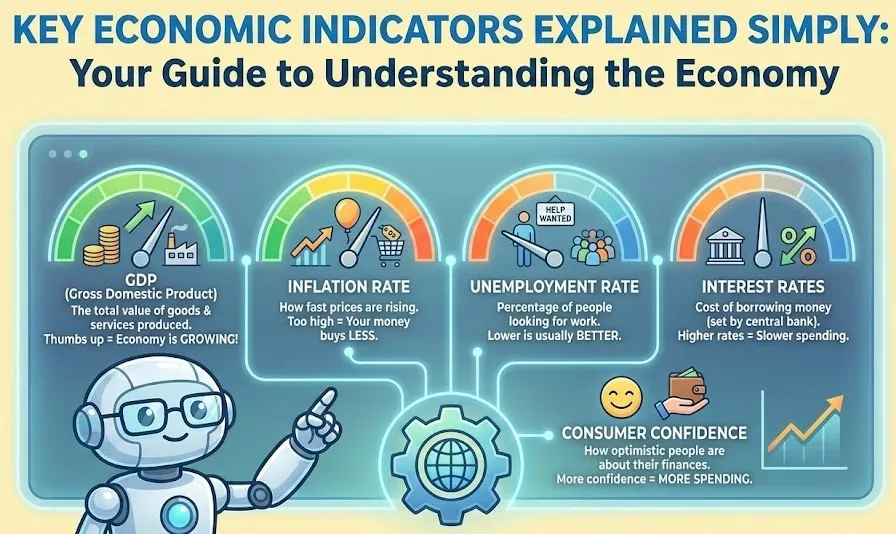
Gross Domestic Product represents the total monetary value of all finished goods and services produced within a country’s borders during a specific time period, typically measured quarterly and annually. It’s the broadest measure of economic activity and serves as the primary indicator of economic health.
GDP can be calculated through three approaches:
- Production approach: Sum of value added at each stage of production
- Income approach: Total national income plus indirect taxes minus subsidies
- Expenditure approach: Sum of consumption, investment, government spending, and net exports (C + I + G + (X-M))
Why GDP Matters
GDP growth indicates economic expansion, while GDP contraction signals recession. Two consecutive quarters of negative GDP growth officially define a recession. For investors, strong GDP growth typically correlates with higher corporate earnings and stock market performance. For consumers, GDP growth often translates to more job opportunities and wage increases.
How to Interpret GDP Data
| GDP Growth Rate | Economic Condition | What It Means |
|---|---|---|
| 2-3% annually | Healthy growth | Sustainable expansion, moderate inflation |
| 4%+ annually | Rapid expansion | Strong economy, potential overheating risk |
| 0-2% annually | Slow growth | Weak expansion, potential warning sign |
| Negative | Contraction | Recession, declining economic activity |
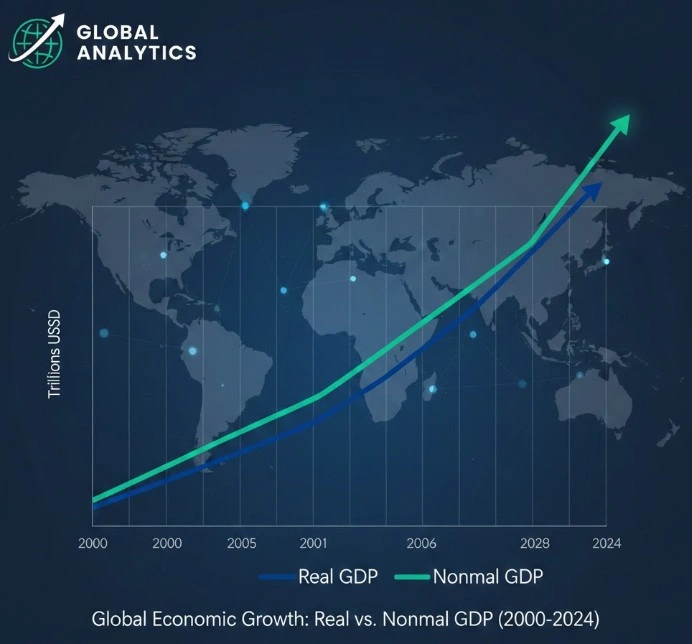
Real GDP vs. Nominal GDP: Always focus on real GDP, which adjusts for inflation, rather than nominal GDP. A 5% nominal GDP growth with 4% inflation means the economy only grew 1% in real terms.
GDP Per Capita: This metric divides total GDP by population, providing a better measure of individual prosperity and living standards than raw GDP figures.
Inflation Rates: Understanding Purchasing Power
The Consumer Price Index (CPI)
The Consumer Price Index measures the average change in prices paid by consumers for a basket of goods and services over time. It’s the most widely used inflation indicator and directly affects your purchasing power.
The CPI basket includes:
- Food and beverages (14%)
- Housing (42%)
- Transportation (17%)
- Medical care (9%)
- Education and communication (7%)
- Recreation (6%)
- Other goods and services (5%)
Core CPI vs. Headline CPI
Headline CPI includes all items, including volatile food and energy prices. Core CPI excludes food and energy to reveal underlying inflation trends. Central banks often focus on core CPI when making monetary policy decisions because it provides a clearer picture of persistent inflation.
Why Inflation Matters to You
Inflation erodes purchasing power. If your income grows at 2% annually but inflation runs at 4%, you’re effectively becoming 2% poorer each year. Understanding inflation helps you:
- Negotiate salary increases that maintain your purchasing power
- Choose investments that outpace inflation
- Time major purchases strategically
- Understand central bank policy decisions that affect interest rates
The Producer Price Index (PPI)
While CPI measures consumer prices, the Producer Price Index tracks prices at the wholesale level. PPI often serves as a leading indicator for CPI—rising producer costs eventually pass through to consumer prices.
Actionable Insight: When PPI rises significantly before CPI, expect consumer prices to follow. This might be a good time to accelerate major purchases or lock in fixed-rate loans before interest rates rise.
Employment Data: The Labor Market Pulse
Understanding the Unemployment Rate
The unemployment rate represents the percentage of the labor force actively seeking employment but unable to find work. However, this seemingly simple metric contains important nuances.
Types of Unemployment:
- Frictional unemployment: Temporary joblessness during career transitions (2-3% is normal)
- Structural unemployment: Skills mismatch between workers and available jobs
- Cyclical unemployment: Job losses due to economic downturns
- Seasonal unemployment: Predictable seasonal job losses
The U-3 vs. U-6 Unemployment Rate
The headline unemployment rate (U-3) only counts people actively seeking work. The broader U-6 measure includes:
- Discouraged workers who’ve stopped looking
- Those working part-time but wanting full-time work
- Marginally attached workers
During economic distress, U-6 provides a more comprehensive picture of labor market weakness.
Non-Farm Payrolls
Released monthly by the Bureau of Labor Statistics, the non-farm payrolls report shows how many jobs were added or lost in the economy (excluding farm workers, government employees, and non-profit workers).
What’s a healthy number? Generally, 150,000-200,000+ monthly job additions indicate a robust labor market. Consistent numbers below 100,000 suggest economic weakness.
Labor Force Participation Rate
This often-overlooked metric measures the percentage of working-age population either employed or actively seeking employment. A declining participation rate can mask unemployment problems—if discouraged workers stop looking, the unemployment rate may fall even as labor market health deteriorates.
Average Hourly Earnings
Wage growth data reveals inflation pressure and consumer spending power. Strong wage growth (3-4% annually) without corresponding productivity gains can signal inflationary pressure, potentially triggering central bank interest rate hikes.
For Your Finances: Strong employment data typically signals:
- Good time to negotiate raises or change jobs
- Growing consumer spending supporting stock markets
- Potential interest rate increases affecting mortgage and loan rates
Interest Rates and Monetary Policy
The Federal Funds Rate
The federal funds rate is the interest rate at which banks lend to each other overnight. While this might seem disconnected from your life, it’s actually the foundation for virtually all other interest rates in the economy.
How the Fed Funds Rate Affects You:
- Mortgage rates: Generally move in tandem with Fed policy
- Credit card rates: Usually adjust within one or two billing cycles
- Savings account yields: Rise when the Fed raises rates
- Auto loan rates: Follow the Fed’s direction
- Stock valuations: Higher rates typically pressure stock prices
The Yield Curve
The yield curve plots interest rates across different maturity dates for government bonds. Normally, longer-term bonds pay higher yields than short-term bonds, creating an upward-sloping curve.
The Inverted Yield Curve: When short-term rates exceed long-term rates, the curve inverts. This has preceded every recession since 1955, making it one of the most reliable recession indicators. An inverted curve suggests investors expect economic weakness and future rate cuts.
Real Interest Rates
Real interest rates equal nominal rates minus inflation. This tells you the true cost of borrowing or return on savings after accounting for inflation.
Example: If your savings account pays 2% interest but inflation runs at 3%, your real return is -1%—you’re losing purchasing power despite earning interest.
Consumer Confidence and Sentiment
Why Consumer Psychology Matters
Consumer spending drives approximately 70% of US GDP. When consumers feel confident about their financial future, they spend more, driving economic growth. When confidence falters, they pull back, potentially triggering economic slowdowns.
The Conference Board Consumer Confidence Index
This monthly survey asks consumers about:
- Current business conditions
- Current employment conditions
- Expectations for business conditions in six months
- Expectations for employment in six months
- Expected family income in six months
A reading above 100 indicates optimism; below 100 signals pessimism.
University of Michigan Consumer Sentiment Index
This similar survey provides another lens on consumer attitudes, often moving in parallel with the Conference Board index but occasionally diverging in meaningful ways.
Investment Application: Rising consumer confidence often precedes increased retail sales and stronger economic growth, potentially signaling a good environment for consumer discretionary stocks.
Retail Sales: Following the Money
Monthly retail sales data tracks consumer spending at retail establishments, providing real-time insight into economic strength since consumer spending dominates GDP.
Key Categories to Watch:
- Auto sales: Major discretionary purchase, economically sensitive
- Gasoline sales: Heavily influenced by prices, not volume
- Excluding autos and gas: Best measure of underlying consumer spending
Strong retail sales indicate:
- Consumer confidence translating to actual spending
- Healthy household balance sheets
- Potential GDP growth ahead
Weak retail sales suggest:
- Economic headwinds
- Consumer caution about finances
- Possible need for economic stimulus
Housing Market Indicators
Why Housing Matters Economically
Housing affects the economy through multiple channels:
- Construction creates jobs and demands materials
- Home purchases trigger spending on furniture, appliances, and renovations
- Rising home values increase household wealth and consumer spending
- Housing represents most families’ largest asset
Key Housing Indicators
Housing Starts: Number of new residential construction projects beginning each month. This leading indicator reflects builder confidence about future demand and economic conditions.
Building Permits: Must be obtained before construction, making this an even earlier leading indicator than housing starts.
Existing Home Sales: Measures completed sales of previously owned homes, representing the bulk of real estate transactions.
Home Price Indices (Case-Shiller, FHFA): Track changes in home values over time, affecting household wealth and refinancing activity.
Housing Affordability Index: Considers home prices, mortgage rates, and income levels to determine whether typical families can afford typical homes.
Interpreting Housing Data
| Indicator Level | Signal | Economic Implication |
|---|---|---|
| Rising housing starts | Positive | Builder confidence, future job growth |
| Declining home sales | Cautionary | Affordability issues, rising rates |
| Falling prices | Negative | Potential wealth destruction |
| Improving affordability | Positive | More potential buyers entering market |
For Your Finances: Housing market weakness often precedes broader economic problems. If you’re considering buying, improving affordability and declining prices may signal opportunity, but also potential job market weakness ahead.
Manufacturing and Industrial Production
Purchasing Managers’ Index (PMI)
The PMI surveys purchasing managers at manufacturing companies about new orders, production, employment, deliveries, and inventories. A reading above 50 indicates expansion; below 50 signals contraction.
Why PMI Matters: As a leading indicator based on forward-looking business decisions, PMI often predicts economic turning points before they appear in lagging data like GDP.
Industrial Production Index
This measures real output from manufacturing, mining, and utilities sectors. While manufacturing represents a smaller share of modern economies than historically, industrial production remains an important economic indicator because:
- Manufacturing jobs typically pay well
- Industrial activity requires significant supply chain employment
- Production trends predict future GDP
Capacity Utilization
This metric shows what percentage of industrial capacity is currently in use. High utilization (above 85%) suggests:
- Strong demand for goods
- Potential inflationary pressure from supply constraints
- Possible need for capital investment in new capacity
Low utilization (below 75%) indicates:
- Weak demand
- Deflationary pressure
- Excess supply relative to demand
International Trade Data
Trade Balance
The trade balance measures the difference between a country’s exports and imports. A trade deficit means imports exceed exports; a surplus means the opposite.
Common Misconceptions: Trade deficits aren’t inherently bad. The US has run trade deficits for decades while maintaining economic prosperity. What matters is why the deficit exists—consuming beyond production capacity signals different issues than importing capital goods for productive investment.
Why Trade Data Matters
- Currency effects: Large trade imbalances affect exchange rates
- Manufacturing health: Export trends indicate international competitiveness
- Consumer strength: Import levels reflect domestic demand
- Geopolitical factors: Trade relationships signal international economic integration
For Investors: A weakening domestic currency from trade deficits can boost export-oriented companies but increase import costs. Companies with international revenue exposure benefit from favorable exchange rates.
Putting It All Together: Reading the Economic Picture
The Economic Dashboard Approach
Rather than focusing on any single indicator, sophisticated analysis considers multiple indicators together, looking for confirmation or divergence.
Example Analysis Framework:
- Growth indicators: GDP, retail sales, industrial production
- Employment health: Unemployment rate, payrolls, wages
- Inflation pressure: CPI, PPI, wage growth
- Forward-looking: PMI, consumer confidence, yield curve
- Monetary policy: Fed funds rate, real interest rates
Strong economy scenario: Rising GDP, falling unemployment, moderate inflation, positive PMI, strong consumer confidence, normal yield curve
Recession warning scenario: Falling GDP, rising unemployment, inverted yield curve, declining PMI, weak consumer confidence
Leading vs. Lagging: Timing Matters
Smart economic analysis distinguishes between what’s happening now (lagging indicators) and what might happen next (leading indicators).
Leading indicators to watch for turns:
- Stock market (6-9 months ahead of economy)
- Building permits (3-6 months ahead)
- Consumer confidence (3-6 months ahead)
- Yield curve (12-18 months ahead of recession)
Lagging indicators confirming trends:
- Unemployment rate (confirms recession after it starts)
- Corporate profits (confirm expansion after it begins)
Practical Applications for Your Financial Life
For Investors
During Economic Expansion:
- Favor cyclical stocks (technology, consumer discretionary, industrials)
- Consider higher risk/reward investments
- International exposure may offer opportunities
- Real estate can benefit from rising values
During Economic Contraction:
- Shift to defensive stocks (utilities, healthcare, consumer staples)
- Increase fixed-income allocation
- Hold adequate cash for opportunities
- Be cautious with leverage
For Career Decisions
Strong labor market (low unemployment, rising wages):
- Excellent time to negotiate raises
- Consider career changes with less risk
- Skill development pays off faster
- Side businesses more likely to succeed
Weak labor market (rising unemployment, stagnant wages):
- Focus on job security
- Build emergency funds
- Delay discretionary career changes
- Develop recession-resistant skills
For Major Purchases
When buying a home:
- Low rates + rising prices = difficult affordability
- High rates + falling prices = potential opportunity (if job secure)
- Strong employment data = safer time for large commitments
When buying a car or making large purchases:
- Rising consumer confidence suggests stable employment
- High inflation argues for accelerating purchases
- Economic uncertainty suggests delaying discretionary spending
For Retirement Planning
Monitor inflation closely—it’s the biggest threat to fixed-income retirees. When inflation rises:
- Adjust withdrawal rates
- Consider inflation-protected securities (TIPS)
- Maintain equity exposure for inflation protection
- Review Social Security timing (benefits adjust for inflation)
Common Mistakes in Interpreting Economic Data
Mistake 1: Overreacting to Single Data Points
One month’s weak employment report doesn’t signal recession. Look for trends across multiple months and multiple indicators before drawing conclusions.
Mistake 2: Ignoring Revisions
Economic data gets revised, sometimes significantly. Initial GDP estimates can change substantially with revised data. Don’t overweight preliminary figures.
Mistake 3: Confusing Levels with Changes
Unemployment falling from 10% to 9% shows improvement even though unemployment remains high. Focus on direction and momentum, not just absolute levels.
Mistake 4: Neglecting Context
Inflation at 4% means different things depending on whether it’s accelerating or decelerating, and whether wages are keeping pace.
Mistake 5: Ignoring Regional Differences
National data masks significant regional variation. Your local economy might diverge substantially from national trends.
Where to Find Reliable Economic Data
Government Sources
- Bureau of Labor Statistics (bls.gov): Employment, wages, inflation
- Bureau of Economic Analysis (bea.gov): GDP, trade, income data
- Federal Reserve (federalreserve.gov): Monetary policy, interest rates
- Census Bureau (census.gov): Housing, retail sales, trade
Economic Calendars
Major financial websites (Bloomberg, Reuters, MarketWatch) maintain economic calendars showing when key data releases occur, consensus expectations, and historical data.
Analysis and Commentary
While raw data is valuable, expert analysis helps interpret significance. Consider:
- Federal Reserve regional bank research
- Academic economists’ blogs and papers
- Reputable financial journalism
- Investment research from major firms
Caution: Be wary of sources with obvious political bias or those making extreme predictions. The best analysis acknowledges uncertainty and considers multiple scenarios.
Conclusion: Becoming an Informed Economic Observer
Understanding key economic indicators transforms you from a passive observer to an informed participant in the financial world. You don’t need a PhD in economics to grasp these concepts—you just need to understand what each indicator measures, why it matters, and how to interpret the data in context.
Key Takeaways
- No single indicator tells the whole story: Always consider multiple indicators together to form a complete picture.
- Distinguish between leading and lagging indicators: Leading indicators help predict future conditions; lagging indicators confirm trends already underway.
- Context matters enormously: The same number means different things depending on trends, revisions, and surrounding economic conditions.
- Apply insights to your financial decisions: Use economic data to inform investment strategy, career moves, major purchases, and retirement planning.
- Stay informed but don’t obsess: Check major indicators monthly or quarterly, not daily. Economic trends develop over months and years, not days.
- Understand the Fed’s perspective: Central bank policy responds to these indicators, affecting interest rates and your borrowing costs.
- Regional variation is significant: Your local economy may diverge from national trends—pay attention to local data for personal decisions.
Action Steps
Start building your economic awareness today:
- Bookmark key data sources: Add BLS, BEA, and Fed websites to your browser.
- Set up an economic calendar: Use Bloomberg or MarketWatch to track major releases.
- Follow monthly: Track unemployment, CPI, and retail sales as your core indicators.
- Review quarterly: Analyze GDP, housing data, and trade balance each quarter.
- Connect to your finances: Before major financial decisions, check relevant economic indicators for context.
- Keep learning: Economic literacy develops over time—each data release teaches pattern recognition.
Remember, professional economists often disagree about interpretations and predictions. Your goal isn’t perfect prediction—it’s informed decision-making. By understanding key economic indicators, you’ll make smarter financial choices, identify opportunities earlier, and protect yourself from risks that others miss.
The economy affects every aspect of your financial life. The time you invest in understanding these indicators will pay dividends throughout your investment career, business planning, and personal financial journey.