Investing has always involved one critical decision: how long should you hold your investments? In an era of volatile markets, social media-driven stock tips, and instant trading apps, more investors are asking whether it’s better to adopt a long-term investing mindset or pursue short-term trading opportunities.
Both strategies can be profitable—but they come with distinct levels of risk, required skills, and psychological demands. This article explores the key differences between long-term and short-term investing, compares their performance across market cycles, and helps you identify which approach aligns with your financial goals, risk tolerance, and time horizon.
Table of Contents
What Is Long-Term Investing?
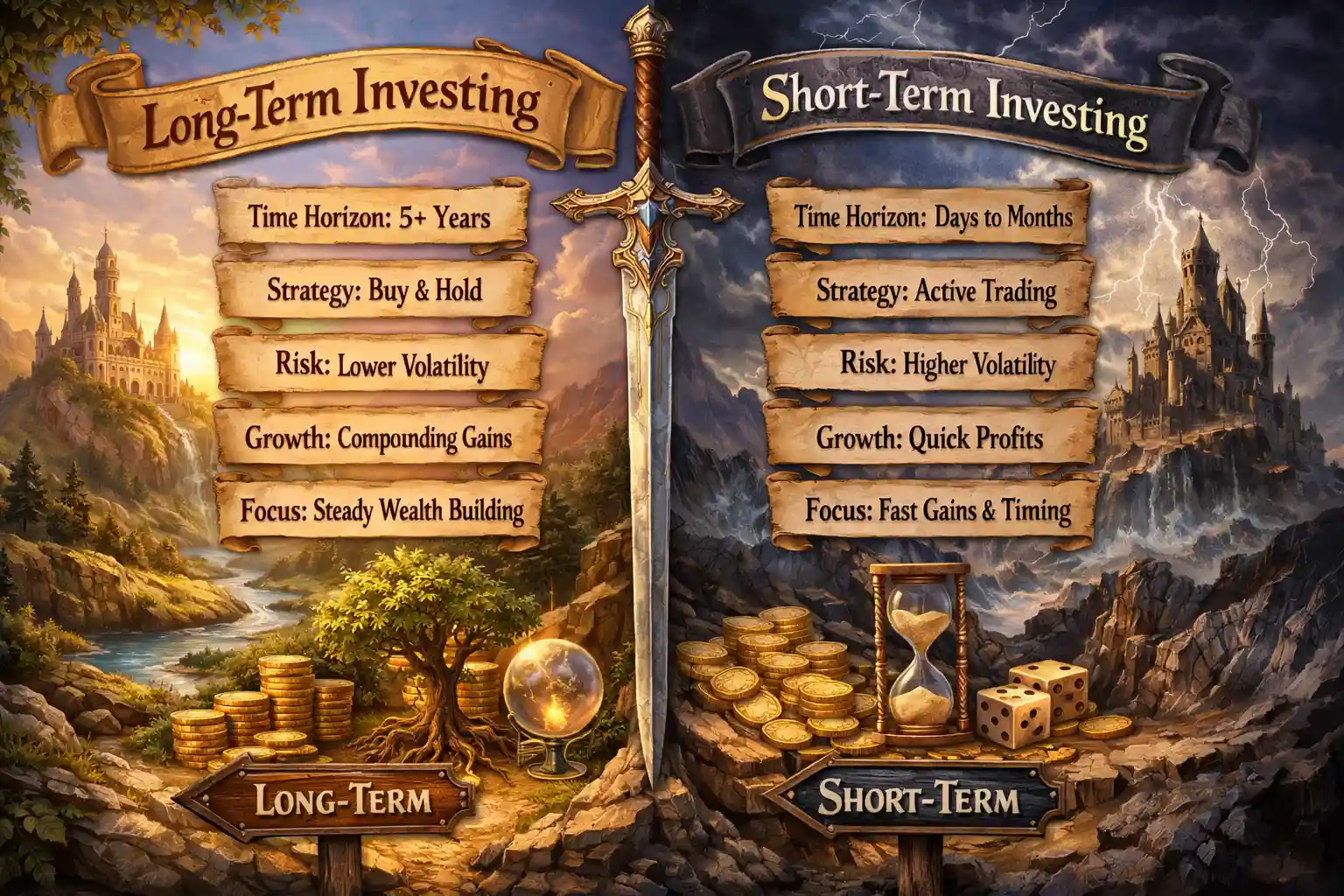
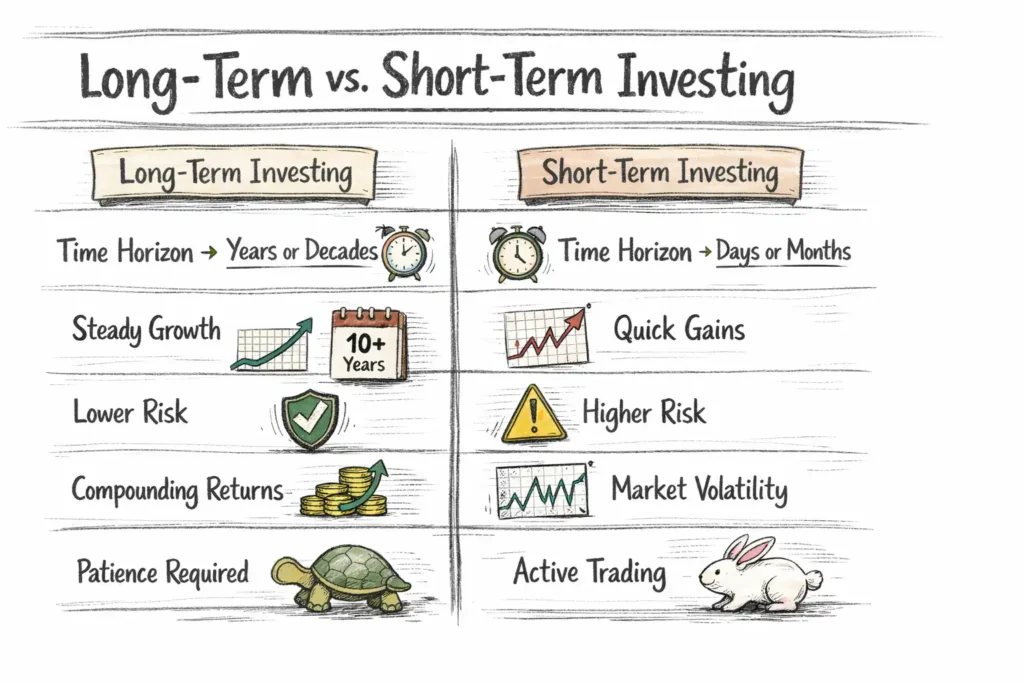
Long-term investing typically means holding assets—such as stocks, ETFs, bonds, or real estate—for five years or more. The goal is to build wealth gradually through compounding returns, dividend reinvestment, and capital appreciation.
Core characteristics:
- Time Horizon: Usually 5–30 years.
- Objective: Wealth accumulation, retirement planning, or financial independence.
- Instruments: Index funds, blue-chip stocks, bonds, and real estate.
- Approach: Passive in nature—fewer trades, focusing on fundamentals and intrinsic value.
Famed investor Warren Buffett summarizes it best: “If you aren’t willing to own a stock for ten years, don’t even think about owning it for ten minutes.”
What Is Short-Term Investing?
Short-term investing—or trading—focuses on profiting from price fluctuations over days, weeks, or months. This approach relies on market timing, technical analysis, and liquidity.
Core characteristics:
- Time Horizon: A few days to under a year.
- Objective: Capitalize on short-lived market opportunities.
- Instruments: Stocks, options, futures, forex, and leveraged ETFs.
- Approach: Active trading with constant monitoring of price action.
Short-term strategies include day trading, swing trading, and momentum investing, where precision, discipline, and risk management are essential.
Historical Performance Comparison
Data-Driven Insights: Long-Term Growth Advantage
Historical data overwhelmingly shows that long-term investors outperform short-term traders on average. Consider the S&P 500 index, which has delivered an average annual return of about 10% since 1928 (source: Morningstar).
Even when accounting for recessions and bear markets, investors who stayed invested over 20 years rarely lost money.
| Time Period | Average Annual Return (S&P 500) | Probability of Positive Return |
|---|---|---|
| 1 Year | 10.2% (highly variable) | 74% |
| 5 Years | 9.8% | 88% |
| 10 Years | 9.4% | 94% |
| 20 Years | 9.5% | 100% |
(Data source: J.P. Morgan Asset Management, 2024)
In contrast, active traders often underperform indexes due to transaction costs, emotional decision-making, and misjudged timing. A 2022 study by the University of California found that over 80% of day traders lose money after accounting for fees and taxes.
The Mechanics Behind Each Strategy
Compounding: The Long-Term Investor’s Secret Weapon
Compounding refers to the reinvestment of earnings to generate more income over time. The longer money stays invested, the greater the effect.
Example:
If you invest $10,000 at a 7% annual return, after
- 10 years → $19,671
- 20 years → $38,696
- 30 years → $76,122
That exponential curve shows how time amplifies returns—something short-term traders seldom enjoy, as they withdraw or reallocate capital frequently.
Market Timing vs. Time in the Market
Short-term investing relies on market timing—predicting price movements. Yet research by Dalbar (2023) indicates that average equity investors earned only 6.81% annually, compared to the S&P 500’s 9.4%, mainly due to poor timing decisions.
Long-term investors, however, focus on time in the market, avoiding emotional reactions to short-term volatility. Missing even a few of the market’s best days can severely cut returns:
| Investor Type | Missed Market Days | 30-Year Return (Hypothetical $10,000 starting, 9% nominal rate) |
|---|---|---|
| Fully Invested | 0 days | $132,676 |
| Missed 10 days | 10 best days | $66,132 |
| Missed 30 days | 30 best days | $32,147 |
(Source: Fidelity Investments, 2023)
This data reinforces the central lesson: trying to time the market often backfires, while staying invested yields compounding growth.
Understanding Risk and Volatility
Short-Term: High Risk, High Reward
Short-term strategies can generate quick gains—but also carry steep losses. For instance:
- Leverage can amplify returns and losses.
- Market news and liquidity risks can trigger sudden price swings.
- Frequent trading results in higher taxes and transaction costs.
Volatility index (VIX) fluctuations illustrate how unpredictable markets can be. Between 2020–2023, the VIX averaged 20.2—nearly double its 2017–2019 average—showing how unstable short-term environments have become.
Long-Term: Smoother Ride Through Volatility
Long-term investing mitigates volatility through diversification and mean reversion—over time, markets tend to revert to their historical growth trend. Even crises like the 2008 financial crash or the 2020 pandemic sell-off were followed by substantial recoveries.
Key defensive principles for long-term investors:
- Diversify across asset classes (stocks, bonds, real estate, international markets).
- Use dollar-cost averaging (DCA) to smooth entry points.
- Rebalance annually to maintain target asset allocation.
Role of Psychology in Investment Strategies
Behavioral biases strongly influence investment outcomes. Short-term traders are susceptible to:
- Overconfidence bias: Believing they can consistently outperform markets.
- Loss aversion: Cutting gains early but letting losses run.
- Herd behavior: Following popular market trends.
In contrast, long-term investors who adhere to structured plans tend to stay rational. Vanguard’s Adviser Alpha study (2022) concludes that maintaining behavioral discipline can add up to 1.5% in annual returns due to fewer emotional mistakes.
A famous quote from economist Benjamin Graham encapsulates this view:
“The investor’s chief problem—and even his worst enemy—is likely to be himself.”
Tax Efficiency and Transaction Costs
Long-Term Investors Benefit from Favorable Tax Treatment
Most countries reward long-term holdings through capital gains tax advantages. For example:
- In the U.S., long-term capital gains (assets held over a year) are taxed at 0–20%, versus up to 37% for short-term gains.
- In the UAE, investors benefit from zero personal income tax, making both strategies potentially tax-efficient—but transaction fees still erode returns.
Short-Term Investing Involves Hidden Costs
Frequent trading means:
- Higher brokerage commissions and spreads.
- Slippage losses (difference between expected and executed prices).
- Psychological fatigue—monitoring markets daily is time-consuming and stressful.
Over a 10-year period, these small frictions can reduce total returns by several percentage points—a significant disadvantage compared to long-term compounding growth.
Technology’s Role in Shaping Investment Strategies
Rise of Algorithmic and High-Frequency Trading (HFT)
Modern trading platforms enable millisecond-level trade execution and AI-driven strategies. While institutional firms profit from these tools, retail short-term investors face steep competition. Algorithms dominate over 70% of trading volume in U.S. equity markets (source: Statista, 2024).
Digital Tools Empower Long-Term Investors
Robo-advisors like Betterment, Wealthfront, or Sarwa (popular in the UAE) automate portfolio management:
- Asset allocation based on risk profile.
- Automatic rebalancing.
- Tax-loss harvesting.
This makes long-term investing more accessible and affordable for both beginners and professionals.
Case Studies: Real-World Outcomes
Case 1: The Power of Staying Invested
An investor who put $10,000 in the S&P 500 in January 2000 and never sold—despite three major downturns—would have about $67,000 by the end of 2023.
Case 2: The Short-Term Trader’s Challenge
A short-term trader trying to time those same ups and downs might have achieved impressive wins but likely suffered steep drawdowns, especially if missing sharp rebounds. Dalbar’s 2023 data shows average short-term equity investors earned less than 6% annually—far below market benchmarks.
Common Myths About Long vs. Short-Term Investing
- “Short-term trading is more profitable.”
Reality: While some traders can achieve high returns, most underperform markets over time. - “Long-term investing is boring.”
Reality: It’s actually more consistent, lower stress, and benefits from compounding. - “You must choose one or the other.”
Reality: A hybrid strategy works for many, blending stable long-term holdings with a smaller, tactical trading portfolio.
Building a Balanced Investment Strategy
Step 1: Know Your Objectives
Ask:
- Is my goal wealth accumulation (long-term) or income generation (short-term)?
- How much time can I commit to monitoring markets?
- What’s my risk tolerance?
Step 2: Allocate Assets Strategically
| Risk Level | Long-Term Allocation | Short-Term Allocation |
|---|---|---|
| Conservative | 90% long-term, 10% short-term | Focus on ETFs and bonds |
| Balanced | 70% long-term, 30% short-term | Mix of equity and swing trading |
| Aggressive | 50% long-term, 50% short-term | Higher exposure to growth stocks |
Step 3: Use Tools and Automation
- Use platforms like Interactive Brokers or eToro for integrated portfolios.
- Leverage apps that track diversification, performance, and volatility.
- Set stop-losses and trailing orders to protect short-term trades.
The Verdict: Which Strategy Wins?
From a risk-adjusted, historical perspective, long-term investing consistently wins in wealth accumulation, stress reduction, and tax efficiency. However, short-term strategies can complement portfolios for experienced traders seeking tactical flexibility and liquidity.
In summary:
- Long-term investing offers stability, compounding, and predictable tax advantages.
- Short-term investing can deliver high rewards—but demands skill, discipline, and resilience.
- The winning strategy is not universal—it depends on your goals, risk appetite, and financial timeline.
Conclusion: Key Takeaways and Next Steps
Key Takeaways:
- Long-term investing historically outperforms short-term trading in total returns and risk-adjusted performance.
- Compounding and tax efficiency favor patient investors.
- Short-term investing can serve as a tactical component—but requires expertise and time commitment.
- Behavioral discipline and diversification underpin success in either strategy.
Practical Actions:
- Define your goals and risk tolerance before choosing a strategy.
- Invest regularly using dollar-cost averaging.
- Rebalance annually and track portfolio performance.
- Use automated investing tools to minimize emotional bias.
In the never-ending debate of long-term vs short-term investing, the strategy that truly “wins” is the one aligned with your lifestyle, psychology, and objectives—not just the market’s latest trend.