Introduction
Understanding economics is no longer reserved for academics or policymakers—it has become essential for anyone who wants to manage money wisely, invest confidently, and build long-term wealth. In an era of rising inflation, volatile financial markets, and endless financial advice online, clarity matters more than ever.
At its core, economics explains how individuals, businesses, and governments make decisions when resources are limited. These decisions influence everything from the price of groceries to interest rates, investment returns, and job opportunities.
In this article, you will learn the foundational economic principles that shape financial markets and personal wealth. We will break down complex concepts such as scarcity, GDP, inflation, interest rates, and investing in a simple, practical way—while still providing meaningful insights for advanced readers.
The Core of Economics: Scarcity, Choice, and Markets
What Is Scarcity and Why It Matters
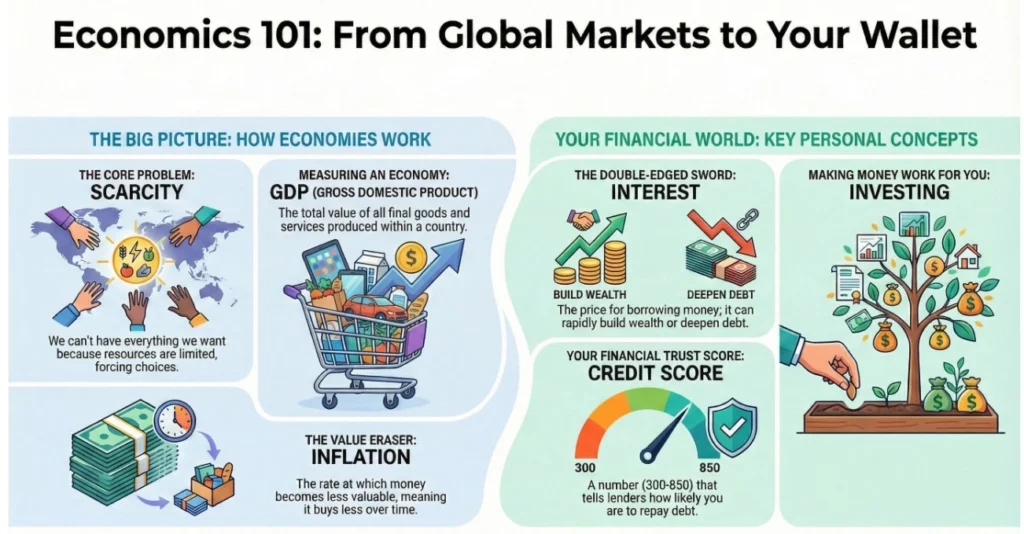
Scarcity is the starting point of all economic thinking. Resources such as time, money, labor, and raw materials are limited, while human desires are unlimited. Because of this imbalance, every financial decision involves trade-offs.
Key implications of scarcity:
- You must choose how to spend your time and money
- Every choice has a cost
- Trade and specialization become necessary
This reality explains why markets exist and why prices matter.
Opportunity Cost: The True Cost of Every Decision
Opportunity cost is the value of the best alternative you give up when making a choice.
Simple example:
- If you spend $1,000 on a vacation, the opportunity cost may be investing that money in the stock market.
- If you invest instead, the opportunity cost is the enjoyment and experiences of the trip.
Understanding opportunity cost improves:
- Budgeting decisions
- Career choices
- Investment planning
Comparative Advantage and the Power of Trade
Comparative advantage explains why trade benefits everyone—even when one party is more efficient at everything.
How it works:
- Individuals or countries specialize in what they produce at the lowest opportunity cost
- They trade for everything else
- Overall productivity and wealth increase
This principle is widely discussed in international trade analysis by institutions such as the World Trade Organization and economics education platforms like Investopedia.
How Financial Markets Work
Supply, Demand, and Price Discovery
Markets are driven by incentives, not instructions.
Core market forces:
- Demand: How much consumers want at different prices
- Supply: How much producers are willing to sell
- Equilibrium price: Where supply equals demand
When demand rises faster than supply, prices increase. When supply exceeds demand, prices fall. This price system coordinates millions of decisions automatically.
The Invisible Hand Explained Simply
The “invisible hand,” a concept introduced by Adam Smith, describes how individuals pursuing their own interests unintentionally benefit society.
For example:
- Businesses seek profit
- Consumers seek value
- Prices guide behavior without central planning
This idea remains a foundation of modern market economies.
Measuring Economic Health: Understanding GDP
What Is GDP?
Gross Domestic Product (GDP) measures the total value of all final goods and services produced within a country over a specific period. Investors, governments, and financial institutions use GDP to assess economic performance.
The Three Ways GDP Is Calculated
1. Expenditure Approach
GDP = C + I + G + (X − M)
- Consumption (C): Household spending
- Investment (I): Business capital spending
- Government Spending (G): Public sector investment
- Net Exports (X − M): Exports minus imports
2. Production Approach
Measures value added at each production stage.
3. Income Approach
Totals wages, profits, rent, and interest earned.
Organizations like the World Bank and IMF rely on these methods to compare global economies.
Nominal vs. Real GDP
- Nominal GDP: Measured at current prices
- Real GDP: Adjusted for inflation
Real GDP provides a clearer picture of true economic growth.
GDP per capita, which divides GDP by population, is often used as a rough indicator of living standards. For example, high-income economies consistently show higher GDP per capita due to productivity and capital efficiency.
Inflation and Interest Rates: The Silent Forces
Inflation: Why Money Loses Value Over Time
Inflation reduces purchasing power, meaning your money buys less each year.
Common causes of inflation:
- Excess money supply
- Supply chain disruptions
- Increased consumer demand
Central banks typically target around 2% annual inflation to balance growth and stability. Historical cases of hyperinflation—such as Zimbabwe—demonstrate the destructive effects of losing control over prices.
Interest Rates and the Power of Compounding
Interest is the cost of borrowing money—or the reward for saving and investing it.
Types of interest:
- Simple interest: Applied only to principal
- Compound interest: Interest earned on both principal and previous interest
Example:
At a 7% annual compound rate, an investment doubles roughly every 10 years. Over 30 years, compounding becomes the single most powerful driver of wealth accumulation.
This principle is frequently emphasized in long-term investing research and retirement planning studies.
Personal Finance Fundamentals
How Banks Operate
Banks use fractional reserve banking, lending most deposited funds to stimulate economic activity. Deposit insurance systems in many countries help protect consumers and maintain trust in the banking system.
Credit Scores: Your Financial Reputation
A credit score reflects how reliably you manage debt.
Key factors include:
- Payment history
- Credit utilization
- Length of credit history
- Credit mix
A strong score lowers borrowing costs and improves financial flexibility.
Understanding Taxes
Taxes fund public services and influence investment decisions.
Common types:
- Income tax
- Capital gains tax
- Progressive tax systems
Knowing how taxes work allows smarter financial planning and after-tax return optimization.
Building Wealth Through Investing
Major Investment Options
- Stocks: Ownership in companies
- Bonds: Fixed-income loans
- Funds: Diversified portfolios
- Real estate: Income and appreciation
Diversification across asset classes reduces risk and improves long-term outcomes.
Risk, Return, and Time
Higher returns require accepting higher risk. However, avoiding investing entirely is often the biggest risk of all—because inflation steadily erodes idle cash.
Key takeaway:
Long-term investing rewards patience, consistency, and discipline more than short-term speculation.
Conclusion: Economics as a Tool for Financial Control
Economics is not abstract theory—it is a practical framework for understanding how money, markets, and incentives shape your life. By mastering concepts such as scarcity, inflation, GDP, and compound interest, you gain the ability to make informed financial decisions with confidence.
Practical Actions You Can Take
- Eliminate high-interest debt
- Protect and improve your credit score
- Start investing early, even with small amounts
- Focus on creating value through skills and productivity
Final takeaway:
The financial system can either quietly drain your wealth or steadily build it. The difference lies in understanding the rules—and using them intentionally.