Naked Economics by Charles Wheelan breaks down the big ideas of economics into simple lessons anyone can understand. Instead of formulas and charts, the book uses real stories to explain how money, markets, and incentives shape our daily lives. Here’s an easy, practical look at the core ideas.
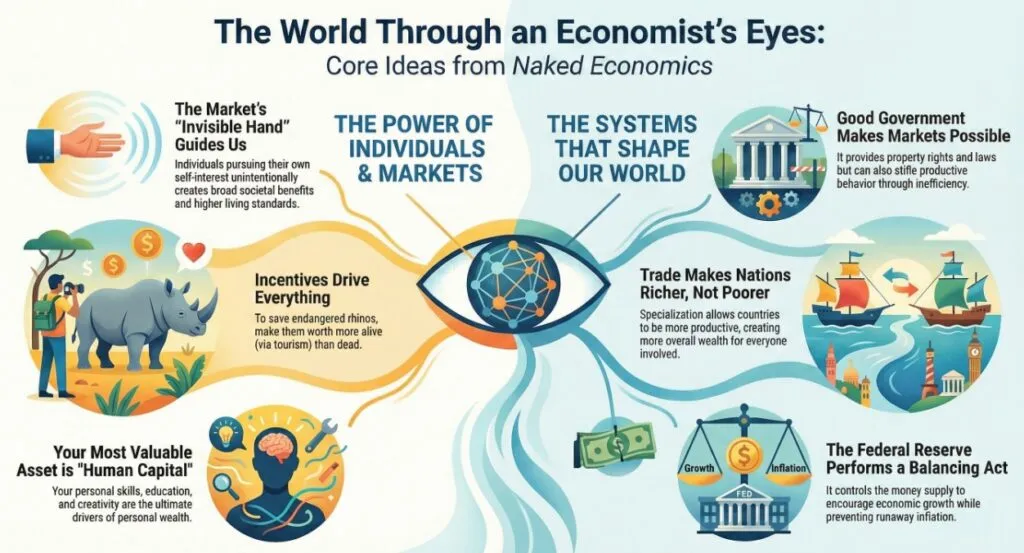
Table of Contents
1. Markets Work Because People Act in Their Own Interest
Wheelan explains Adam Smith’s idea of the “invisible hand”—when people make decisions based on self-interest, markets naturally organize themselves.
Businesses produce what people want to buy, and millions of daily choices create efficiency without central control.
But there’s a catch:
Markets are amoral. They give us what we want, not always what society needs.
2. Incentives Shape Behavior
A key lesson: people respond to incentives.
Whether it’s saving endangered animals or improving workplace performance, the right incentives direct behavior in the desired direction.
Poorly designed incentives → bad outcomes.
Good incentives → better decisions and stronger economic results.
3. Government Is Essential… but Not Perfect
Government plays a critical role by:
- Fixing market failures (like pollution or unsafe products)
- Providing public goods (roads, education, national defense)
- Setting rules that keep markets fair
But the government can also be inefficient.
Monopolies such as the DMV lack competition and often deliver poor service. The real challenge is finding the balance between helpful regulation and unnecessary barriers.
4. Your Real Wealth Is Your Human Capital
Human capital—your knowledge, skills, experience, and education—is the biggest driver of income and opportunity.
Countries with strong education systems and skilled workforces enjoy higher productivity and better living standards.
The message:
Invest in yourself. It pays the highest return.
5. Successful Investing Requires Discipline
Financial markets help people save, invest, and manage risk. But they are not shortcuts to overnight wealth.
The winning formula:
- Save regularly
- Diversify
- Think long-term
Markets reward patience, not luck.
6. Trade Makes Everyone Better Off
International trade works because each country specializes in what it does best—this is the idea of comparative advantage.
Trade:
- Lowers prices
- Increases variety
- Raises global living standards
Protectionism may sound good politically, but economically, it slows growth and makes things more expensive.
7. Prosperity Depends on Strong Institutions
Why are some countries rich and others poor?
Wheelan highlights key ingredients:
- Good governance
- Rule of law
- Property rights
- Low corruption
- Investment in education
- Open markets
Countries that build these foundations achieve long-term prosperity.
Conclusion
Naked Economics shows that economics isn’t about equations—it’s about how people make decisions every day. When you understand incentives, markets, government roles, and global trade, you gain a clearer view of how wealth is created and why some policies succeed while others fail.
Economics becomes less of a mystery—and more of a practical guide to improving your financial life and understanding how the world really works.