Introduction: Why This Book Changes Everything
Are you ready to stop running on the financial treadmill and start building a path toward true freedom? For decades, Rich Dad Poor Dad has challenged conventional wisdom and flipped the script on how people worldwide think about money. Authored by Robert Kiyosaki, this international bestseller contrasts the philosophies and advice of his two influential fathers: his highly educated but financially struggling “Poor Dad,” and his uneducated but eventually wealthy “Rich Dad”. As Kiyosaki notes,
“Having two dads offered me the choice of contrasting points of view: one of a rich man and one of a poor man“.
This book is essentially a roadmap based on the six primary lessons Robert learned over thirty years from his Rich Dad. It provides a powerful foundation that enables anyone to gain control of their financial future.
For those feeling trapped in the endless cycle of working hard just to pay bills—a situation Rich Dad famously called “the Rat Race”—this summary offers vital insights. You will learn that success isn’t just about how much money you earn, but about mastering financial education and understanding key principles that the rich use to make money work for them.
The world is rapidly changing, and old advice like “go to college, get a good job, save money” is becoming obsolete. By focusing on these Rich Dad Poor Dad Key Lessons, you can develop the financial intelligence needed to welcome change and prosper greatly in the Information Age, rather than dreading uncertainty.
Table of Contents
Core Ideas & Key Lessons from Rich Dad Poor Dad
Rich Dad’s approach to money was fundamentally different from the mainstream advice focused on scholastic and professional skills. Instead of learning how to work for money, his education was rooted in understanding how money works, so it could eventually work for you.
Lesson 1: The Rich Don’t Work for Money
The fundamental lesson that separates the wealthy from everyone else is simple: “The poor and the middle class work for money. The rich have money work for them“,,. This concept was so radical that Kiyosaki recounts that a few publishers initially rejected the book because they disagreed with Rich Dad’s number one lesson.
Two primary emotions perpetually control people’s lives and keep them stuck in the cycle: fear and greed. As Rich Dad observed, “People’s lives are forever controlled by two emotions: fear and greed“,. The fear of not having enough money motivates people to work, but once they receive a paycheck, desire (greed) causes them to increase spending, starting the cycle anew.
Rich Dad taught Kiyosaki the critical distinction that “There is a difference between being poor and being broke. Broke is temporary. Poor is eternal“. Broke is a temporary lack of funds, but poverty is a mindset where you stop trying. The focus must shift from working for earned income (which is highly taxed) to building assets that generate cash flow automatically.
Lesson 2: Why Teach Financial Literacy?
True financial success is determined not by how much money you make, but by mastering a core truth: “It’s not how much money you make. It’s how much money you keep“,,. To achieve this, you must become financially literate.
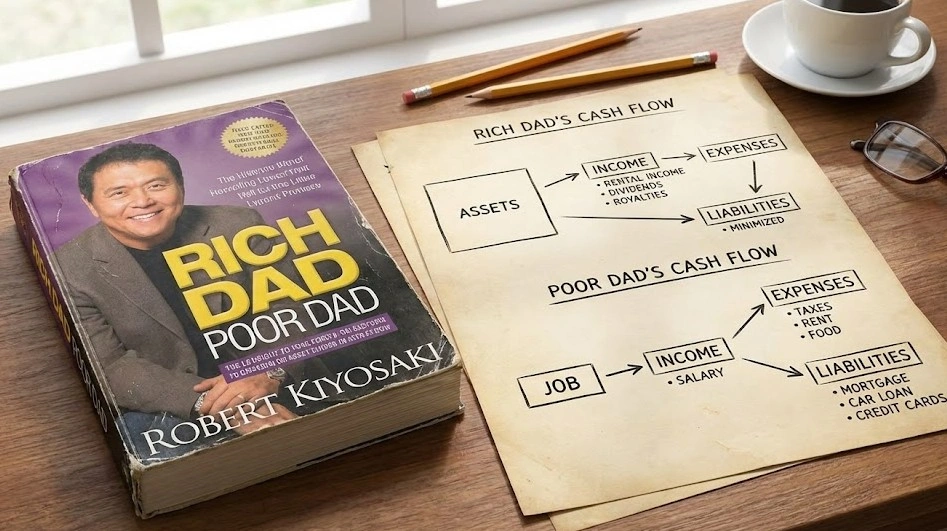
Financial literacy begins with learning Rule #1: You must know the difference between an asset and a liability, and buy assets.
- Asset Defined: An asset is something that puts money in your pocket.
- Liability Defined: A liability is something that takes money out of your pocket.
Rich Dad summarized this critical distinction by stating that “Rich people acquire assets. The poor and middle class acquire liabilities that they think are assets“,,.
The common mistake is acquiring liabilities that people think are assets. Kiyosaki’s poor dad believed their home was their greatest investment, while his rich dad countered, “My house is a liability, and if your house is your largest investment, you’re in trouble“. This is because a house takes money out of your pocket through taxes, insurance, and maintenance, thus fitting the definition of a liability.
The flow of money, or cash flow, tells the real story of a person’s financial situation, illustrating why “Money without financial intelligence is money soon gone“,.
Lesson 3: Mind Your Own Business
The rich focus on their asset columns, while everyone else focuses on their income statements (their job),. Kiyosaki emphasizes the difference between your profession and your business: “To become financially secure, a person needs to mind their own business“.
- Financial Struggle: Kiyosaki warns that “Financial struggle is often directly the result of people working all their lives for someone else“,.
- Asset Focus: While keeping your daytime job, you should diligently build a strong base of solid assets, keeping expenses and liabilities low.
- Assets as Employees: Rich Dad taught Kiyosaki to view invested capital as his workers: “Once a dollar goes into your asset column, it becomes your employee. The best thing about money is that it works 24 hours a day and can work for generations“,.
A core distinction for the wealthy is that they buy luxuries last, funding them with the income generated by their assets. Conversely, “An important distinction is that rich people buy luxuries last, while the poor and middle class tend to buy luxuries first“.
Lesson 4: The Power of Corporations and Financial IQ
The rich legally minimize their tax burden by using the power of corporations. This is based on Rich Dad’s understanding that taxes were intended to punish the rich but ended up taxing the middle class heavily,. Kiyosaki argues that if you work for money, you surrender power: “If you work for money, you give the power to your employer. If money works for you, you keep the power and control it“,.
Financial intelligence (Financial IQ) is crucial for navigating this system and is composed of four main areas of expertise,. A corporation offers profound legal and tax advantages: “Employees earn and get taxed, and they try to live on what is left. A corporation earns, spends everything it can, and is taxed on anything that is left. It’s one of the biggest legal tax loopholes that the rich use“,.
Lesson 5: The Rich Invent Money
Financial success often relies less on pure intellect and more on courage and creativity. Kiyosaki points out that “Often in the real world, it’s not the smart who get ahead, but the bold“,. Financial intelligence is the ability to generate solutions and create opportunities.
Rich Dad emphasized the immense potential of the mind: “The single most powerful asset we all have is our mind. If it is trained well, it can create enormous wealth seemingly instantaneously“,. By training your mind to spot opportunities, you create your own luck.
This intelligence allows investors to see beyond surface appearances, knowing that “Great opportunities are not seen with your eyes. They are seen with your mind“,. Those who cling to outdated thinking and resist change find that “Old ideas are some people’s biggest liability“.
Lesson 6: Work to Learn—Don’t Work for Money
The fundamental difference in educational philosophy between the two fathers was that “Job security meant everything to my educated dad. Learning meant everything to my rich dad“,,. Kiyosaki advocates seeking work for the skills you will acquire, not just the paycheck.
Rich Dad encouraged learning a broad set of skills, suggesting: “You want to know a little about a lot“. This contrasts with traditional specialization, which often leads to dependence. Many talented people struggle financially because they are “one skill away” from great wealth, often lacking skills outside their core profession, such as sales and marketing,.
Practical Applications: Actionable Steps to Financial Freedom
To break free from the Rat Race, Robert outlines critical actions focused on managing internal obstacles and practical strategies.
Overcoming Psychological Obstacles
Five internal obstacles often prevent people from building wealth: Fear, Cynicism, Laziness, Bad Habits, and Arrogance.
- Fear: Kiyosaki notes: “The primary difference between a rich person and a poor person is how they manage fear“,. Winners understand that losing is part of the process, observing that he has “never met someone rich who has never lost money“,. True success is built when “Failure inspires winners. Failure defeats losers“,.
- Cynicism: Cynics criticize; winners analyze,. Stop focusing on “I don’t want to fix toilets” and, instead, analyze how to profit while mitigating risks,.
- Laziness: This often manifests as “laziness by staying busy,” avoiding necessary financial education. The cure is constructive desire. Kiyosaki notes that Rich Dad forbade the phrase “I can’t afford it,” believing that asking “How can I afford it?” opens up possibilities, excitement, and dreams,.
- Bad Habits: Adopt the powerful habit of paying yourself first. Kiyosaki’s poor dad paid everyone else first, but Rich Dad would always pay himself first, even if short on funds. Rich Dad argued, “If I pay myself first, I get financially stronger, both mentally and fiscally“,. The pressure created by having creditors waiting forces your financial genius to create new income streams.
- Arrogance: Arrogance (believing what you don’t know isn’t important) is ignorance hiding in plain sight. Kiyosaki learned from Rich Dad that “What I know makes me money. What I don’t know loses me money“.
Strategies for Getting Started
Robert provides practical steps for action (from a list of 10 steps he personally followed):
- Find Your “Why”: Establish a reason greater than the reality of financial struggle—a combination of deep emotional “wants” and “don’t wants” that fuels your determination through setbacks,. “Without a strong reason or purpose, anything in life is hard“,.
- Invest in Education First: Your mind is your greatest asset. Kiyosaki observed that “Ninety percent of the population buys TV sets, and only about 10 percent buy business books“,. Invest in seminars and courses, recognizing that this learning is a long-term play: “I am always shocked at people who buy stocks or real estate, but never invest in their greatest asset, their mind“.
- Choose Your Association Wisely: Spend time with financially knowledgeable friends. “I’ve noticed that my friends with money talk about money“,.
- Make Offers and Think Big: Don’t wait for the “right price.” Make lots of offers (even with escape clauses) because the process of searching and negotiating is how you find opportunities. “Small thinkers don’t get the big breaks“.
Key Takeaways
The path to wealth is determined by daily choices and commitment to financial education.
- Focus on the Asset Column: Concentrate efforts on buying income-generating assets (passive and portfolio income), not liabilities.
- Convert Income: The ultimate goal is converting high-taxed earned income into low-taxed passive or portfolio income,. As Rich Dad taught: “The government taxes the income you work hard for more than the income your money works hard for”.
- Use Money as a Tool: Employ financial intelligence to make money work hard for you.
- Manage Risk, Don’t Avoid It: Understand that financial failure is a natural part of the learning process. As Warren Buffett notes: “Risk comes from not knowing what you’re doing”.
- The Power of Giving: To receive money, you must first give it. Rich Dad taught: “If you want something, you first need to give“,.
Final Thoughts: Applying the Rich Dad Poor Dad Key Lessons
The great gift we all possess is our mind and our time. With every dollar that passes through your hands, you choose your destiny—to be poor (spending it foolishly), middle class (buying liabilities), or wealthy (investing it in your mind and assets).
Financial intelligence is the ability to convert earned income into passive and portfolio income as quickly as possible,. This conversion is the key to achieving financial freedom. Kiyosaki concludes that the rich choose a path many ignore, and that, drawing on Robert Frost’s poem,
“that has made all the difference“.
It only takes a few dollars and a strong commitment to learning to start growing something big. Stop doing what isn’t working, take action, and learn to have money work hard for you. Do not play it safe; play it smart.