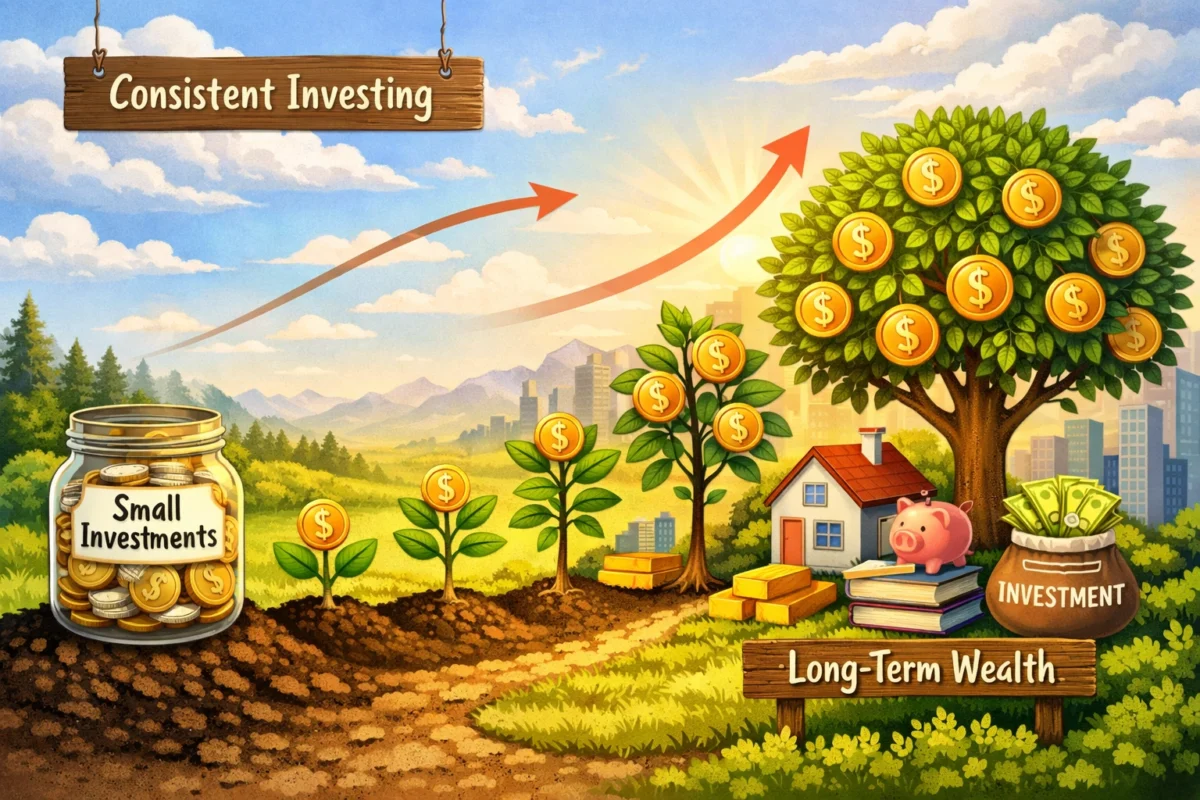
The stock market can seem mysterious, noisy, and even intimidating, yet it is one of the most important engines of modern capitalism and long-term wealth building. The goal of this guide is to get the stock market explained in a clear, practical way—whether you are a beginner or already investing and looking to deepen your understanding.firstpagesage
You will learn what the stock market is, how it really works behind the scenes, how prices are set, how investors make (and lose) money, and how to use it wisely in your own financial plan. Along the way, you will see tables, simple examples, and suggested images or charts you can use in a blog or presentation.nogood
As Benjamin Graham, mentor to Warren Buffett, famously wrote, “In the short run, the market is a voting machine but in the long run, it is a weighing machine” – a quote that captures both the psychology and fundamentals behind stock prices.seoprofy
Table of Contents
Introduction: Why the Stock Market Matters
The stock market is where companies raise money from investors and where those investors can buy and sell ownership stakes—called “shares”—in those companies. It matters because:
- It is a key source of funding for businesses to expand, innovate, and hire.
- It is one of the primary tools individuals use to grow wealth over the long term.
- It influences everything from pensions and insurance to mortgages and job security.seoprofy
For personal finance and passive income seekers, understanding the stock market explained properly is essential. Used correctly, it can power long-term financial independence; used blindly, it can magnify risk and emotional mistakes.firstpagesage
Stock Market Basics: Simple Definitions
What Is a Stock?
A stock represents a small slice of ownership in a company. When you own one share of Apple, you own a tiny piece of Apple Inc., including a claim on its future profits.seoprofy
Companies issue shares to raise capital instead of (or in addition to) borrowing from banks. In exchange, investors get:
- Potential capital gains if the share price rises.
- Potential dividends if the company pays out part of its profits.seoprofy
What Is a Stock Market?
The stock market is a network of exchanges where these shares are traded. The best-known exchanges include:
- New York Stock Exchange (NYSE)
- Nasdaq
- London Stock Exchange (LSE)
- Tokyo Stock Exchange
- National Stock Exchange of India (NSE)seoprofy
These exchanges don’t “own” the companies; they are organized marketplaces that enforce rules, match buyers and sellers, and ensure transparency and fair access.
Primary vs Secondary Market
A critical part of getting the stock market explained is understanding two different “layers” of trading.seoprofy
| Layer of Market | What Happens | Who Gets the Money | Example |
|---|---|---|---|
| Primary Market | Company sells new shares for the first time | Company | An Initial Public Offering (IPO) |
| Secondary Market | Investors trade existing shares with each other | Other investors | You buy shares from someone on an exchange |
When you buy shares on your app or broker today, you are almost always trading in the secondary market, with your money going to another investor, not to the company itself.seoprofy
How Does the Stock Market Actually Work?
Order Matching: How Trades Are Executed
Every time you buy or sell a stock through a broker, that order goes into an electronic system that matches buyers and sellers. Modern stock markets operate via:
- Electronic order books that list all bids (buy offers) and asks (sell offers).
- Algorithms that match the highest bid with the lowest ask.
- Market makers and liquidity providers that help ensure trades can occur quickly.nogood
There are two main types of orders:
- Market order: “Buy or sell at the best available price now.”
- Limit order: “Buy or sell only at a specific price or better.”
Market orders guarantee execution but not price, while limit orders prioritize price but not immediate execution.seoprofy
How Prices Are Set: Supply, Demand, and Expectations
Stock prices are driven by the same forces that govern any marketplace: supply and demand. The twist is that in markets, what people demand is based heavily on expectations about the future.seoprofy
Factors that influence demand include:
- Company earnings and growth prospects
- Interest rates and inflation
- Economic data (GDP, employment, consumer spending)
- Market sentiment and news
- Global events and policy changesseoprofy
To paraphrase Warren Buffett: “Price is what you pay, value is what you get.” This quote reflects that market prices can swing above or below a company’s underlying value, often due to emotion and speculation.seoprofy
Key Participants: Who Actually Makes Up “The Market”?
Retail vs Institutional Investors
The stock market explained is incomplete without recognizing who is on the other side of your trades.firstpagesage
| Participant Type | Description | Typical Size | Examples |
|---|---|---|---|
| Retail investors | Individual investors trading via apps/brokers | Small orders | You, everyday savers and traders |
| Institutional investors | Professional money managers | Large orders | Pension funds, mutual funds, hedge funds |
| Market makers | Firms providing continuous buy/sell quotes | Varies | Large broker-dealers, HFT firms |
| Governments & sovereign funds | State-linked investors | Very large | Sovereign wealth funds, central banks |
Institutional investors account for the majority of trading volume in most major markets, which means their behavior can move prices significantly.seoprofy
Role of Regulators
Regulators aim to keep markets fair, orderly, and transparent. In major markets, examples include:
- U.S.: Securities and Exchange Commission (SEC)
- U.K.: Financial Conduct Authority (FCA)
- EU: European Securities and Markets Authority (ESMA)seoprofy
They enforce rules against insider trading, market manipulation, and fraudulent offerings, and they require listed companies to publish regular financial reports.
What Drives Stock Prices Over Time?
Earnings, Growth, and Fundamentals
Over the long term, stock prices tend to follow company earnings. When a company consistently grows revenue and profit, the market usually rewards it with a higher share price and possibly a higher valuation multiple (like a higher price-to-earnings ratio).seoprofy
Key fundamental drivers include:
- Revenue growth
- Profit margins
- Cash flow
- Debt levels
- Competitive advantages (brand, technology, scale)seoprofy
As Peter Lynch famously said, “Behind every stock is a company. Find out what it’s doing.” This simple quote reminds investors that stocks are not just “tickers”; they reflect real businesses.seoprofy
Interest Rates and the Macro Environment
Interest rates and inflation strongly influence stock valuations:
- When interest rates are low, bonds and savings accounts yield less, making stocks more attractive, often pushing prices up.
- When rates rise, future profits are discounted more heavily, and investors may shift back to bonds or cash, putting pressure on stock prices.seoprofy
Central banks like the U.S. Federal Reserve, the European Central Bank, and others are therefore key indirect players in stock markets through their interest rate policies and economic guidance.seoprofy
How Investors Make Money in the Stock Market
Capital Gains and Dividends
Investors can benefit from stocks in two main ways:
- Capital gains:
- The stock price rises above the purchase price.
- Example: You buy at 100 and sell at 150, making a 50 profit per share.
- Dividends:
- Some companies pay out part of their profits to shareholders as cash dividends.
- Dividend yields in mature markets often range from 2–4% per year for large, stable companies.seoprofy
Total return is the combination of price changes plus dividends reinvested over time.
The Power of Compounding
If dividends and gains are reinvested, returns can compound. Over long periods, major stock indexes have historically delivered positive real (inflation-adjusted) returns, although this is never guaranteed.seoprofy
Simple illustrative example (for concept only):
- Invest 10,000 in a broad stock index.
- Assume an average annual return of 7% over 30 years.
- Without additional contributions, the investment could grow to around 76,000 due to compounding.
This is why long-term investors often focus more on time in the market rather than trying to time the market.nogood
Major Types of Stocks and Investment Vehicles
Common vs Preferred Stock
Most investors buy common stock, which comes with:
- Voting rights at shareholder meetings (in most cases)
- Potential for capital growth and dividends
Preferred stock generally:
- Has priority for dividends and in liquidation
- Often has fixed dividend rates
- Usually lacks voting rightsseoprofy
Individual Stocks vs Funds (ETFs and Mutual Funds)
For many individuals wanting the stock market explained in practical terms, the real decision is between buying single company stocks or diversified funds.firstpagesage
| Option | What It Is | Pros | Cons |
|---|---|---|---|
| Individual stocks | Shares in specific companies | High upside, full control | Higher risk, requires research, less diversification |
| Mutual funds | Professionally managed pooled investments | Diversification, convenient | Active funds often charge higher fees |
| ETFs (exchange-traded funds) | Funds that trade like stocks on exchanges | Typically low fee, diversified, transparent | Market risk remains; some ETFs can be complex |
Index funds and broad-market ETFs have become popular because they provide diversified exposure to hundreds or thousands of companies at low cost.nogood
Risks You Must Understand
Market, Company, and Liquidity Risk
No explanation of the stock market is complete without risk. Main categories include:seoprofy
- Market risk: Overall market drops due to economic shocks or crises.
- Company-specific risk: A particular company faces scandal, disruption, or poor management.
- Sector risk: An entire industry (e.g., airlines, banks, tech) is hit by regulation or structural change.
- Liquidity risk: Difficulty buying or selling without significantly moving the price, more common in small or illiquid stocks.
Volatility and Emotional Risk
Prices can be very volatile in the short term. Large indices have seen single-day moves of 3–5% or more during crises.seoprofy
As John Bogle, founder of Vanguard, put it: “Your success in investing will depend in part on your character and guts, and in part on your ability to realize at the height of euphoria and the depth of despair that this too shall pass.” This highlights that emotional discipline is as important as analysis.nogood
How Stock Indexes Work
What Is a Stock Index?
A stock index is a basket of selected stocks meant to represent a specific market or sector. Examples include:
- S&P 500 (large U.S. companies)
- Dow Jones Industrial Average (30 large U.S. companies)
- FTSE 100 (U.K. large caps)
- MSCI World (global developed markets)seoprofy
Indexes are used to:
- Measure market performance.
- Serve as benchmarks for mutual funds and ETFs.
- Provide simple access for investors via index-tracking funds.seoprofy
Price-Weighted vs Market-Cap-Weighted Indexes
There are different ways to construct indexes:
- Market-cap-weighted: Larger companies have more influence (e.g., S&P 500).
- Price-weighted: Higher-priced shares have more weight (e.g., Dow Jones).seoprofy
Most modern index funds track market-cap-weighted indexes because they automatically assign more weight to larger, more valuable companies.
The Stock Market and Your Personal Finance Plan
Where the Stock Market Fits in Your Wealth Strategy
The stock market should not be your entire financial life; it is one pillar among several. A balanced plan typically includes:
- Emergency savings in cash or high-yield savings accounts
- Debt management (paying down high-interest loans)
- Long-term investments (stocks, bonds, funds)
- Protection (insurance, retirement plans)seoprofy
For building passive income and long-term wealth, stocks and stock funds often play a central role, particularly for goals 10+ years away.
Time Horizon and Risk Tolerance
How you use the stock market depends on:
- Time horizon: How long before you need the money?
- Risk tolerance: How much volatility can you emotionally and financially handle?
- Goals: Retirement, education, buying a home, business funding, etc.seoprofy
A common rule of thumb is that money needed in the next 3–5 years should not be heavily exposed to stocks; longer-term goals can tolerate more equity exposure.
Practical Steps: Getting Started Safely
1. Choose a Regulated Broker
Select a broker or platform that:
- Is regulated in your jurisdiction.
- Offers investor protection schemes where applicable.
- Provides clear fees and an intuitive interface.seoprofy
2. Start with a Simple, Diversified Portfolio
To get exposure to the market without overcomplicating things, many beginners start with:
- One global or regional stock index ETF
- Possibly one bond ETF for stabilizing returns
- Consistent monthly contributions (dollar-cost averaging)nogood
3. Automate and Avoid Overtrading
Automation helps reduce emotional decision-making:
- Set up automatic monthly investments.
- Rebalance once or twice a year rather than trading frequently.
- Focus on long-term goals, not day-to-day noise.nogood
Example Table: Simple Long-Term Portfolio Structure
Below is an example of how a long-term investor might structure a simple portfolio for educational purposes (not personal advice).seoprofy
| Investor Profile | Stocks (%) | Bonds (%) | Cash (%) | Notes |
|---|---|---|---|---|
| Conservative | 40 | 50 | 10 | Prioritizes stability and lower volatility |
| Balanced | 60 | 30 | 10 | Mix of growth and stability |
| Growth-focused | 80 | 10 | 10 | Higher potential return, higher short-term swings |
A suggested chart for a blog post could show how these three portfolios would have behaved during a past market cycle, highlighting differences in volatility versus long-term growth.nogood
Visual and Image Ideas for Better Understanding
To make the stock market explained article more engaging on a blog:
- Image 1: A simple diagram of the flow from “Company → IPO → Exchange → Investors (secondary market).”
- Chart 1: Line chart comparing stock index growth vs inflation and cash over 20–30 years.
- Diagram 2: “Layers of the Market” graphic showing primary vs secondary markets.
- Table/Graphic: Illustration of a simple diversified ETF-based portfolio.nogood
Adding descriptive alt text (e.g., “Illustration showing how companies raise capital and investors trade shares on the stock market”) will also support SEO and accessibility.fullyvested
Conclusion: How the Stock Market Really Works for You
The stock market is not a casino, nor is it a guaranteed money machine; it is a mechanism for allocating capital and sharing in the growth of businesses. When you understand the stock market explained in terms of ownership, earnings, risk, and time horizon, it becomes a powerful tool within a broader financial plan.seoprofy
To use it wisely:
- Treat stocks as partial ownership of real businesses, not just symbols on a screen.
- Match your stock exposure to your goals, time frame, and risk tolerance.
- Focus on diversification, low costs, and long-term compounding instead of short-term speculation.
- Remember the words of John Bogle: “Stay the course,” especially when markets are volatile.nogood
Used with discipline and knowledge, the stock market can help you build long-term wealth, generate passive income through dividends, and move closer to financial independence.seoprofy
Sources:
- https://fullyvested.com/insights/seo-for-finacial-services/
- https://www.mintcopywritingstudios.com/blog/seo-for-financial-services
- https://www.omnius.so/blog/seo-for-financial-services-and-products
- https://seoprofy.com/blog/seo-for-financial-services/
- https://nogood.io/blog/fintech-seo/
- https://firstpagesage.com/seo-blog/seo-best-practices/
- https://www.promodo.com/blog/6-top-seo-trends-in-finance
- https://www.contentdevelopmentpros.com/blog/seo-for-financial-services-6-strategies-firms-actually-need/
- https://councils.forbes.com/blog/mastering-seo-for-agency-leaders
- https://storyenvelope.com/seo-for-financial-advisors/