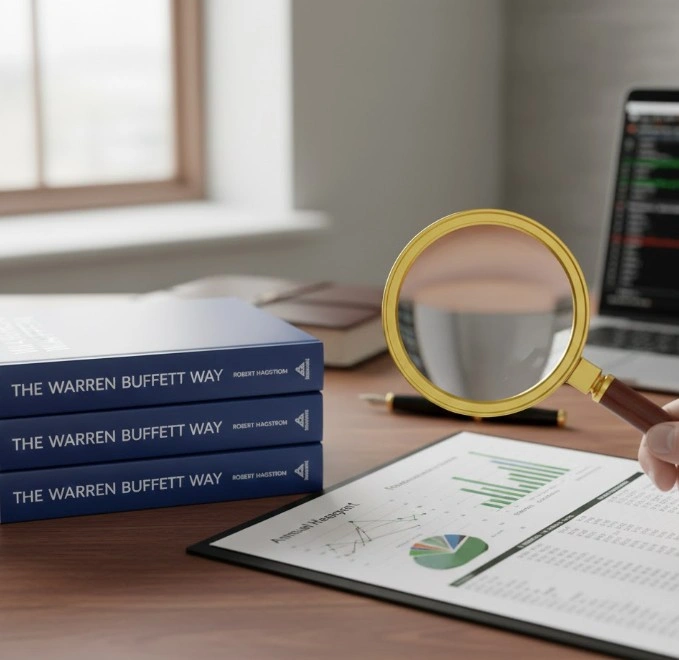
Warren Buffett is more than just the “World’s Greatest Investor”—he is a teacher whose wisdom has been shared openly for decades. His investment career, detailed comprehensively by Robert Hagstrom in The Warren Buffett Way, demonstrates an unmatched record of performance achieved by consistently applying fundamental principles available to everyone, regardless of their financial status.
In an era defined by overwhelming market noise, constant volatility, and the temptation to chase the next “hot stock,” Buffett’s rational voice rises above the chaos. The enduring popularity of his strategies is a testament to the value of his advice and the accuracy of the underlying analysis.
This summary cuts through the complexity of finance to present the core, actionable strategies that guide Buffett’s remarkable success, equipping you with timeless investment principles you can implement today.
You won’t find complicated formulas or computer programs here. Instead, you will learn how to shift your mindset from merely buying “stocks” to acquiring fractional ownership in profitable businesses. By adopting The Warren Buffett Way, you can model your decisions on his approach, learn discipline, patience, and courage, and become a more effective and rational investor.
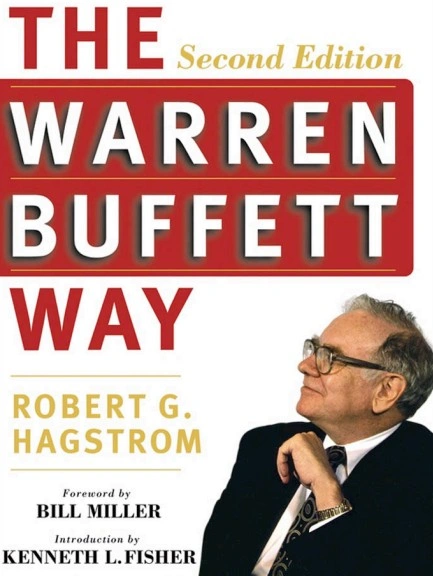
Table of Contents
Core Ideas & Key Lessons: The Foundation of Value Investing
Buffett’s investment philosophy, developed over five decades, is a brilliant synthesis of ideas gleaned from four key thinkers: Benjamin Graham, Philip Fisher, John Burr Williams, and his indispensable partner, Charlie Munger. Understanding these influences reveals the DNA of his long-term success.
The Intellectual Bedrock: Four Guiding Philosophies
1. Benjamin Graham: The Value Disciplinarian Graham, often called the dean of financial analysis, taught Buffett the fundamental idea that investing means looking at stocks as businesses. Graham defined a true investment as an operation that, based on thorough analysis, promises safety of principal and a satisfactory return.
His most critical contribution is the Margin of Safety. This concept exists when securities are purchased at a price significantly less than their real (intrinsic) value.
Graham taught that emotional market fluctuations—driven by fear and greed—often push stock prices far below a company’s intrinsic value, creating the necessary margin of safety for a purchase.
2. Philip Fisher: The Quality Seeker In contrast to Graham’s quantitative focus on cheap assets, Fisher emphasized the qualitative aspects of a company, particularly its growth potential and management team.
Fisher advocated for intense research (which he called “scuttlebutt”) by talking directly to customers, suppliers, former employees, and competitors to gain a full picture of the business. Critically, Fisher believed that it was wise to own only a few outstanding companies rather than a large number of average businesses, influencing Buffett’s focused portfolio strategy.
3. John Burr Williams: The Intrinsic Value Calculator Williams provided the mathematical model for determining a business’s true worth. He believed that the value of any investment is determined by the discounted present value of its future cash flow.
Buffett condensed Williams’s thesis: “The value of a business is determined by the net cash flows expected to occur over the life of the business discounted at an appropriate interest rate.”.
4. Charles Munger: The Quality Advocate Munger is credited with pushing Buffett beyond Graham’s strict focus on finding undervalued, often mediocre, companies toward paying a reasonable price for truly high-quality businesses.
Munger taught that “It’s far better to buy a wonderful company at a fair price than a fair company at a wonderful price.”. This evolutionary shift allowed Buffett to acquire powerful franchise businesses like Coca-Cola.
The Twelve Tenets: A Framework for Analysis
Buffett’s investment principles can be organized into twelve clear guidelines used every time he considers acquiring a company or buying its stock. These tenets ensure the investment meets his stringent criteria for quality, value, and management integrity.
| Category | Key Tenet |
|---|---|
| Business Tenets | 1. Is the business simple and understandable? |
| 2. Does the business have a consistent operating history? | |
| 3. Does the business have favorable long-term prospects? | |
| Management Tenets | 4. Is management rational (in capital allocation)? |
| 5. Is management candid with its shareholders? | |
| 6. Does management resist the institutional imperative? | |
| Financial Tenets | 7. What is the return on equity? |
| 8. What are the company’s “owner earnings”? | |
| 9. What are the profit margins? | |
| 10. Has the company created at least one dollar of market value for every dollar retained? | |
| Value Tenets | 11. What is the intrinsic value of the company? |
| 12. Can it be purchased at a significant discount to its value? |
Practical Applications: Investing Like the Oracle of Omaha
The power of The Warren Buffett Way lies not in theoretical knowledge, but in practical application. These actionable lessons, drawn from Buffett’s successful acquisitions and stock selections, show you precisely how to think like a business owner.
Focus on Understanding (Business Tenets)
The first step in any investment process is ruling out businesses you cannot competently analyze.
Actionable Lesson 1: Define Your “Circle of Competence” Limit your investments to businesses that are “simple and understandable” and within your intellectual grasp.
- Practical Example: Buffett avoids technology stocks, confessing he hasn’t a clue how to estimate the future cash earnings of a company like Microsoft. Conversely, he readily invests in razor blades (Gillette), soft drinks (Coca-Cola), and insurance, because he thoroughly understands their revenues, expenses, and cash flows. Investment success is determined not by how much you know, but by how realistically you define what you don’t know.
Actionable Lesson 2: Seek the Enduring Franchise Look for businesses with durable competitive advantages that will last 25 to 30 years. Buffett calls these advantages a “moat”—something that protects the company from competitors.
- Practical Example: A strong franchise is one whose product is needed, has no close substitute, and is unregulated. Coca-Cola is the world’s most valuable franchise, possessing unmatched global distribution and brand recognition. Its ability to maintain pricing flexibility, even when demand is flat, is a defining characteristic of a great, profitable franchise.
Evaluate Integrity and Rationality (Management Tenets)
Buffett places immense weight on the quality and integrity of management, believing that “We’ve never succeeded in making a good deal with a bad person”.
Actionable Lesson 3: Demand Rational Capital Allocation The single most important managerial act is deciding what to do with the company’s accumulated earnings (capital allocation). You want managers who think like owners, maximizing shareholder value.
- If a company generates cash but can only reinvest it for below-average returns, the rational choice is to return that money to shareholders via dividends or stock buybacks.
- When a management team uses excess cash for unnecessary or poorly priced acquisitions (buying growth), that is a sign of irrationality.
Actionable Lesson 4: Resist the Institutional Imperative The “institutional imperative” is the common, destructive tendency for corporate managers to imitate their peers, even when the behavior is foolish. This includes mindlessly expanding, chasing trendy acquisitions, and setting excessive executive compensation.
- Practical Example: When rival insurance companies wrote policies guaranteeing inadequate returns, Buffett and his subsidiary managers like Jack Ringwalt refused to participate, thereby avoiding the institutional imperative and maintaining underwriting discipline. Seek managers who are willing to look foolish in the short term to ensure long-term stability and profit.
Measure True Profitability (Financial Tenets)
Forget the noise generated by quarterly earnings reports; Buffett focuses on fundamental, lasting financial metrics.
Actionable Lesson 5: Measure Real Economic Performance The best way to evaluate management is by looking at the Return on Equity (ROE)—the ratio of operating earnings to shareholder equity—over several years, without excessive reliance on debt.
Actionable Lesson 6: Calculate “Owner Earnings” Don’t trust simple cash flow figures, as they often fail to account for necessary capital expenditures. Owner Earnings (net income + depreciation/amortization – necessary capital expenditures) is Buffett’s preferred metric for truly measuring cash generation.
- Quote: “I would rather be vaguely right than precisely wrong.” (Acknowledge that this is not a precise mathematical measure, but a practical one.)
Actionable Lesson 7: The “One-Dollar Premise” Test Check if the company’s increase in market value over time equals or exceeds the total amount of earnings the company retained and reinvested during that period. If they retain a dollar but only generate fifty cents of market value, they are destroying shareholder wealth.
Price is What You Pay, Value is What You Get (Value Tenets)
All analysis must culminate in the final decision: whether the price is right.
Actionable Lesson 8: Determine Intrinsic Value Use John Burr Williams’s framework to calculate a business’s intrinsic value by estimating future owner earnings and discounting that stream back to present day.
Actionable Lesson 9: Buy with a Margin of Safety Only purchase a company when its stock price is selling at a significant discount to your calculated intrinsic value. This discount protects you against unforeseen changes or slight errors in valuation, while simultaneously setting you up for “extraordinary stock returns” once the market corrects itself.
“Price is what you pay. Value is what you get.”
Actionable Key Takeaways for The Warren Buffett Way
To successfully adopt The Warren Buffett Way, you must embrace three core behavioral shifts—thinking independently, acting with patience, and maintaining emotional discipline.
Focus and Long-Term Thinking
- Concentrate Your Bets: Instead of diversifying broadly, which Buffett says protects against ignorance, focus your resources on a small number of your best ideas—the companies you understand best and have the highest probability of success.
- Embrace Sloth: Inactivity is intelligent behavior when owning superior companies. The ideal holding period is “forever”. Holding stocks long-term reduces transaction costs and dramatically increases after-tax returns due to the compounding effect of deferred capital gains.
Temperament and Discipline
- Be Patient: Be prepared to wait, turning down most opportunities, even over a long period. Buffett suggests operating as if you have a “lifetime decision card with just twenty punches on it,” forcing you to wait for truly great opportunities.
- Master Mr. Market: The stock market is manic-depressive, constantly gyrating. Never allow market fluctuations to dictate your actions. Be calm when prices drop, and remember that lower prices are opportunities to acquire more of a good business cheaply.
- Seek Integrity: Invest only with managers who possess integrity, intelligence, and energy. If the integrity is lacking, the other two traits are fatal. Avoid managers who promise to “make the numbers” as they will eventually “make up the numbers”.
Final Thoughts: The Simplicity of The Warren Buffett Way
The biggest challenge in adopting The Warren Buffett Way is often psychological, not intellectual. The methodology is straightforward—find great, understandable businesses, run by honest and competent people, and buy them when they are selling below their intrinsic value.
Buffett’s success doesn’t require “doing extraordinary things”. It comes from his formidable ability to integrate sound principles, maintain radical discipline, and ignore the complex distractions that lead other investors astray. If you are willing to think for yourself and possess the courage of your convictions, you will significantly increase your chances for investment profit.
Ultimately, you need only ask yourself: Are you willing to help yourself by doing the homework necessary to understand your investments, and are you prepared to stand apart from the crowd?
“It is just not necessary to do extraordinary things to get extraordinary results.”