Introduction: The Invisible Force Shaping Your Financial Future
In an era of instant gratification, where Amazon delivers within hours and streaming services offer endless entertainment at the click of a button, the concept of waiting for anything has become almost obsolete. Yet this cultural shift toward immediacy is silently eroding one of the most powerful wealth-building tools humanity has ever known: long-term thinking.
According to Fidelity’s 2024 State of Wealth Mobility Study, only 11% of Americans currently consider themselves wealthy, while a staggering 70% of American households remain financially unhealthy according to the Financial Health Network’s 2024 report. The disconnect isn’t primarily about income levels—it’s about mindset, behavior, and the ability to delay gratification for future rewards.

This article explores the psychological, behavioral, and practical reasons why long-term thinking creates wealth while short-term thinking perpetuates poverty. You’ll discover evidence-based strategies to develop a long-term mindset, understand the mathematics behind compound growth, and learn how to break free from the cycle of financial struggle that traps millions.
Table of Contents
The Psychology of Time: Why Our Brains Sabotage Our Financial Futures
The Marshmallow Test and Financial Destiny
In the late 1960s, Stanford psychologist Walter Mischel conducted what would become one of psychology’s most famous experiments. Children were offered a simple choice: eat one marshmallow immediately, or wait 15 minutes and receive two marshmallows. The results revealed something profound about human behavior and future success.
Follow-up studies tracking these children over decades showed that those who waited for the second marshmallow demonstrated better life outcomes across multiple dimensions. Children who were able to wait longer for the preferred rewards tended to have better life outcomes, as measured by SAT scores, educational attainment, body mass index, and other life measures.
However, more recent research has added crucial nuance to this narrative. A 2018 replication study found that the correlation was only half the size of the original studies and was reduced by two thirds when controlling for family background, early cognitive ability, and home environment. This tells us something critical: while delayed gratification matters, it’s not the only factor. Economic background, trust in institutions, and access to resources all play significant roles.
For wealth building, the lesson is clear: the ability to delay gratification isn’t innate—it can be learned and strengthened, especially when combined with the right environment and resources.
The Scarcity Mindset vs. The Abundance Mindset
Financial psychologists have identified two fundamentally different approaches to money: the scarcity mindset and the abundance mindset. Those trapped in scarcity thinking focus on limitations, immediate needs, and short-term survival. The abundance mindset, conversely, sees opportunities, long-term possibilities, and growth potential.
Growing up in poverty often instills a scarcity mindset that persists long after financial circumstances improve. According to behavioral research, people who experienced financial hardship in childhood may either hoard money anxiously or spend it immediately, fearing it could be taken away. Both behaviors prevent effective long-term wealth accumulation.
The neuroscience behind this is fascinating. When faced with financial stress, the brain’s prefrontal cortex—responsible for planning and rational decision-making—becomes less active, while the amygdala—our fear and emotion center—takes over. This makes it physiologically harder to think long-term when you’re worried about paying next month’s rent.
The Mathematics of Long-Term Thinking: Compound Interest Explained
The Eighth Wonder of the World
Albert Einstein allegedly called compound interest “the eighth wonder of the world,” noting that “he who understands it, earns it; he who doesn’t, pays it.” Whether or not Einstein actually said this, the principle remains profoundly true.
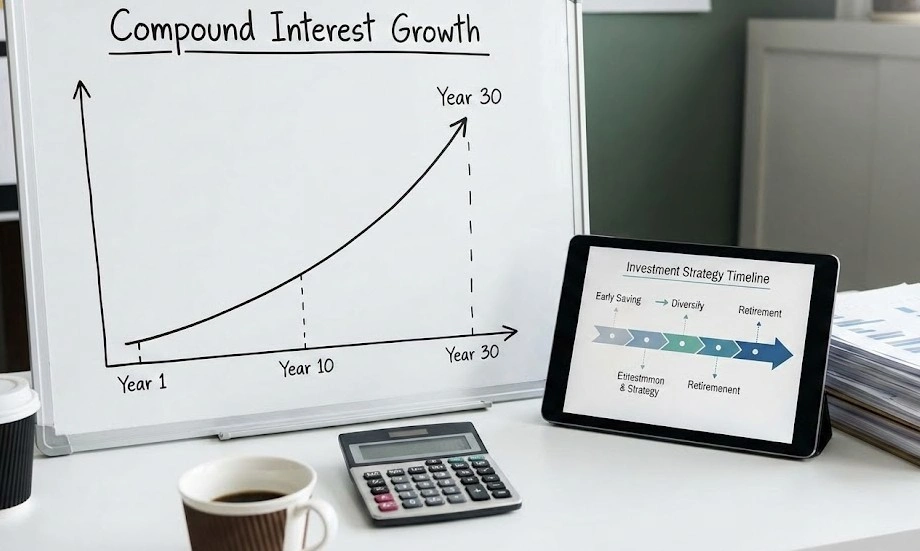
Compound interest is the process where your money earns returns, and those returns themselves generate additional returns. Unlike simple interest, which only calculates returns on your initial investment, compound interest calculates returns on both your principal and all accumulated earnings.
Let’s look at concrete examples to understand the power of starting early:
Sarah, Age 24: Invests $500 monthly at 7% annual return. By age 65, her portfolio could grow to approximately $1.5 million.
Mike, Age 30: Invests the same $500 monthly at 7% annual return. By age 65, his portfolio reaches around $920,000—$580,000 less than Sarah’s, despite Mike only starting six years later.
Emily, Age 40: Invests $500 monthly at 7% annual return. By age 65, she accumulates approximately $380,000.
John, Age 50: Invests $500 monthly at 7% annual return. By age 65, he reaches about $180,000.
These calculations, based on data from financial planning research, illustrate a crucial truth: time is the most valuable asset in wealth building. Sarah doesn’t contribute more money than the others—she simply starts earlier, allowing compound growth to work its magic over a longer period.
The Real Cost of Waiting
The difference between starting to invest at 25 versus 35 isn’t just about ten years of contributions. It’s about losing decades of compound growth on those early investments. Consider this stark comparison:
- A single $1,000 investment at age 25 growing at 8% annually becomes approximately $21,725 by age 65
- The same $1,000 invested at age 35 becomes approximately $10,063 by age 65
- Invested at age 45, it grows to only $4,661
That first $1,000 invested a decade earlier generates an additional $11,662 in wealth—not because you contributed more, but because time multiplied your returns.
Compound Interest Works Both Ways
While compound interest builds wealth for savers and investors, it destroys wealth for borrowers. According to the FinHealth Spend Report 2024, credit card fees and interest for accounts carrying balances increased by an estimated 25%, dramatically impacting households already struggling financially.
A $5,000 credit card balance at 20% annual interest compounds to over $6,100 in just one year with no payments. This is negative compound interest—your debt grows exponentially, making escape increasingly difficult. Understanding this dual nature of compounding is essential: you want it working for you through investments, not against you through debt.
Why Most People Stay Poor: The Behavioral Trap
Short-Term Thinking in a Long-Term World
The fundamental reason most people remain financially insecure isn’t insufficient income—it’s misaligned time horizons. According to research on wealth-building behaviors, poor and middle-class individuals often prioritize immediate needs and wants over future financial security, not necessarily by choice, but by circumstance and conditioning.
Several factors reinforce short-term thinking:
Immediate Financial Pressure: When you’re struggling to pay this month’s bills, planning for retirement seems not just difficult but irrelevant. Poor households often allocate most of their income to necessities like food, housing, and transportation, leaving little to no room for savings or investments.
Lack of Financial Education: Most Americans receive minimal formal financial education. Without understanding concepts like compound interest, asset allocation, or tax-advantaged accounts, people can’t make informed long-term decisions. People with low incomes often have limited access to education about personal finance, budgeting, and investing, leading to poor financial decisions.
Cultural Programming: We live in a culture that celebrates consumption and instant gratification. Marketing messages bombard us with calls to “buy now, pay later.” Social media amplifies comparison culture, encouraging spending to keep up with perceived peers. This constant pressure makes delayed gratification feel like deprivation rather than investment.
Cognitive Bandwidth: Financial stress literally reduces cognitive capacity for long-term planning. When your mental bandwidth is consumed by immediate concerns, you have fewer resources available for complex future planning. Research from behavioral economics shows that poverty itself impairs decision-making by monopolizing mental resources.
The Poverty Trap: How Economic Circumstances Perpetuate Themselves
Economic research has identified the concept of a “poverty trap”—a self-reinforcing cycle where poverty creates conditions that make escaping poverty extremely difficult. Key elements include:
Limited Access to Capital: Without savings or assets to use as collateral, low-income individuals can’t access affordable credit to invest in wealth-building opportunities like education, homeownership, or entrepreneurship. They’re forced to rely on high-interest payday loans and predatory lending, which drain resources rather than building wealth.
The Cost of Being Poor: Paradoxically, being poor is expensive. Without funds for bulk purchases, poor families pay more per unit for necessities. Without bank accounts, they pay check-cashing fees. Without reliable transportation, they lose job opportunities. These “poverty penalties” consume resources that could otherwise be saved or invested.
Systemic Barriers: Beyond individual choices, structural inequalities in education, employment, housing, and financial services create unequal starting points. Communities facing historical discrimination often lack access to quality schools, well-paying jobs, and fair lending practices, making wealth accumulation systematically harder regardless of individual effort.
The Wealthy Mindset: How Long-Term Thinkers Build Fortunes
Strategic Goal Setting and Planning
According to Fidelity’s research, 37% of wealthy Americans said that saving from a young age was essential to achieving wealth. Wealthy individuals set clear, specific, long-term financial goals and create strategic plans to achieve them. They think in decades, not days.
This forward-thinking approach manifests in several ways:
Clear Financial Milestones: Wealthy individuals establish specific targets—saving $100,000 by age 30, becoming debt-free by 35, accumulating $1 million in investments by 50. These milestones create roadmaps that guide daily financial decisions.
Regular Monitoring and Adjustment: They don’t simply set goals and forget them. Successful wealth builders review their progress quarterly or annually, adjusting strategies based on changing circumstances while maintaining their long-term vision.
Aligned Daily Decisions: Every spending choice is evaluated against long-term objectives. This doesn’t mean never enjoying life—it means consciously choosing which expenditures align with values and which detract from long-term goals.
Living Below Your Means: The Foundation of Wealth
One of the most consistent patterns among wealth builders is spending significantly less than they earn. According to wealth management research, many millionaires live relatively frugal lifestyles, driving used cars, living in modest homes, and avoiding conspicuous consumption.
Effective wealth builders recognize the significance of maintaining a lifestyle where they spend less than they bring in, also known as maintaining a positive lifetime wealth ratio. This isn’t about deprivation—it’s about prioritization.
The wealthy understand that today’s luxury purchase is tomorrow’s lost investment return. That $50,000 luxury car doesn’t just cost $50,000—it costs the future value of $50,000 invested over decades, which could be $200,000 or more. Every dollar spent is a dollar that can’t compound.
Consistent Investing: The Tortoise Strategy
Fidelity’s study found that 32% of Americans who consider themselves wealthy said consistently saving a portion of their paycheck helped them reach financial comfort. The key word is “consistently.”
Wealthy individuals don’t try to time the market or wait for perfect conditions. They invest systematically, month after month, year after year, regardless of market conditions. This approach, called dollar-cost averaging, reduces risk while ensuring continuous growth.
Consider two investors:
- Investor A contributes $500 monthly for 30 years, achieving an average 8% annual return: approximately $680,000
- Investor B tries to time the market, contributing the same amount but missing the ten best-performing days each year: approximately $310,000
Consistency beats cleverness. The tortoise beats the hare because the tortoise never stops moving forward.
Breaking the Cycle: From Short-Term Thinking to Long-Term Wealth
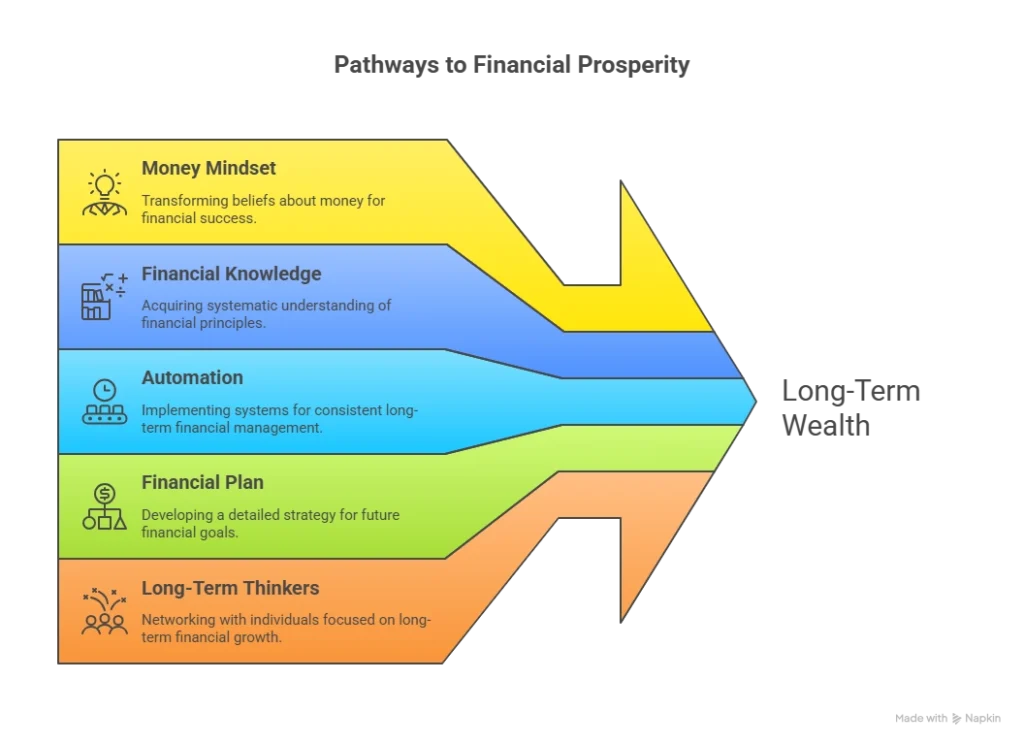
Step 1: Acknowledge and Shift Your Money Mindset
Before you can change your financial outcomes, you must examine your relationship with money. Ask yourself:
- Do I view money as scarce or abundant?
- Do I make financial decisions based on fear or strategy?
- Am I focused on today’s pleasure or tomorrow’s security?
- What money beliefs did I inherit from my family?
According to the World Economic Forum’s research on financial behavior, addressing underlying beliefs and emotional responses to money is essential for lasting change. Knowledge and tools alone fall short without addressing the psychological foundations of financial behavior.
Practical exercises for mindset shift:
Gratitude Practice: Daily acknowledge what you have rather than fixating on what you lack. This reduces scarcity thinking and opens mental space for long-term planning.
Future Self Visualization: Spend time imagining your life in 10, 20, and 30 years. What does financial security look like? How will today’s choices affect that future self?
Reframe Delayed Gratification: Stop seeing saving as sacrifice. Instead, view it as paying your future self. You’re not giving up pleasure—you’re choosing future abundance over temporary satisfaction.
Step 2: Build Financial Knowledge Systematically
Financial literacy isn’t optional for wealth building—it’s foundational. The good news is that basic financial concepts aren’t complicated; they’re just rarely taught.
Priority Learning Areas:
Compound Interest: Deeply understand how time and returns multiply wealth. Use online calculators to see how different contribution amounts, time periods, and return rates affect outcomes.
Asset Classes: Learn the difference between stocks, bonds, real estate, and alternative investments. Understand risk-return tradeoffs and how diversification protects wealth.
Tax Efficiency: Understand tax-advantaged accounts like 401(k)s, IRAs, and HSAs. Maximizing these accounts can save tens of thousands in taxes over a lifetime, dramatically accelerating wealth building.
Basic Economics: Understanding inflation, interest rates, and economic cycles helps you make informed decisions and avoid panic during market volatility.
Resources for Learning:
- Free online courses from platforms like Khan Academy and Coursera
- Personal finance blogs and podcasts (avoiding get-rich-quick schemes)
- Books by established financial experts
- Reputable financial advisors (fee-only, fiduciary advisors preferred)
Step 3: Automate Your Long-Term Thinking
Willpower is a limited resource. Don’t rely on it for wealth building. Instead, create systems that make long-term thinking automatic:
Automatic Transfers: Set up automatic transfers from checking to savings and investment accounts on payday. This makes saving effortless and ensures you “pay yourself first” before spending on other things.
Retirement Account Contributions: Maximize employer 401(k) matches (free money) and set contributions high enough that you won’t miss the money. Many people who automate 10-15% contributions barely notice the difference after a few months.
Automatic Investment Increases: Some plans allow you to automatically increase contribution percentages annually. A 1% annual increase is painless but compounds significantly over decades.
Automatic Bill Payments: Avoiding late fees and maintaining good credit scores saves money and opens access to better financial products.
Step 4: Create a Comprehensive Financial Plan
Long-term wealth requires a roadmap. A comprehensive financial plan should include:
Emergency Fund: Build 3-6 months of expenses in readily accessible savings. This prevents derailing long-term plans during unexpected crises.
Debt Elimination Strategy: High-interest debt undermines wealth building. Create a systematic plan to eliminate it, typically focusing on highest-interest debt first while maintaining minimum payments on everything else.
Investment Strategy: Based on your age, risk tolerance, and goals, determine appropriate asset allocation. Generally, younger investors can take more risk with growth-focused investments, while older investors need more stability.
Insurance Coverage: Protect your wealth-building plan with appropriate health, disability, life, and property insurance. Unexpected events shouldn’t destroy decades of progress.
Estate Planning: Even modest wealth benefits from basic estate planning—wills, beneficiary designations, and healthcare directives ensure your wishes are honored and your loved ones are protected.
Step 5: Surround Yourself with Long-Term Thinkers
Your social environment profoundly influences financial behavior. Research shows that spending habits, saving rates, and financial attitudes are socially contagious—we tend to mirror the financial behaviors of those around us.
Strategies for Building a Supportive Network:
Join or Create an Investment Club: Regular discussions about investing and wealth building normalize long-term thinking and provide accountability.
Find a Financial Mentor: Seek out someone who has successfully built wealth through consistent, long-term behavior. Learn from their experience and mistakes.
Limit Exposure to Consumption Culture: Reduce social media consumption if it triggers comparison and unnecessary spending. Curate your feeds to include financial education content instead of lifestyle influencers.
Discuss Finances Openly: Break the taboo around money conversations with trusted friends and family. Shared goals and accountability dramatically increase success rates.
Common Obstacles and How to Overcome Them
“I Don’t Earn Enough to Save”
This is the most common objection to long-term wealth building, and it’s often valid for those truly living paycheck-to-paycheck. However, research shows that even small amounts can compound significantly over time.
Solutions:
- Start with just 1-2% of income. It’s barely noticeable but creates the habit
- As income increases (raises, bonuses), immediately increase savings rather than lifestyle
- Find one expense to eliminate—a subscription service, dining out once weekly—and redirect that amount to investing
- Increase income through side work, freelancing, or skill development
Even $50 monthly invested from age 25 to 65 at 8% returns becomes over $175,000. Small actions compound.
“The Market is Too Risky”
Market volatility frightens many potential investors, leading them to keep money in low-interest savings accounts where inflation slowly erodes purchasing power.
Solutions:
- Understand that volatility decreases with time horizon. Short-term fluctuations smooth out over decades
- Diversify through index funds rather than individual stocks, reducing single-company risk
- Remember that missing market gains is also a risk—arguably a greater one for long-term investors
- Keep emergency funds separate from investments so you never need to sell during downturns
Historical data shows that the stock market has never had a negative return over any 20-year period. Time dramatically reduces risk.
“I’ll Start Next Year”
Procrastination is the enemy of long-term wealth. The “I’ll start soon” mentality costs thousands or even millions in lost compound growth.
Solutions:
- Start with whatever you can today, even if it’s just $25
- Set up automatic contributions now and increase them later
- Calculate exactly what waiting costs using compound interest calculators
- Remember: the best time to start was yesterday; the second-best time is now
“I Made Bad Decisions Before, It’s Too Late”
Many people feel their past mistakes have permanently damaged their financial futures. This defeatist thinking becomes a self-fulfilling prophecy.
Solutions:
- Understand that financial recovery is always possible, though timelines vary
- Focus on the present and future rather than dwelling on the past
- Create a concrete plan to address past mistakes (debt repayment, rebuilding credit)
- Recognize that many wealthy individuals experienced financial setbacks before succeeding
Research shows that consistent behavior change can overcome past mistakes within a few years for most people.
The Long-Term Wealth Building Action Plan
Years 1-2: Foundation Building
Month 1-3:
- Track all spending to understand money patterns
- Create a realistic budget with savings built in
- Open a high-yield savings account
- Start building $1,000 emergency fund
Month 4-12:
- Maximize employer 401(k) match (if available)
- Increase emergency fund to one month of expenses
- Eliminate highest-interest debt
- Begin financial education through books/courses
Year 2:
- Complete 3-6 month emergency fund
- Open and fund IRA or increase 401(k) contributions
- Eliminate all credit card debt
- Develop comprehensive financial plan
Years 3-10: Accumulation Phase
Investment Focus:
- Consistently max out tax-advantaged accounts
- Build diversified portfolio through index funds
- Increase income through career development
- Maintain discipline during market volatility
Wealth-Building Behaviors:
- Annual financial plan reviews and adjustments
- Avoid lifestyle inflation as income grows
- Consider additional income streams (real estate, side businesses)
- Deepen financial knowledge in specific areas of interest
Years 10+: Acceleration Phase
Advanced Strategies:
- Tax-loss harvesting to minimize tax burden
- Estate planning and wealth transfer strategies
- Consider more sophisticated investments if appropriate
- Mentor others in wealth-building principles
Maintain Core Principles:
- Never abandon long-term thinking for short-term gains
- Continuously reinvest returns
- Stay disciplined during market ups and downs
- Keep lifestyle reasonable relative to wealth
Real-World Success Stories: Long-Term Thinking in Action
The Teacher Who Became a Millionaire
Ronald Read worked as a gas station attendant and janitor, never earning more than modest wages. He died in 2014 at age 92, surprising everyone by leaving an estate worth $8 million to charity. His secret? He invested consistently in dividend-paying stocks for over 60 years, reinvested all dividends, and lived frugally. Time and compound growth did the rest.
The Couple Who Retired at 40
Pete Adeney, known as “Mr. Money Mustache,” retired with his wife at age 30 through aggressive saving (50-70% of income) and long-term investing. They didn’t earn extraordinary incomes—one was an engineer, the other a marketing professional. They simply prioritized long-term financial independence over short-term consumption, invested consistently in index funds, and let compound growth work for a decade.
The Immigrant Who Built Generational Wealth
Many immigrant families demonstrate extraordinary long-term thinking, working multiple jobs and living in multi-generational households to build wealth. First-generation immigrants often sacrifice comfort to invest in education and property, creating opportunities for subsequent generations. Their willingness to delay gratification and think in multi-decade timespans frequently results in substantial wealth accumulation within two or three generations.
The Generational Impact of Long-Term Thinking
According to Rothschild & Co research, an old adage says families often go from shirtsleeves to shirtsleeves in three generations, meaning the first generation builds wealth, the second maintains it, and the third loses it. This pattern highlights the critical importance of passing down not just wealth, but wealth-building values and long-term thinking.
Building Lasting Wealth Across Generations
Financial Education for Children: Teach children about money, saving, investing, and delayed gratification from an early age. Make these conversations normal and ongoing.
Modeling Behavior: Children learn more from what you do than what you say. Demonstrate disciplined saving, thoughtful spending, and long-term planning.
Structured Wealth Transfer: Rather than simply leaving inheritances, create structures that encourage continued long-term thinking—matching funds for retirement contributions, education trusts, business investment capital.
Value-Based Conversations: Discuss your family’s values around money, work, and financial responsibility. Share your own financial journey, including mistakes and lessons learned.
The foundations of any successful legacy are preparation, education and communication. Families that successfully build lasting wealth across multiple generations share these characteristics consistently.
Conclusion: The Choice That Changes Everything
The gap between financial struggle and financial success often isn’t about income, luck, or even intelligence—it’s about time horizon. The ability to think long-term, delay gratification, and consistently invest in your future self is the true wealth-building advantage.
Most people stay poor not because they lack resources, but because they think in days and weeks rather than decades. They prioritize today’s comfort over tomorrow’s security. They fall victim to instant gratification culture, consumption pressure, and short-term thinking.
But you don’t have to follow that pattern.
Every journey begins with a single step, and every fortune begins with a single investment. The mathematics of compound growth means that starting today—even with small amounts—creates exponentially better outcomes than waiting. Time is the secret ingredient that transforms modest contributions into substantial wealth.
The question isn’t whether you can afford to invest in your future. The question is whether you can afford not to.
Your Action Items for This Week:
- Calculate your current net worth (assets minus debts)
- Open a high-yield savings account if you don’t have one
- Set up automatic transfers of at least $50 monthly to savings
- Research and open a retirement account (IRA or 401k)
- Use a compound interest calculator to see your potential 30-year returns
- Identify one recurring expense to eliminate and redirect to investing
- Share your wealth-building goals with someone who will support you
Remember: the best time to start building wealth was 20 years ago. The second-best time is right now. Your future self will thank you for the long-term thinking you practice today.