Introduction
In today’s fast-changing economy, relying on a single paycheck is increasingly risky. Rising living costs, inflation, and economic uncertainty have pushed many people to explore additional income streams. This is where the debate around active vs passive income becomes especially important.
Should you focus on earning more money by trading your time for income, or should you prioritize building systems that generate money with minimal ongoing effort?
This article provides a clear, beginner-friendly yet in-depth comparison of active vs passive income, helping you understand how each works, their advantages and risks, and—most importantly—which one you should focus on first based on sound financial strategy. By the end, you’ll have a practical roadmap you can apply immediately, regardless of your income level or experience.
“You must gain control over your money or the lack of it will forever control you.” — Dave Ramsey
Table of Contents
Understanding Active Income
What Is Active Income?
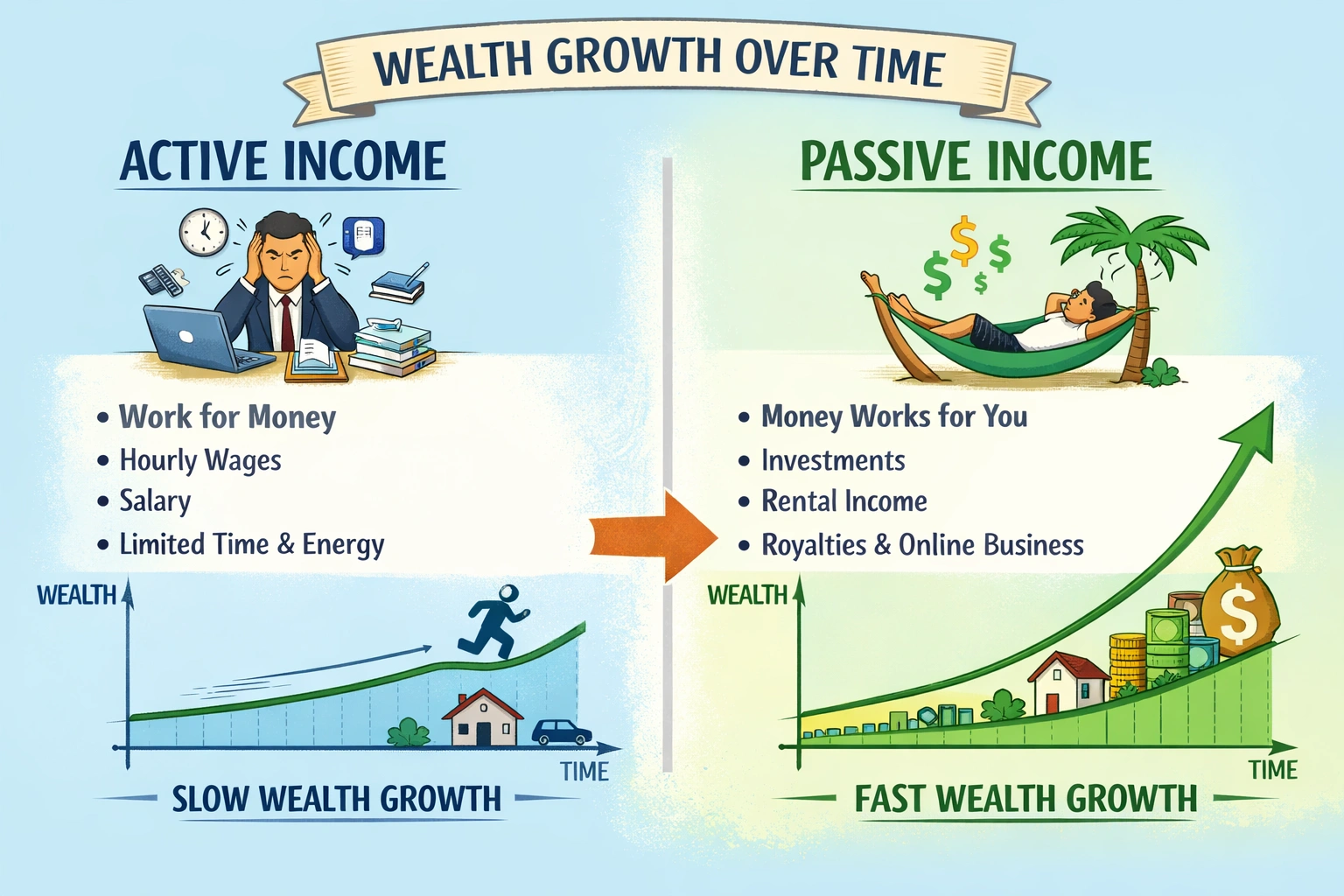
Active income is money earned through direct effort and time. If you stop working, the income usually stops as well. This is the most common and familiar form of income worldwide.
Common examples of active income include:
- Salaries and hourly wages
- Freelancing or consulting fees
- Overtime pay and commissions
- Service-based side hustles
In short, active income follows a simple formula:
Time + Effort = Money
Advantages of Active Income
Active income plays a critical role, especially in the early stages of financial growth.
Key benefits include:
- Immediate cash flow: You get paid quickly and predictably
- Lower upfront risk: Little to no capital required to start
- Skill development: Increases your earning power over time
- Financial stability: Essential for covering daily living expenses
For most people, active income is the foundation upon which everything else is built.
Limitations of Active Income
Despite its importance, active income has clear constraints.
Major drawbacks include:
- Limited scalability: Income is capped by time and energy
- Burnout risk: More hours often mean more stress
- No work, no pay: Illness or job loss can immediately cut income
As the saying goes:
“There are only so many hours in a day, and active income is bound by all of them.”
Understanding Passive Income
What Is Passive Income?
Passive income is money earned from assets or systems that continue to generate income with little ongoing effort after the initial setup.
Unlike active income, passive income is decoupled from time—at least to a large extent.
Common passive income examples include:
- Dividend-paying stocks
- Rental real estate
- Interest from bonds or savings
- Royalties from books, courses, or digital products
- Automated online businesses
Advantages of Passive Income
Passive income is often associated with financial freedom—and for good reason.
Key benefits include:
- Scalability: Income can grow without proportional effort
- Time flexibility: Earn money while focusing on other priorities
- Wealth building: Compounds over time
- Resilience: Diversifies income beyond a single job
“If you don’t find a way to make money while you sleep, you will work until you die.” — Warren Buffett
Challenges and Risks of Passive Income
Despite its appeal, passive income is not “easy money.”
Important challenges include:
- Upfront investment: Time, money, or both are usually required
- Delayed results: Income may take months or years to materialize
- Market risk: Investments can fluctuate or underperform
- Maintenance: Truly passive income is rare—most streams require oversight
Active vs Passive Income: A Side-by-Side Comparison
| Feature | Active Income | Passive Income |
|---|---|---|
| Time requirement | High and ongoing | Low after setup |
| Income speed | Immediate | Delayed |
| Scalability | Limited | High |
| Risk level | Generally lower | Varies by asset |
| Wealth potential | Moderate | High (long-term) |
This comparison highlights a crucial truth: active vs passive income is not an either/or choice—it’s a sequence.
Which One Should You Focus On First?
Why Active Income Comes First for Most People
For beginners, active income should almost always be the starting point.
Here’s why:
- You need reliable cash flow to cover essentials
- Passive income usually requires capital, which comes from active income
- Skills developed through active work can later be leveraged passively
Think of active income as the engine and passive income as the investment portfolio that engine fuels.
When Passive Income Becomes the Priority
Once your active income:
- Covers your living expenses
- Allows consistent savings
- Leaves some surplus capital
…it becomes strategically smart to focus on building passive income streams.
A common progression looks like this:
- Earn active income
- Build an emergency fund
- Eliminate high-interest debt
- Invest surplus into passive assets
Blending Active and Passive Income for Long-Term Success
The most financially secure individuals don’t choose between active vs passive income—they combine both.
Examples of smart income blending include:
- Using salary income to invest in index funds
- Turning freelance expertise into digital products
- Reinvesting dividends to accelerate compounding
- Using active income raises to scale passive investments
“Do not save what is left after spending, but spend what is left after saving.” — Warren Buffett
The Role of Financial Markets in Passive Income
Financial markets play a central role in modern passive income strategies.
Common market-based passive income tools include:
- Dividend-paying equities
- Exchange-Traded Funds (ETFs)
- Bonds and fixed-income instruments
- Real Estate Investment Trusts (REITs)
These instruments allow individuals to participate in economic growth without running businesses themselves, making them accessible and scalable for long-term investors.
Conclusion: Key Takeaways and Practical Actions
The debate around active vs passive income is not about choosing sides—it’s about timing and strategy.
Key takeaways:
- Active income is essential for financial stability and capital creation
- Passive income is critical for wealth building and time freedom
- Most people should focus on active income first, then transition gradually
- A blended approach offers the strongest financial resilience
Practical actions you can take today:
- Assess your current active income and growth potential
- Identify one realistic passive income path aligned with your skills or capital
- Start small, stay consistent, and reinvest earnings
Financial freedom is not built overnight—but with the right income strategy, it is absolutely achievable.