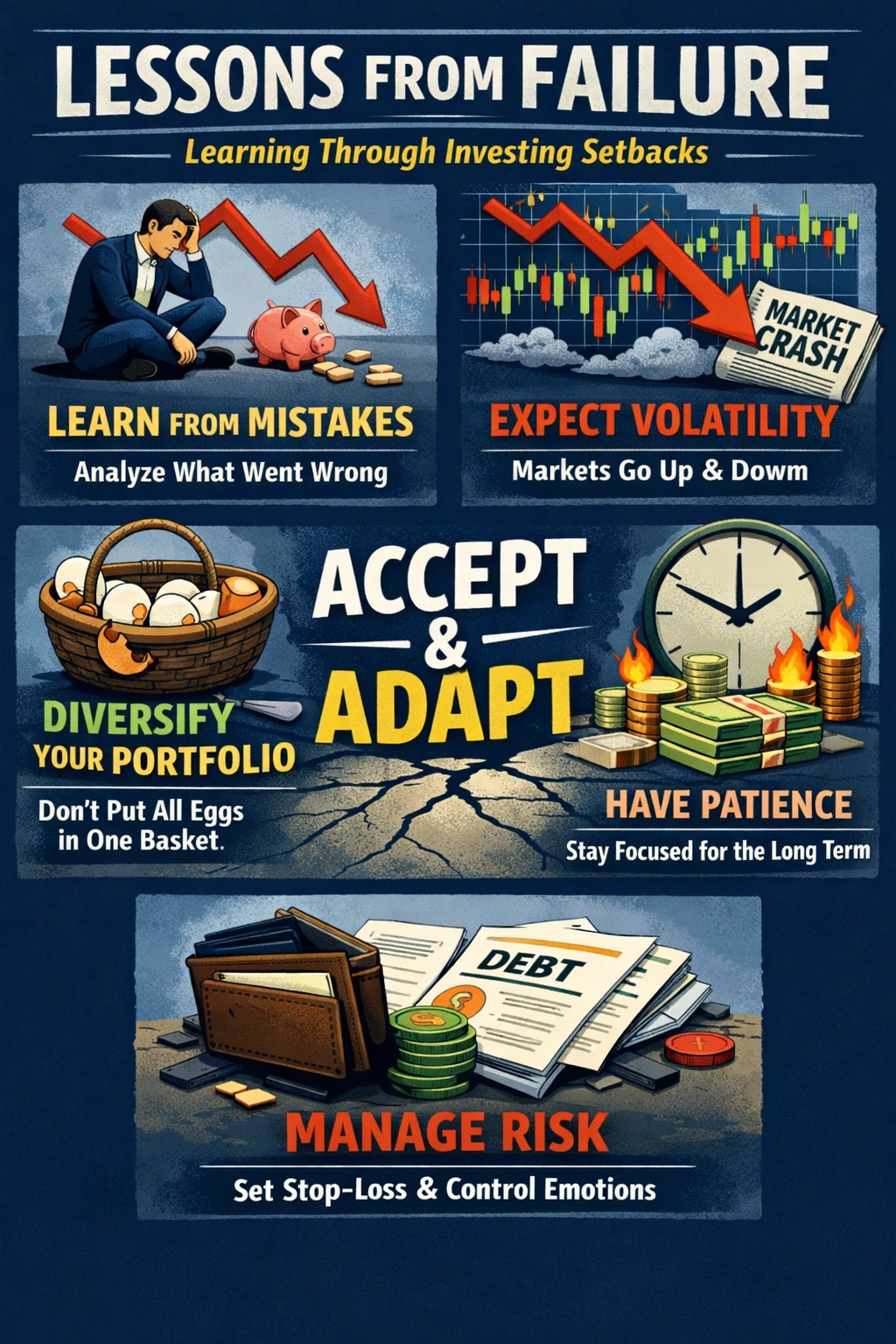
Introduction: Why Failure Is a Hidden Asset in Finance and Life
Failure is often framed as something to avoid at all costs—especially in investing, personal finance, and career growth. Yet history tells a very different story. Many of the world’s most successful investors, entrepreneurs, and business leaders built their long-term success not by avoiding mistakes, but by learning systematically from failure.
In financial markets, losses are inevitable. In personal finance, wrong decisions happen. In building passive income or businesses, setbacks are part of the process. The real differentiator is how individuals respond to those failures.
This article explores lessons from failure through the lens of investing, personal finance, passive income, and financial markets. You will learn:
- Why failure is unavoidable—and even necessary—for long-term wealth creation
- What successful people learned the hard way from financial mistakes
- How to turn losses into data-driven improvements
- Practical frameworks to apply these lessons to your own financial life
As Thomas Edison famously said:
“I have not failed. I’ve just found 10,000 ways that won’t work.”
Table of Contents
Understanding Failure in Investing and Personal Finance
Why Failure Is Inevitable in Financial Markets
Financial markets are uncertain by nature. Prices move based on information, emotions, macroeconomic forces, and unexpected events. Even professional fund managers with decades of experience experience losing years.
Common sources of financial failure include:
- Market volatility and economic downturns
- Emotional decision-making (fear and greed)
- Overconfidence during bull markets
- Poor diversification or risk management
Failure, in this context, is not a sign of incompetence—it is a statistical reality.
“Risk comes from not knowing what you’re doing.” — Warren Buffett
The key lesson successful investors learn early is that avoiding all losses is impossible, but avoiding catastrophic losses is achievable.
Lessons from Failure in Investing
Lesson 1: Losses Teach Risk Management Better Than Theory
Many investors understand risk management intellectually—but only learn its true importance after a painful loss.
Common early mistakes include:
- Investing too much in a single stock
- Using leverage without understanding downside risk
- Ignoring asset allocation
Successful investors learn to:
- Diversify across asset classes (stocks, bonds, real assets)
- Limit position sizes
- Accept small losses to avoid large ones
Example:
An investor who loses 50% of their portfolio must gain 100% just to break even. This mathematical reality often becomes clear only after experiencing loss firsthand.
Lesson 2: Timing the Market Is Harder Than It Looks
Many first-time investors believe they can “buy the bottom” and “sell the top.” Market failures quickly expose this illusion.
What failure teaches:
- Market timing requires near-perfect decisions twice
- Missing just a few strong market days can drastically reduce returns
- Long-term consistency beats short-term prediction
A simple chart often used by financial educators compares:
- Investor A: Tries to time the market
- Investor B: Invests consistently over time
Investor B almost always wins in the long run.
“The stock market is a device for transferring money from the impatient to the patient.” — Warren Buffett
Lessons from Failure in Personal Finance
Lesson 3: Lifestyle Inflation Is a Silent Wealth Killer
Many people experience financial failure not because they earn too little—but because spending grows faster than income.
Common mistakes learned the hard way:
- Increasing expenses after every raise
- Relying on debt for lifestyle upgrades
- Delaying savings “until later”
Successful individuals eventually realize:
- Wealth is the gap between income and expenses
- Saving and investing must come before discretionary spending
- Automation beats willpower
A simple personal finance table illustrates this lesson clearly:
| Income | Expenses | Savings Rate | Long-Term Outcome |
|---|---|---|---|
| High | High | Low | Financial stress |
| Moderate | Low | High | Financial freedom |
Lesson 4: Emergency Funds Prevent Financial Collapse
Many people only appreciate emergency funds after facing a crisis—job loss, medical expense, or unexpected repair.
Failure teaches that:
- Debt is expensive during emergencies
- Liquidity matters as much as returns
- Peace of mind has real financial value
A commonly recommended emergency fund covers 3–6 months of essential expenses. This buffer often prevents long-term financial damage from short-term setbacks.
Lessons from Failure in Building Passive Income
Lesson 5: Passive Income Is Rarely Passive at the Start
Online businesses, dividends, rental properties, and digital products are often marketed as effortless income streams. Failure quickly corrects this misconception.
Early-stage failures reveal that:
- Most passive income requires upfront effort or capital
- Systems must be built before income becomes scalable
- Sustainability matters more than speed
Successful individuals learn to treat passive income like an investment project, not a shortcut.
“You must learn to work while you sleep, or you will work until you die.” — Often attributed to Warren Buffett
The lesson is not that passive income is a myth—but that patience and systems are required.
Lessons from Failure in Financial Markets and Business
Lesson 6: Emotional Discipline Beats Intelligence
Many intelligent people fail in markets because emotions override logic during stress.
Common emotional failures include:
- Panic selling during market crashes
- Chasing hype during bubbles
- Refusing to admit mistakes
Over time, successful participants learn to:
- Follow predefined rules
- Separate emotions from execution
- Review decisions objectively
This is why many professionals use written investment plans—to protect themselves from their own psychology.
Turning Failure into a Strategic Advantage
How Successful People Analyze Failure
The most valuable lessons from failure come from structured reflection:
- What assumptions were wrong?
- What risks were underestimated?
- What signals were ignored?
Failure becomes feedback—not a verdict.
A simple post-failure framework:
- Document the decision
- Identify controllable vs. uncontrollable factors
- Adjust strategy or process
- Reapply with discipline
This approach transforms losses into long-term competitive advantages.
Conclusion: Failure Is the Tuition Fee for Financial Wisdom
Failure is not the opposite of success—it is often the path to it. In investing, personal finance, passive income, and financial markets, mistakes are inevitable. What separates successful people from everyone else is not luck or perfection, but learning speed and discipline.
Key Takeaways:
- Failure is unavoidable in financial growth
- Risk management is learned through experience
- Emotional discipline matters more than predictions
- Systems and long-term thinking turn losses into assets
Practical Actions You Can Take Today:
- Review one past financial mistake and extract a clear lesson
- Write a simple investment or savings rule to prevent repetition
- Focus on process improvement, not outcome perfection
As Henry Ford once said:
“Failure is simply the opportunity to begin again, this time more intelligently.”