
The digital asset landscape is constantly evolving, but few innovations have reshaped the concept of passive income as profoundly as the emergence of liquid staking. For investors navigating the complex terrain of the 2026 market, understanding the fundamental differences between liquid staking vs traditional staking is not merely academic—it is the key to unlocking superior, capital-efficient yields. Traditional staking, the bedrock of Proof-of-Stake (PoS) networks, has long offered a secure, albeit rigid, path to earning rewards. However, the requirement to lock up assets, often for extended periods, creates a significant opportunity cost. This inherent illiquidity has been the primary catalyst for the development of liquid staking protocols, which aim to solve this dilemma by issuing tradable tokens representing the staked assets. As the market matures and institutional interest surges, the choice between these two methods has become a critical strategic decision for both retail and institutional participants looking to maximize their returns while managing risk. This comprehensive guide will explore the mechanics, benefits, risks, and long-term implications of both approaches, providing a clear roadmap for optimizing your staking strategy in the current financial climate.
Table of Contents
The Foundation: Understanding Traditional Proof-of-Stake (PoS)

Traditional staking is the foundational mechanism that secures and validates transactions on Proof-of-Stake blockchains, such as Ethereum, Solana, and Cardano. In this model, asset holders lock up (or “stake”) their native tokens directly on the network to participate in the consensus process. By committing their capital, these stakers, or validators, are rewarded with newly minted tokens or transaction fees for their service in verifying new blocks. This process is essential for the security and decentralization of the network, replacing the energy-intensive “mining” of Proof-of-Work systems. The core principle is straightforward: the more tokens you stake, the higher your chance of being selected to validate a block and receive a reward. However, this commitment comes with a crucial trade-off: illiquidity. Once tokens are staked, they are typically subject to an unbonding period, which can range from a few days to several weeks. During this time, the assets are inaccessible and cannot be used for trading, lending, or any other activity within the decentralized finance (DeFi) ecosystem. This lock-up period is a necessary security measure, ensuring validators are financially penalized (slashed) if they act maliciously or fail to maintain their infrastructure. For many investors, especially those with large capital allocations, this lack of flexibility represents a significant opportunity cost, which is precisely the problem liquid staking seeks to address.
The Mechanics of Traditional Staking
Traditional staking can be executed in a few ways, each with varying technical requirements and levels of control. The most direct method is solo staking, where an individual runs their own validator node. This typically requires a substantial minimum stake (e.g., 32 ETH for Ethereum) and a high degree of technical expertise to maintain 24/7 uptime and prevent slashing. Alternatively, users can opt for centralized exchange staking or staking pools, which lower the barrier to entry by allowing users to stake smaller amounts. While these options eliminate the technical burden and minimum stake requirement, they introduce a layer of counterparty risk, as the user must trust the exchange or pool operator with their funds and private keys. The rewards in traditional staking are generally predictable, consisting of the base protocol yield, but they are isolated from the broader DeFi landscape.
Benefits and Drawbacks of the Classic Approach
The traditional method remains a robust and critical component of the PoS ecosystem. Its primary strength lies in its simplicity and direct contribution to network security. However, its limitations are what drove the market to seek out more capital-efficient alternatives.
| Feature | Traditional Staking | Liquid Staking |
|---|---|---|
| Liquidity | Locked assets; subject to unbonding periods (days/weeks). | Instant liquidity via Liquid Staking Tokens (LSTs). |
| Yield Source | Base protocol staking rewards only. | Staking rewards + DeFi yields (Lending, LPing, Restaking). |
| Minimum Stake | Often high (e.g., 32 ETH for solo); lower for pools/exchanges. | Very low (fractional staking is standard). |
| Slashing Risk | Direct risk to the staker/validator. | Risk is socialized across all LST holders in the pool. |
| Composability | None. Assets are dormant. | High. LSTs can be used as collateral or traded. |
The Evolution: Why Liquid Staking Emerged

The rise of liquid staking is a direct response to the fundamental problem of capital inefficiency inherent in traditional staking. In a dynamic DeFi environment, having assets locked up is equivalent to leaving money on the table. The innovation of liquid staking protocols, such as Lido and Rocket Pool, was to introduce a synthetic asset—the Liquid Staking Token (LST)—that represents the user’s staked position. This simple yet powerful mechanism effectively removes the traditional trade-off between securing the network and participating in the broader DeFi ecosystem. By issuing an LST, the protocol allows the user to maintain full access to their capital’s value while their underlying assets remain locked and earning staking rewards on the base layer. This is the core reason why the liquid staking market has grown exponentially, with the TVL for Ethereum liquid staking alone reaching approximately $44.8 billion in 2025 [1].
How Liquid Staking Tokens (LSTs) Work
When a user deposits their native tokens (e.g., ETH) into a liquid staking protocol, the protocol immediately stakes those tokens with a decentralized set of professional validators. In return, the user receives an LST (e.g., stETH, rETH, JitoSOL). This LST is an interest-bearing token, meaning its value relative to the underlying asset accrues staking rewards over time. The LST is fully liquid and can be instantly traded, transferred, or, most importantly, used across the entire DeFi landscape. For example, a user holding stETH can deposit it into a lending protocol like Aave to earn additional lending yield, or use it as collateral to borrow stablecoins. This ability to “double-dip” on yield—earning staking rewards and DeFi yields simultaneously—is the primary driver of liquid staking’s popularity and its central role in the 2026 market.
The Core Value Proposition: Liquidity and Composability
The value proposition of liquid staking is centered on two key concepts: liquidity and composability. Liquidity ensures that users are not penalized by unbonding periods, allowing them to react quickly to market changes or access their capital without delay. Composability, however, is the true game-changer. LSTs act as primitive building blocks within DeFi, enabling users to stack multiple layers of yield. This has created a powerful flywheel effect, driving massive capital into liquid staking protocols and cementing their status as a core layer of the decentralized financial infrastructure. As Layer 2 ecosystems consolidate around Ethereum and other major chains, LSTs are becoming the preferred form of collateral and yield-bearing asset for cross-chain and application-layer activities.
Liquid Staking vs Traditional Staking: A Comparative Deep Dive for 2026
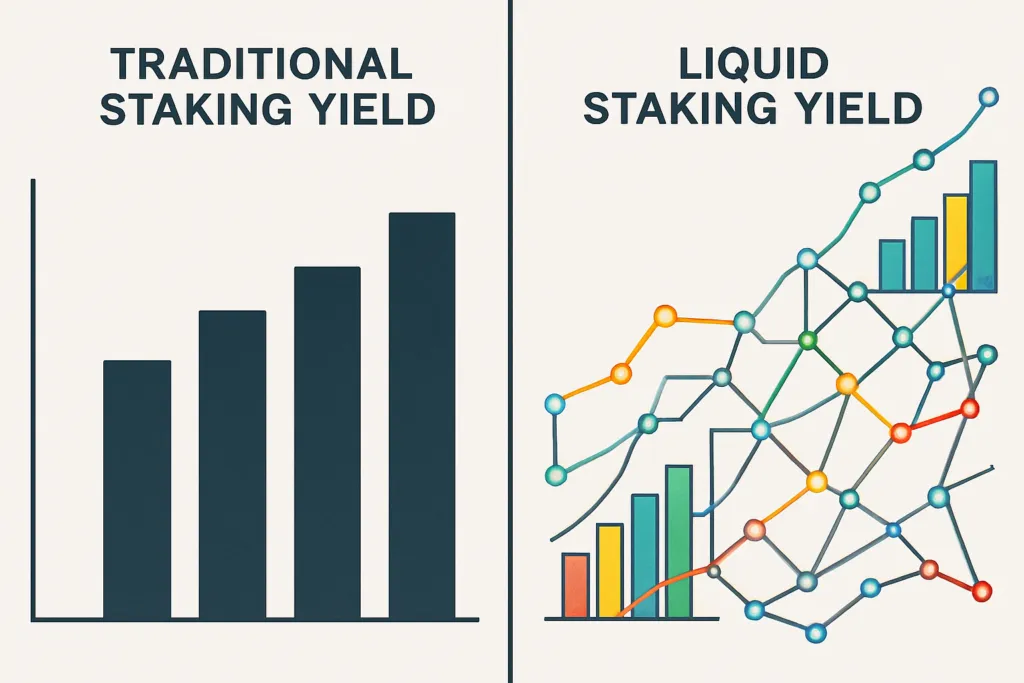
The choice between traditional and liquid staking in 2026 is less about which is “better” and more about which aligns with an investor’s risk tolerance, capital size, and desired level of engagement with DeFi. The market has matured to a point where both options are highly secure, but their economic profiles diverge significantly. Traditional staking offers a simple, low-engagement path to earning the base protocol yield, making it suitable for long-term holders prioritizing security and simplicity. Liquid staking, conversely, is the choice for capital efficiency, offering the potential for significantly higher yields through composability, but introducing a new set of complex risks that must be actively managed. The institutional influx, driven by increasing regulatory clarity, is further polarizing this choice, with institutions often favoring regulated liquid staking solutions that meet compliance standards while still offering capital efficiency.
Yield Maximization: Staking Rewards vs. DeFi Composability
In traditional staking, the yield is fixed by the network’s inflation and transaction fees. While stable, this yield is often subject to reward compression, a trend observed in 2026 where staking returns decline due to lower validator commissions and reduced protocol inflation across many ecosystems. Liquid staking, however, allows for yield stacking. The LST itself earns the base staking reward, but the token can then be deployed in various DeFi strategies:
- Lending: Depositing LSTs into money markets to earn lending interest.
- Liquidity Provision: Pairing LSTs with stablecoins or other assets in a liquidity pool to earn trading fees.
- Restaking: Utilizing LSTs in protocols like EigenLayer to secure other decentralized services (Actively Validated Services or AVSs) and earn additional, often higher, rewards.
This ability to generate multiple streams of income from a single underlying asset is the primary mechanism for maximizing yield in the liquid staking paradigm.
Risk Assessment: Smart Contracts, De-Pegging, and Slashing
While liquid staking offers higher potential returns, it also layers on additional risks that are absent in the direct, traditional method. A careful risk assessment is paramount for any investor considering the liquid route.
| Risk Category | Traditional Staking | Liquid Staking | Mitigation Strategy |
|---|---|---|---|
| Slashing | Direct risk to the staker/validator for downtime or malicious behavior. | Socialized risk across all LST holders; protocols often have insurance funds. | Choose reputable validators/protocols with high uptime and insurance. |
| Liquidity/Unbonding | High risk of capital being locked during market volatility. | Low risk; LSTs are instantly tradable. | N/A (inherent benefit of LSTs). |
| Smart Contract | Minimal (limited to the base protocol). | High risk of bugs or exploits in the liquid staking protocol’s smart contracts. | Choose audited, battle-tested protocols with high TVL and bug bounties. |
| De-Pegging | None. | LST may temporarily trade below its 1:1 value with the underlying asset (e.g., stETH vs. ETH). | Monitor LST/asset peg ratio; use protocols with robust redemption mechanisms. |
| Centralization | Risk of a few large pools dominating validation. | Risk of a single protocol (e.g., Lido) controlling a majority of staked assets. | Diversify across multiple liquid staking protocols (e.g., Rocket Pool, StakeWise). |
The Institutional Shift: Staking in the 2026 Market Landscape

The year 2026 is widely anticipated to be a watershed moment for the digital asset industry, marked by a decisive shift toward institutional integration and regulatory clarity. This transition is profoundly impacting the staking landscape. As regulatory frameworks, such as the expected bipartisan crypto market structure legislation in the U.S. [2], begin to take shape, major regulated institutions are moving from experimental involvement to active deployment of capital in the DeFi space. This institutional interest is not just in holding assets but in utilizing them efficiently, making liquid staking the preferred vehicle.
The Role of Regulation and Compliance
For institutional players, compliance is non-negotiable. Traditional staking, while secure, often presents operational challenges related to custody and accounting for locked assets. Liquid staking protocols that partner with regulated custodians and offer KYC/AML-compliant LSTs are becoming the go-to solution. The ability to hold a liquid, yield-bearing asset on their balance sheet that can be instantly liquidated or used as collateral simplifies regulatory reporting and capital management. This demand is driving the development of institutional-grade liquid staking solutions, such as those offered by Liquid Collective, which are specifically designed to meet the stringent requirements of traditional finance.
Market Consolidation and the Rise of Restaking
The 2026 market is also characterized by consolidation and the emergence of new yield layers. The dominance of a few major liquid staking protocols, particularly Lido on Ethereum, highlights a growing concern about centralization, a risk that both retail and institutional investors are keenly aware of. This has spurred the growth of decentralized alternatives like Rocket Pool and the rise of Restaking protocols like EigenLayer. Restaking allows LSTs to be “re-staked” to secure additional decentralized services, creating a new, higher-yield layer. While the initial hype around restaking saw some reward compression, the long-term trend is toward a multi-layered yield structure where LSTs are the foundational collateral for a vast network of decentralized trust services. This complexity, while daunting, is where the highest capital efficiency is found.
Practical Strategies for Maximizing Yield in 2026
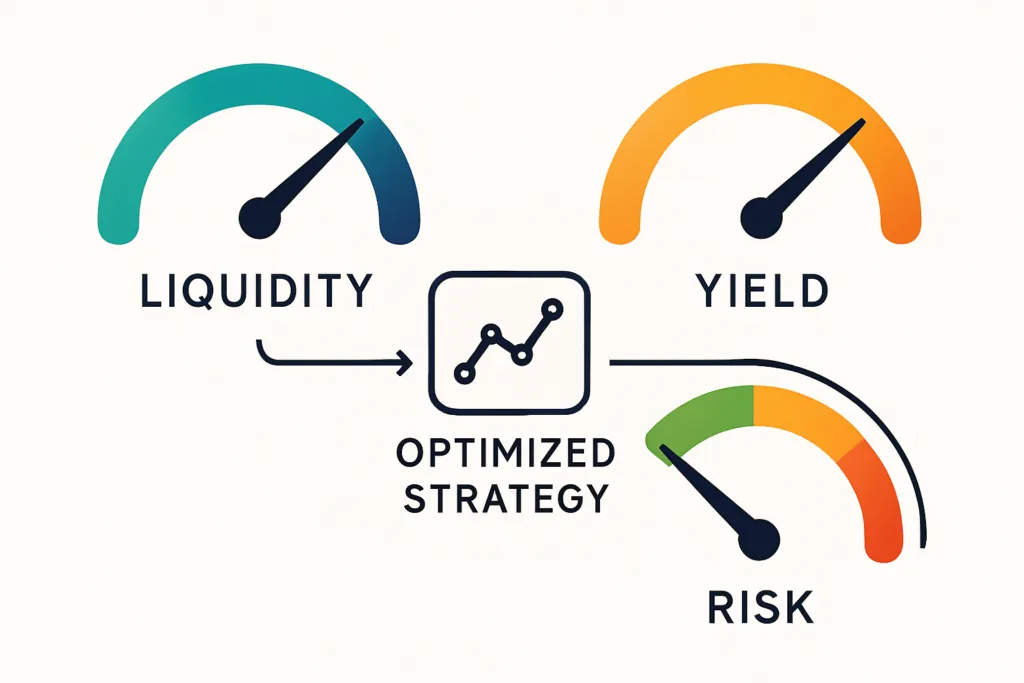
Maximizing yield in the 2026 market requires a nuanced strategy that balances the security of traditional staking with the capital efficiency of liquid staking. The optimal approach is rarely a binary choice but rather a diversified portfolio that leverages the strengths of both. The key is to understand your investment horizon, your risk tolerance for smart contract exposure, and your need for immediate liquidity.
Strategy 1: The Hybrid Approach (Diversification)
For most investors, a hybrid strategy offers the best balance. Allocate a portion of your capital to traditional staking (either solo or via a trusted, non-custodial pool) to secure a base, low-risk yield. This portion acts as a stable anchor in your portfolio. The remaining capital should be deployed into liquid staking protocols, with a further diversification across multiple LSTs (e.g., stETH, rETH, JitoSOL) to mitigate protocol-specific risks. This liquid portion can then be actively managed in DeFi, using LSTs for lending or restaking to capture compounded yields.
Strategy 2: Active Yield Stacking (Advanced)
This strategy is for the active investor comfortable with higher smart contract risk. It involves maximizing the composability of LSTs:
- Acquire LSTs: Stake native assets via a liquid staking protocol.
- Lend LSTs: Deposit the LSTs into a money market (e.g., Aave) to earn lending interest.
- Borrow Stablecoins: Use the LSTs as collateral to borrow stablecoins.
- Re-deploy: Use the borrowed stablecoins for yield farming or other low-risk strategies, effectively leveraging the initial staked position.
This approach significantly amplifies yield but increases the risk of liquidation if the LST’s value drops or if the underlying protocol is exploited.
Strategy 3: The Institutional-Grade Path (Compliance Focus)
For large-scale or institutionally-minded investors, the focus shifts to security and compliance. This involves using specialized, regulated liquid staking solutions that offer:
- KYC/AML Compliance: Ensuring the LSTs meet regulatory standards.
- Segregated Custody: Partnering with institutional custodians to hold the underlying staked assets.
- Audited Protocols: Prioritizing protocols with multiple, rigorous third-party audits and substantial insurance coverage.
This path may offer slightly lower yields than the most aggressive DeFi strategies, but the reduced counterparty and regulatory risk makes it the most viable option for large-scale capital deployment.
Conclusion
The choice between liquid staking vs traditional staking is a defining one for the 2026 digital asset investor. Traditional staking provides the secure, foundational yield necessary for network stability, but its illiquidity is a significant constraint on capital efficiency. Liquid staking, through the innovation of LSTs, has shattered this constraint, creating a dynamic, composable asset that can generate multiple layers of yield across the burgeoning DeFi ecosystem. As the market continues its trajectory toward institutional maturity, liquid staking is poised to become the dominant form of staking, driven by its superior capital efficiency and the increasing demand for liquid, yield-bearing collateral. However, this path is not without its complexities, requiring investors to navigate the layered risks of smart contract vulnerabilities, de-pegging events, and centralization concerns. The most successful investors in 2026 will be those who adopt a balanced, diversified strategy, leveraging the security of the traditional approach while strategically deploying capital into the most robust and audited liquid staking protocols to maximize their yield potential.
FAQ
What is the main difference between liquid staking and traditional staking?
The main difference is liquidity. Traditional staking requires you to lock your assets, making them inaccessible for a period. Liquid staking gives you a Liquid Staking Token (LST) in return for your staked assets, which you can use in other decentralized finance (DeFi) applications while still earning staking rewards.
Is liquid staking riskier than traditional staking?
Yes, liquid staking introduces additional layers of risk. While traditional staking primarily carries the risk of slashing (penalties for validator failure), liquid staking adds smart contract risk (the protocol could be exploited) and de-pegging risk (the LST might temporarily trade below the value of the underlying asset).
Can I use my Liquid Staking Tokens (LSTs) as collateral?
Absolutely. The primary benefit of LSTs is their composability. You can use them as collateral in lending protocols, deposit them into liquidity pools, or even use them in restaking protocols to earn additional yield on top of your base staking rewards.
What is the minimum amount required for liquid staking?
One of the major advantages of liquid staking is the low barrier to entry. Unlike solo traditional staking, which often requires a large minimum (e.g., 32 ETH), liquid staking protocols allow users to stake any fractional amount, making it accessible to virtually all investors.
Which liquid staking protocol is the most dominant in the 2026 market?
Lido remains the most dominant liquid staking protocol, particularly on Ethereum, controlling a significant portion of the staked ETH. However, decentralized alternatives like Rocket Pool and newer, institutional-focused solutions are gaining market share as investors seek diversification and compliance.
The world of staking is moving fast. Don’t let your capital sit idle. Share your thoughts on the future of restaking and LSTs in the comments below, and subscribe to our newsletter for more in-depth analysis of the evolving DeFi landscape.
References
[1] Everstake. The Next Chapter for Crypto: 2025 Review & 2026 Outlook. https://everstake.one/blog/the-next-chapter-for-crypto-market-analysis-of-2025-and-expectations-for-2026
[2] Grayscale. 2026 Digital Asset Outlook: Dawn of the Institutional Era. https://research.grayscale.com/reports/2026-digital-asset-outlook-dawn-of-the-institutional-era
[3] Coinbase. Liquid Staking vs. Traditional Staking vs. Pool Staking: Which One Is Right for You. https://www.coinbase.com/learn/advanced-trading/liquid-staking-vs-traditional-staking-vs-pool-staking-which-one-is-right-for-you
[4] BeInCrypto. Top High-Yield Liquid Staking Platforms to Watch in 2026. https://beincrypto.com/top-picks/liquid-staking-platforms-to-watch/
[5] Intel Market Research. Liquid Staking Market Outlook 2026-2032. https://www.intelmarketresearch.com/liquid-staking-market-23520