Introduction
When markets shake, portfolios tremble but investors often do far worse than markets. While economic shocks like the 2008 global financial collapse, the dot‑com bust, or the COVID‑19 crash are reminders of how unpredictable economies can be, the real threat during these times isn’t the markets themselves. It’s how humans react under stress. Behavioral biases those invisible, psychological patterns that sway our decisions often turn temporary downturns into long‑term financial regrets.
Understanding investment mistakes during crises isn’t just an academic exercise. Crises expose the raw edges of human decision‑making: fear is amplified, judgment is clouded, and mistakes become amplified versions of what many investors do even in calm markets. This article dives into five powerful behavioral biases that consistently lead investors astray during crises. These biases aren’t about intelligence or financial literacy; they’re about how humans naturally respond to uncertainty, loss, and pressure.
By the end of this guide, you will understand not just what these biases are, but why they occur, how they show up in real investment scenarios, and what practical steps you can take to prevent them from sabotaging your financial future. From loss aversion to herd behavior, we’ll explore both the psychology and the practical pain points of these biases. Real‑world examples from market sell‑offs, expert quotes, and data will bring these concepts to life so you can spot them in yourself and others.
If you’ve ever wondered why “doing the wrong thing at the right time” feels easier than staying disciplined, you’re not alone. What you’re about to learn are the invisible forces that cause otherwise rational investors to make irrational choices when it matters most. And more importantly, you’ll walk away with tools to fight back.
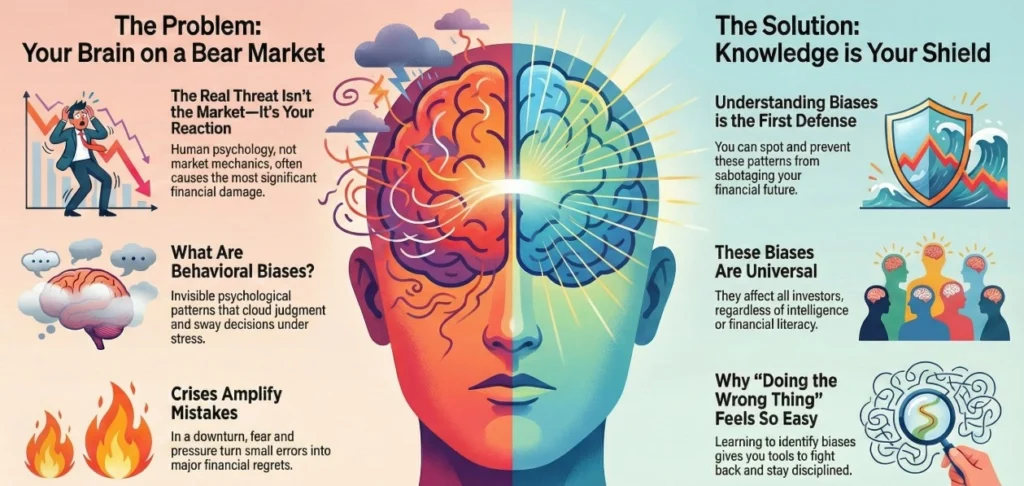
Table of Contents
Loss Aversion, Why Pain Hurts More Than Pleasure Helps
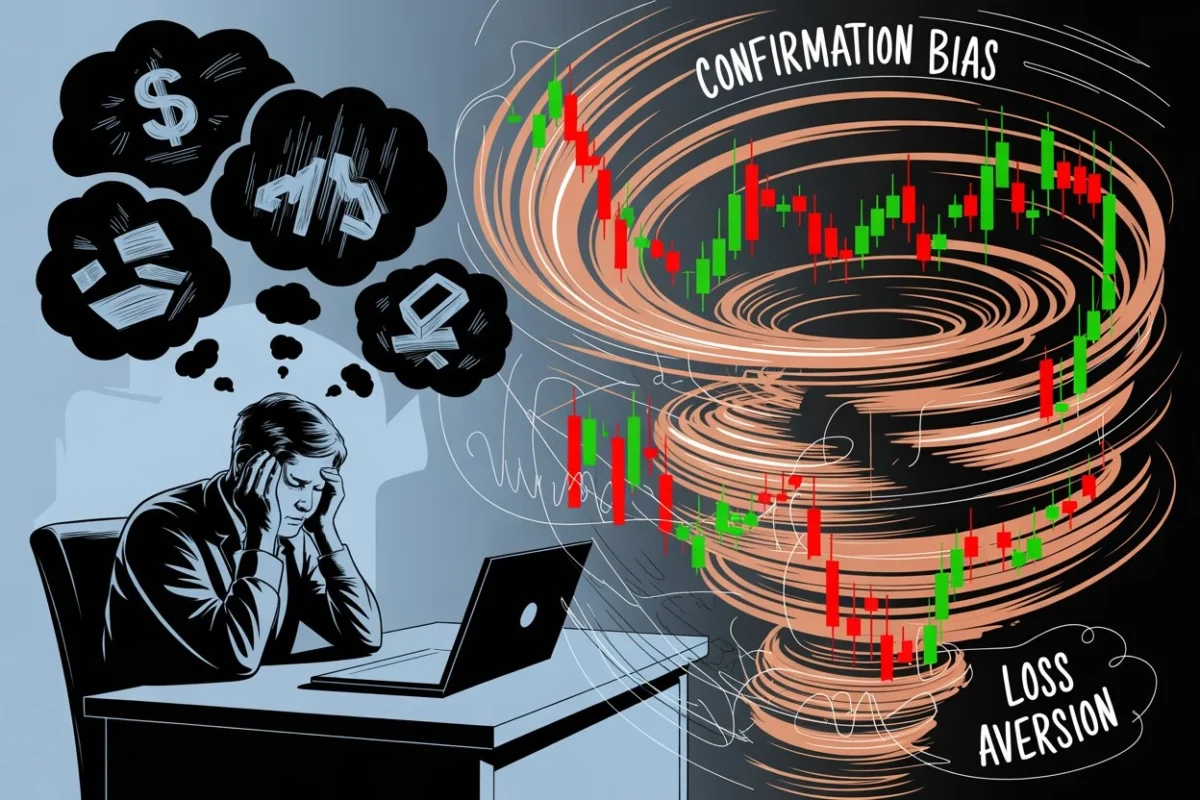
When financial markets tumble, most investors feel the drops more intensely than they feel the joy of gains. This is the essence of loss aversion: the psychological impact of losing is typically far stronger than the pleasure associated with equivalent gains. In behavioral economics, loss aversion is one of the most consistent findings across studies. For example, researchers Daniel Kahneman and Amos Tversky showed that people feel the pain of losing $100 roughly twice as strongly as the pleasure of gaining the same amount. This bias becomes especially dangerous during times of market stress.
During a crisis, loss aversion pushes investors to exit positions at the first sign of trouble usually after prices have already fallen significantly. The emotional reaction overrides logical planning. Instead of evaluating whether a stock or asset is still fundamentally sound, many investors sell to “stop the pain,” locking in losses that might have been temporary.
Loss aversion doesn’t disappear simply because someone is financially savvy. It roots itself in how the brain evaluates pain and reward. When markets are calm, this bias can still lead to sub‑optimal decisions, such as holding losing positions too long. But during crises, its effects are magnified: sudden volatility triggers primal fear responses that were adaptive in ancient environments but are counterproductive in financial decision‑making.
Why Loss Aversion Causes Investment Mistakes During Crises
- Investors focus on avoiding losses rather than maximizing long‑term returns.
- Quick selling during downturns often means locking in losses instead of waiting for markets to recover.
- Fear clouds judgment, leading to reactive decisions instead of strategic planning.
- Historical market data shows that downturns are often followed by recoveries, but loss‑averse decisions prevent investors from benefiting.
Herd Behavior, Following the Crowd and Losing Your Way
Humans are inherently social creatures. In everyday life, social cues help us stay connected and safe. But in investing, especially during turbulent times, this instinct can become a liability. Herd behavior occurs when individuals follow what others are doing often without independent analysis simply because “everyone else is doing it.”
This bias creates powerful market dynamics. During crises, negative news often triggers widespread selling. When investors see peers or headlines about others exiting markets, they assume that selling is the correct strategy. This seems logical on the surface: if so many people are selling, maybe there’s good reason. But that assumption sidesteps analysis of fundamentals. Many investors buy into the narrative because it feels safer to align with the group rather than risk being wrong alone.
Herd behavior also feeds into market extremes. During the dot‑com bubble, rampant optimism drove valuations beyond reasonable levels. During the 2008 crisis, panic selling spread like wildfire even in assets that were only loosely connected to the underlying problem. The danger lies in the momentum of emotions, not the momentum of value.
How Herd Behavior Leads to Investment Mistakes During Crises
- Investors abandon individual research in favor of following majority actions.
- Panic selling spreads rapidly on social media, news outlets, and trading platforms.
- Herd behavior amplifies volatility, pushing prices far from intrinsic value.
- Buying after a sharp rebound (fear of missing out) often leads to buying at high prices rather than strategic entry points.
Confirmation Bias Seeing the World You Want, Not the World That Is
We all like to be right. Confirmation bias is the psychological tendency to seek out information that backs up our existing beliefs and ignore evidence that contradicts them. In normal times, confirmation bias affects many small decisions. But in crisis periods, it can derail entire investment strategies.
Imagine an investor convinced that a particular stock is a long‑term winner. When the price starts to fall, that investor may only read articles that affirm why the company is still strong, dismissing critical analysis as short‑sighted. The investor ends up trapped in a self‑reinforcing loop, unwilling to consider signs that might warrant reducing exposure.
Confirmation bias doesn’t just affect individual stocks it can influence beliefs about entire markets or asset classes. For example, if someone is convinced that real estate is always a safe investment, they may overlook local economic risks during an economic downturn. Similarly, during the COVID‑19 market crash, some investors clung to the belief that certain sectors were immune to downturns, despite clear data suggesting otherwise.
The danger of confirmation bias is that it filters reality through a subjective lens, turning each piece of information into a tool for justification rather than understanding.
How Confirmation Bias Damages Crisis Investment Decisions
- Investors ignore warning signs that contradict their preconceptions.
- Echo chambers on social media reinforce biased narratives.
- Critical voices or data are dismissed, leading to poor risk assessments.
- Confirmation bias prevents timely realignment of portfolio risk.
Overconfidence, The Quiet Risk That Grows Loud During Stress
Confidence is useful in investing it helps people stay committed to long‑term plans and avoid frequent trading. But overconfidence crosses the line when an investor overestimates their ability to predict markets, especially during unprecedented events. Crises are terrains of uncertainty, where past patterns may break down and new information unfolds rapidly.
Overconfidence manifests in several ways. Some investors think they “beat the market” because of a few early wins and assume they can do it again. Others believe they understand the full implications of a crisis when data is still emerging. This overestimation of skill or knowledge can lead to aggressive trading, excessive risk‑taking, or ignoring expert warnings.
During the 2008 crisis, for instance, many market participants believed that certain financial instruments were low risk simply because they had performed well in prior years. This misplaced confidence fueled the housing bubble and exacerbated the crash when reality diverged from belief.
Overconfidence becomes even more dangerous when it intersects with leverage (borrowed money). An overconfident investor may use leverage to increase returns, unaware that leverage increases losses just as quickly in a downturn.
Why Overconfidence Causes Investment Mistakes During Crises
- Investors assume they can time market bottoms or tops, which is extremely difficult even for professionals.
- Past success is mistaken for predictive skill.
- Aggressive trading spikes transaction costs and emotional stress.
- Leverage magnifies both gains and losses, often disproportionately during downturns.
Recency Bias, The Present Overpowers the Past
Recency bias is the tendency to weigh recent events more heavily than historical data when making decisions. Financial markets are cyclical bull markets eventually give way to bear markets, and vice versa. But during crises, recent losses dominate investor attention, pushing them to believe that the recent trend will continue indefinitely.
This bias was evident during the March 2020 market crash when many investors, seeing rapid declines over days or weeks, assumed markets would continue falling for months. Without considering prior recoveries or historical mean reversion, panic selling intensified. Investors neglected the fact that markets have historically rebounded from sharp downturns given time even though there are no guarantees.
Recency bias interacts with emotion: recent pain feels more real than distant history. Even when reminded of past recoveries, investors tend to discount them because the emotional impact of the latest drop is fresh.
The Role of Recency Bias in Investment Mistakes During Crises
- Investors project current trends into the future without context.
- Recent losses overshadow long‑term strategy and historical resilience.
- Recency bias fuels panic selling during sharp declines.
- It leads to short‑sighted decisions instead of long‑term planning.
How to Break Biases and Improve Decision‑Making in Crises
Recognizing these five behavioral biases is only half the battle. Knowing how to actively counteract them is the key to avoiding investment mistakes during crises and making better decisions.
The first step is emotional awareness. Just as a seasoned pilot trains to remain calm in turbulence, investors must acknowledge that crises trigger emotional reactions. Awareness allows you to pause and assess rationally rather than react impulsively.
Another powerful tool is having a predetermined investment plan. When you predefine your risk tolerance, asset allocation, and criteria for rebalancing, you reduce the chance of making hasty decisions under pressure. Legendary investor Benjamin Graham once said, “The investor’s chief problem and even his worst enemy is likely to be himself.” A disciplined plan helps curb the self‑destructive impulses that biases create.
Diversification also plays a starring role. By spreading risk across asset classes, sectors, and regions, you reduce the emotional impact of any single asset’s decline. Diversification doesn’t eliminate losses, but it makes them more manageable and less likely to trigger panic.
Professional guidance whether from financial advisors, evidence‑based research, or trusted analysis can also serve as a reality check. When your instincts are clouded, external perspectives grounded in fundamental analysis can help you stay anchored.
Practical Strategies to Mitigate Behavioral Biases
- Build and document a long‑term investment plan.
- Set predefined rebalancing rules to avoid emotional trading.
- Diversify across assets to reduce stress from single‑asset swings.
- Use stop‑loss or risk management tools based on logic, not fear.
- Consult objective, long‑term focused advisors or research.
- Regularly review historical market patterns to counteract recency bias.
Conclusion
Crises reveal the true nature of both markets and the human mind. While economic downturns inevitably test portfolios, the real risk often lies in the emotional responses and psychological biases that influence decisions. Loss aversion, herd behavior, confirmation bias, overconfidence, and recency bias are powerful forces that can turn temporary market shocks into painful, long‑lasting financial setbacks.
Understanding these biases isn’t just a matter of intellectual curiosity it’s a practical necessity for anyone who wants to invest well, especially during uncertain times. The good news is that these psychological tendencies can be recognized, managed, and, with discipline, mitigated. Awareness leads to better strategies; planning leads to better decisions; and steady emotions lead to stronger financial outcomes.
As you reflect on your own investment journey, consider how these biases may have influenced your past decisions. Choose to build systems that protect against emotional impulsivity. The most successful investors don’t eliminate uncertainty they prepare for it. By cultivating a mindset grounded in patience, discipline, and self‑awareness, you reduce the likelihood that investment mistakes during crises derail your long‑term financial goals.