Introduction
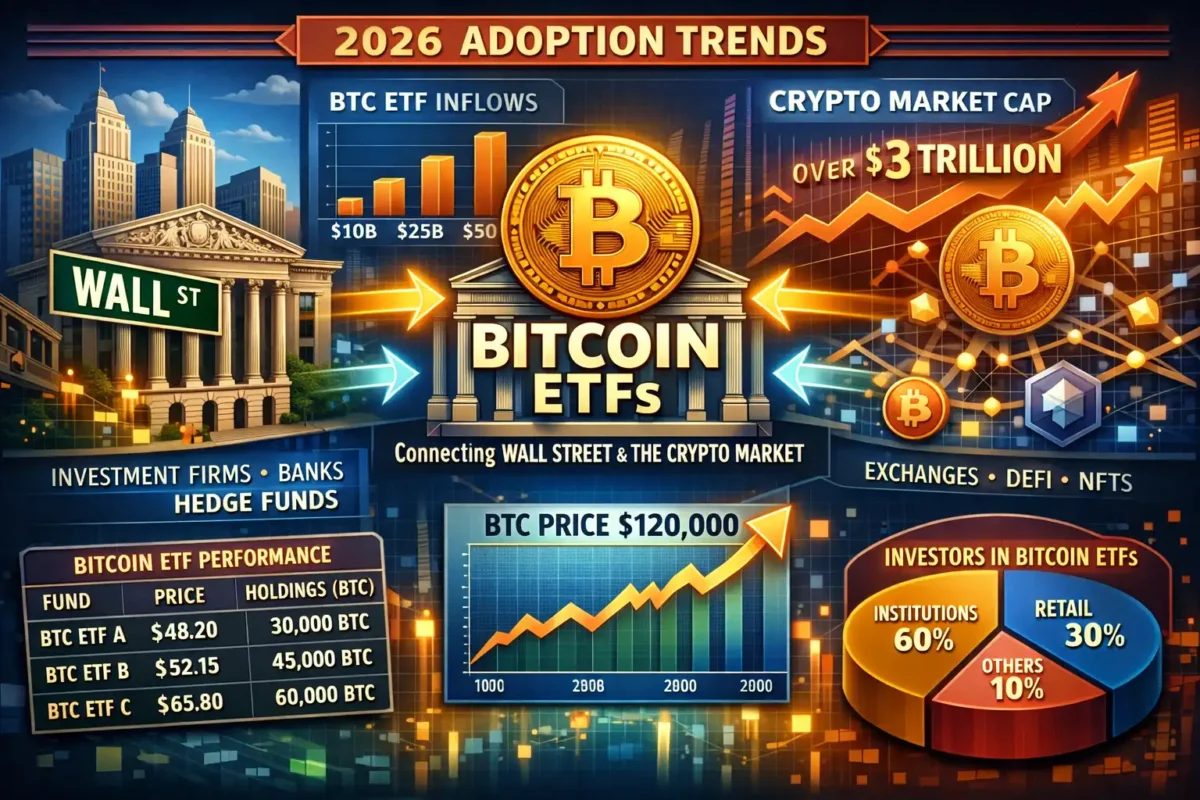
In just over a decade, Bitcoin has evolved from a niche experiment discussed on online forums into an asset class debated in boardrooms, central banks, and regulatory agencies. In 2026, the conversation has shifted again. The rise of bitcoin ETFs 2026 marks a turning point where traditional finance and crypto markets are no longer operating in separate worlds. Instead, they are increasingly interconnected, with institutional investors playing a defining role in shaping price behavior, market stability, and long-term adoption.
This topic matters today because investment access shapes demand, and demand shapes markets. When pension funds, insurance companies, and asset managers enter a space, they bring scale, rules, and expectations that differ sharply from retail speculation. Bitcoin ETFs act as a bridge, allowing institutions and everyday investors alike to gain exposure to Bitcoin without dealing directly with wallets, private keys, or crypto exchanges.
In this article, you will learn how bitcoin ETFs 2026 work, why Wall Street has embraced them, and what this means for market structure, volatility, and long-term crypto adoption. We will explore benefits and risks, compare ETFs with direct Bitcoin ownership, examine historical parallels, and translate complex financial concepts into plain English so you can understand where this transformation may lead.
Table of Contents
What Are Bitcoin ETFs and Why They Matter in 2026
A Bitcoin ETF, or exchange traded fund, is a financial product that tracks the price of Bitcoin and trades on traditional stock exchanges. Instead of buying Bitcoin directly, investors purchase shares of the ETF through a brokerage account. In 2026, bitcoin ETFs 2026 have become one of the most influential access points to the crypto market, especially for institutions that are restricted from holding digital assets directly due to custody, compliance, or regulatory constraints.
The importance of Bitcoin ETFs lies in accessibility and legitimacy. Large institutions typically operate under strict rules that favor regulated, transparent instruments. ETFs meet these requirements by offering audited holdings, regulated custodians, and daily disclosure. This structure reduces operational risk and aligns Bitcoin exposure with existing portfolio frameworks. According to Investopedia, ETFs have historically played a key role in mainstreaming commodities and alternative assets by making them easier to trade and regulate.
Bitcoin ETFs also change market dynamics. When ETF providers accumulate Bitcoin to back their shares, they introduce consistent institutional demand. This can affect liquidity, price discovery, and volatility patterns over time.
| Feature | Bitcoin ETF | Direct Bitcoin Ownership |
|---|---|---|
| Access | Brokerage account | Crypto exchange or wallet |
| Custody | Managed by regulated custodian | Investor-managed private keys |
| Regulation | High | Varies by jurisdiction |
| Ease of use | Very high | Moderate to complex |
Institutional Adoption and the Shift in Market Structure
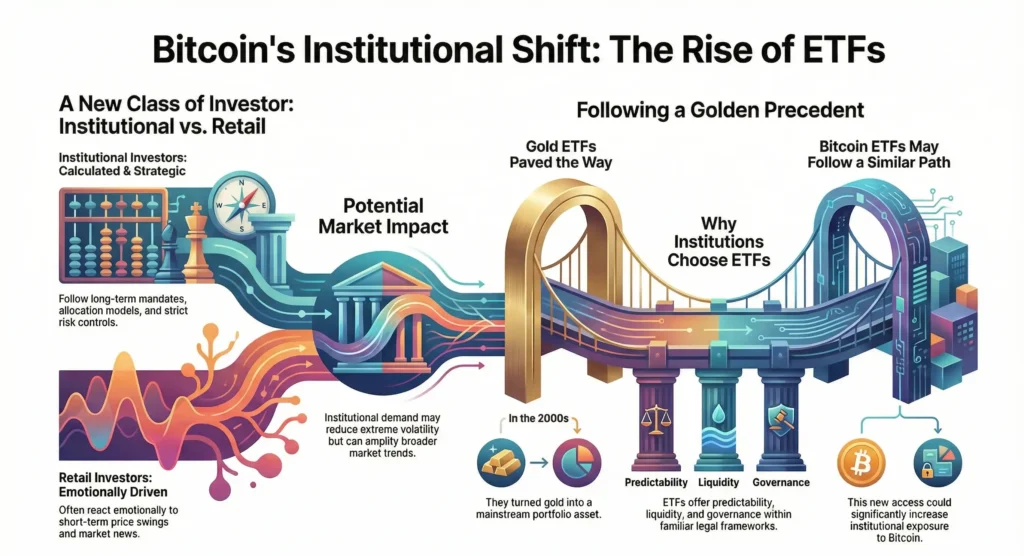
Institutional adoption refers to large organizations such as pension funds, hedge funds, banks, and endowments allocating capital to Bitcoin-related assets. In 2026, bitcoin ETFs 2026 have become the preferred vehicle for this participation. Institutions value predictability, liquidity, and governance, all of which ETFs provide within familiar legal frameworks.
This shift matters because institutions behave differently than retail traders. Retail investors often react emotionally to price swings, while institutions typically follow allocation models, risk controls, and long-term mandates. As a result, ETF-driven demand can reduce extreme volatility during certain market phases, although it may also amplify trends during broader risk-on or risk-off cycles.
Historical context helps explain this shift. When gold ETFs launched in the early 2000s, they transformed gold from a niche commodity into a mainstream portfolio component. Research from the World Gold Council shows that ETF access significantly increased institutional gold exposure. Bitcoin ETFs may be following a similar path.
Benefits of Bitcoin ETFs for Investors and Markets
Bitcoin ETFs offer several advantages that explain their rapid adoption. For individual investors, they simplify access. For institutions, they reduce operational complexity and compliance risks. In 2026, bitcoin ETFs 2026 also contribute to deeper market liquidity by consolidating large pools of capital into transparent structures.
Another benefit is integration into traditional portfolios. ETFs can be combined with stocks, bonds, and commodities within the same account, enabling balanced allocation strategies. Morningstar notes that diversified portfolios tend to perform better over long time horizons due to risk spreading.
Key benefits include:
- Simplified access without managing wallets or keys
- Regulatory oversight and audited holdings
- Easier tax reporting in many jurisdictions
- Improved liquidity and market depth
| Benefit | Impact on Investors | Impact on Market |
|---|---|---|
| Accessibility | Lower entry barriers | Broader participation |
| Transparency | Clear pricing | Better price discovery |
| Liquidity | Easier buying and selling | Reduced fragmentation |
Risks and Limitations of Bitcoin ETFs
Despite their advantages, Bitcoin ETFs are not risk-free. Investors are still exposed to Bitcoin price volatility, which can be significant. In addition, ETFs introduce management fees that reduce long-term returns compared to direct ownership. In 2026, bitcoin ETFs 2026 also raise questions about market concentration, as large custodians may hold substantial portions of circulating Bitcoin.
Another concern is regulatory dependency. ETFs operate within regulatory frameworks that can change. A shift in policy could affect trading rules, taxation, or access. The International Monetary Fund has repeatedly highlighted the need for balanced crypto regulation that protects investors without stifling innovation.
There is also the issue of detachment from the underlying ethos of Bitcoin. Some critics argue that ETFs weaken the decentralized nature of Bitcoin by centralizing ownership through large financial institutions.
| Risk | Description | Who It Affects Most |
|---|---|---|
| Price volatility | Bitcoin price swings | All investors |
| Management fees | Ongoing costs | Long-term holders |
| Centralization | Concentrated custody | Network purists |
How Bitcoin ETFs Are Reshaping Long-Term Crypto Adoption
The long-term impact of bitcoin ETFs 2026 extends beyond price charts. By integrating Bitcoin into pension funds, retirement accounts, and institutional portfolios, ETFs normalize crypto as a legitimate asset class. This normalization influences regulation, infrastructure investment, and public perception.
As adoption grows, related services such as custody solutions, analytics platforms, and compliance tools expand. The World Bank has noted that financial infrastructure development often accelerates when new asset classes gain institutional acceptance. Over time, this ecosystem growth can benefit the broader crypto market, including blockchain innovation beyond Bitcoin.
However, long-term adoption also depends on education. ETFs make access easier, but understanding risk remains essential. Investors who view Bitcoin ETFs as a guaranteed return rather than a volatile asset may face disappointment during downturns.
Conclusion
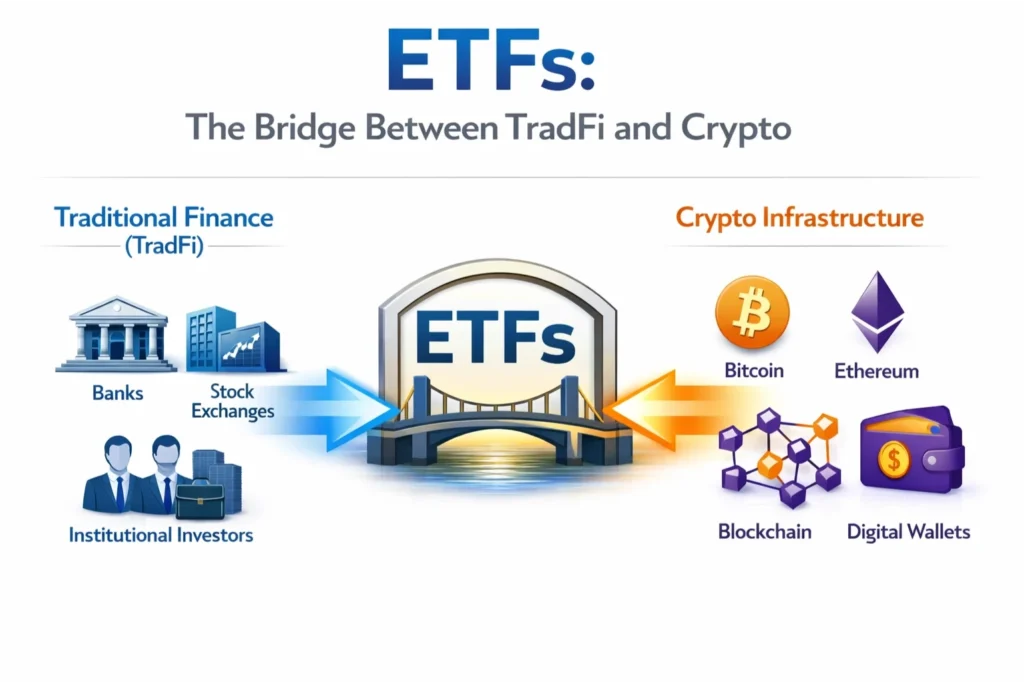
Bitcoin’s journey from an experimental digital currency to a Wall Street-backed investment vehicle reflects a broader transformation in global finance. In 2026, bitcoin ETFs 2026 stand at the center of this shift, acting as a bridge between decentralized innovation and institutional capital. They have expanded access, improved liquidity, and introduced new forms of legitimacy that were once unimaginable for crypto assets.
At the same time, ETFs do not eliminate risk. Bitcoin remains volatile, and institutional participation does not guarantee price stability or universal acceptance. What it does offer is structure. Structure brings rules, oversight, and predictability, qualities that attract long-term capital and influence market behavior.
For investors, the key takeaway is balance. Bitcoin ETFs can play a role in diversified portfolios, but they should be approached with realistic expectations and a clear understanding of their mechanics. For the broader market, institutional adoption through ETFs may support gradual maturation, even if short-term cycles remain turbulent.
Ultimately, the rise of Bitcoin ETFs is not about replacing the original vision of crypto. It is about expanding its reach. Whether this reshaping leads to stability, innovation, or new challenges will depend on how investors, regulators, and institutions navigate the years ahead.
Frequently Asked Questions
What makes bitcoin ETFs 2026 different from earlier crypto investment options
Bitcoin ETFs in 2026 are more regulated, widely available, and integrated into traditional financial systems compared to earlier crypto funds.
Are Bitcoin ETFs safer than owning Bitcoin directly
They reduce custody and operational risks but do not remove price volatility.
Can Bitcoin ETFs reduce market volatility
They may smooth certain extremes, but Bitcoin remains a volatile asset overall.
Do Bitcoin ETFs affect decentralization
They can concentrate ownership, which raises concerns among decentralization advocates.
Are Bitcoin ETFs suitable for long-term investors
They can be suitable as part of a diversified strategy, not as a standalone investment.
If you found this analysis helpful, consider subscribing for more deep dives into global finance and crypto trends. Share your thoughts or questions in the comments and join the discussion.