Many people work hard, earn decent incomes, yet feel permanently “stuck” in the same financial place year after year. The reason is rarely just low income; more often, it is a set ofcommonmoney mistakes repeated over time. These mistakes quietly erode cash flow, increase stress, and block long‑term wealth building.
This article explains the most common money mistakes, why they happen from a behavioral and economic perspective, and how to fix them with simple, practical strategies. You will see real data, clear examples, and an easy framework you can apply immediately to get unstuck financially.
Table of Contents
Why Money Mistakes Are So Persistent
Even smart, educated people regularly make basic personal finance mistakes. Surveys show that three in five adults feel their limited understanding of credit and personal finance has led them to make costly financial mistakes, and 60% of those say these errors have cost them at least 1,000 dollars.
Younger generations are hit especially hard: 29% of Gen Z and 38% of Millennials report mistakes that cost 5,000 dollars or more. As Experian’s consumer education manager notes, “Financial mistakes, such as missed payments, overpaying on interest or simply not understanding the terms you are agreeing to, can come at a serious cost for consumers.”
The Most Common Money Mistakes (With Data)
The table below summarizes a few of the most common money mistakes that keep people stuck financially, along with data or examples.
Key money mistakes and impacts
| Money mistake | What it means in practice | Evidence / impact |
|---|---|---|
| No emergency fund | Little or no savings for unexpected expenses | About 37% of adults struggle to cover a 400‑dollar emergency. |
| High‑interest credit card debt | Carrying balances at rates over 20% | Average credit card APR is around 22.77%. |
| Only paying minimums on credit cards | Making the smallest required payment each month | Interest charges can wipe out investment gains and delay saving. |
| Leaving cash in low‑yield accounts | Keeping savings in regular accounts with very low interest | Missing out on higher returns from high‑yield accounts. |
| No budgeting or tracking | Not knowing where money goes each month | Leads to overspending and inability to save consistently. |
| Lack of basic financial education | Not understanding credit, interest, or loan terms | 60% say poor knowledge led to costly mistakes. |
| Emotional and biased investing decisions | Letting fear, greed, or biases drive investment choices | Loss aversion and other biases distort decisions. |
These mistakes compound over time. A few years of high‑interest debt or missed savings opportunities can easily cost tens of thousands of dollars in lost net worth.
Visual snapshot: How common are these mistakes?
The chart below illustrates how widespread some of these money mistakes are among adults.
- Around 37% of adults cannot cover a 400‑dollar emergency expense in full.
- 60% of adults who lack financial knowledge say their mistakes have cost them at least 1,000 dollars.
- Among Gen Z and Millennials, roughly one‑third have made mistakes costing 5,000 dollars or more.
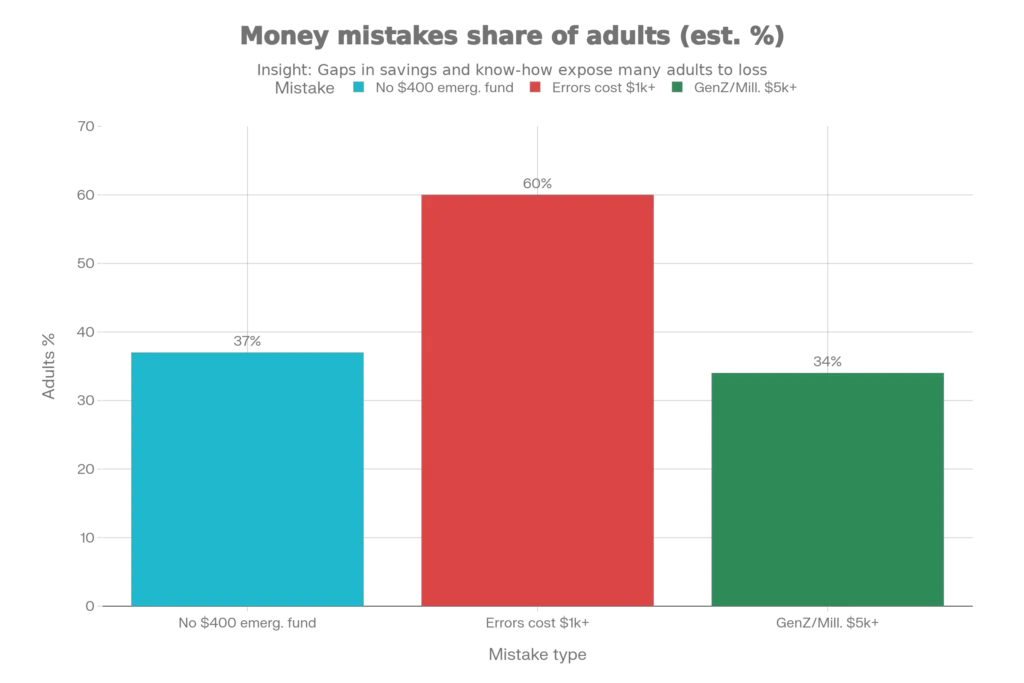
This visualization shows why understandingcommonmoney mistakes is not just theoretical; it is a real‑world issue affecting millions.
Mistake 1: Not Having an Emergency Fund
Why no emergency fund keeps you stuck
An emergency fund is money set aside for unexpected events like job loss, medical bills, or urgent car repairs. Without it, a single shock often forces people into high‑interest debt or late payments.
A Federal Reserve–related survey highlighted that more than a quarter of adults would struggle to cover a 400‑dollar emergency expense, and about 37% would need to borrow, use a credit card, or sell something to do it. This lack of buffer is one of the fastest ways to fall into a debt spiral.
Practical steps to fix it
- Start with a small, concrete goal.
Aim first for 400–1,000 dollars in a dedicated emergency account, then build toward 3–6 months of basic living expenses depending on your job stability and family situation. - Automate savings.
Set an automatic transfer on payday into a separate high‑yield savings account labeled “Emergency Fund” to reduce the temptation to spend. - Use “found money” wisely.
Direct bonuses, refunds, or side‑income windfalls straight into the emergency fund until your target is reached, instead of treating them as extra spending money.
Mistake 2: Carrying High‑Interest Credit Card Debt
How credit card debt traps you
Credit cards are convenient, but revolving balances at high interest rates are extremely expensive. In late 2023 the average credit card APR reached about 22.77%, meaning even a modest balance can grow rapidly if not paid down aggressively.
Paying only the minimum can stretch repayment over many years and cost more in interest than the original purchase itself. Credit card interest effectively acts as a “negative investment,” consuming cash that could otherwise be used for saving and investing.
How to get out of high‑interest debt
- Stop adding new debt.
Shift new expenses to cash or a debit card and keep one card for essential recurring bills only, paid in full each month. - Use a structured payoff strategy.
Two common methods are:- Debt avalanche: Pay extra toward the highest‑interest debt first while paying minimums on others, which minimizes total interest.
- Debt snowball: Pay extra toward the smallest balance first to get quick psychological wins, then roll payments to the next debt.
- Consider lower‑cost refinancing.
Balance transfer offers, consolidation loans, or negotiating lower rates with your bank can meaningfully reduce your interest burden if used carefully and paired with disciplined spending.
Mistake 3: Leaving Cash in Low‑Yield Accounts
Why this is a hidden money mistake
Many people are proud simply to have money in savings, but where that money sits matters. A significant share of savers keep cash in traditional savings accounts that pay very low interest, even when high‑yield savings accounts or money market funds pay considerably more.
This is an opportunity cost problem: the saver is not losing money outright, but they are missing out on extra, low‑risk interest income that could accelerate their financial progress.
Simple optimization moves
- Compare yields regularly.
Review your bank’s savings rate at least once a year and compare it to reputable high‑yield savings accounts or money market accounts. - Keep safety first.
For emergency funds and short‑term goals, prioritize insured accounts and liquidity; once that is in place, look at improving yield within that safe category. - Separate short‑term cash and long‑term investing.
Money needed in the next 1–3 years should stay in cash‑like instruments, while longer‑term funds can move into diversified investments.
Mistake 4: Not Budgeting or Tracking Spending
Why not tracking spending is so costly
Without a budget or tracking system, it is almost impossible to know where money is actually going. This lack of visibility leads to “lifestyle creep” — spending rising in line with income — and leaves little left for saving, investing, or debt payoff.
Even simple self‑reported surveys show that many households live paycheck to paycheck, with low personal savings rates and very limited buffers against shocks. Without a clear plan, any raise or bonus tends to get absorbed by higher discretionary spending.
A simple budgeting framework
- Use the 50/30/20 guideline as a starting point.
Allocate roughly:- 50% of net income to needs (housing, food, utilities, minimum debt)
- 30% to wants (restaurants, subscriptions, travel)
- 20% to saving, investing, and extra debt payments
- Track spending automatically.
Use an app, spreadsheet, or bank categorization tools to see your monthly spending across key categories. Review once a week and adjust. - Introduce “pay yourself first.”
Treat saving and investing as non‑negotiable bills paid at the start of the month, not whatever is left over at the end.
Mistake 5: Lack of Financial Education
How knowledge gaps drive costly errors
A 2024 survey of 2,000 adults found that three in five respondents feel their limited understanding of credit and personal finance has led them to make financial mistakes, with 60% saying those mistakes cost them at least 1,000 dollars. Among younger groups, over 70% of Gen Z and Millennials reported that inadequate financial knowledge has come at a price.
The same research highlights a structural issue: while 78% of adults believe personal finance should be mandatory in high school, only around half of U.S. states currently require such coursework. This mismatch leaves many people to learn by trial and error, often in high‑stakes situations such as credit cards, mortgages, or student loans.
How to build your financial literacy
- Focus on core concepts first.
Start with budgeting, interest (simple vs compound), credit scores, debt payoff strategies, and basic investing tools like index funds and retirement accounts. - Use credible sources.
Read educational content from reputable financial institutions, regulators, universities, and established finance sites rather than unverified social media advice. - Learn “just in time.”
Before taking a loan, investing in a product, or signing a contract, spend an hour learning the basics of that topic to avoid hidden pitfalls.
Mistake 6: Emotional and Biased Investing
Behavioral biases that hurt investors
Even investors who save regularly can get stuck financially if they let emotions or cognitive biases drive decisions. Behavioral finance research highlights several recurring biases:
- Loss aversion.
People feel the pain of losses more intensely than the pleasure of equivalent gains, which can cause them to hold onto losing investments too long or avoid productive risk entirely. - Herd behavior.
Investors often chase popular assets because “everyone else is buying,” leading to buying high and selling low. - Present bias.
Short‑term emotions overshadow long‑term goals, causing impulsive trades rather than disciplined investing.
One analysis notes that loss aversion leads investors to keep declining assets beyond the point where rational portfolio adjustments would be beneficial, particularly in areas like real estate where attachment is strong.
How to invest more rationally
- Set a written investment policy.
Specify your goals, time horizon, risk tolerance, and rebalancing rules so you are not making major decisions in the heat of the moment. - Use systematic review points.
Review your portfolio on a fixed schedule (for example, quarterly or annually) rather than reacting to daily market moves. - Focus on total financial health, not single trades.
A portfolio can succeed overall even if some individual positions underperform; the key is maintaining a diversified, goal‑aligned strategy.
Putting It All Together: From Stuck to Progress
To move from being financially stuck to building momentum, the priority is not perfection but removing the most damaging mistakes first. The sequence below is a practical roadmap:
Step 1: Stabilize your foundation
- Build a starter emergency fund in a separate, accessible savings account.
- Stop accumulating new high‑interest debt and get current on essential bills.
Step 2: Reduce expensive leaks
- Aggressively pay down high‑interest credit card balances using avalanche or snowball methods.
- Move idle cash to better‑yielding but safe accounts for short‑term needs.
Step 3: Systematize your money
- Implement a simple monthly budget and track spending at least weekly.
- Automate transfers to your emergency fund, retirement accounts, and investment accounts.
Step 4: Upgrade your knowledge and habits
- Commit to learning a small piece of personal finance or investing each week from trusted sources.
- Identify your emotional triggers around money and investing, and put rules in place to prevent impulsive decisions.
Once these steps are in place, your income begins to translate more reliably into net‑worth growth instead of being lost to interest, fees, and avoidable mistakes.
Conclusion: Key Takeaways and Actions
“Common money mistakes” are common precisely because they are easy to make and socially normalized, not because they are harmless. Data shows that lack of emergency savings, high‑interest debt, and poor financial knowledge are widespread and can cost thousands of dollars over time.
The most effective way to get unstuck financially is to focus on a few high‑impact changes: establish an emergency fund, eliminate high‑interest debt, optimize where your cash sits, implement a simple budget, and steadily improve your financial literacy and investing discipline. These actions turn money management from reactive and stressful into proactive and strategic, creating room for long‑term investing, passive income, and genuine financial independence.