Introduction
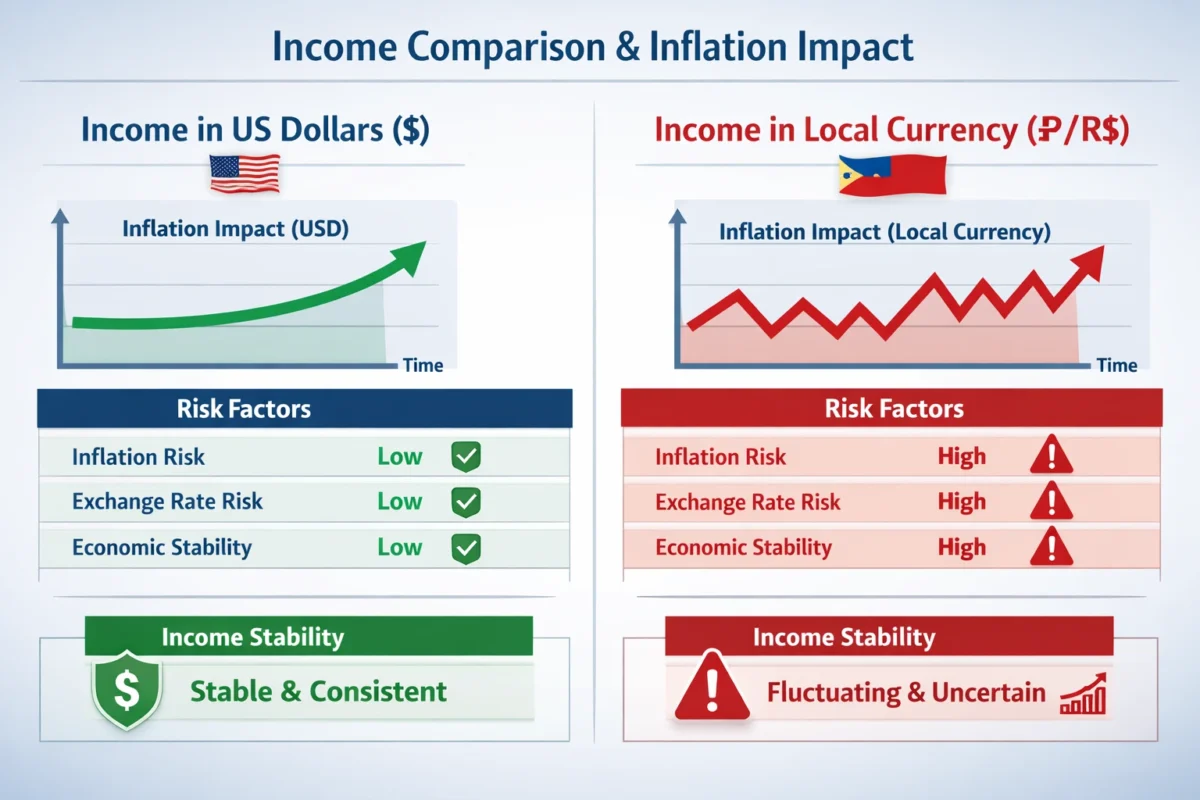
In a world shaped by inflation cycles, currency fluctuations, and economic uncertainty, the way you earn your income matters more than ever. For millions of people across emerging and developed economies alike, the debate around dollar income vs local currency income is no longer theoretical. It is a real, practical concern that affects savings, lifestyle stability, and long term financial security.
Over the past decade, global shocks such as pandemics, wars, interest rate hikes, and supply chain disruptions have shown how quickly local currencies can lose value. At the same time, earning in a foreign currency like the US dollar has become more accessible through remote work, freelancing, online businesses, and global platforms. This has pushed many individuals to ask a critical question. Is it safer to earn in dollars or rely on income paid in local currency?
This article explores that question calmly and realistically. You will learn how dollar based income and local currency income actually behave during inflation, recessions, and currency devaluations. We will break down risks, benefits, and hidden trade offs using plain language, real world examples, and historical context. By the end, you will be able to assess which income structure aligns best with your personal goals, risk tolerance, and economic environment.
Rather than promoting one option blindly, this guide focuses on understanding how each income type works, when it helps, when it hurts, and how smart earners combine both for resilience.
Table of Contents
Understanding Dollar Based Income and Local Currency Income
Before comparing safety, it is essential to clearly understand what each income type means in practice. Dollar based income refers to earnings that are paid or denominated in US dollars, regardless of where you live. This can include salaries from international companies, freelance payments via platforms like Upwork, export based businesses, dividends from US assets, or remote contracts paid in USD. The key feature is that your income value is tied to the dollar rather than your domestic currency.
Local currency income, on the other hand, is earnings paid in the official currency of your country. This includes traditional employment salaries, local business profits, government wages, and most domestic services. Its value depends entirely on your country’s monetary policy, inflation rate, and economic stability.
The difference becomes crucial during periods of economic stress. When inflation rises, local purchasing power often falls. When currencies devalue, imported goods become more expensive. Institutions like the International Monetary Fund regularly highlight how exchange rate volatility affects household income stability, especially in developing economies.
However, income safety is not only about exchange rates. It also involves job security, payment reliability, taxation, regulation, and lifestyle alignment. A strong local currency in a stable economy may offer more predictability than volatile freelance dollar income. That is why understanding the full picture matters before drawing conclusions.
How Inflation Impacts Dollar Income vs Local Currency Income
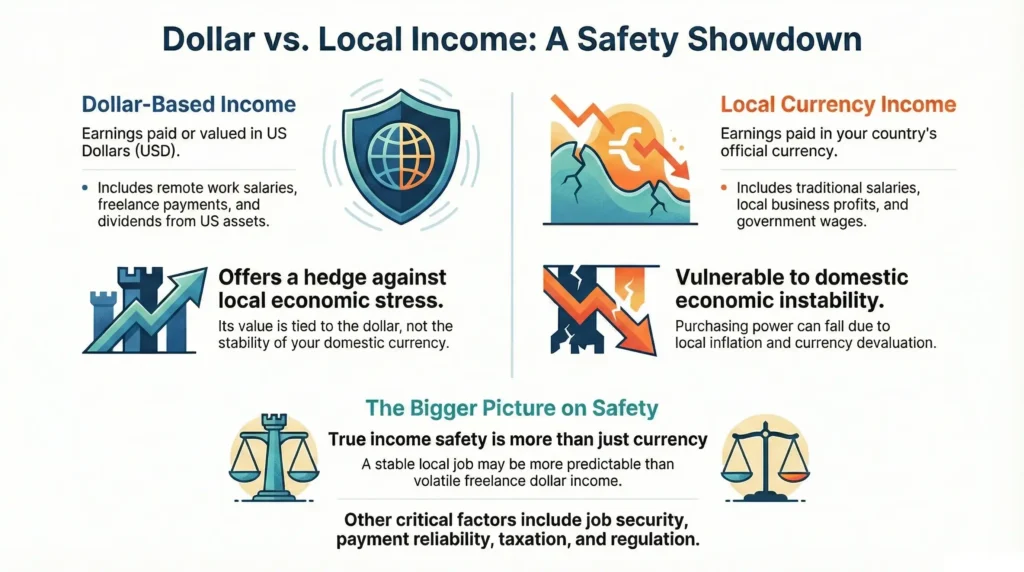
Inflation is the silent force that slowly reshapes income safety. It represents the general increase in prices over time, which reduces how much your money can buy. Central banks such as the Federal Reserve and the European Central Bank closely monitor inflation because of its direct effect on wages and purchasing power.
Local currency income is usually the first to feel inflation pressure. In many countries, wages do not rise at the same pace as prices. This creates a gap where individuals earn the same nominal amount but can afford less each month. Historical data from the World Bank shows that in high inflation environments, real wages often decline even when employment remains stable.
Dollar based income behaves differently. Since the US dollar is a global reserve currency, it tends to retain value better during global inflationary periods. When local currencies weaken, dollar income often increases in local purchasing power. For example, a freelancer earning $1,000 per month may suddenly afford more locally if their domestic currency depreciates.
However, dollar income is not immune. US inflation still affects the real value of earnings globally. According to Federal Reserve data, periods of high US inflation reduce the real purchasing power of dollar earners worldwide. The difference is that dollar inflation tends to be more stable and predictable compared to inflation spikes in weaker economies.
This dynamic explains why many people seek dollar income as a hedge rather than a perfect shield.
Currency Devaluation and Income Safety
Currency devaluation occurs when a country’s currency loses value relative to others, often due to trade deficits, debt, political instability, or monetary expansion. This is one of the strongest arguments in the dollar income vs local currency income debate.
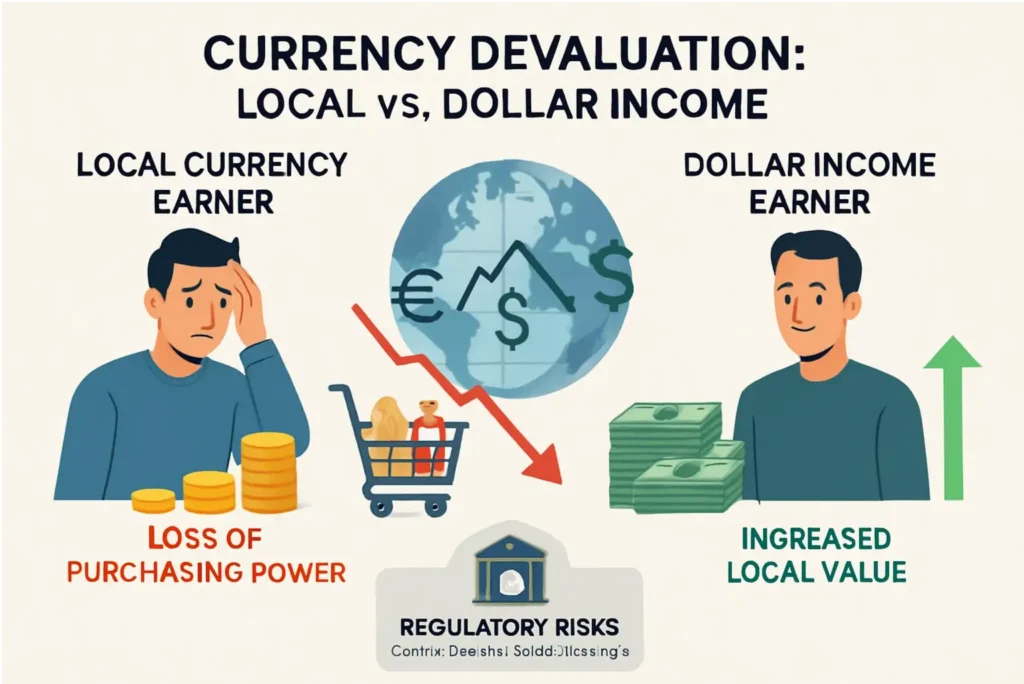
When devaluation happens, local currency earners experience an immediate drop in global purchasing power. Imported goods, technology, fuel, and medicine become more expensive. Savings held in local currency lose value quickly. The World Bank has documented repeated cases where households saw years of savings eroded in months after sharp devaluations.
Dollar income earners, by contrast, often experience the opposite effect. Their earnings increase in local terms, allowing them to maintain or even improve their lifestyle. This effect is why dollar earners are sometimes seen as insulated during crises.
However, there is a less discussed risk. Governments facing currency crises may impose capital controls, taxation changes, or restrictions on foreign currency inflows. These policies can complicate access to dollar income. Examples can be found in historical IMF case studies of emerging market crises.
So while dollar income offers protection against devaluation, it also introduces exposure to regulatory and policy risks that local income earners may not face.
Job Stability and Predictability
Income safety is not only about value. It is also about reliability. Many people assume dollar income is always safer, but stability varies widely depending on the source.
Local currency jobs, especially in established companies or government roles, often offer predictability. Monthly salaries, benefits, legal protections, and labor laws provide a safety net. In stable economies, this structure can outweigh inflation risks, particularly when wages are indexed or regularly adjusted.
Dollar based income is often linked to global markets and performance based work. Freelancing, consulting, and online businesses can fluctuate month to month. Clients may reduce spending during global downturns. Platforms can change rules or fees. Payment delays and currency conversion issues can occur.
According to research cited by the OECD, non traditional income streams tend to have higher volatility despite offering higher upside. This means dollar income can be financially powerful but emotionally stressful for those who value certainty.
The safest income is not necessarily the strongest currency, but the one that matches your ability to handle variability.
Taxation and Legal Considerations
Taxes play a critical role in determining real income safety. Local currency income is usually straightforward. Taxes are withheld at source or paid under well defined national systems. Compliance is simpler, and legal obligations are clearer.
Dollar income often crosses borders, creating complexity. Depending on your country, foreign income may be taxed differently or require self reporting. Some jurisdictions impose additional documentation or penalties for undeclared foreign earnings.
Institutions like the OECD publish guidelines on international taxation to prevent double taxation, but implementation varies widely by country. Failure to understand these rules can turn a seemingly safer dollar income into a compliance risk.
In some cases, dollar income may benefit from tax treaties or exemptions. In others, it may attract higher scrutiny. This makes professional advice essential for anyone relying heavily on foreign currency earnings.
Cost of Living and Lifestyle Alignment
Income safety must always be evaluated against expenses. Earning in dollars does not automatically mean financial comfort if your lifestyle costs are also dollar linked.
In many countries, housing, utilities, and services are priced in local currency. Dollar income can stretch further in these environments. However, in highly dollarized economies, costs may adjust quickly to exchange rates, reducing the advantage.
Local currency income aligns naturally with domestic pricing. This reduces friction and uncertainty. Budgeting is easier, and financial planning feels more grounded.
The safest income is one that maintains balance between earnings and expenses without constant recalculation or stress.
Risk vs Reward Comparison
| Factor | Dollar Income | Local Currency Income |
|---|---|---|
| Inflation Protection | High | Low to Medium |
| Currency Devaluation Risk | Low | High |
| Income Stability | Medium | High |
| Regulatory Risk | Medium | Low |
| Tax Complexity | High | Low |
| Global Flexibility | High | Low |
Can a Hybrid Income Strategy Be Safer?
Many experienced earners avoid choosing sides. Instead, they diversify income sources. A hybrid strategy combines local stability with global currency protection.
For example:
- A stable local job covers fixed expenses.
- Dollar freelance or investment income builds savings and hedges inflation.
- Emergency funds are held in mixed currencies.
Financial principles taught by institutions like Morningstar emphasize diversification not only in assets but also in income streams. This approach reduces dependency on any single economic system.
A hybrid model is often the most resilient answer to the dollar income vs local currency income question.
Long Term Wealth Building Implications
Income safety today influences wealth tomorrow. Dollar income can accelerate wealth accumulation when invested wisely, especially in globally diversified assets. Local income can provide the consistency needed for disciplined investing.
According to long term studies referenced by Investopedia, wealth is built not only by earning more, but by maintaining purchasing power and investing consistently over time. Currency stability directly affects both.
Those who convert dollar income into productive assets rather than consumption tend to benefit most. Meanwhile, those relying solely on local income without inflation hedges often fall behind over decades.
Common Myths About Dollar Income
- Dollar income is risk free. This is false. It carries market, platform, and regulatory risks.
- Local income is always unsafe. This ignores stable economies and indexed wage systems.
- Higher income automatically means higher security. Stability matters as much as amount.
Understanding these myths helps avoid emotional decisions driven by headlines rather than fundamentals.
Conclusion
The question of dollar income vs local currency income does not have a universal answer. Safety depends on context, country, profession, and personal temperament. Dollar income offers strong protection against inflation and currency devaluation, making it attractive in unstable economies. However, it introduces volatility, tax complexity, and regulatory exposure.
Local currency income provides predictability, legal clarity, and lifestyle alignment. In stable economies, it can be extremely safe, even if long term purchasing power grows more slowly.
The most resilient strategy is awareness and balance. Understand how your income behaves under stress. Track inflation, exchange rates, and policy changes. Avoid emotional decisions driven by fear or hype. Where possible, diversify income streams and currencies to spread risk.
Ultimately, income safety is not about chasing the strongest currency. It is about building a structure that supports your life today while protecting your future tomorrow. Thoughtful planning, not currency obsession, is what creates lasting financial security.
Frequently Asked Questions
Is dollar income always better than local income?
No. Dollar income offers currency protection but can be unstable and complex. Local income may be safer in stable economies.
How does inflation affect dollar income vs local currency income?
Local income usually loses purchasing power faster. Dollar income tends to retain value better, especially in weak currency environments.
Can governments restrict dollar income?
Yes. Capital controls and regulations can affect access to foreign currency earnings.
Should beginners aim for dollar income immediately?
Not necessarily. Stability and skill development matter more than currency at early stages.
Is a mixed income strategy safer?
In most cases, yes. Combining dollar and local income reduces dependency on one system.
If you found value in this article, share your perspective in the comments. Do you earn in dollars, local currency, or both? Subscribe for more practical insights on income, inflation, and long term financial resilience.