Introduction: The Invisible Web of Global Commerce
When you purchase a smartphone manufactured in China, wear clothing sewn in Vietnam, or invest in an emerging market fund, you are directly participating in the global economy—a vast, interconnected system that transcends borders and shapes prosperity for billions. Yet most people understand remarkably little about how their financial decisions, a central bank’s interest rate changes in Washington, or a trade dispute in Asia can ripple through their local job market and household finances.
The global economy is not a single, monolithic entity, but rather a sophisticated web of trade flows, capital movements, technology transfers, and institutional arrangements that bind countries together in relationships of mutual dependency. Understanding these connections is no longer a luxury for economists and policy experts—it is essential knowledge for investors, business owners, and anyone concerned with personal financial security in an increasingly volatile world.
This article provides a comprehensive explanation of how countries are financially connected, examining the mechanisms, institutions, and dynamics that create global economic interdependence. By the end, you will understand why a manufacturing slowdown in Germany affects job prospects in Vietnam, how a U.S. Federal Reserve interest rate decision influences currency values in emerging markets, and why trade fragmentation threatens prosperity worldwide.
Table of Contents
The Architecture of Global Finance: Institutions That Hold It Together
The modern global financial system rests on three foundational pillars: institutions, agreements, and market mechanisms that facilitate the seamless flow of goods, capital, and information across borders.
The Key Institutions
TheInternational Monetary Fund (IMF),World Bank, andWorld Trade Organization (WTO)form the institutional backbone of international commerce. Established in the post-World War II era, these organizations were designed to prevent the protectionism and currency wars that had devastated the 1930s global economy.
TheIMFfocuses on monetary cooperation and macroeconomic stability, promoting exchange rate flexibility and helping countries manage balance-of-payments crises. TheWorld Bankprovides financing and technical assistance for development projects, facilitating long-term economic growth in emerging and developing nations. TheWTOestablishes trade rules and conducts multilateral negotiations to reduce tariffs and non-tariff barriers, creating a predictable framework for international commerce.
Beyond these “Big Three,” central banks—particularly the U.S. Federal Reserve, European Central Bank, and Bank of England—exercise tremendous influence over global financial conditions through their control over interest rates and monetary policy.
The Global Financial System in Practice
The global financial system operates through a complex network of banks, stock exchanges, bond markets, currency markets, and regulatory bodies. National governments, multinational corporations, and institutional investors constantly engage in cross-border transactions valued at trillions of dollars annually. This system was severely tested during the 2008 financial crisis, which originated in the United States but rapidly spread to Europe, Asia, and emerging markets, demonstrating how deeply integrated modern economies have become.
In recent years, discussions about “fragmentation” have become prevalent among policymakers. This refers to a potential splintering of the global financial system into geopolitically aligned blocs, with separate regulatory frameworks, currency arrangements, and trade rules—a development that would raise transaction costs and reduce overall economic efficiency.
Trade: The Lifeblood of Global Interdependence
International trade represents the most visible manifestation of global economic connection. When countries trade, they specialize in goods and services where they have comparative advantages, allowing all participants to consume more than they could in isolation.
The Scale of Global Trade
Global merchandise and services trade reached a record $33 trillion in 2024, with developing economies leading the growth surge. Developing nations grew their imports and exports by 4% in 2024, outpacing developed countries, driven primarily by East and South Asia.
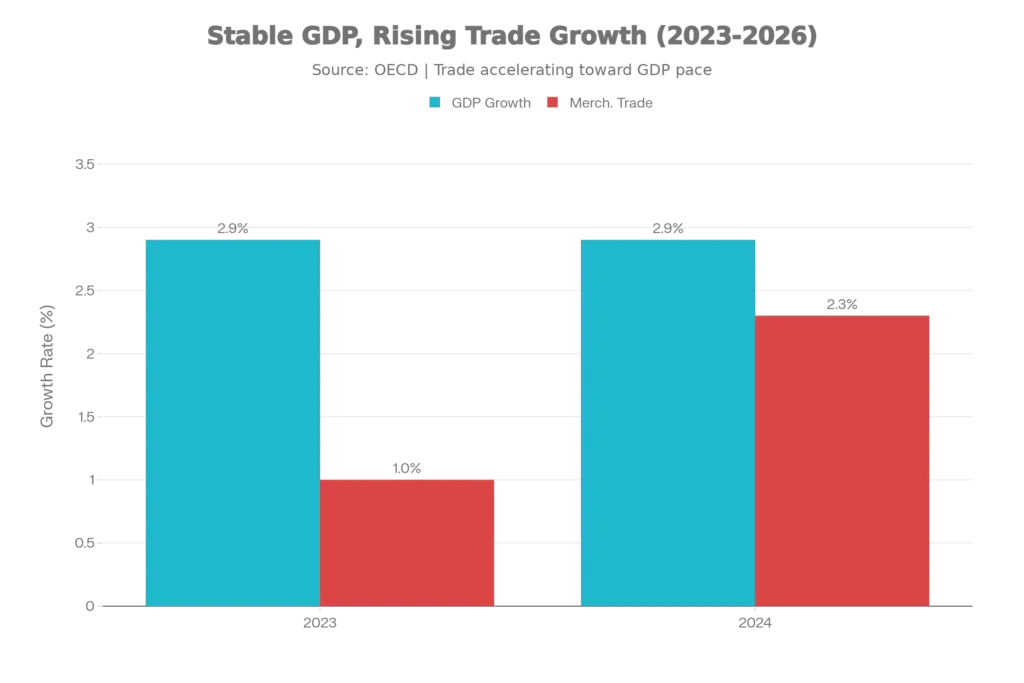
The OECD projects global merchandise trade to grow by 2.3% in 2024 and 3.3% in 2025—more than double the sluggish 1% growth recorded in 2023. This acceleration reflects recovering demand, lower inflation, and moderating interest rates that make international commerce more attractive.
Global Supply Chains: The Hidden Connectors
Behind headline trade figures lies a reality most consumers never witness: global supply chains that fragment production across multiple countries. A modern smartphone contains components from Japan, semiconductors from South Korea, rare earth minerals from China, assembly in multiple nations, and final distribution from the United States or Europe.
Developing countries now participate substantially in these global value chains. By 2008, North-South and South-North trade in intermediate goods represented approximately 40% of all intermediate trade, compared to just 10% in the early 1990s. This reflects the structural shift toward “factory Asia,” where countries like Vietnam, Thailand, and Indonesia have become essential nodes in global production networks.
Supply chains create powerful economic interdependencies. When Japan experienced earthquake-triggered manufacturing disruptions in 2011, automotive production shutdowns rippled across the globe. Similarly, port congestion during the COVID-19 pandemic raised shipping costs and created shortages from Europe to North America. The lesson is unambiguous: you cannot disconnect trade without imposing significant economic costs.
Trade Imbalances and Tensions
Despite the benefits of trade, persistent imbalances create political tensions. In 2024, the U.S. trade deficit with China widened to $355 billion, while the deficit with the European Union increased to $241 billion. China, conversely, accumulated its largest trade surplus since 2022, creating fiscal pressures in deficit countries.
These imbalances have prompted protectionist responses. On April 2, 2025, the Trump administration announced reciprocal tariffs on 57 trading partners, with China facing a 34% duty rate. Economists project this could reduce China’s GDP growth by 2.4% in 2025 alone, with spillover effects extending to commodity exporters and nations dependent on Chinese demand.
Capital Flows: The Rivers of Investment
While trade in goods dominates headlines, capital flows—the movement of money for investment purposes—may be even more important to global connectivity. When a U.S. pension fund invests in Brazilian stocks, a European bank finances infrastructure in Southeast Asia, or a Chinese corporation acquires a factory in Germany, these flows reflect confidence in foreign economies and create permanent relationships.
Foreign Direct Investment: Building Long-Term Connections
Foreign Direct Investment (FDI) represents capital committed to establishing, acquiring, or expanding operations in a foreign country. In 2024, global FDI reached approximately $1.4-$1.5 trillion, though this headline figure masks significant volatility.
Notably, when excluding “conduit flows” (investments that pass through financial centers like the Netherlands and Luxembourg before reaching final destinations), global FDI actually declined 8-11% in 2024. This discrepancy reveals how financial engineering obscures true investment patterns.

Asia-Pacific remains the world’s largest FDI destination, though China experienced a 29% decline in inflows—a troubling sign given its historical role as the largest emerging market recipient. Conversely, Africa posted remarkable 75% FDI growth, driven by a mega-project in Egypt. These shifts reflect strategic capital reallocation as investors reassess geopolitical risks and growth prospects.
FDI differs fundamentally from portfolio investment (stock and bond purchases) in one critical way: it cannot be quickly liquidated. When a company builds a factory overseas, that commitment is inherently long-term, signaling confidence in the host nation’s political stability and growth prospects. This permanence makes FDI far more stabilizing during crises than portfolio flows, which can reverse overnight.
The Challenge of Capital Flight
Developing countries remain vulnerable to sudden capital reversals. When interest rates rise sharply in advanced economies—as they did in 2022-2023 when the Federal Reserve aggressively tightened policy—investors withdraw capital from emerging markets to chase higher returns in safer assets. This capital flight depreciates emerging market currencies, increases borrowing costs for local companies, and can trigger financial crises.
The conundrum for emerging market central banks is acute: if they fail to raise their own interest rates in response to Fed tightening, their currencies depreciate, making imports more expensive and fueling inflation. But if they do raise rates to defend currencies, they slow domestic economic growth. There is no costless escape from this policy trilemma.
The Foreign Exchange Market: Determining Value Across Borders
To understand how countries are financially connected, one must comprehend the foreign exchange (FX) market—the global marketplace where currencies are traded. With daily trading volumes exceeding $1.5 trillion, the FX market is far larger than all stock markets combined, yet remains opaque to most investors.
How Currency Values Reflect Economic Health
Currency exchange rates are determined by supply and demand—the collective judgment of millions of traders betting on countries’ economic futures. When a country’s economy strengthens, foreign investors demand more of its currency to buy assets there, pushing the currency higher. Conversely, economic weakness causes currency depreciation.
These movements have profound real-world consequences. A 10% depreciation of a country’s currency boosts export competitiveness (foreign buyers need fewer of their own currency to purchase the same goods) but increases import costs and can trigger inflation if the country imports essential commodities like oil.
The Dollar’s Persistent Dominance
The U.S. dollar remains overwhelmingly dominant in international finance, used in approximately 90% of all currency trades and as the official or unofficial reserve currency for most nations. This dominance gives the United States extraordinary economic power: it can print dollars to finance spending without immediate balance-of-payments constraints, and Federal Reserve policies have outsized global impacts.
Major currency pairs—particularly EUR/USD—see enormous trading volumes. In London alone, EUR/USD trades valued $797 billion daily in October 2024, representing about 25% of the global FX market. These trades don’t simply reflect speculation; they embody the prices at which global commerce actually occurs.
Emerging Markets: The Growth Engine with Vulnerabilities
Emerging and developing economies have transformed from economic periphery to the global economy’s center of gravity. These nations collectively account for nearly 60% of global GDP, up from just half a decade ago. They contributed over 80% of global growth since the 2008 financial crisis, positioning them as the world’s primary growth engine.
The Rapid Rise of Developing Nations
India epitomizes this transformation. By 2035, India is projected to become the world’s third-largest economy (after the United States and China), with projected GDP growth exceeding 6% annually. Other major emerging markets—Indonesia, Brazil, Vietnam, and the Philippines—are similarly poised for substantial expansion.
However, growth creates new vulnerabilities. Developing countries often borrow heavily in foreign currencies (particularly dollars) to finance infrastructure and industrial projects. When currencies depreciate or interest rates spike globally, the local-currency cost of servicing this debt becomes unsustainable. Brazil, India, and other nations faced precisely this challenge during the 2022-2023 Federal Reserve tightening cycle.
The Complex Interdependence
The relationship between emerging and advanced economies is fundamentally asymmetric. Advanced economies can borrow at lower interest rates, maintain larger fiscal deficits, and attract capital flows more easily. Emerging markets must earn the credibility of foreign investors through consistently sound policies.
The debt burdens in developing countries represent a critical vulnerability. Many countries now allocate excessive revenues to debt service rather than education, healthcare, and infrastructure—creating a vicious cycle where economic growth slows, reducing the capacity to service debt.
The Cost of Fragmentation: Trade Wars and Protectionism
The post-World War II global trading system was built on a simple principle: reducing tariffs and removing barriers benefits all parties by allowing specialization and consumer choice. Yet 2025 has witnessed an unprecedented reversal of this paradigm, with major economies adopting protectionist measures that threaten to fragment the global economy.
The April 2025 Tariff Escalation
On April 2, 2025, President Trump announced broad “reciprocal tariffs” on nearly all U.S. trading partners. China faced a 34% base rate, while countries with large trade surpluses faced even higher duties—some exceeding 50%. This action marked what many analysts describe as a watershed moment for the global trading system.
China retaliated with its own escalating tariffs, eventually reaching 145% on most U.S. imports, while the U.S. imposed 125% duties on Chinese goods—effectively a complete decoupling of bilateral trade. These tariff rates are economically punitive and designed primarily for political leverage rather than rational trade policy.
How Tariffs Ripple Through Supply Chains
Tariffs function as a direct tax on imported goods, immediately raising acquisition costs for businesses. A manufacturer importing components from Asia faces higher input costs, which typically translate into higher consumer prices rather than reduced import demand. This creates a troubling outcome: consumers pay more, but the targeted production shift to domestic suppliers often fails to materialize because domestic costs exceed foreign alternatives even with tariffs included.
The 2002 steel tariffs under President George W. Bush provide a cautionary historical example. Those duties increased consumer prices and reduced demand, leading to job losses in steel-consuming industries that exceeded job gains in steel production. A 2019 study of washing machine tariffs found that while roughly 1,800 jobs were created domestically, consumers paid $1.5 billion more annually—an implicit cost of $815,000 per job created.
The Broader Economic Impact
The macro-level consequences are potentially severe. The IMF estimated that the initial 2018-2019 trade war reduced global economic growth by 0.8% in 2019. Current tariff levels are substantially higher, suggesting similar or greater growth impacts.
Trade uncertainty itself damages economic performance. When businesses face policy uncertainty, they postpone investment, expansion, and hiring. Trade policy uncertainty spiked to record highs in early 2025, reflecting the sharp departure from decades of relative stability.
Retaliation and Escalation
Trade wars are inherently escalatory. When the U.S. imposes tariffs, trading partners retaliate—often strategically targeting politically sensitive sectors. China, for example, previously targeted American agricultural products, imposing tariffs specifically on soybeans and pork to pressure farm-dependent regions of the Midwest. The European Union has threatened retaliatory tariffs on American manufacturers and agricultural products.
Such tit-for-tat exchanges can spiral. According to CEPR research, when the EU responds to U.S. tariffs with full retaliation (targeting both final and intermediate goods), the economic contraction more than doubles compared to unilateral U.S. tariffs, and inflation remains persistently elevated.
Technology Transfer: Bridging Development Gaps
One of globalization’s greatest benefits is the transfer of technology and knowledge from advanced to developing economies. This occurs through multiple channels: foreign direct investment, international trade, human migration, and explicit licensing agreements.
When multinational corporations establish operations in developing countries, they bring modern management techniques, quality standards, and production technologies. Local workers acquire new skills and knowledge that enhance their productivity and earning potential. Some economists argue technology transfer is as important as capital flows in explaining development success.
However, intellectual property protection and strategic concerns complicate technology transfer. Developed nations worry about technology theft and competitive advantage loss, while developing nations argue that restrictive intellectual property regimes prevent access to life-saving medicines and critical technologies.
The ongoing U.S.-China competition increasingly includes technology decoupling. Export controls on semiconductors, artificial intelligence, and biotechnology represent efforts by developed nations to restrict technology flows to strategic competitors. Yet such restrictions reduce global innovation efficiency and create incentives for alternative technology development outside Western frameworks.
The Spillover Mechanism: How Crises Spread Globally
The 2008 financial crisis provided a harsh lesson in economic interdependence. A collapse in American mortgage securities spread within months to European banks, triggering a eurozone sovereign debt crisis that threatened the entire monetary union. The lesson was clear: in a deeply integrated global financial system, contagion spreads with remarkable speed.
Monetary Policy Spillovers
When the U.S. Federal Reserve raises interest rates, the consequences extend far beyond American borders. Higher U.S. rates make dollar-denominated investments more attractive, causing capital to flow out of emerging markets. This depreciates emerging market currencies, increases costs for countries that borrow in dollars, and slows economic growth.
The Federal Reserve’s 2022-2023 tightening cycle increased the federal funds rate from near zero to over 5%, comparable to levels not seen in two decades. The spillover effects were significant: capital fled emerging markets, currencies depreciated sharply, and economic growth slowed across Asia, Latin America, and Africa.
Pandemic Interconnection
The COVID-19 pandemic illustrated another dimension of global interdependence: supply chain fragility. Lockdowns in China disrupted manufacturing and shipping, creating cascading shortages worldwide. Port congestion drove shipping costs to ten times normal levels, raising prices from electronics to furniture.
The pandemic also revealed how monetary responses in one country affect others. Fiscal stimulus in the United States and monetary easing by the Federal Reserve increased demand for imports, temporarily boosting exports from Asia. Yet the same policies created inflation that forced rate increases that eventually slowed global trade.
Pandemic-driven research also highlighted that unilateral stimulus can create imbalances: when major economies implement coordinated policies, outcomes are more favorable for the global economy than when countries pursue independent strategies.
Conclusion: Navigating an Interconnected World
The global economy is characterized by profound interdependence. Countries are connected through trade in goods and services, flows of capital and investment, movements of technology and knowledge, and the monetary and regulatory frameworks that govern commerce. A disruption anywhere can reverberate everywhere—a reality that demands sophisticated policymaking and long-term strategic thinking.
The defining challenge of the mid-2020s is navigating between two competing pressures: maintaining the openness and integration that have driven unprecedented prosperity, while adapting to legitimate concerns about inequality, job displacement, and strategic vulnerability. Protectionism and trade fragmentation offer superficially appealing solutions to these concerns, yet evidence suggests they impose greater costs than benefits.
For individual investors and savers, the key takeaway is straightforward: global economic connectivity means your financial security depends on the health of economies and financial systems far beyond your borders. Diversifying geographically, monitoring global trade and monetary policy developments, and understanding how emerging markets function are essential components of prudent financial management.
The global economy will likely remain turbulent in coming years as major powers reassess relationships and trading rules. Yet the fundamental interdependencies remain: countries need each other’s goods, capital, and technology. Rebuilding a more resilient, equitable, but equally open global system is the great challenge of our time.