Introduction
In today’s interconnected financial world, central banks quietly shape the direction of almost every major asset class. From stocks and bonds to currencies and commodities, monetary policy decisions ripple across global markets within minutes. Over the past decade, digital assets have joined this ecosystem, raising a crucial question for modern investors: how interest rate decisions affect bitcoin and the broader altcoin market.
This topic matters more today than ever before. Bitcoin and altcoins are no longer niche experiments traded by a small group of technologists. They are now held by institutional investors, hedge funds, corporations, and millions of individuals worldwide. As inflation rises or falls and central banks adjust interest rates in response, crypto markets often react with sharp moves that surprise beginners and even experienced traders.
Understanding this relationship helps investors avoid emotional decisions driven by headlines. It also provides context for why prices sometimes fall even when adoption news is positive, or rise during periods of economic stress. In this article, you will learn how central banks influence liquidity, risk appetite, and capital flows, and how those forces transmit directly into Bitcoin and altcoin prices. We will explore historical examples, explain key financial concepts in simple language, compare crypto with traditional assets, and highlight both risks and opportunities. By the end, you will have a clear framework to interpret central bank announcements and apply that knowledge to long term crypto investing.
Table of Contents
What Central Banks Do and Why Markets Listen
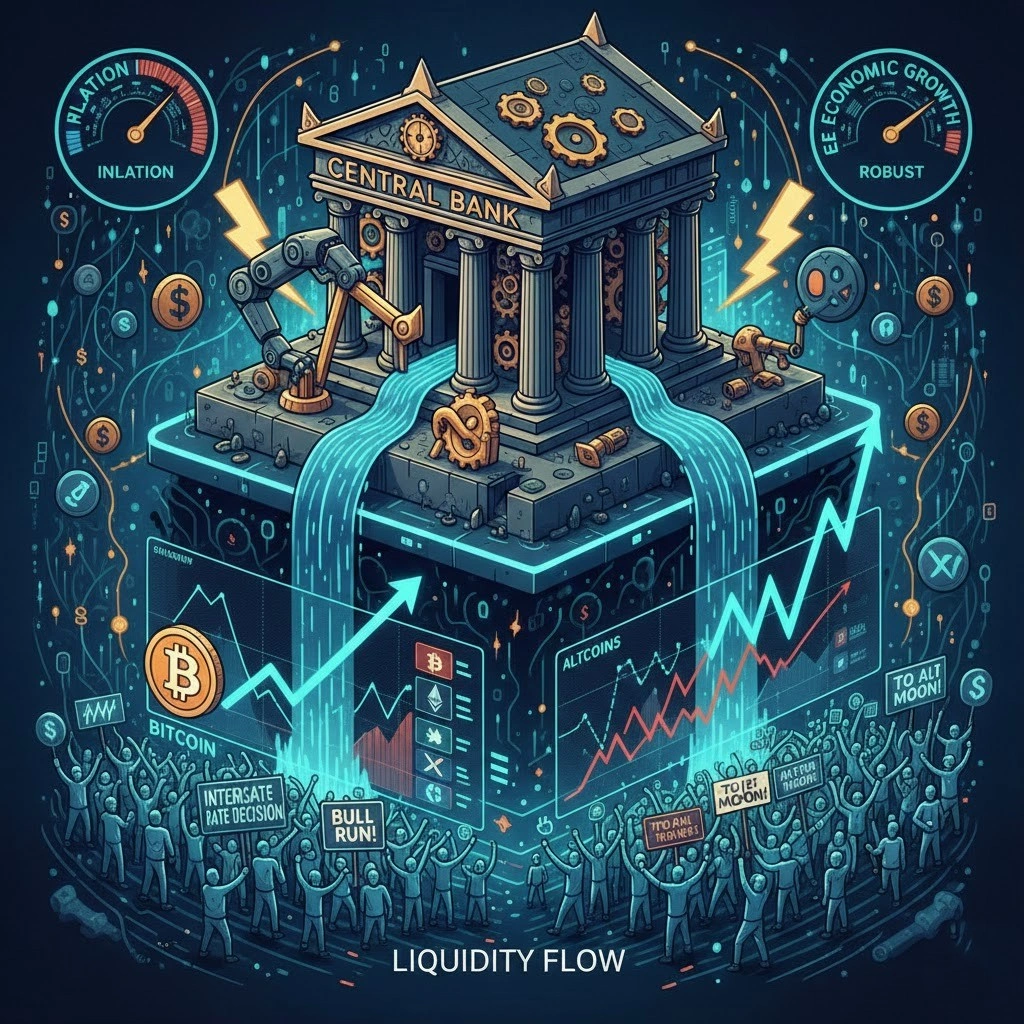
Central banks sit at the core of modern financial systems. Institutions such as the US Federal Reserve, the European Central Bank, and the Bank of England are responsible for managing inflation, employment, and overall economic stability. Their most powerful tool is the policy interest rate, which determines how expensive or cheap it is to borrow money across the economy.
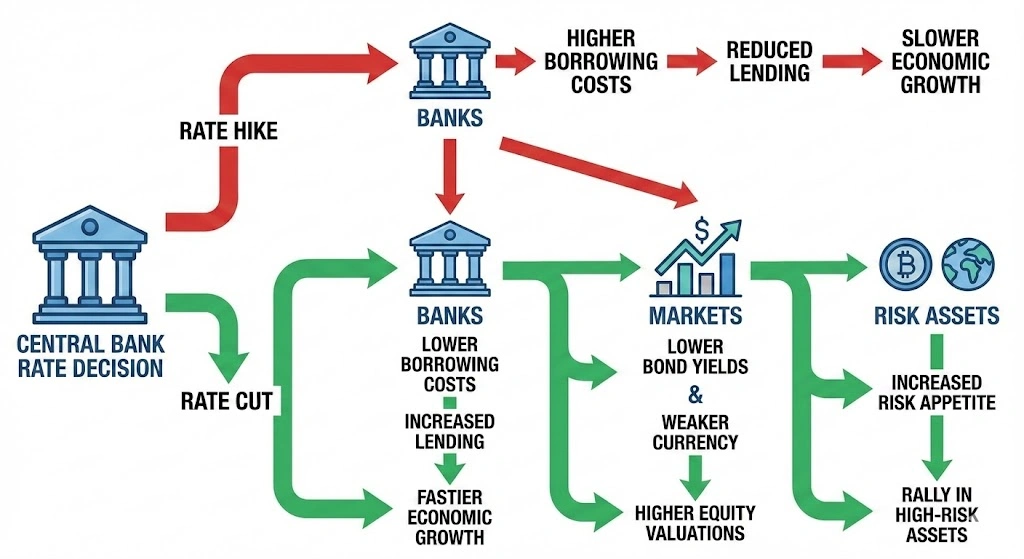
When a central bank raises interest rates, borrowing becomes more expensive. Businesses slow investment, consumers reduce spending, and economic growth cools. When rates are lowered, credit becomes cheaper, encouraging spending, investment, and risk taking. Financial markets watch these decisions closely because they influence expected returns across all assets. According to the Federal Reserve itself, interest rate changes are designed to balance inflation control with sustainable growth, a delicate tradeoff that affects everything from mortgages to equity valuations.
For investors, interest rates act like gravity. Higher rates pull money toward safer assets like government bonds, while lower rates push capital outward into stocks, real estate, and alternative investments. This dynamic explains why even assets that are not directly controlled by central banks, such as Bitcoin, still respond to their decisions. Crypto exists outside traditional monetary systems, but it does not exist outside investor psychology or global liquidity conditions.
How Interest Rate Decisions Affect Bitcoin Liquidity
Liquidity refers to how easily money moves through the financial system. When liquidity is abundant, investors have more capital available to allocate into higher risk assets. When liquidity tightens, cash becomes scarce and investors prioritize safety. This is a central mechanism behind how interest rate decisions affect bitcoin.
Low interest rates increase liquidity by making borrowing cheap and encouraging banks to lend. Investors can access leverage, meaning borrowed money, at lower cost. In such environments, speculative assets often perform well because capital is searching for higher returns. Bitcoin benefited greatly from this dynamic during the low rate era following the global financial crisis and again during the pandemic stimulus period.
When rates rise, the opposite happens. Borrowing costs increase, leverage becomes expensive, and investors reduce exposure to volatile assets. Bitcoin, despite its decentralized design, is still treated as a high volatility asset by most market participants. As liquidity contracts, selling pressure increases, especially among traders who rely on leverage. Research from the International Monetary Fund has shown that global liquidity cycles strongly influence crypto asset valuations, reinforcing this connection.
This liquidity channel explains why Bitcoin often falls sharply after aggressive rate hike announcements, even if there is no negative crypto specific news. It is not a judgment on Bitcoin’s technology, but a response to changing financial conditions.
Risk Appetite and Investor Psychology in Crypto Markets
Risk appetite describes how willing investors are to accept uncertainty in pursuit of higher returns. Interest rates play a major role in shaping this mindset. When rates are low, safe assets like bonds offer limited returns, pushing investors toward riskier alternatives. When rates rise, safer assets become more attractive, reducing the incentive to hold volatile investments.
Bitcoin and altcoins are highly sensitive to shifts in risk appetite. During periods of easy monetary policy, crypto is often framed as innovative, transformative, and full of upside potential. During tightening cycles, narratives shift toward risk, regulation, and downside volatility. This psychological swing amplifies price movements beyond what fundamentals alone would suggest.
Altcoins are particularly exposed. Many altcoins represent early stage projects with uncertain cash flows and long development timelines. In low rate environments, investors are more willing to fund these experiments. When rates rise, capital flows back toward assets perceived as more established, including Bitcoin itself or traditional investments. This explains why altcoin markets often experience deeper drawdowns than Bitcoin during tightening cycles.
Bitcoin as Digital Gold and the Interest Rate Debate
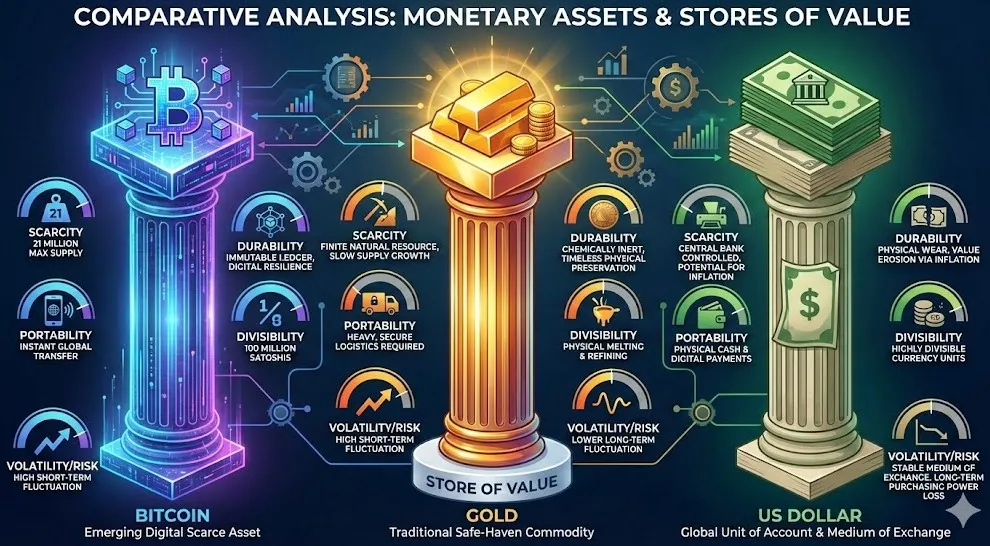
One of the most debated topics in crypto economics is whether Bitcoin behaves like digital gold. Gold traditionally performs well during periods of monetary easing and inflation concerns, serving as a store of value when fiat currencies lose purchasing power. Bitcoin shares some characteristics with gold, including scarcity and independence from central banks, but it also differs in important ways.
Understanding how interest rate decisions affect bitcoin requires acknowledging this dual identity. In theory, rising inflation and negative real interest rates, meaning rates adjusted for inflation, should support Bitcoin as a hedge. When real rates are low or negative, holding cash or bonds guarantees a loss in purchasing power, making scarce assets more attractive.
However, in practice, Bitcoin has often traded like a high risk asset rather than a defensive one, especially over shorter time frames. During rapid rate hikes, Bitcoin has tended to fall alongside stocks, reflecting liquidity and risk appetite effects. Over longer horizons, some investors still view Bitcoin as protection against monetary debasement, particularly when central banks expand balance sheets aggressively.
This tension explains why Bitcoin’s response to rate decisions can seem contradictory. Short term price movements often reflect liquidity conditions, while long term narratives focus on monetary credibility and scarcity.
Altcoins and Sensitivity to Monetary Policy
Altcoins, which include all cryptocurrencies other than Bitcoin, are generally more sensitive to central bank decisions. Many altcoins rely on ongoing funding, developer activity, and speculative interest. These factors thrive when capital is abundant and struggle when financial conditions tighten.
Lower interest rates support venture capital investment, which flows into blockchain startups and token ecosystems. This funding fuels development, marketing, and user growth, creating positive feedback loops for altcoin prices. During tightening cycles, venture funding slows, projects cut costs, and speculative enthusiasm fades.
The World Bank has highlighted how global financial conditions influence emerging technology sectors, including digital finance. Altcoins often resemble early stage tech investments, making them especially vulnerable to rising rates. Investors tend to rotate into Bitcoin as a relative safe haven within crypto, or exit the asset class entirely during aggressive tightening.
Table 1: Relative Sensitivity to Interest Rate Changes
| Asset Type | Sensitivity to Rate Hikes | Typical Investor Behavior |
|---|---|---|
| Bitcoin | Medium | Reduced leverage, long term holders remain |
| Large cap altcoins | High | Capital rotation, higher volatility |
| Small cap altcoins | Very high | Sharp sell offs, liquidity dries up |
| Stablecoins | Low | Used as temporary parking |
Historical Examples of Rate Cycles and Crypto Markets
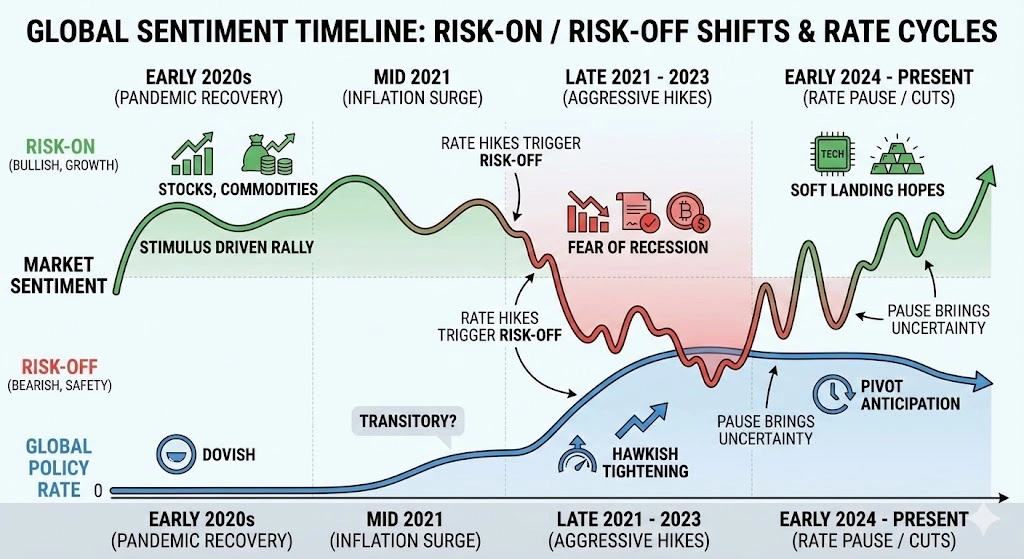
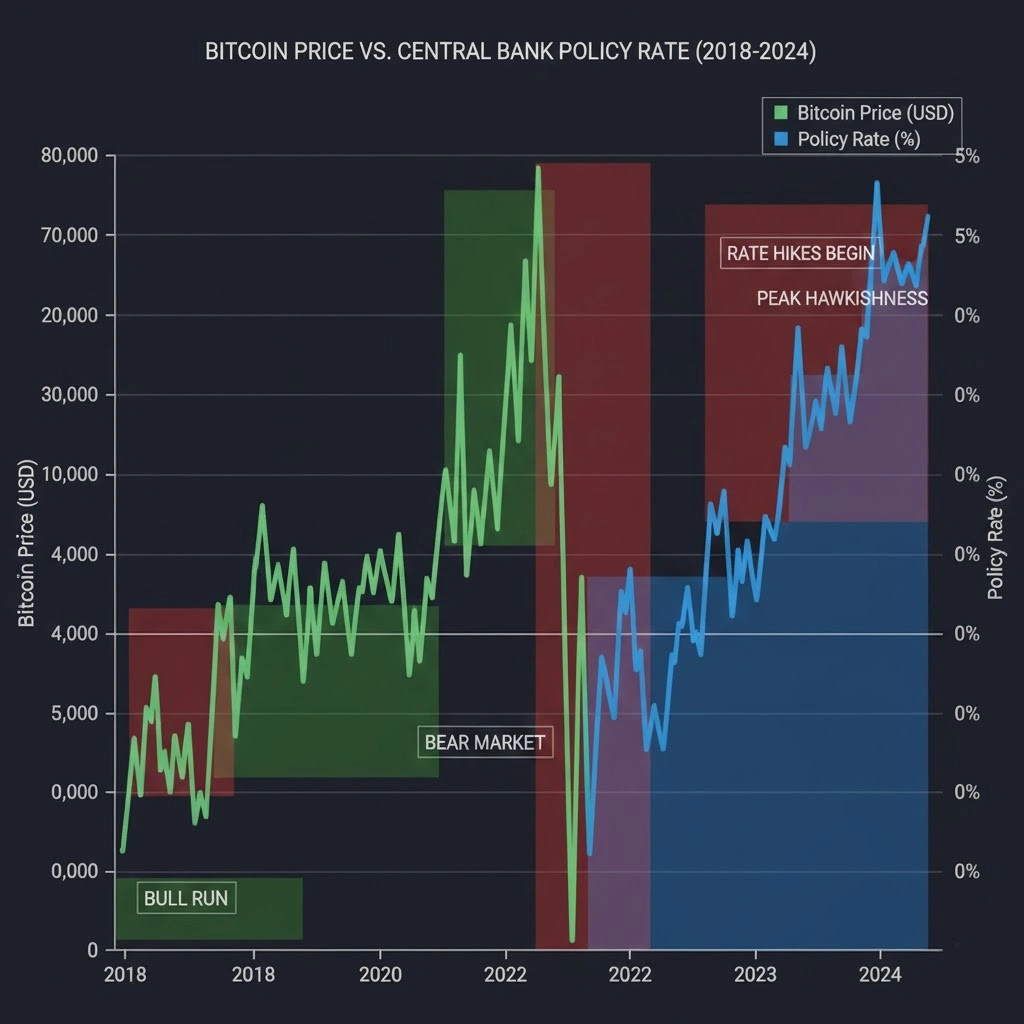
History provides valuable lessons about how interest rate decisions affect bitcoin and altcoins. During the pandemic period, central banks cut rates to near zero and injected massive liquidity into the system. This environment fueled one of the strongest bull markets in crypto history, with Bitcoin reaching new highs and altcoins experiencing explosive growth.
As inflation surged in subsequent years, central banks reversed course. The US Federal Reserve embarked on one of the fastest tightening cycles in decades. Crypto markets responded with significant declines, reflecting reduced liquidity and risk appetite. These moves were not unique to crypto, as stocks and other risk assets also suffered, but crypto’s volatility magnified the impact.
Earlier cycles show similar patterns. Periods of monetary easing tend to coincide with rising crypto valuations, while tightening phases bring corrections or prolonged bear markets. This does not mean central banks control crypto prices directly, but their influence on financial conditions is undeniable.
Comparing Crypto With Stocks and Bonds
To fully grasp the impact of interest rates, it helps to compare crypto with traditional assets. Stocks represent ownership in companies and are valued based on future earnings. Higher interest rates reduce the present value of those earnings, often pressuring stock prices. Bonds, on the other hand, become more attractive as rates rise because new bonds offer higher yields.
Crypto does not generate cash flow like stocks or fixed income like bonds. Its valuation depends on adoption, scarcity, and investor perception. This makes it more sensitive to changes in risk appetite and liquidity than to discounted cash flow models.
Table 2: Asset Class Response to Rising Interest Rates
| Asset Class | Typical Impact | Reason |
|---|---|---|
| Bonds | Prices fall initially | New bonds offer higher yields |
| Stocks | Valuations compress | Higher discount rates |
| Bitcoin | Often declines short term | Liquidity and risk effects |
| Altcoins | Larger declines | Speculative capital withdrawal |
This comparison highlights why crypto often moves in sync with equities during tightening cycles, even though its long term thesis differs.
Inflation, Real Rates, and Long Term Crypto Value
Inflation is a key driver behind central bank decisions. When inflation rises above targets, rates are increased to slow demand. For crypto investors, the relationship between inflation and Bitcoin is nuanced. High inflation alone does not guarantee rising Bitcoin prices. What matters more are real interest rates.
Real rates represent nominal interest rates minus inflation. When real rates are negative, holding cash erodes purchasing power. In such environments, scarce assets like Bitcoin may attract long term investors. When real rates turn positive, traditional savings and bonds become more attractive, reducing the appeal of alternative stores of value.
Investopedia explains that real rates are a critical indicator for understanding asset allocation decisions. Monitoring this metric alongside central bank policy provides deeper insight than focusing on inflation headlines alone.
Risks of Ignoring Central Bank Signals in Crypto Investing
Many crypto investors focus exclusively on on chain metrics or technological developments. While these factors matter, ignoring macroeconomic signals can lead to poor timing and unnecessary losses. Central bank decisions often act as catalysts that accelerate existing trends.
During tightening cycles, leverage unwinds quickly, causing sudden price drops. Investors who fail to anticipate these moves may panic sell at lows. Conversely, during easing cycles, skepticism can cause investors to miss early stages of recovery.
This does not mean trying to trade every rate announcement. Instead, it means understanding the broader direction of monetary policy and adjusting expectations accordingly. Long term investors can use tightening periods to accumulate gradually, while being mindful of volatility and risk management.
Practical Strategies for Crypto Investors During Rate Cycles
Applying this knowledge requires discipline and patience. Investors should first identify their time horizon. Short term traders are more sensitive to central bank announcements, while long term holders focus on adoption and fundamentals.
Diversification within crypto can also help. Bitcoin often holds value better than smaller altcoins during tightening phases. Stablecoins can provide flexibility, allowing investors to deploy capital when conditions improve.
Table 3: Investor Approach by Rate Environment
| Rate Environment | Suggested Strategy |
|---|---|
| Falling rates | Gradual accumulation, higher risk tolerance |
| Stable rates | Balanced allocation, focus on fundamentals |
| Rising rates | Risk reduction, emphasis on Bitcoin and cash |
Understanding how interest rate decisions affect bitcoin allows investors to align strategy with macro conditions rather than react emotionally.
Conclusion
Central bank decisions may seem distant from the decentralized world of crypto, but their influence is deeply embedded in global financial behavior. Interest rates shape liquidity, risk appetite, and capital flows, all of which directly impact Bitcoin and altcoin markets. By understanding how interest rate decisions affect bitcoin, investors gain a powerful lens for interpreting price movements beyond surface level narratives.
This article has shown that Bitcoin’s reaction to monetary policy is shaped by both short term liquidity effects and long term debates about store of value potential. Altcoins, with their higher risk profiles, are even more sensitive to tightening and easing cycles. Historical examples confirm that crypto markets thrive during periods of abundant liquidity and struggle when financial conditions tighten.
For investors, the goal is not to predict every central bank move, but to understand the environment in which decisions are made. Monitoring interest rates, inflation, and real yields provides context that complements on chain analysis and project research. This balanced approach reduces emotional decision making and supports long term thinking.
As crypto continues to mature and integrate with traditional finance, the connection between monetary policy and digital assets will likely grow stronger. Investors who take the time to understand this relationship will be better equipped to navigate volatility, manage risk, and seize opportunities when they arise.
Frequently Asked Questions
How interest rate decisions affect bitcoin in the short term
Interest rate hikes often reduce liquidity and risk appetite, leading to short term price declines. Rate cuts usually support price recovery by increasing available capital.
Why do altcoins fall more than Bitcoin when rates rise
Altcoins are considered higher risk and depend more on speculative capital. When borrowing costs increase, investors reduce exposure to these assets first.
Does Bitcoin protect against inflation when rates increase
Bitcoin may protect against long term monetary debasement, but rising rates can pressure prices in the short term due to liquidity effects.
Should crypto investors follow central bank announcements
Yes, understanding policy direction helps investors interpret market reactions and align strategies with broader financial conditions.
Are rate cuts always bullish for crypto
Rate cuts often support crypto, but the broader economic context matters. Cuts during recessions may coincide with risk aversion.
If you found value in this article, tell us in the comments how you approach crypto investing during different economic cycles. You are also welcome to share your experience or ask questions. For more insights on macroeconomics and digital assets, consider subscribing for future updates.