Introduction
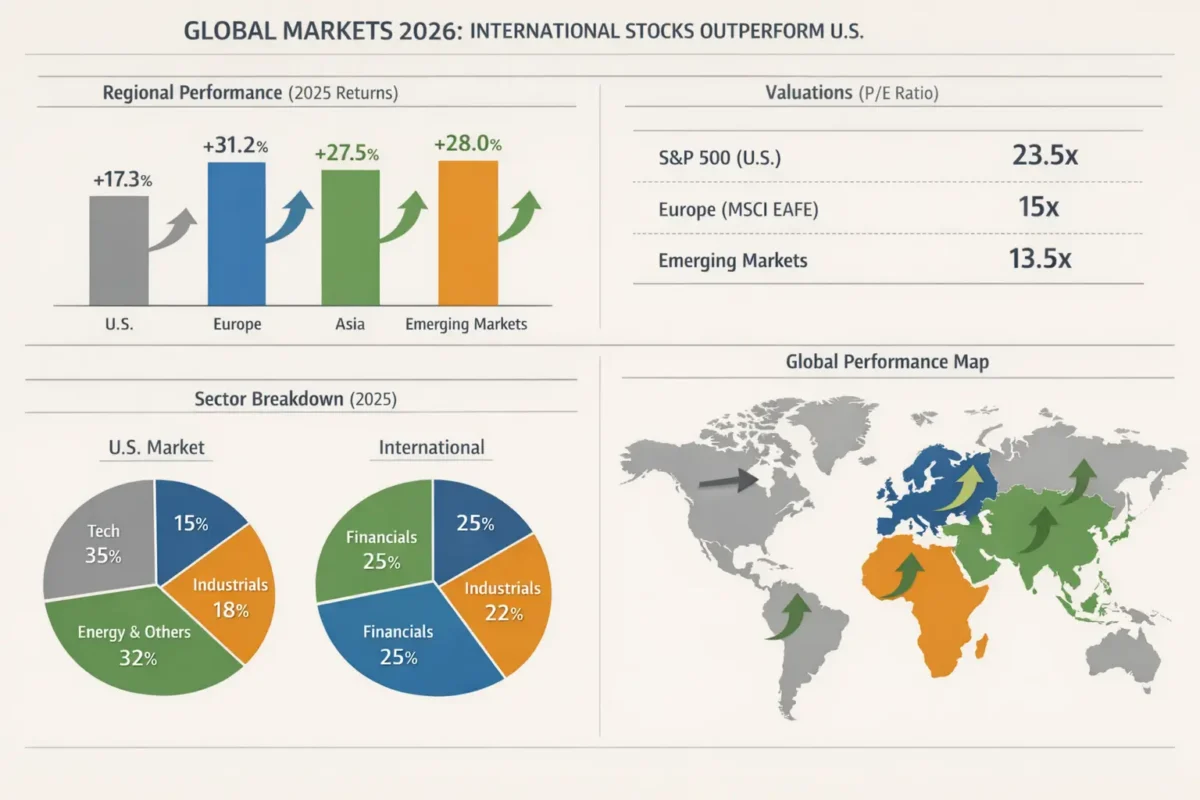
Over the past decade, US stock markets have dominated global headlines, fueled by technology giants, easy monetary policy, and strong consumer spending. Many investors became accustomed to assuming that US equities would always lead global performance. However, that assumption is being quietly challenged. As we move deeper into a shifting economic cycle, international stocks 2026 are emerging as a surprising source of strength, resilience, and opportunity for global investors.
This trend matters today because global economic leadership is no longer concentrated in one country or one region. Interest rate cycles are diverging, currencies are adjusting, and growth engines are shifting toward markets that were previously overlooked. Investors who focus only on US markets may be missing meaningful opportunities elsewhere, especially as valuation gaps widen and global trade patterns evolve.
In this article, you will learn why international markets are outperforming US equities in many regions, what economic and financial forces are driving this shift, and how global diversification can reduce portfolio risk while enhancing long-term returns. We will explore valuation differences, monetary policy dynamics, sector leadership, and real-world examples across Europe, Asia, and emerging markets. By the end, you will have a clearer framework for understanding global equity performance and how international stocks fit into a modern investment strategy.
Table of Contents
The Changing Balance of Global Market Leadership
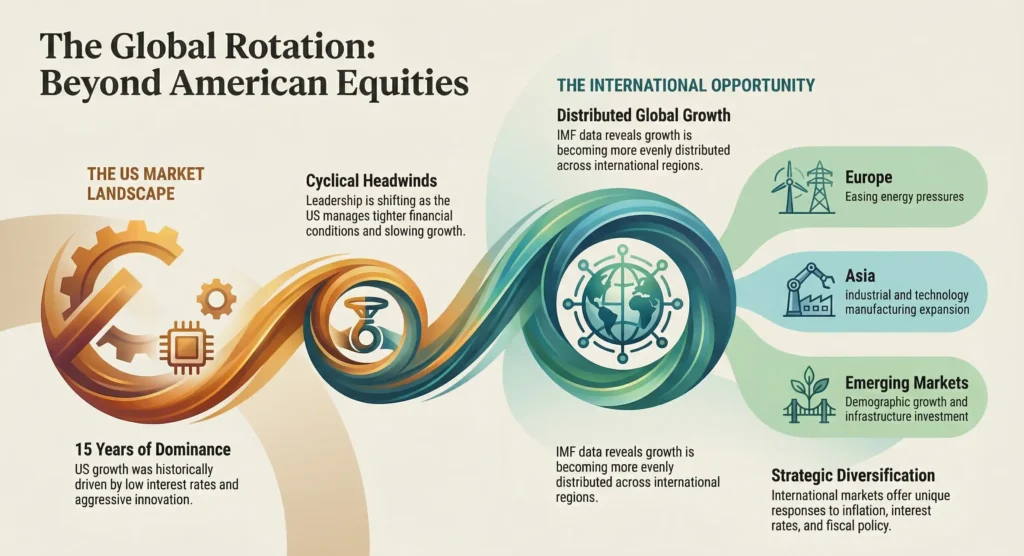
For much of the last 15 years, US equities benefited from exceptional conditions. Low interest rates, aggressive innovation, and deep capital markets helped American companies grow faster and attract global capital. However, market leadership is cyclical by nature. Economic cycles rotate, and capital follows relative value and growth prospects rather than historical dominance.
Today, many international economies are entering different phases of the business cycle than the United States. While the US has been managing tighter financial conditions and slowing growth, several international regions are experiencing improving fundamentals. Europe has benefited from easing energy pressures, Asia continues to capitalize on industrial expansion and technology manufacturing, and emerging markets are supported by demographic growth and infrastructure investment. According to data from the International Monetary Fund, global growth contributions are becoming more evenly distributed across regions, rather than concentrated in the US alone (IMF World Economic Outlook).
This shift is reflected in equity performance. International markets often outperform when US valuations are stretched and global recovery broadens. Investors are rediscovering the value of geographic diversification as different regions respond differently to inflation, interest rates, and fiscal policy.
Valuation Gaps Between US and International Markets
One of the most powerful drivers behind the performance of international equities is valuation. Valuation simply refers to how expensive or cheap stocks are relative to their earnings, assets, or growth potential. Over time, buying markets at lower valuations has historically improved long-term returns.
US stocks currently trade at higher price-to-earnings ratios compared to many international markets. This means investors are paying more for each dollar of profit in the US than in Europe, Japan, or many emerging economies. According to analysis from MSCI and data summarized by Morningstar, international stocks have traded at a valuation discount to US equities for several years, creating a potential margin of safety for investors willing to look abroad.
Lower valuations do not automatically guarantee higher returns, but they reduce downside risk and increase the potential for upside when economic conditions improve. As earnings growth stabilizes globally, this valuation gap becomes harder for markets to ignore.
| Market Region | Average Valuation Level | Long-Term Return Potential |
|---|---|---|
| United States | High | Moderate |
| Europe | Medium to Low | Moderate to High |
| Japan | Low | High |
| Emerging Markets | Low | High but volatile |
Monetary Policy Divergence and Its Market Impact
Central bank policy plays a critical role in shaping stock market performance. Interest rates influence borrowing costs, consumer spending, corporate investment, and ultimately company profits. In recent years, monetary policy paths have diverged across regions rather than moving in sync.
While the Federal Reserve has focused on controlling inflation through higher interest rates, other central banks have adopted more supportive or flexible approaches. The European Central Bank and the Bank of Japan, for example, have maintained policies that support economic recovery and credit availability. This divergence affects equity markets by influencing currency values, capital flows, and corporate financing conditions.
Lower or stabilizing interest rates abroad can boost equity valuations by reducing discount rates applied to future earnings. At the same time, stronger local currencies can enhance returns for international investors. Research published by the OECD highlights how asynchronous monetary cycles often create windows of opportunity for international diversification during late-cycle US slowdowns.

Sector Leadership Outside the United States
Another reason international markets are outperforming lies in sector composition. The US market is heavily weighted toward technology and consumer discretionary companies. While these sectors delivered exceptional returns in the past, they are also more sensitive to interest rates and valuation compression.
International markets offer broader exposure to sectors such as industrials, materials, energy, financials, and manufacturing. Many of these sectors benefit directly from global infrastructure spending, supply chain restructuring, and industrial modernization. For example, European firms lead in renewable energy equipment and industrial automation, while Asian companies dominate semiconductor manufacturing and electric vehicle supply chains.
This sector diversity allows international stocks to perform well even when US tech stocks face pressure. According to Investopedia’s sector analysis resources, diversification across industries reduces concentration risk and improves portfolio stability over time.
| Sector | Strong Presence in US | Strong Presence Internationally |
|---|---|---|
| Technology | Very High | High in Asia |
| Industrials | Moderate | Very High |
| Energy | Moderate | High |
| Financials | High | Very High |
Currency Effects and Global Returns
Currency movements are often overlooked but can significantly influence international investment performance. When the US dollar weakens relative to other currencies, returns from international stocks can be amplified for dollar-based investors. Conversely, a strong dollar can temporarily reduce foreign returns.
Currency cycles tend to move over long periods, often reversing after extended trends. As global trade balances adjust and interest rate differentials narrow, currencies outside the US may strengthen. The World Bank has highlighted how currency diversification can act as an additional layer of risk management in global portfolios.
For long-term investors, currency exposure should not be feared but understood. Over full market cycles, currency effects tend to balance out, while diversification benefits remain.
Risks and Challenges of International Investing
Despite the benefits, investing internationally is not without risks. Political instability, regulatory changes, weaker corporate governance, and economic volatility can affect returns. Emerging markets, in particular, may experience sharper swings due to capital flows and external shocks.
However, these risks can be managed through diversification, broad index exposure, and long-term discipline rather than concentrated bets. Understanding local economic drivers and using reputable global benchmarks helps mitigate many of these concerns.
| Factor | Potential Risk | Mitigation Strategy |
|---|---|---|
| Political risk | Policy changes | Broad regional exposure |
| Currency volatility | Return fluctuation | Long-term holding |
| Liquidity | Market stress | Use diversified funds |
How Global Diversification Improves Portfolio Resilience
Global diversification is not about replacing US stocks but complementing them. By spreading investments across regions with different economic drivers, investors reduce reliance on any single market outcome. Historical data from Vanguard and academic research consistently shows that diversified portfolios experience smoother returns and lower volatility over time.
When one region underperforms, another often compensates. This balance becomes increasingly valuable during periods of economic uncertainty, geopolitical shifts, or structural change.
Conclusion
The outperformance of international equities is not a short-term anomaly. It reflects deeper structural forces shaping the global economy. Valuation disparities, monetary policy divergence, sector leadership differences, and currency cycles are all aligning to favor broader geographic exposure. International stocks 2026 represent an opportunity for investors to rebalance portfolios toward a more globally representative approach.
Rather than chasing past winners, thoughtful investors focus on future potential. International markets offer access to growth drivers that the US market does not fully capture, from industrial expansion to demographic growth and infrastructure development. By understanding the risks and benefits, investors can make informed decisions that support long-term financial goals.
Practical action does not require dramatic shifts. Gradually increasing international allocation, choosing diversified funds, and maintaining a long-term mindset can meaningfully improve portfolio resilience. Global diversification is not about predicting which market will win next year. It is about building a portfolio that can endure and grow across changing economic landscapes.
Frequently Asked Questions
Why are international stocks outperforming US markets now?
International markets benefit from lower valuations, different sector exposure, and supportive monetary policies compared to the US.
Are international stocks riskier than US stocks?
They can be more volatile in the short term, but diversification across regions often reduces overall portfolio risk.
How do international stocks 2026 fit into a long-term strategy?
They provide exposure to global growth trends and reduce dependence on US market cycles.
Should beginners invest in international markets?
Yes, through diversified funds or ETFs that spread risk across multiple countries.
How much of a portfolio should be international?
Many financial institutions suggest 20 to 40 percent depending on risk tolerance and goals.
If you found this article helpful, tell us in the comments how you approach global investing. Subscribe to our newsletter for deeper insights on international markets, portfolio strategy, and long-term wealth building.