Introduction
For most people, the dream of financial freedom begins with earning passive income — money that flows into your account without constant effort. It could come from dividends, rental properties, royalties, interest, or online businesses that continue generating cash long after the initial work is done. Yet while earning passive income is a major milestone, it’s only the first chapter of the story. To truly build lasting wealth, the real magic lies in what you do after the money arrives. That’s where reinvestment comes in.
Reinvesting passive income means taking the cash flow you earn and channeling it back into assets that continue to grow and generate even more income. It’s a strategy rooted in compound growth — the same principle Albert Einstein famously called the “eighth wonder of the world.” Whether your goal is early retirement, financial independence, or simply creating more security for your family, how you manage your passive income can make all the difference between short-term comfort and lifelong abundance.
Today’s world presents both challenges and opportunities for investors. Interest rates fluctuate, market cycles shift, and new asset classes like digital investments complicate the picture. Yet, the core principle hasn’t changed: money that works for you must stay in motion. Simply spending all your passive income can slow down your long-term progress, while reinvesting it wisely multiplies your earning potential.
By the end of this article, you’ll understand exactly how to reinvest passive income for wealth in a strategic, practical, and sustainable way. We’ll explore why reinvestment is essential, how to assess your options, what the proven methods are, and how to design a reinvestment plan that fits your personal goals and risk tolerance. This is not about chasing quick profits — it’s about laying the foundation for enduring prosperity.
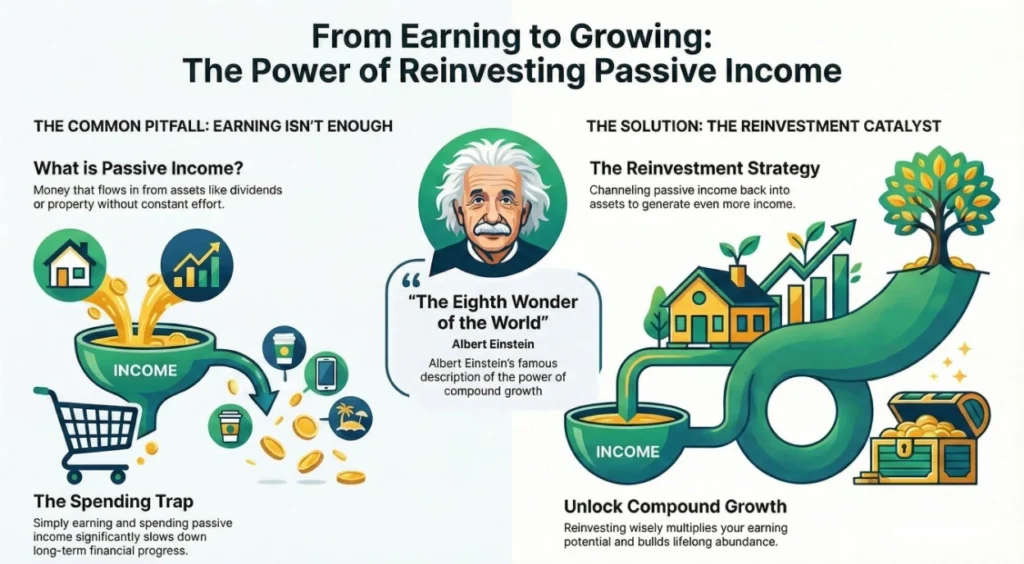
Table of Contents
Why Reinvesting Passive Income Matters
The biggest reason reinvestment matters is the exponential growth effect it triggers. When you continuously feed your profits back into productive assets, your returns begin to compound — meaning your profits start earning their own profits. Over time, this creates a snowball effect: your wealth grows faster and faster, even without additional labor. This is the same compounding principle that turns small, consistent efforts into remarkable results. For example, a $1,000 dividend reinvested annually at an average of 8% will double in just under nine years. If you keep reinvesting those dividends, your effective income grows too, turning financial momentum into long-term acceleration.
The alternative, of course, is spending your passive income immediately. While it can provide short-term pleasure, it interrupts the compounding process and limits your future earning capacity. Many early investors fall into this trap — they earn their first dividends or rental profits and celebrate by spending them. Yet seasoned investors view every distribution as a reinvestment opportunity. Their mindset is long-term: they see every dollar as a seed capable of growing into a tree that bears fruit year after year.
Reinvesting also strengthens financial discipline. It helps you resist lifestyle inflation — the tendency to increase spending as income rises. By consciously redirecting your passive income into growth opportunities, you condition yourself to prioritize future freedom over temporary gratification.
- Compounding drives wealth creation. By reinvesting, you allow your earnings to generate more earnings over time.
- It builds momentum. Each reinvestment increases the base amount that earns future income.
- It prevents lifestyle creep. Redirecting income into assets instead of consumption sustains long-term growth.
- It aligns time with wealth. The longer you reinvest, the more your wealth compounds without requiring active effort.
Understanding Types of Passive Income
Before deciding how to reinvest your passive income, you need to understand where it’s coming from. Not all passive income sources behave the same way. Some are stable and predictable, like bond interest, while others fluctuate with markets, like dividends or rental profits. Recognizing these differences helps you tailor your reinvestment approach.
Passive income typically falls into several broad categories. Investment-based income comes from assets like dividend-paying stocks, real estate investment trusts (REITs), or bonds. Business-based income often comes from online ventures, royalties, or automated product sales. Asset-based income may come from property rentals, intellectual property, or digital assets that yield cash flow. Each category carries its own risk and liquidity profile — meaning how easily you can access or reinvest the cash.
For example, reinvesting stock dividends is relatively seamless; you can use dividend reinvestment plans (DRIPs) that automatically buy more shares. Rental income reinvestment might require accumulating enough cash to buy another property or upgrade an existing one. Similarly, income from digital royalties may be reinvested into marketing, content production, or intellectual property development.
- Stock dividends: Can be automatically reinvested into additional shares, increasing ownership over time.
- Rental income: Can fund property upgrades, new purchases, or real estate crowdfunding investments.
- Bond interest: Often reinvested into higher-yield instruments or mixed portfolios for diversification.
- Digital royalties and business income: Can be directed into scaling operations or building new revenue streams.
Understanding the nature of your passive income allows you to match each inflow with the right reinvestment strategy — one that fits its timing, risk, and growth potential.
The Power of Compounding and Time
The most profound lesson in reinvesting passive income is the silent power of compounding over time. Compounding works because each reinvested dollar doesn’t just earn a return once — it continues earning returns again and again, on an ever-growing base. The longer the time horizon, the more dramatic the effect.
Imagine two investors. The first receives $5,000 in annual dividends and spends them every year. The second reinvests the same $5,000 at an average return of 7%. After 20 years, the spender still enjoys $5,000 per year, while the reinvestor sees her dividends rise to over $19,000 annually — without adding any new capital. The difference isn’t intelligence or luck; it’s time and consistency.
Time magnifies reinvestment outcomes because compounding accelerates exponentially. Early reinvestments may feel small, but after years of consistent growth, they become remarkably powerful. Warren Buffett’s fortune is the ultimate proof — over 90% of his wealth was accumulated after his 60th birthday, thanks to pure compounding at work.
- Reinvestment multiplies wealth exponentially — it turns income into new capital, fueling faster growth.
- Time is the hidden multiplier — the earlier you start reinvesting, the stronger the compounding effect.
- Patience is an asset — compounding rewards disciplined investors who think in decades, not quarters.
- Interruptions slow growth — pausing reinvestment or withdrawing earnings reduces compounding efficiency.
Strategic Approaches to Reinvesting Passive Income
Reinvesting isn’t just about putting money back into the same asset that generated it. The most effective strategies consider diversification, risk management, and timing. The idea is to balance consistency with adaptability — keeping your money productive while adjusting to changes in the economy or markets.
One approach is the “same-asset reinvestment” method, where you reinvest income into the same type of asset. For example, reinvesting dividends into the same stock or mutual fund using a DRIP program compounds your position automatically. This strategy is simple, cost-effective, and highly efficient for long-term investors.
Another approach is cross-asset reinvestment, where you redirect income from one source to another asset class. For instance, using rental income to buy stocks or directing dividend income into real estate investments. This method expands diversification, reducing reliance on any single income type while exposing you to new growth opportunities.
Finally, reinvestment with rebalancing means strategically allocating income to maintain your target portfolio mix. If one asset class outperforms others, reinvesting new income into underweighted areas helps maintain a balanced risk level. This disciplined approach keeps your portfolio aligned with your goals.
- Same-asset reinvestment: Simple, automatic, and effective for compounding returns in one area.
- Cross-asset reinvestment: Expands diversification and leverages profits across different income sources.
- Reinvestment with rebalancing: Maintains desired risk levels and optimizes long-term performance.
- Strategic timing: Holding cash temporarily for better entry points can enhance long-term returns.
Balancing Growth and Stability
One challenge investors face when reinvesting passive income is balancing between high-growth opportunities and steady, low-risk assets. Some reinvestments promise higher potential returns but carry volatility; others offer stable income but slower growth. The art lies in managing this balance according to your financial stage and goals.
Early in your wealth-building journey, it often makes sense to emphasize growth. Reinvesting income into equity-based assets like dividend stocks, index funds, or growth ETFs allows compounding to work aggressively during your prime earning years. However, as your wealth matures and your risk capacity declines, gradually shifting toward income stability becomes wiser. This might mean reinvesting into safer vehicles like bonds, real estate, or cash-flowing businesses that produce consistent returns.
This balance ensures your wealth continues growing without being overly exposed to market downturns. It’s similar to tending a garden: you plant fast-growing crops for early yield while nurturing long-term trees that provide stability for decades.
- Growth reinvestments: Stocks, ETFs, startups, or business expansions for capital appreciation.
- Income reinvestments: Bonds, REITs, and rental properties for stability and regular payouts.
- Life-stage alignment: Younger investors can pursue growth; older investors often seek stability.
- Diversified approach: Balancing growth and safety protects both short-term income and long-term security.
Reinvestment vs. Saving vs. Spending
Reinvesting passive income is not the only option — you can also save or spend it. Understanding the trade-offs among these three choices helps clarify why reinvesting often outperforms the others in building wealth.
Spending your passive income provides immediate satisfaction but no lasting financial benefit. It helps with lifestyle upgrades or personal enjoyment but doesn’t advance your long-term goals. Saving, such as keeping income in a low-interest account, offers security but limited growth. Inflation erodes its value over time, meaning your purchasing power actually decreases. Reinvesting, on the other hand, puts your money back to work in productive assets, allowing it to grow faster than inflation and generate even more passive income in the future.
The ideal balance often combines all three. For example, using a portion of passive income for current living expenses, saving a small buffer for emergencies, and reinvesting the remainder into wealth-building assets. The key is intentionality — knowing why and how you allocate each dollar.
- Spending: Provides short-term enjoyment, but no compounding benefits.
- Saving: Offers liquidity and safety but underperforms inflation over time.
- Reinvesting: Generates exponential returns and protects purchasing power.
- Balanced strategy: Assigns specific roles to each dollar to optimize growth and stability.
Practical Ways to Reinvest Passive Income
Putting reinvestment into practice requires deciding where your income will go and understanding the options available. The best choices depend on your risk appetite, investment horizon, and financial goals. While there’s no one-size-fits-all formula, several proven reinvestment strategies stand out.
1. Dividend reinvestment plans (DRIPs): These programs automatically use your dividend payouts to buy more shares of the same stock, allowing compounding to happen seamlessly without extra effort. They’re ideal for investors seeking simplicity and long-term growth.
2. Real estate reinvestment: Using rental profits to upgrade properties, reduce debt, or acquire new assets can exponentially increase net worth. Over time, rents rise, property values appreciate, and the income base expands.
3. Index fund reinvestment: Channeling income into diversified index funds offers market-wide growth potential with minimal management. It’s a hands-off yet powerful reinvestment path.
4. Peer-to-peer lending or private investments: For experienced investors, reinvesting into alternative markets can enhance yield and diversification.
5. Business reinvestment: Entrepreneurs can reinvest digital royalties or business earnings into marketing, technology, or new product lines that expand future cash flow.
- Automation helps. Automatically reinvesting income ensures consistency without emotional interference.
- Diversification matters. Reinvesting into varied income streams smooths volatility.
- Tax considerations count. Tax-advantaged accounts (like IRAs or ISAs) can amplify reinvested growth.
- Consistency drives results. Regular reinvestment — monthly, quarterly, or annually — builds compounding momentum.
Managing Risk in Reinvestment Decisions
Even the best reinvestment strategy carries risks. Markets fluctuate, interest rates change, and unexpected events can disrupt returns. That’s why risk management must be built into every reinvestment decision. The goal isn’t to eliminate risk — that’s impossible — but to manage and balance it intelligently.
Begin by identifying your risk tolerance, which depends on your age, financial goals, and emotional comfort with volatility. Younger investors can often accept higher risk because they have time to recover from downturns. Older investors, closer to their withdrawal phase, should favor stability and preservation.
Risk management also means diversification — spreading reinvestments across industries, asset types, and even geographic regions. Avoid concentrating all reinvested income in one company, property, or asset class. Another layer is liquidity management: keeping some reinvestments in assets that can be easily sold or accessed without penalty when emergencies arise.
- Diversify broadly: Mix equities, bonds, real estate, and alternative assets to reduce exposure.
- Assess liquidity: Maintain flexibility by keeping part of your reinvestment accessible.
- Monitor performance: Track each reinvested asset’s progress and adjust allocations periodically.
- Stay informed: Understand economic cycles and market indicators that affect your reinvestment returns.
Creating a Personalized Reinvestment Plan
Building a reinvestment plan tailored to your situation turns theory into sustainable progress. Start by defining your financial goals — what does long-term wealth mean to you? Early retirement, generational legacy, time freedom? Your purpose shapes your reinvestment horizon and strategy.
Next, analyze your cash flow: identify how much passive income you regularly receive, and determine what portion can be safely reinvested after covering necessities. Then, choose reinvestment vehicles that align with your goals and risk profile — growth for long-term expansion, income for stability, or a blend of both.
Finally, ensure automation and review. Automating reinvestments minimizes emotional biases and missed opportunities. However, review your plan annually to adjust for life changes, economic shifts, or goal updates.
- Set clear goals: Define wealth targets and time frames.
- Establish reinvestment ratios: Decide what percentage of income to reinvest versus save or spend.
- Diversify channels: Combine multiple reinvestment paths for balance.
- Automate and track: Use tools and platforms to reinvest consistently and monitor progress.
Conclusion
Reinvesting passive income for wealth is one of the most underappreciated yet transformative practices in personal finance. It turns static cash flow into an engine for unstoppable growth — not through luck, but through simple, repeatable discipline. Every reinvested dividend, rental profit, or royalty accelerates your journey toward financial independence.
The secret lies not in timing the market or finding perfect investments, but in consistency and patience. By understanding your income sources, balancing growth and safety, managing risk, and reinvesting strategically, you create a compounding cycle that strengthens year after year. The earlier you start, the greater the reward — but it’s never too late to begin.
Ultimately, reinvestment is not just a financial technique. It’s a mindset: the belief that wealth builds silently through steady action and time. As the saying goes, “Do not spend the seed; plant it.” Each dollar reinvested today is a promise of greater financial freedom tomorrow. Keep your money in motion, let it multiply, and watch time become your most powerful asset.