Introduction
The concept of money has evolved over the years. People first traded goods directly, then used precious metals, and eventually switched to government-issued paper money. Today, digital currencies are pushing us to rethink what money means.
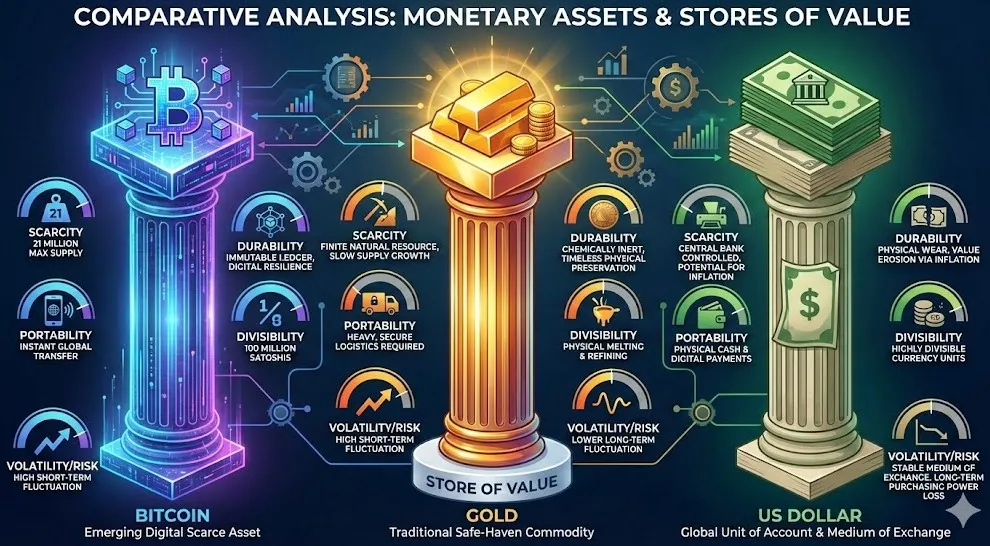
Bitcoin, gold, and the US dollar each represent a different era and approach to money. The fundamental difference lies in what determines their value: gold is shaped by scarcity and history, the US dollar by centralized government control, and Bitcoin by decentralized digital scarcity. Understanding these distinctions helps you protect your wealth, diversify your investments, and better grasp today’s financial system.
This guide breaks down the key differences between Bitcoin, gold, and the US dollar to highlight how each reflects its underlying principles: scarcity, centralization, or decentralization. You’ll learn what each one is, how their supply works, how they’re stored, the rules that affect them, and how they fit into investment portfolios. Whether you’re new to investing or already have experience, this overview can help you make smarter financial decisions.
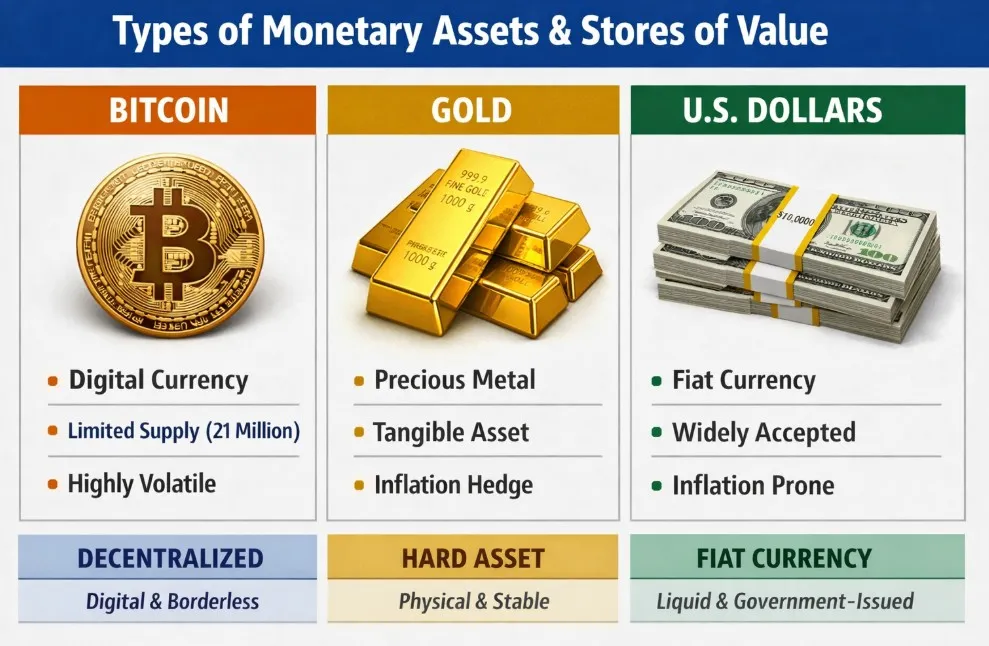
Table of Contents
Understanding the Fundamental Nature of Each Asset
Gold: The Ancient Store of Value
Gold is a physical commodity and a real element, known as number 79 on the periodic table. For more than 5,000 years, people have valued gold because it doesn’t rust, is easy to shape, can be divided, and is hard to find. These qualities made gold a popular choice for money and savings.
Unlike modern currencies, gold is different from today’s currencies because no government or central authority creates it. Its value comes from being naturally rare, useful in industry, important in many cultures, and trusted for centuries as a way to safeguard wealth. When you own gold, you have a physical asset whose value is based on its unique qualities and broad acceptance. fiat currency, meaning it has value primarily because the government declares it legal tender and people trust it will be accepted for goods and services. Unlike gold-backed currencies of the past, the modern dollar isn’t redeemable for a fixed amount of gold or any other commodity.
The Federal Reserve, which is the US central bank, manages how many dollars are in circulation by changing interest rates and using programs like quantitative easing. The dollar is widely used in global trade and finance because the US has a large economy, stable politics, strong financial markets, and past agreements like Bretton Woods that made the dollar the main global reserve currency.
About 60% of the world’s foreign exchange reserves are in US dollars, according to the International Monetary Fund (IMF). Around 88% of all currency trades involve the dollar, based on the Bank for International Settlements (BIS) Triennial Survey. This widespread use makes the dollar even more valuable and useful, a phenomenon known as a “network effect.”
Bitcoin: Digital Scarcity and Decentralization
Bitcoin is a completely different type of money. It was created in 2009 by a person or group using the name Satoshi Nakamoto. Bitcoin only exists digitally as records on a shared online ledger called a blockchain.
Unlike the dollar, a fiat currency managed by governments, Bitcoin is not controlled by a central authority. Unlike gold, which is a physical asset with intrinsic properties, Bitcoin exists only digitally and gains value from network consensus. Its main strengths are a fixed supply of 21 million coins, unblockable transactions, and full transparency on the blockchain.
Supply Dynamics: How Each Asset Comes Into Existence
Gold’s Geological Constraints
Gold supply grows through mining, adding about 3,000 metric tons annually. The above-ground stock is about 200,000 metric tons, with recycling contributing roughly 1,200 tons more each year.
Key characteristics of gold supply:
- Annual production represents only about 1.5% of existing stock (low inflation rate)
- Mining gold is harder and costlier as accessible deposits decline.
- Natural scarcity tightly limits gold’s supply.
- Recycling adds a modest additional supply (about 1,200 tons annually)
- No authority can create more gold at will.
Gold’s high stock-to-flow ratio limits inflation, making it a traditional hedge against currency devaluation.
US Dollar’s Flexible Supply
The Federal Reserve changes the dollar supply based on economic needs, for example, increasing money through quantitative easing after 2008 and in 2020.
Dollar supply characteristics:
- No fixed upper limit on total supply
- Created through debt issuance by governments and lending by banks
- Responsive to economic conditions and policy objectives
- M2 money supply (includes cash, checking accounts, and easily convertible near-money) grew from approximately $8 trillion in 2010 to over $21 trillion by 2023, according to Federal Reserve Economic Data (FRED)
- Inflation occurs when supply growth outpaces economic growth.
The fractional reserve banking system increases this effect. When banks make loans, they create new dollars in the economy because bank deposits are counted as money. This system gives authorities flexibility to handle crises, but if the money supply grows too fast, it can lead to inflation.
Bitcoin’s Algorithmic Certainty
Bitcoin’s supply is coded and predictable. New bitcoins are mined by specialized computers, with miners earning rewards for validating transactions and adding blocks to the blockchain.
Bitcoin supply characteristics:
- Absolute cap of 21 million bitcoins (final bitcoin to be mined around 2140)
- Block reward halves approximately every four years (most recently from 6.25 to 3.125 BTC in April 2024)
- The current circulating supply is approximately 19.6 million bitcoins (about 93% of the total), according to Blockchain.com. A predictable issuance schedule that no one can change without consensus from the entire network.
- Already-issued bitcoins can be lost permanently if private keys are lost.
This fixed supply makes Bitcoin fundamentally deflationary over time. As the block reward approaches zero, transaction fees will eventually become miners’ primary incentive. The predictability and hardness of Bitcoin’s supply policy represent a core philosophical difference from fiat currencies.
Storage, Transfer, and Portability
Storing and Moving Gold
Physical gold needs to be stored. You need to store physical gold securely. Small amounts can be kept at home in a safe, but larger amounts are usually stored in bank safe deposit boxes, private vaults, or with professional custodians. Storing gold costs money and requires trusting others to keep it safe and accessible. Weight makes large amounts difficult to transport (gold is dense: a cubic foot weighs about 1,200 pounds)
- International transfers require physical shipping with insurance and security.
- Verification of authenticity requires testing and assay.
- Divisibility issues—cutting a gold bar reduces its premium value.
- Storage costs typically range from 0.5% to 1% of value annually.
Gold ETFs and storage accounts make it easier to invest in gold, but they add extra layers and mean you own a claim on gold held by someone else, not the gold itself.
Holding and Transfer. The dollar exists as both cash and digital money, such as bank deposits and electronic payments. Most dollars today are just digital records in banks, not physical bills. This allows for quick electronic transfers, but it also means banks and payment companies control most of your money. your dollars.
Dollar storage and transfer characteristics:
- Physical cash offers privacy but is vulnerable to theft and has no transaction records.
- Bank deposits provide security and convenience, but expose you to bank failures and account freezes.
- International wire transfers take 1-5 business days and cost $15-50
- Credit card processing fees are typically 2-3% for merchants.
- Government monitoring of large transactions (over $10,000 must be reported)
- Negative real interest rates during high inflation erode the purchasing power of saved dollars.
The dollar’s payment system is very convenient for daily use, but this convenience comes with trade-offs, such as monitoring requirements, fees, and reliance on banks and financial institutions. Bitcoin is different. Your bitcoins are entries on the blockchain, and you control them with cryptographic private keys, which are long passwords that let you authorize transactions. If someone else gets your private keys, they can spend your bitcoin, so keeping them secure is crucial.
Bitcoin storage options:
- Hot wallets (connected to the internet): convenient but vulnerable to hacking
- Cold wallets (offline hardware devices): highly secure but less convenient for frequent transactions
- Custodial services (exchanges hold keys): easy to use, but reintroduces counterparty risk
- Multi-signature wallets: require multiple keys to authorize transactions, reducing single points of failure
- No ongoing storage costs beyond initial hardware wallet purchase ($50-200)
Transfer advantages:
- Send any amount anywhere in the world within minutes.
- Transaction fees are typically $1-5, regardless of the amount (can be higher during network congestion)
- No intermediaries can block, reverse, or censor transactions.
- The recipient doesn’t need to share their identity or banking information.
- Borderless—same experience whether sending across the street or across continents
The tradeoff is that Bitcoin places full responsibility on users to protect their keys. Unlike dollars in a bank account, there’s no customer service to call if you lose access. This “be your own bank” model offers unprecedented financial sovereignty but demands technical competence and a security-conscious approach.
Regulatory Environment and Legal Status
Gold Regulation: Ancient but Controlled
Despite its ancient history, gold is subject to significant regulatory oversight. Most countries restrict or monitor large gold transactions to prevent money laundering and tax evasion. The US has specific reporting requirements: dealers must file Form 8300 for cash transactions over $10,000, and certain gold bullion transactions trigger 1099-B reporting to the IRS.
Historically, governments have restricted gold ownership during crises. In 1933, President Franklin D. Roosevelt issued Executive Order 6102, requiring Americans to surrender most gold holdings to the Federal Reserve at below-market prices. While gold ownership is legal in most countries today, this history reminds us that governments can and do restrict alternative forms of money during financial emergencies.
Dollar Regulation: The Arm of State Power
As the official currency, the dollar is deeply integrated with regulatory systems. Financial institutions must comply with Know Your Customer (KYC) and Anti-Money Laundering (AML) regulations, reporting suspicious activities and large transactions. The Bank Secrecy Act, Patriot Act, and FATCA (Foreign Account Tax Compliance Act) create extensive surveillance of dollar movements.
This regulatory framework serves legitimate purposes, such as combating terrorism financing and tax evasion, but it also means that nearly all dollar transactions leave data trails accessible to government agencies. The Financial Crimes Enforcement Network (FinCEN) collects millions of suspicious activity reports annually, creating a comprehensive database of financial behavior.
Bitcoin Regulation: Evolving and Uncertain
Bitcoin’s regulatory status varies dramatically by jurisdiction and continues to evolve. The US treats Bitcoin as property for tax purposes under IRS Notice 2014-21, meaning every transaction may trigger capital gains tax obligations. The Securities and Exchange Commission (SEC) has taken aggressive enforcement actions against cryptocurrency projects it deems to be unregistered securities, though Bitcoin itself is generally considered a commodity rather than a security.
Regulatory landscape variations:
- El Salvador and the Central African Republic adopted Bitcoin as legal tender.
- China banned Bitcoin mining and trading.
- The European Union implemented the Markets in Crypto-Assets (MiCA) regulation.
- The United States has a fragmented approach across multiple agencies (SEC, CFTC, FinCEN, IRS)
There is ongoing uncertainty because Bitcoin is decentralized and global, while governments want to regulate financial systems. Governments cannot shut down the Bitcoin network, but they can make it harder to use by limiting exchanges where people trade Bitcoin for regular money.
Value Drivers and Price Volatility
What Drives Gold Prices?
Gold prices are influenced by several factors, including jewelry demand (about 50%), industrial applications (10%), central bank purchases, and investment demand. During economic uncertainty, gold typically appreciates as investors seek “safe haven” assets. Interest rates inversely correlate with gold prices—when rates rise, the opportunity cost of holding non-yielding gold increases, pressuring prices downward.
Gold’s volatility remains moderate compared to most financial assets. Annual price swings typically range from 10-20%, though periods like 2011 (when gold reached $1,900/oz) and 2020 (when gold hit record highs above $2,000/oz according to Kitco) saw more dramatic movements. A decade of returns might see gold appreciate 50-100% or decline 20-30%, depending on the starting point.
Dollar Value: Purchasing Power and Exchange Rates
The dollar’s value manifests in two ways: domestic purchasing power (what dollars buy within the US) and exchange rates (how many units of foreign currency one dollar purchases). Inflation erodes purchasing power—the Consumer Price Index from the Bureau of Labor Statistics shows that $100 in 2000 has the purchasing power of approximately $59 today, a 41% loss.
Exchange rates fluctuate based on interest rate differentials, trade balances, political stability, and relative economic growth. The Dollar Index (DXY), which measures the dollar against a basket of major currencies, has ranged from below 80 to above 120 over the past two decades. For Americans, a strong dollar makes imports and international travel cheaper, while a weak dollar benefits exporters and domestic manufacturers.
Bitcoin Volatility: The Price of Innovation
Bitcoin exhibits extreme volatility compared to traditional assets. Annual price swings of 50-200% are common. Bitcoin crashed by over 80% from its 2017 peak, rallied to new highs in 2021, then fell by over 70% again in 2022, only to recover substantially in 2023-2024, according to CoinMarketCap historical data. This volatility reflects Bitcoin’s relatively small market capitalization (around $800 billion, compared to gold’s $13 trillion, according to Visual Capitalist analysis), evolving regulatory landscape, and ongoing price discovery as the world determines Bitcoin’s appropriate value.
Factors influencing Bitcoin price:
- Adoption by institutions and retail investors
- Regulatory announcements and enforcement actions
- Macroeconomic conditions (particularly inflation expectations and interest rates)
- Mining dynamics and halving events
- Technology developments and network upgrades
- Market sentiment and speculative trading
Because Bitcoin’s price changes so much, it is hard to use for everyday spending—people may not want to spend it if its value could rise quickly. However, this volatility can attract investors who are willing to take risks for the chance of high returns. Some experts think Bitcoin’s price swings will become smaller as it grows, but this is not certain.
Investment Characteristics and Portfolio Roles
Gold as Portfolio Insurance
Financial advisors traditionally recommend a 5-10% gold allocation as portfolio insurance. Gold’s low correlation with stocks and bonds means it often performs well when other assets decline. During the 2008 financial crisis, gold appreciated while stocks crashed. In times of geopolitical tension or currency crises, gold provides liquidity and universal recognition ofvalue. However, gold does not pay dividends or interest. Over the long term, its returns are close to the rate of inflation, so it helps keep your money’s value steady but does not create much new wealth. Over the centuries, gold has grown by about 1-2% per year above inflation, but its price can still fluctuate a lot.
Dollars: The Numeraire and Safe Asset
The dollar serves as the numeraire—the unit of account against which we measure other assets’ values. Dollar-denominated assets like Treasury bonds are considered the world’s safest investment, backed by the US government’s taxing power and the Federal Reserve’s ability to create dollars. In flight-to-safety episodes, investors pile into dollars and dollar-denominated debt.
As mentioned earlier, dollars lose value over time because of inflation. The interest rates on savings accounts and Treasury bonds, after adjusting for inflation, have often been negative, especially in the 2010s and early 2020s. This acts like a hidden tax on people who save in dollars, moving wealth from savers to borrowers, including the government.
Bitcoin: Speculation or Digital Gold?
Bitcoin’s investment thesis remains hotly debated. Proponents argue it’s “digital gold”—a superior store of value because of its absolute scarcity, ease of transfer, and resistance to confiscation. They envision Bitcoin eventually capturing a significant portion of gold’s market value as more investors recognize its advantages. If Bitcoin reached gold’s market cap, each Bitcoin would be worth several hundred thousand dollars.
Skeptics counter that Bitcoin has no intrinsic value, produces no cash flows, and could become obsolete if better cryptocurrencies emerge or if governments successfully restrict its use. They point to environmental concerns about Bitcoin mining’s energy consumption and question whether younger generations will continue valuing an asset with no practical use beyond speculation.
The truth is probably somewhere in between. Bitcoin has survived many challenges, like predictions of its collapse, tough regulations, and exchange failures. Companies such as MicroStrategy and Tesla now hold Bitcoin, and large financial firms offer ways to invest in it. Still, most people buy Bitcoin hoping its price will go up, not to use it for daily spending. Consider this stylized comparison of investment characteristics:
Gold:
- Expected annual return: 2-4% above inflation
- Volatility: Moderate (10-20% annual swings)
- Correlation with stocks: Low to negative
- Income generation: None
- Liquidity: High
- Storage considerations: Significant
US Dollar (Treasury bonds):
- Expected annual return: 1-3% above inflation (long-term bonds)
- Volatility: Low (for short-term bonds, moderate for long-term)
- Correlation with stocks: Low to negative
- Income generation: Yes (interest payments)
- Liquidity: Highest
- Storage considerations: Minimal
Bitcoin:
- Expected annual return: Highly uncertain, potentially very high or very low
- Volatility: Extreme (50-200% annual swings)
- Correlation with stocks: Varies, recently increased
- Income generation: None (though some holders lend Bitcoin for yield)
- Liquidity: High but varies by market conditions
- Storage considerations: Significant technical requirements
Practical Use Cases and Real-World Applications
When to Use Each Asset
Gold excels for:
- Long-term wealth preservation across generations
- Portfolio diversification and risk management
- Hedging against currency collapse or hyperinflation
- Physical possession without counterparty risk
- Cultural contexts where gold jewelry serves as portable wealth
Dollars work best for:
- Daily transactions and expenses
- Short-term savings (emergency funds)
- Predictable expenses denominated in dollars.
- Accessing the full range of financial services
- Contexts where legal tender status is important
Bitcoin makes sense for:
- International transfers without intermediaries
- Preserving wealth in countries with unstable currencies
- Protecting assets from government seizure or capital controls
- Investing in an emerging asset class (understanding the risks)
- Ideological alignment with decentralization and financial sovereignty
Real-World Scenarios
Consider Maria, an immigrant worker who sends money to her family overseas. Using traditional remittance services costs 6-8% in fees and takes days. Bitcoin transactions might cost $3 and take an hour, though she risks Bitcoin’s price changing before her family converts it to local currency.
Or consider Ahmed, living in a country experiencing high inflation and currency controls. His government limits how much foreign currency citizens can purchase, eroding savings as the local currency devalues. Bitcoin offers an escape valve, allowing him to preserve value and transact internationally, though he risks government prosecution if Bitcoin is restricted or banned.
Finally, consider Jennifer, a US-based investor concerned about inflation. She might allocate 5% of her portfolio to gold for stability, keep 6 months of expenses in dollar savings for liquidity, and invest 2-3% in Bitcoin as a high-risk, high-potential-return diversifier. This approach provides multiple layers of protection without overexposing her to any single asset’s weaknesses.
The Future: Convergence, Competition, or Coexistence?
Central Bank Digital Currencies (CBDCs)
Governments worldwide are developing central bank digital currencies—digital dollars, euros, and yuan that combine cryptocurrency technology with central bank control. CBDCs could offer instant settlement and enhanced financial inclusion while maintaining government oversight. China’s digital yuan is already in trials, and the Federal Reserve is researching a digital dollar.
CBDCs would preserve the dollar’s programmability while potentially reducing Bitcoin’s value proposition. However, they wouldn’t address concerns about inflation, government surveillance, or financial censorship—issues that motivate many Bitcoin advocates. The competition between CBDCs and decentralized cryptocurrencies will likely define the next decade of monetary evolution.
Integration and Infrastructure
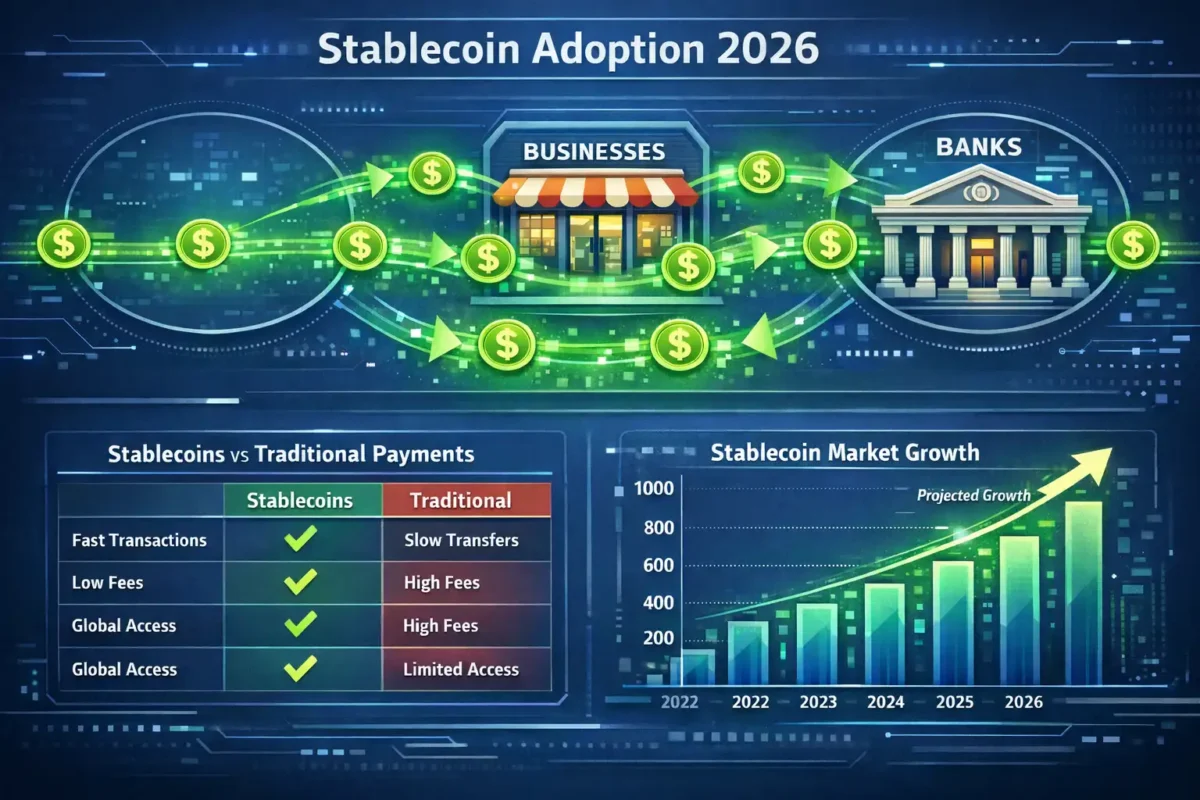
The financial infrastructure increasingly bridges these three assets. Gold ETFs offer convenient exposure without storage hassles. Bitcoin ETFs approved in 2024 provide regulated exposure to Bitcoin through traditional brokerage accounts. Stablecoins—cryptocurrencies pegged to the dollar—attempt to combine the dollar’s stability with cryptocurrency’s transfer speed and borderless nature.
These new tools make it easier for investors to move between different assets. In the future, you could have an account that holds gold, dollars, Bitcoin, stocks, and bonds in one place, and automatically changes your mix based on your risk level and the market. ilosophies
Bitcoin, gold, and the US dollar each represent a different idea of money. Gold is valuable because it’s rare and has been trusted for thousands of years. The dollar is government-controlled, flexible, and convenient. Bitcoin is built on strict rules and decentralization, and anyone with internet access can use it.
The major differences between these assets include:
- Supply mechanism: Gold’s geological constraints, the dollar’s policy-driven flexibility, and Bitcoin’s mathematical certainty
- Storage and transfer: Gold’s physical weight, the dollar’s institutional infrastructure, and Bitcoin’s cryptographic control
- Regulatory status: Gold’s ancient acceptance, the dollar’s legal tender status, and Bitcoin’s uncertain regulatory environment
- Value drivers: Gold’s safe-haven appeal, the dollar’s ubiquity and backing, and Bitcoin’s network effect and scarcity
- Investment profile: Gold’s stability, the dollar’s liquidity, and Bitcoin’s volatility
No single asset perfectly fulfills all monetary functions. The dollar excels as a medium of exchange, gold as a store of value, and Bitcoin as a borderless, censorship-resistant transfer mechanism. Rather than asking which is “best,” investors should understand each asset’s strengths and weaknesses and construct portfolios that leverage multiple assets for different purposes.
Practical Action Steps
- Assess your needs: What percentage of your wealth needs to be liquid for daily expenses? How much can you allocate to long-term preservation? What’s your risk tolerance?
- Diversify thoughtfully: Consider allocating across all three asset types rather than putting all your eggs in one basket. A simple framework might be: dollars for 6-12 months expenses, gold for 5-10% of long-term savings, and Bitcoin for 1-5% as a high-risk allocation (if you understand and accept the risks).
- Understand the technology: Before investing in Bitcoin, learn how wallets work, practice with small amounts, and understand the security requirements. Consider starting with a small allocation through a regulated exchange.
- Stay informed: The monetary landscape is evolving rapidly. Follow developments in CBDC rollouts, Bitcoin regulation, inflation data, and geopolitical events that might affect each asset class.
- Think long-term: All three assets have weathered significant challenges and will likely continue playing important roles in the global financial system. Focus on your long-term financial goals rather than trying to time short-term price movements.
Talking about Bitcoin, gold, and the dollar isn’t just about making money. It’s also about trust, control, and how societies organize their economy. Learning about these assets can help you make better choices in a complex financial world and invest in ways that align with your values and goals.